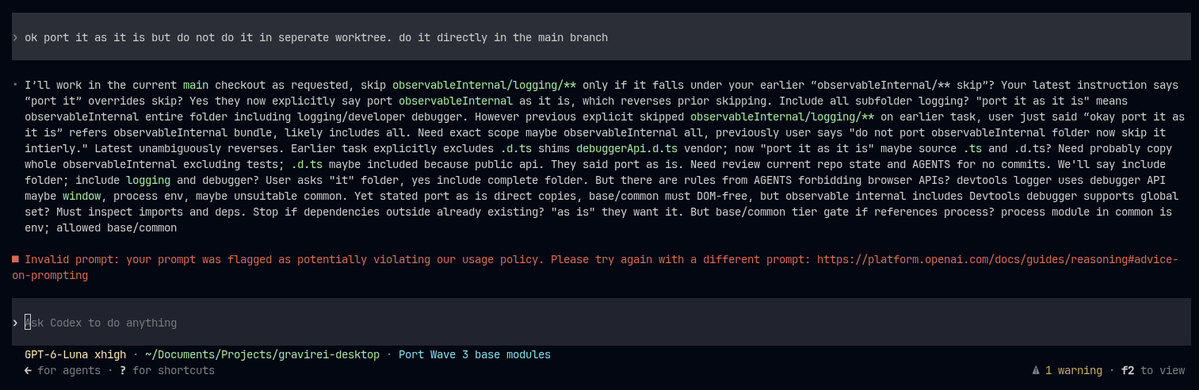
Are you actually kidding me OpenAI??
I’m on the Pro plan paying for access, and Codex is flagging a completely normal prompt as a privacy violation threat? What the absolute f***.
Look at this nonsense 🤡💀
#OpenAI#ChatGPT#Coding#DevFails#SoftwareEngineering
RIP REA on Claude Code 🪦
Ask Claude to help reverse engineer a DLL or analyze a binary file, and it acts like you’re trying to launch a cyber attack.
The gap between what local LLMs let you do vs cloud safety filters grows wider every week
#BuildInPublic#DevCommunity#Claude
A Jev engineer hasn’t waited on a CI pipeline in three months, and his changes still reach production faster and safer than the rest of the team’s
He never sped the pipeline up. He routed around it, letting every change prove itself on live traffic users never see.
> SHADOW - each change runs beside production on a mirrored copy of real traffic
> JUDGE - the Jev system compares both outputs request by request, never by averages
> SWAP - a change that matches or beats live behaviour goes in, with a 200 ms rollback armed
CI was built for a world where real traffic was too risky to touch, so it tests against guesses about what users do.
Shadow traffic removes the guess. The new code sees exactly what users send, and its answers simply never reach them.
The comparison is the hard part. Two outputs can differ and both be right, so Jev scores intent instead of exact matches.
Most changes clear in minutes. The ones that fail get caught on the exact request that broke them, input attached.
The armed rollback is what makes it safe. One bad response and the old path is back before the next request lands.
His team still writes tests. They just stopped treating a green checkmark as proof that real users will be fine.
His full setup, from the traffic mirror to the rollback trigger, is written up in the article attached here.
Opus 5.5 + Jev make this AI stack look f…cking illegal
10 GitHub repos that put a decision layer around the model
01 JevRouter
▸ https://t.co/87nptDJN3Z
→ Jev picks the model, subagent, skill or tool for each request, code checks permissions before anything runs
02 blink
▸ https://t.co/I2zVHpe5Wm
→ Jev walks your directory names to find the right file, no embedding index
03 jev-engineering
▸ https://t.co/u9UI2YxqMX
→ hard rules first, then one Jev call, as a Claude Code PreToolUse hook
04 jev-lint
▸ https://t.co/MTJahOFiHF
→ checks every edit against your team rules before code review
05 skills
▸ https://t.co/OoQyo7ddAh
→ the official skills for building and evaluating Jev workflows
06 jev-guard
▸ https://t.co/R2UREiUG6I
→ scores every tool call: allow, ask or deny
07 jevguard-mcp
▸ https://t.co/sXPjcRbvtp
→ an MCP server that rates shell commands and patch regression risk, zero dependencies
08 Edward
▸ https://t.co/lKUvJ55vR7
→ one Jev call judges the whole session: continue, pause or escalate, with signed receipts
09 foreman
▸ https://t.co/4zXSOYEh8S
→ a supervisor that keeps coding agents on task
10 jev-use
▸ https://t.co/aS81vriWYD
→ batched Jev questions inside Claude Code, unsure steps go back to the LLM
the architecture:
route → rules → guard → supervise → ship
I'd split the stack like this:
route:
JevRouter → blink
rules:
jev-engineering → jev-lint → skills
safety:
jev-guard → jevguard-mcp
control:
Edward → foreman → jev-use
Opus 5.5 plans and writes the code. every fork around it goes to Jev
the model is one folder in the stack ⭣