Tobin’s Q Ratio just hit 2.35, the highest in 126 years... meaning the stock market is more expensive than at any other point in modern history... 60% above the 2000 dot-com bubble peak... 122% above the 1929 bubble peak.
$spx $ndx $qqq $spy
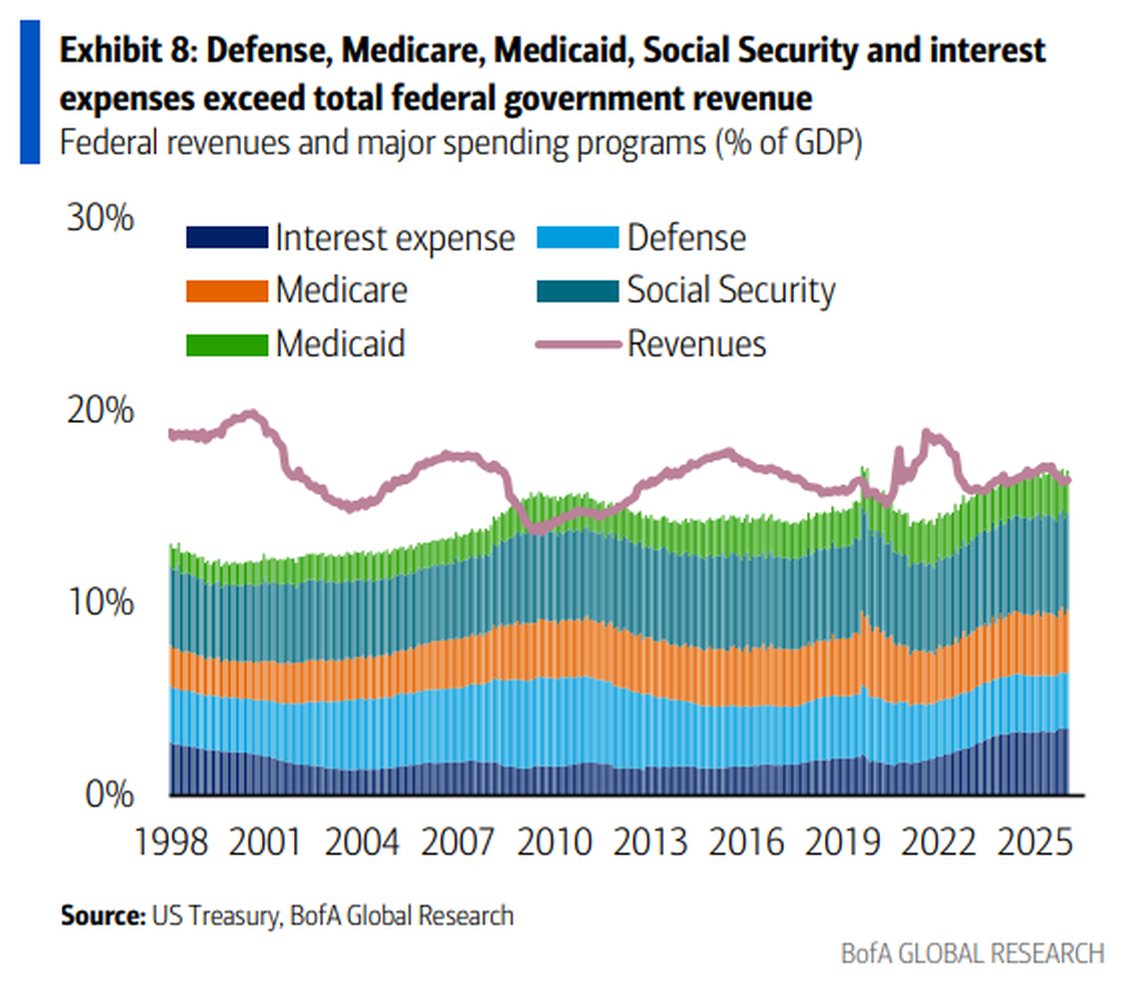
....AAANNNDDD this is why you can't cut spending, regardless of which political party is in office, particularly when you run the government on "continuing resolutions," which automatically increase spending, versus passing a budget. (None since Obama took office.)
Yes, we can defense spending but the rest is mandatory and can't be cut.
Your only option is to increase revenues - taxes, tariffs, etc., but the problem is those options erode economic growth which generates increased tax revenue.
Sooooo....how are you going to fix the problem?
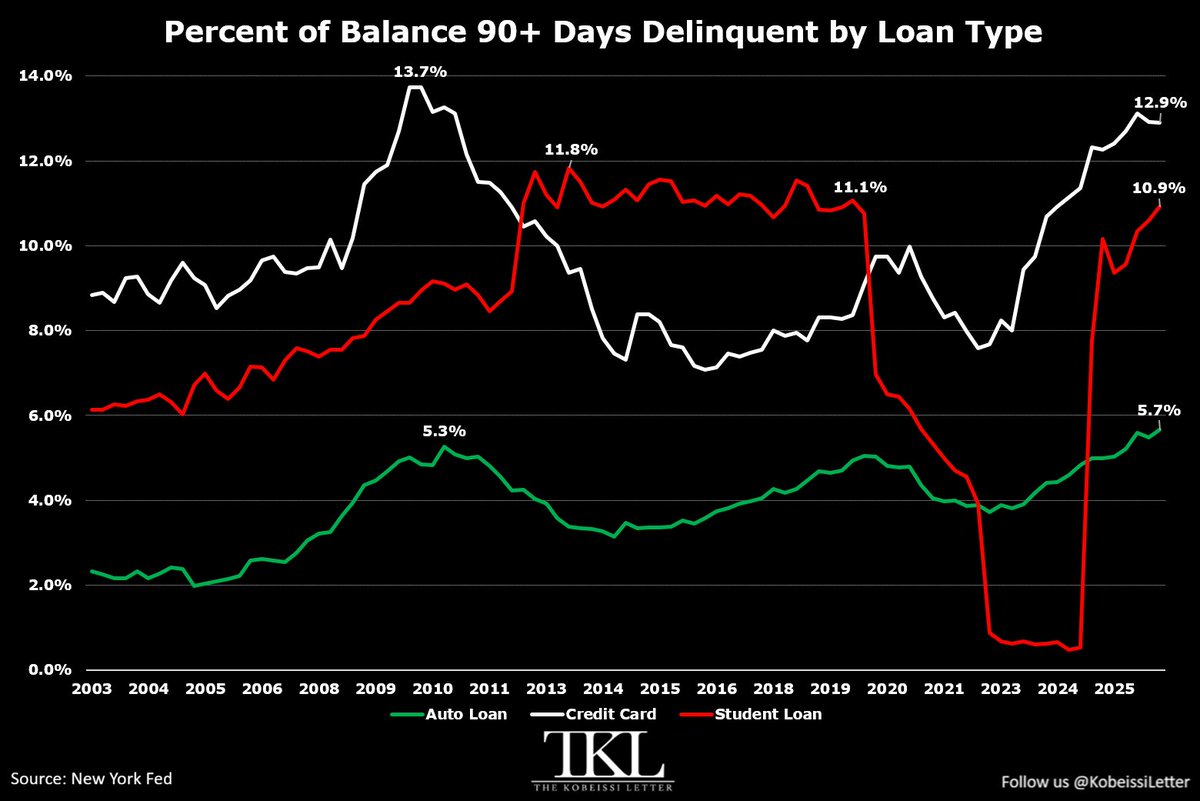
BREAKING: Student loan serious delinquencies increased +0.3 percentage points in Q3 2026, to 10.9%, the highest percentage since Q4 2019.
This marks the 4th consecutive quarterly increase, with a cumulative gain of +1.5 percentage points.
Auto loan 90+ day serious delinquencies rose +0.2 percentage points, to 5.7%, their highest level on record.
By comparison, the post-2008 Financial Crisis peak in this metric stood at 5.3% in Q4 2010.
Meanwhile, credit card 90+ day delinquencies stood at 12.9%, the 2nd-highest level since Q1 2011.
US households are falling further behind on their debt payments.
One of the reasons I don’t like socialism is public bathrooms.
A public bathroom is about as basic a shared resource as you can get. Everyone gets to use it, and everyone is expected to show a little consideration for the next person. The rules aren’t particularly complicated.
And yet, a shocking number of adults can’t even manage to throw their paper towels in the trash. Some will pee all over a toilet seat and leave it for the next person. And the next person, who didn’t make the mess, certainly isn’t going to clean it up either.
Now imagine trusting these same people to collectively manage an entire economy.
We can’t even get everyone to agree that cleaning up their own pee is a personal responsibility, but somehow we’re supposed to believe everyone will become hardworking, responsible, and considerate when we’re sharing the fruits of each other’s labor.
Now, compare your average public restroom to a Buc-ee’s bathroom.
Buc-ee’s figured something out. Clean bathrooms attract customers. Customers spend money. So the company has a financial incentive to keep those bathrooms spotless. They hire people to maintain them, hold employees accountable, and compete for your business.
And people will literally plan their road trips around stopping there.
That’s capitalism. Someone recognized a problem, found a way to solve it, and made money because people valued the result.
Of course, not everyone contributes equally to society. Some people work harder, make better decisions, and take more responsibility. Others seem perfectly content making life more difficult for everyone around them.
I believe people should have the freedom to live however they choose. I also believe in helping people who genuinely need it.
But I have a hard time accepting an economic philosophy that expects me to trust everyone to act in the collective interest when some people can’t be bothered to clean up after themselves.
Buc-ee’s figured out how to get people to willingly pay for a better experience.
Socialism wants me to believe the people leaving paper towels on the floor will suddenly become responsible stewards of everyone else’s resources.
I’m going with the beaver.
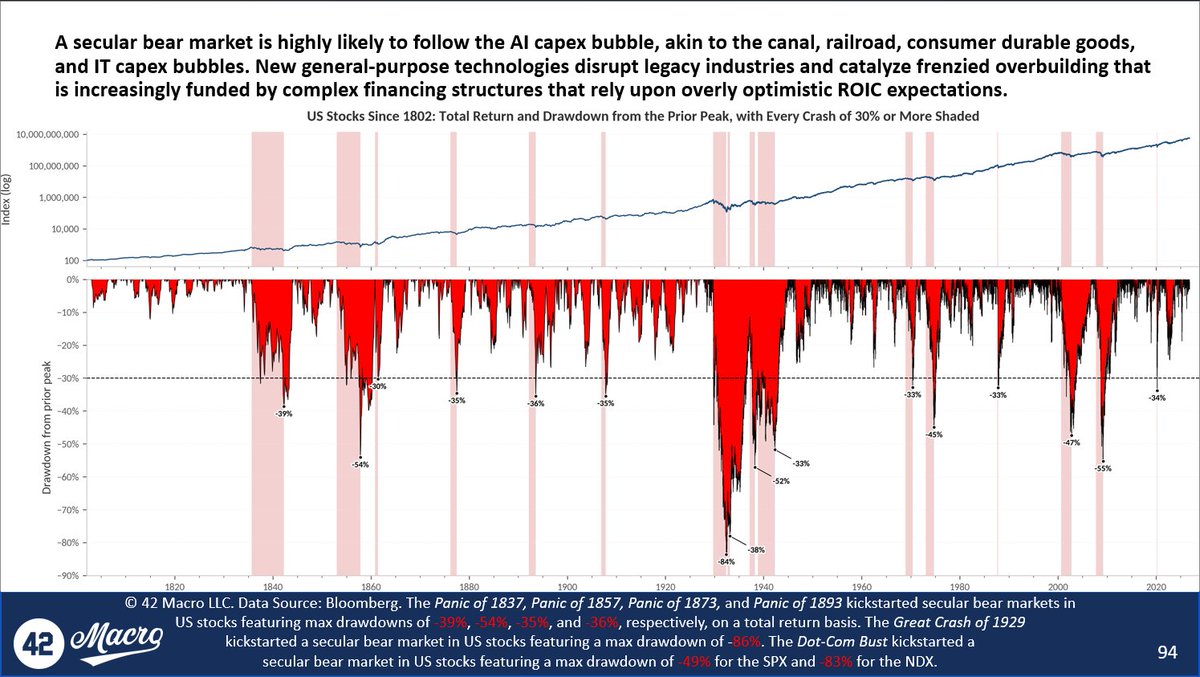
2028 ELECTION RISK: The worst secular bear market in stocks in US history is the one that priced in the New Deal. If the midterm election results prove prescient, lots of families will have their lives ruined by Wall Street's self-serving "buy-and-hold" BS over the next decade.
A history lesson in following the "future estimates" from management teams and Wall Street analysts...
From 2010 - 2014, every shale drilling shitco had a slide in their investor presentation showing a future cash flow windfall coming in the next 12 months, and the analyst community dutifully copy/pasted it into their financial models.
There was zero incentive to question these rosy projections, because management teams were cashing in on overinflated stock grants while the sell side "analysts" were helping their investment bank masters shill worthless paper to the investment community
Of course, the cash flow windfall never came, as shalecos continued burning cash drilling more wells until supply overwhelmed demand, prices crashed, and $1 trillion in debt/equity value was wiped out
Your prize for owning the businesses that unleashed the greatest energy revolution in US history was a donut in cases of marginal players, and a decade of lost returns in the absolute best case of owning the top tier operators
BREAKING: Anthropic is now expected to receive a "high junk" rating from major credit rating agencies after its IPO, which could come as soon as November, per FT.
Details include:
1. Blackstone has told investors that Anthropic likely will not receive an investment-grade rating immediately after its IPO
2. Blackstone is working with banks that stumped up financing on selling the debt on to other investors
3. An investment-grade rating is "central" to Anthropic's ability to continue its AI buildout
4. The company says it expects to spend over $800 billion on computing infrastructure between now and 2045
Debt markets are increasingly in the spotlight as AI funding becomes less abundant.
Tether and Circle, the issuers of the two largest dollar stablecoins, initially froze well over $1 billion of the stolen funds from today's Binance hack. On the surface this looks like a rescue. In reality it is a demonstration of raw centralized power. A handful of corporate issuers can reach into the blockchain and freeze assets at will, with no court, no jury, and no due process for the holder.
This directly contradicts the decentralized ethos that made cryptocurrency worth owning in the first place. Stablecoins are permissioned instruments -- they are dollars wearing a blockchain costume. Stablecoin holders do not own a bearer asset; they own a claim on a company that can censor it.
In other words, you don't really own USDT even if you hold it. It can be turned off remotely, without your knowledge or consent.
I have the exact same reaction.
If Tether can freeze your USDT, then you NEVER own any USDT at all. No control = no ownership.
Satoshi would be weeping...
Three things I don't love about the current market set up:
1) Hyperscaler credit spreads have broken above their July (Leopold Liquidation) wides (chart below).
2) Index momentum has stalled and entered a consolidation.
3) Financials/Staples ratio falling apart.
🚨 A MAJOR CREDIT CRISIS COULD BE BUILDING IN THE U.S.
The riskiest U.S. corporate bonds are now yielding over 18%, their highest level since the pandemic.
Just six months ago, these bonds were yielding around 13%.
That means companies with the weakest finances are now facing borrowing costs that could make refinancing their debt extremely difficult.
But what's more concerning is the growing gap between strong and weak companies.
BBB-rated bonds are paying around 1.1% above U.S. Treasuries, while CCC-rated bonds are paying more than 13% above them.
And the stress is already spreading through the loan market.
According to JPMorgan:
• $139.8 BILLION in risky corporate loans are trading below 80 cents on the dollar, up nearly 90% in a year.
• $65 BILLION in loans are trading below 60 cents, up from $40 billion a year earlier and the highest since March 2020.
• Technology companies account for 39% of all distressed loans, or roughly $54.4 BILLION.
AI-related borrowing is also becoming a serious concern.
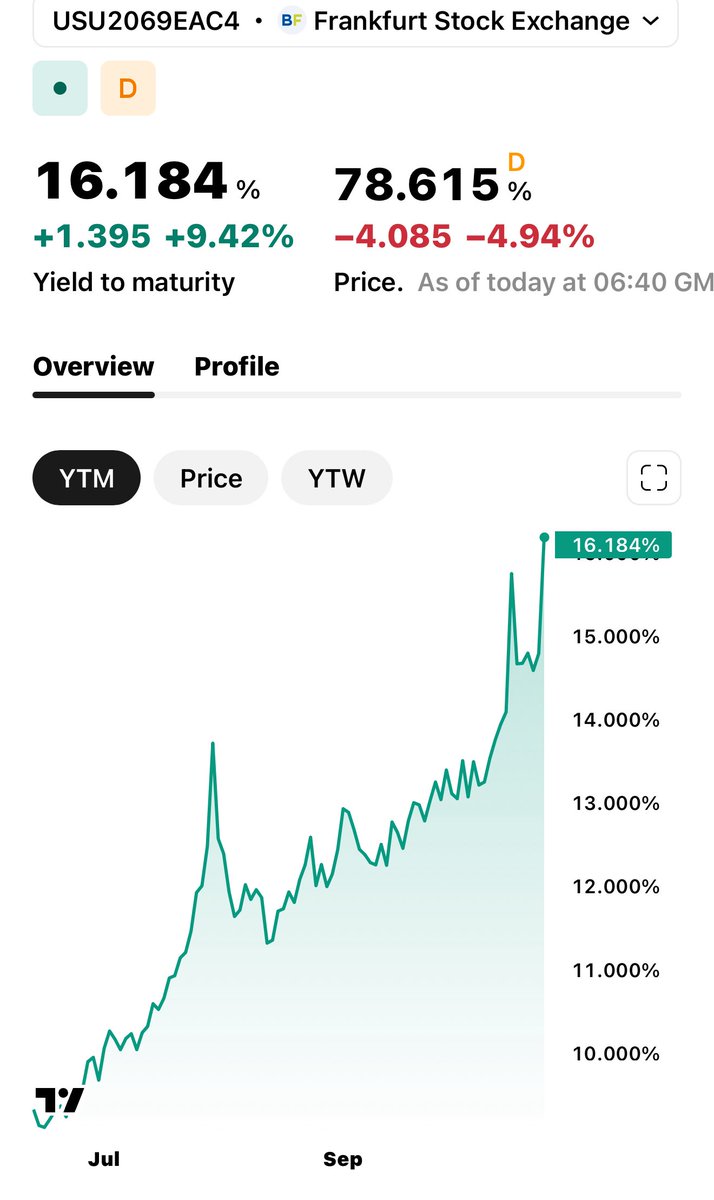
CoreWeave, one of the biggest AI infrastructure companies, has seen some of its bond yields climb toward 15%.
Its quarterly interest expenses have jumped from $267 million to $640 million in just one year.
The company has roughly $50 billion in debt and financing commitments to support its expansion.
Meanwhile, higher Treasury yields, persistent inflation and uncertainty surrounding the Iran war are making borrowing more expensive.
The problem is that many heavily indebted companies need to refinance their existing loans at much higher interest rates.
Some may not be able to afford it.
Probably one of the most horrifying statistics I have seen today
Married + home by 30 years old in America
> 1950: 50%
> 1960: 52%
> 1970: 48%
> 1980: 45%
> 1990: 43%
> 2000: 35%
> 2010: 25%
> 2026: 12%
Historically, falling real consumer incomes have often been a warning sign of a major recession.
Yet today, the economy remains resilient despite -ve real income growth.
Is this time truly different, or is history about to repeat itself?
A thread 🧵