>50% of population meme-bouncing in self-curated echo chambers
while some of them w/obscene wealth undermine & upend truth seeking democracies
autocrats then game reality to feed simulacrum w/ spectacle
for a society w ability to destroy itself
what could go wrong
@FilmUpdates dude, what? he’s using his lower back on both the positive and negative; with a real weight instead of a prop, his back is donezo
here’s a real power cling — https://t.co/P4jZeKruhb note the full engagement of the glutes and quads which are the power source for this lift
@MatthiasTroy@TheVintageMMA Ken had a heating and cooling biz as his main gig if i recall, he drove his co van to the den
Frank wasn’t there when i visited
@edzitron nice!
turning what you know into 15 sec sound bites —hello 10k word blogs— is going to be a tough transition. i assume you’ve had media training?
they’re giving you the right questions, and i know you can get to concise/precise answers if you polish & practice.
gl man 🤟🏻✌🏻
@warblers4me@MattJMcClintock agreed and yet incentives, flows, options, quants etc have evolved the market we once knew into this max pain meme machine where everything is bifurcsted into two momo camps of 1. up 2. down and-to-the-right until *something* (e.g. ER, m&a etc) violently flips the narrative
$15k in avg wealth gains since 2020 for 125M that make up the bottom 50%
…vs $10.8B avg gain for the 250 (!) people that make up the .0001%
the latter’s influence on political contributions + media make, for all intents & purposes, ours a govt of, by and for … 250 people
🦔GitHub Copilot switched to token-based billing this morning and users are already out of credits. Pro+ subscribers paying $39 a month are reporting 60% of their credits gone in two hours of normal use. One user lost 20% of their allowance from a single file review with no code changes. Another hit their monthly cap before the calendar even flipped to June.
Orgs with shared token pools have no way to see individual usage, so entire teams get cut off when one person runs a heavy prompt. Users are canceling and moving to Claude Code and Codex. GitHub community forums are on fire.
My Take
Flat-rate AI subscriptions were always subsidized. Everyone in the industry knew it. Today the subsidy ran out for a few million developers at once. The problem is a lot of companies already restructured around these tools. They cut headcount and told remaining engineers to lean on Copilot instead of building skills internally. Those companies now depend on a tool whose cost just became unpredictable and whose usefulness completely changes when you have to ration prompts to stay under budget.
The developers moving to Claude Code and Codex will hit the same wall eventually. Every AI provider faces the same unit economics. Anthropic filed its S-1 this morning, and the durability of its revenue depends on whether customers stick around once real pricing kicks in everywhere. If a $39 subscriber cancels after one day because the tool became unusable, multiply that across millions of seats and the churn risk becomes very real.
Today showed what happens when AI pricing meets reality. The companies that built their workflows around cheap tokens just discovered the tokens aren't cheap anymore and the people who knew how to do the work without them are already gone.
Hedgie🤗
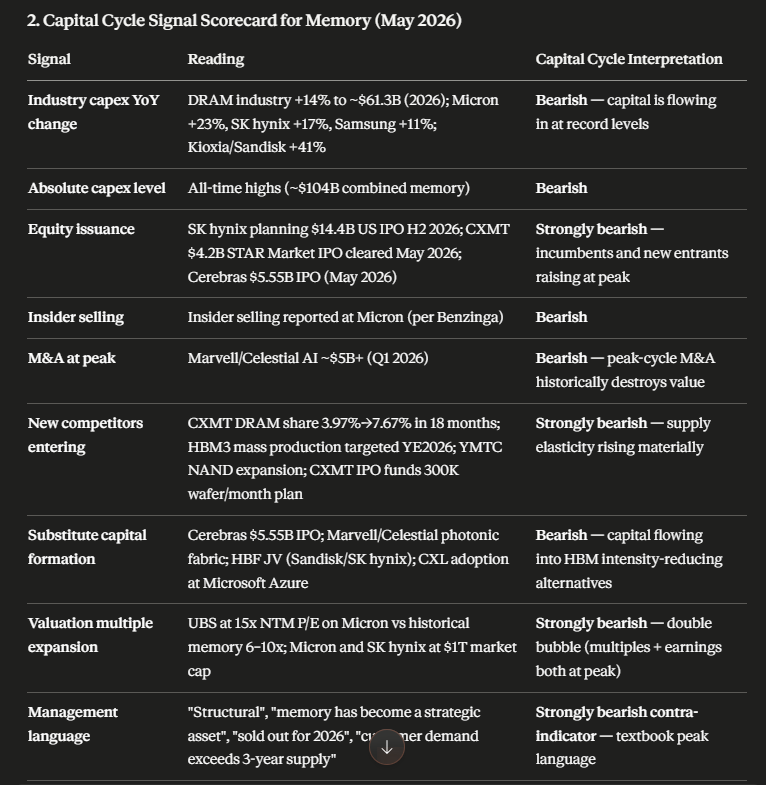
I asked Claude to apply a capital cycle analysis to $MU. Here's what it came up with:
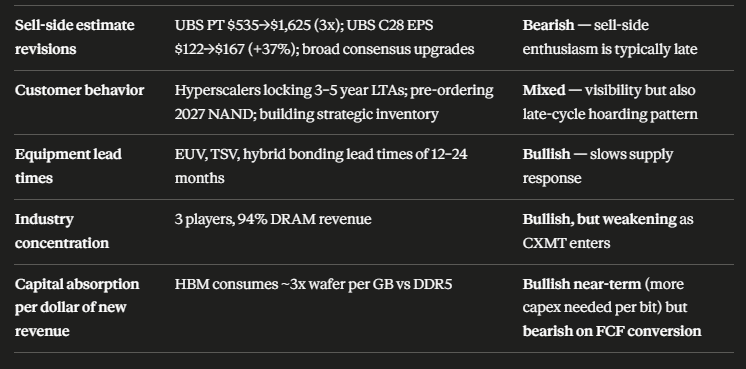
Net reading: 11 of 14 capital cycle signals are bearish or strongly bearish. The framework reads this as late-cycle, not early/mid-cycle. The two unambiguously bullish signals (equipment lead times, industry concentration) are eroding rather than strengthening.
Insights Yielded by Capital Cycle Analysis:
1) "Structural change" rhetoric is itself diagnostic. The capital cycle framework treats coordinated industry-wide CEO claims of regime change as evidence of late-cycle euphoria. The same language was deployed by the same CEOs (Mehrotra at Micron specifically) in 2017–2018 and was wrong. Bayesian base rates argue against accepting the current claims at face value. The previous analysis under-weighted this base-rate evidence.
2) Look at total capital flowing into the supply curve, not just incumbent capex. The structural-change analysis focused on Big Three capex. The capital cycle lens forces aggregation of all capital flowing into memory output:
a) Incumbent capex: ~$104B in 2026 across DRAM + NAND;
b) CXMT IPO proceeds: ~$4.2B (with state-aligned co-financing many multiples larger);
c) YMTC capacity additions (privately financed)
d) Substitute technology capital (Cerebras, photonic startups, CXL controller designers) — billions of dollars of equity raised to reduce HBM intensity per dollar of AI compute deployed.
When aggregated, total effective supply-side capital formation in 2026 is materially higher than the Big Three capex alone suggests. The supply response is being underestimated.
3) The customer base is doing exactly what late-cycle customers do. Hyperscalers locking in 3–5 year LTAs, pre-ordering 2027 NAND, building strategic inventory — these are not signs of confident long-cycle visibility, they are signs of late-cycle scarcity panic. Historically (DRAM 2017–2018, oil 2008, shipping 2007), customer pre-buying at peak prices is followed by sharp inventory destocking when prices roll over. The structural-change narrative frames LTA penetration as a benefit; the capital cycle frames it as a peak signal.
4) Multiple expansion + earnings expansion = asymmetric downside. The previous analysis flagged the 15x NTM P/E multiple as aggressive (referring to UBS PT raise). The capital cycle framework sharpens this: when both earnings and multiple are at peak, the compound drawdown when either reverts is severe. Memory historically goes from 60% gross margin to negative gross margin and from 10x P/E to <5x P/E. Even a modest reversion to 35% gross margin and 8x P/E from current levels implies a 60–75% equity drawdown for the memory primaries — without any disorderly cycle.
5) Supply lag is real but not unique. The bullish point about EUV/TSV/hybrid bonding lead times is correct but mis-weighted. The capital cycle history of other capital-intensive industries (oil refining, shipbuilding, semiconductor wafer fab) shows that long lead times increase the eventual amplitude of the down-cycle: capital decisions made at peak are not reversible when conditions soften, leading to capacity overhang. Long lead times delay the down-cycle; they do not abolish it.
6) China is the textbook capital-cycle disruptor. In Chancellor's historical case studies (steel, shipbuilding, solar, panels, batteries), state-backed Chinese entrants repeatedly compressed margins of consolidated Western/Korean/Japanese oligopolies once technology gaps narrowed. The U.S. equipment restrictions on China have created the illusion that this dynamic is paused, but the data shows CXMT doubled DRAM share in 18 months and is targeting domestic HBM3. The structural-change analysis appropriately flagged this; the capital cycle framework would weight it heavier as the single most important multi-year risk.
7) Substitute capital formation is its own supply curve. The capital cycle framework treats financing flows into substitutes as a parallel supply expansion. Cerebras' $5.5B IPO, Marvell's $5B Celestial acquisition, the Sandisk/SK hynix HBF JV, and the CXL ecosystem (ALAB, MRVL, MCHP) are collectively financing "HBM intensity reduction." Even if HBM unit demand is met, the value capture per dollar of AI compute is diluted. Capital is flowing in adjacent to the memory primaries to reduce the share of AI spend that ends up in their P&L.
8) The bull case relies disproportionately on demand visibility. The capital cycle warns against demand-anchored theses. The bull case requires AI capex to continue at current levels or accelerate, hyperscaler ROI economics to remain favorable, sovereign AI to scale, and inference workloads not to migrate to non-HBM architectures. Each of these is plausible; the joint probability that all hold through 2028 is materially lower than the headline narrative suggests.
9) Sell-side estimate trajectory is itself a signal. UBS's PT trajectory ($535 → $1,625, a 3x increase in one revision) is historically associated with peak euphoria. Estimate revisions of this magnitude have a poor forward record. The framework would treat the velocity of estimate revisions as a contra-signal.
10) Where the asymmetry sits. The capital cycle framework reframes the risk/reward calculation. Even if the bull thesis is right and earnings hold through 2028, the upside from current levels is modest (multiple expansion has already happened). If the bull thesis is partially wrong — say, 2028 brings 25% peak-to-trough EPS decline rather than 50% — the equity drawdown is still material because multiples will compress simultaneously. The asymmetry is not favourable at current valuations.
Bottom line: The structural change thesis was directionally correct but materially overweighted by the original analysis. The capital cycle framework appropriately reweights toward supply-side caution and treats current peak conditions, peak valuations, peak management confidence, and accelerating capital inflows as a coherent set of late-cycle signals. The memory industry has undergone real and beneficial structural change in shape, but the empirical base rate against the "cycle has been abolished" claim is overwhelming. The economic characteristics of memory businesses have improved but have not been transformed into stable, compounding, low-volatility ones — and the next 18–30 months are statistically more likely to mark the end of this up-cycle than a transition to a new regime.
🦔Picnic, a Seattle pizza robotics startup that raised $53 million and partnered with Domino's, just shut down. The company sold its IP to an unnamed buyer and left at least one restaurant owner stuck with $250,000 of useless robots. Zume Pizza did the same thing in 2023 after burning nearly $500 million trying to keep cheese from sliding off pies inside their delivery trucks. Both companies promised one worker could output 100 pizzas an hour with their hardware.
My Take
Picnic and Zume burned through $550 million combined trying to automate something humans do for $15 an hour. The Seattle restaurant owner stuck with the leftover hardware compared his kitchen to an aquarium of useless machines. That image is funny until you remember the same script is running across Starbucks pulling its AI inventory tool, Waymo pausing eight cities, Microsoft killing Claude Code internally, and Uber blowing through its 2026 AI budget in four months.
The mechanism is always the same in every story I've been covering. The demo works in a controlled environment with clean inputs. The deployment fails because real kitchens, real intersections, and real warehouses produce messy inputs the demo never tested. The vendor gets paid through the failure cycle. The buyer eats the cost and quietly retires the product. If a pizza chef can lose $250,000 on a topping robot, the people writing $80 billion capex checks for general purpose AI agents should expect to learn the same lessons at much larger scale.
Hedgie🤗
@Yourmom32522@zerohedge since fasb m2m rule changes in ‘09 + breakers, fewer things cause index level selling vortexes
meanwhile, XL put OI has corresponding XL short futes hedge
nature of vol + gamma are such that it seeds ‘reverse’ avalanche conditions ie. hedge covering snowballs as puts collapse