If you have a bug zapper up, it's time to take that shit down.
A landmark University of Delaware study (Frick and Tallamy, 1996) counted nearly 14,000 insects killed by residential bug zappers over a single summer.
Mosquitoes were 31 of them. A mere 0.22%.
The other 99.78% were moths, beetles, midges, fireflies, and the night-shift pollinators your yard depends on.
Mosquitoes don't navigate by light. They find you by your carbon dioxide, body heat, and skin chemistry. Your bug zapper is invisible to them and lethal to almost everything else.
Harvard Medical School's Zika page specifically warns against bug zappers because they may increase mosquito populations by killing the predators that eat them.
What actually works: eliminate standing water within 100 feet of where you spend time outside.
Bug zappers are 1970s technology built on a 1970s misunderstanding of mosquitoes. It's time to take it down.
Walmart just reported $5.33 billion in profits for Q1.
The average Walmart worker is paid less than a living wage, forcing them to rely on taxpayer-funded government assistance.
Walmart's profits are our tax dollars subsidizing their poverty wages.
Let me lay out the unpleasant arithmetic of the replacement rate, and why a modern society finds it so hard to reach.
A population of 100 women in an advanced economy needs 210 children to replace itself. Why?
Absent sex-selective practices, roughly 105 boys are born for every 100 girls. Evolution overshoots male births because boys are more prone to early death from accidents and disease. Therefore, of 210 children, about 108 are boys and 102 are girls. Not all girls reach the midpoint of their fertile age: accidents, suicide, homicide, and illness take some. In an advanced economy, about 98% of them survive, leaving 100 women to replace the original 100.
Now consider the distribution of children per woman.
Imagine 15 women have no children. Five do so by choice, for various reasons (professional, affective, religious). Ten face unfixable fertility problems, theirs or their partner’s. The 10% figure is conservative: the medical literature points to around 13%, and that does not even count male fertility problems.
Of the remaining 85, 10 have one child, 60 have two, 10 have three, and 5 have four. I am stopping at four to keep the post concise; very few women in younger cohorts have five or more children, but I could adapt the example to account for them.
Hence, the 100 women in this population have 180 children, for a completed fertility rate of 1.8.
Interestingly, this is roughly the rate we saw in many advanced economies until the early 1990s, and in the U.S. until around 2008.
But we are still 30 children short of replacement! Voluntary childlessness is only 5%. Three-quarters of women have two or more children. Look around: most of your friends will have two, plenty will have three or four. And yet, we are well below replacement.
You would not look at this population and call it selfish (is having two kids hedonistic?) or accuse it of losing family values (only 5% of women are choosing voluntarily not to have children).
The point is simpler. To reach 210 births, you need a substantial share of women to have three or more children. Two as the “normal” pattern will not get you there. And modern society makes three or more a costly proposition for most families.
Of course, current fertility rates in most advanced economies are well below 1.8. But my point is that, under present social arrangements, we should not expect 2.1, even if (to humor last weekend’s debate) we banned smartphones and TikTok. We need many, many more families with three or four children.
More pointedly, there is no self-regulating mechanism that pushes a society back to 2.1. The market-clearing analogy many economists use is flawed; scarcity feedback does not work the same way. (Another post on this another day.) And, as I often read, the claim that “nature” somehow regulates current overpopulation is just childish mumbo jumbo.
So yes, the arithmetic of replacement rate is unpleasant.
Everyone who cares about climate should understand this. Texas, with no pro-climate policies, has blown passed California in clean energy. In large part because Texas has less red tape and makes it easier to build.
Being against wasteful subsidies and inefficient welfare programs is a cornerstone of rural and conservative beliefs right up until the subsidy and inefficient welfare is for farms.
If the “rural lifestyle” can only exist via subsidy let’s just do UBI payments and call it a day.
Banning lab grown meat:
-violates free market principles
-strips consumers of choice and autonomy
-is based on fearmongering that defies current scientific research
-promotes animal abuse
-promotes monopolies
Disgusting and vile— unAmerican at best.
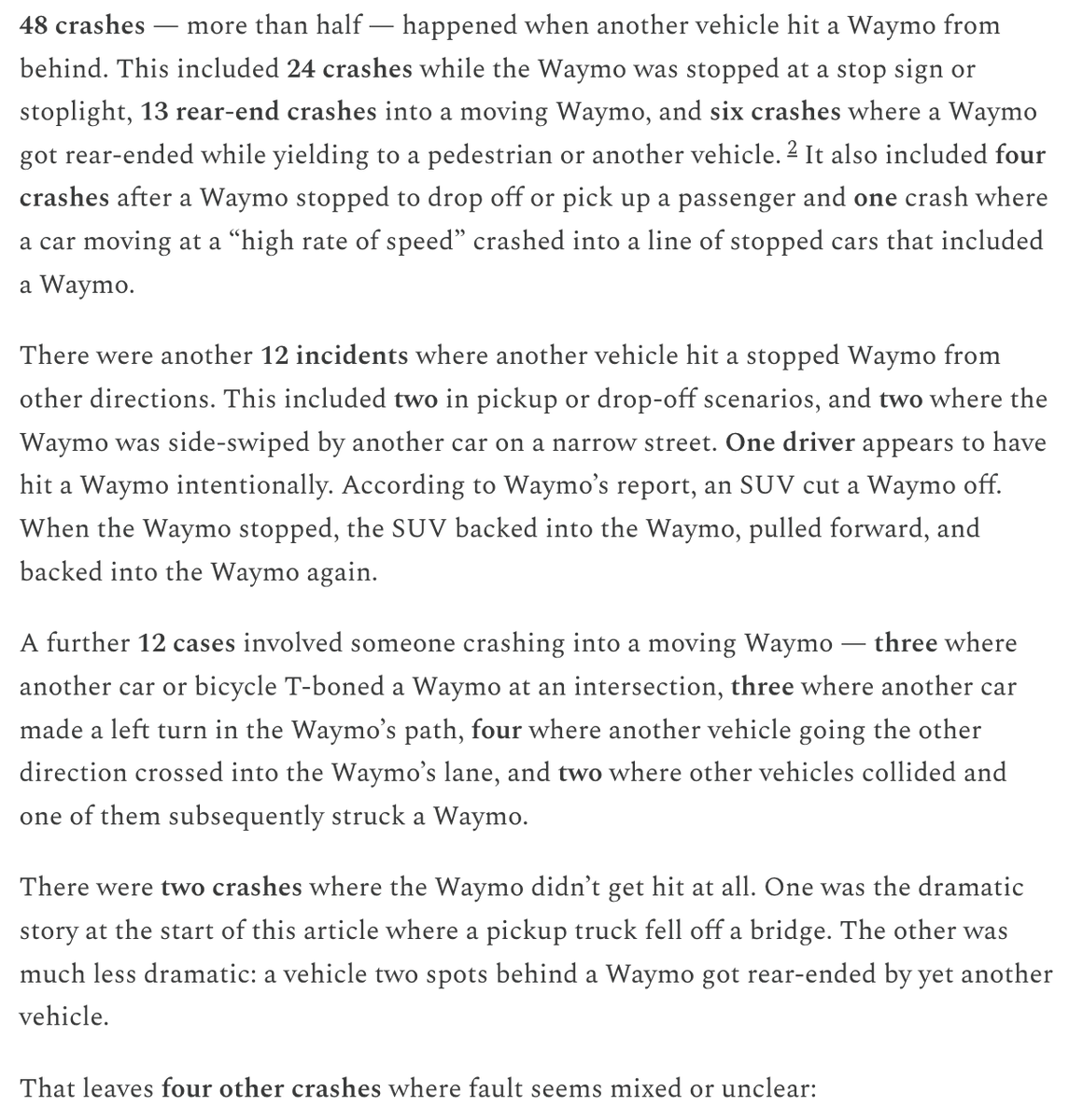
We (mainly @chi_t_williams) looked at the 78 worst Waymo crashes of the last seven months. The vast majority (60 out of 78) were "human rear-ends Waymo" and/or "human hits stationary Waymo."
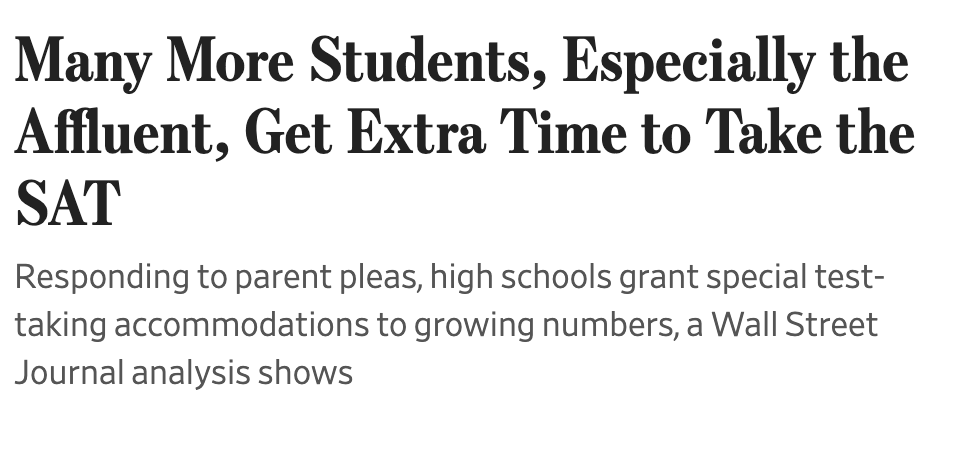
Happy SAT day to all who celebrate.
Reminder that a disproportionate number of kids in rich school districts get 1.5x the time that everyone else does.
And everyone in the system is conspiring to keep the numbers non-transparent.
"if it's such a great project why isn't the private sector financing it?"
Why is this question valid for a train but never ever used for a road or a bridge?