Got into an argument with a client once over whether a project was "done."
I'd hit every item on the brief. They felt something was missing that they couldn't quite name. We were both right, in the sense that neither of us was lying.
That argument happens constantly on freelance platforms, and it's the exact reason a network like Braintrust can't fully decentralize the part that actually matters.
Braintrust lets workers own the network instead of a company taking a cut. Great model. But disputes over whether deliverables meet the brief still get resolved by a human support team behind the scenes, because there's no other option. Code can confirm a file got uploaded. It can't tell you if "done" actually means done.
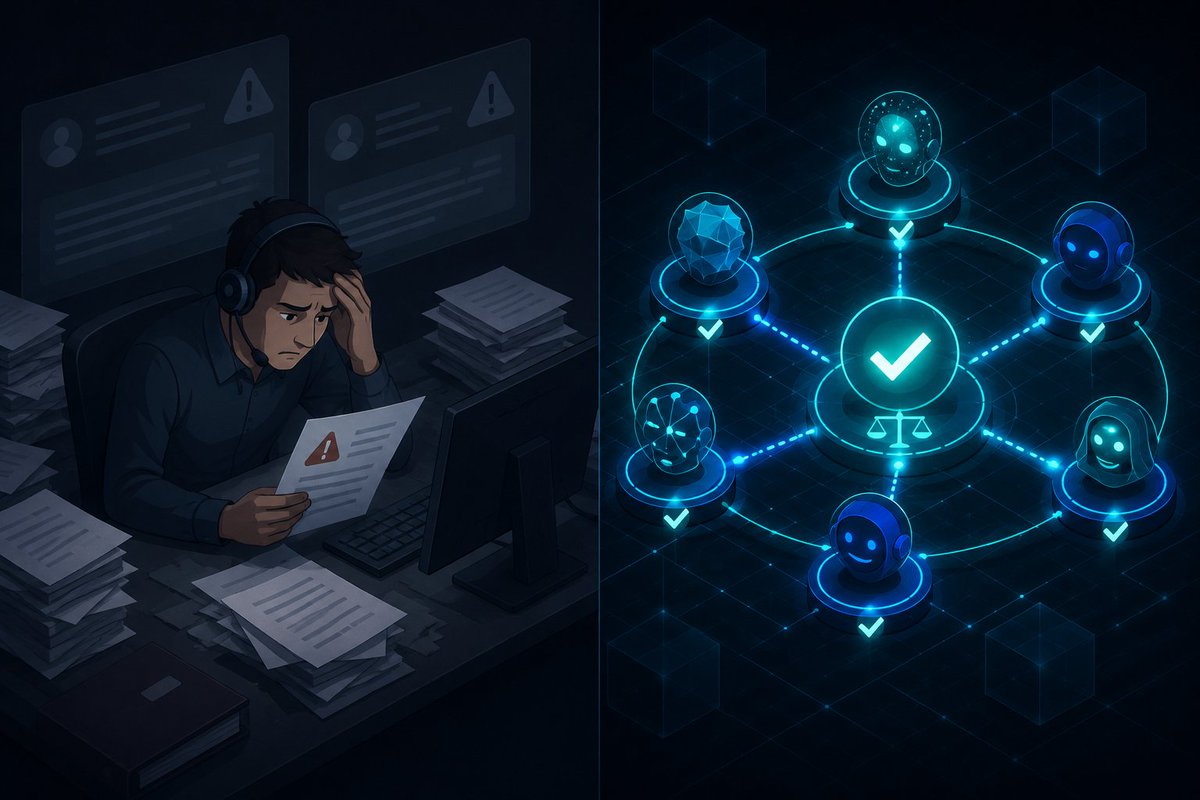
@GenLayer is built for that exact gap. Instead of one support rep making a judgment call, a set of validators running different AI models would review the brief, the deliverable, and the conversation history independently, then vote on whether the work holds up. Disagreement rotates the validator set instead of escalating to a manager. The decision can be appealed until it actually settles.
That turns "done" from something a support team decides into something the network itself can adjudicate, transparently and the same way every time.
Freelance platforms talk a lot about removing the middleman from payments. Nobody's removed the middleman from judgment yet.
What's a freelance dispute you've seen where you genuinely think both sides had a point?
@cryptony0x "we were both right in the sense neither of us was lying" is such an accurate way to describe most freelance disputes. it's never actually about dishonesty
Most explanations of GenLayer repeat the same line without explaining the actual mechanic.
Here's the real version.
Every blockchain today runs on one strict rule: every node must compute the exact same answer from the exact same input. That's not a limitation, it's why blockchains can be trusted with money. No room for opinion means no room for manipulation.
The tradeoff is that this only works when the answer is binary. Did the payment clear, yes or no. The moment a question needs context instead of computation, every blockchain just stops.
@GenLayer is built for what happens after that stop. It runs Intelligent Contracts, written in Python, that can read real information from the web and weigh it the way a person would. A set of validators, each running a different AI model, reviews the same situation independently and votes. If they disagree, the set rotates, and the decision can be appealed until the network actually agrees.
It's not one AI deciding for everyone. It's a rotating group that has to reach real consensus, with a built in way to challenge the result.
Freelance disputes, insurance claims, AI agents negotiating with each other, anything where two honest parties could read the same situation differently, needs exactly this.
If you had to pick one type of disagreement to take onchain first, what would it be?
@cryptony0x freelance disputes is such an underrated example. half of upwork's existence is just arguing about whether "revisions included" means what the client thinks it means
A post on a decentralized social app gets flagged for harassment.
The poster says it was satire. The person it named says it was targeted. Five other users vote it's fine, three vote it's not.
Nobody's lying. They're just looking at the same post through different thresholds for what counts as harm.
This is the actual problem with moderation on decentralized social platforms like Farcaster. Anyone can build a client, anyone can write moderation rules, but the hard calls were never really decentralized. Someone, somewhere, is still making that call by hand, or one algorithm is making it for everyone whether people agree with it or not.
@GenLayer changes what that call can look like. Instead of one moderator or one model deciding what harassment, misinformation, or spam actually means in a gray area case, a group of validators running different AI models reviews the same post independently and votes. Disagreement doesn't break the system, it rotates the validator set until consensus holds, with room to appeal.
Decentralized social keeps solving for who can post. It still hasn't solved for who decides what shouldn't have been posted, fairly and without one person or one company holding that power alone.
What's a moderation call you've seen online where you genuinely couldn't say who was right?
A post on a decentralized social app gets flagged for harassment.
The poster says it was satire. The person it named says it was targeted. Five other users vote it's fine, three vote it's not.
Nobody's lying. They're just looking at the same post through different thresholds for what counts as harm.
This is the actual problem with moderation on decentralized social platforms like Farcaster. Anyone can build a client, anyone can write moderation rules, but the hard calls were never really decentralized. Someone, somewhere, is still making that call by hand, or one algorithm is making it for everyone whether people agree with it or not.
@GenLayer changes what that call can look like. Instead of one moderator or one model deciding what harassment, misinformation, or spam actually means in a gray area case, a group of validators running different AI models reviews the same post independently and votes. Disagreement doesn't break the system, it rotates the validator set until consensus holds, with room to appeal.
Decentralized social keeps solving for who can post. It still hasn't solved for who decides what shouldn't have been posted, fairly and without one person or one company holding that power alone.
What's a moderation call you've seen online where you genuinely couldn't say who was right?
Try writing a contract clause for "reasonable effort."
You can't, not really. Two lawyers will read it differently. A judge might read it a third way. That's not sloppy writing, that's just what happens when language meets a standard instead of a number.
Smart contracts don't have this problem because they don't use language like that. Every node runs the same code and gets the same answer every time. That's why blockchains are trustworthy for moving money.
It's also why they go silent the moment a question needs interpreting instead of computing. They can verify a payment cleared. They can't tell you if a deliverable was actually "reasonable," or "good enough."
@GenLayer exists for that exact gap. It's the adjudication layer for the agentic economy. When a question can't be settled by code alone, a group of validators, each running a different AI model, reviews the evidence independently and votes. If they disagree, the group rotates and the case can be appealed until it's settled.
It's the difference between a calculator and a panel of reviewers. One gives you an exact number. The other gives you a judgment call, still decentralized, still transparent, still fast enough for software making decisions at machine speed.
That second kind of trust hasn't really existed onchain until now.
What's a real agreement in your life that hinges on a word like "reasonable" instead of a number?
Try writing a contract clause for "reasonable effort."
You can't, not really. Two lawyers will read it differently. A judge might read it a third way. That's not sloppy writing, that's just what happens when language meets a standard instead of a number.
Smart contracts don't have this problem because they don't use language like that. Every node runs the same code and gets the same answer every time. That's why blockchains are trustworthy for moving money.
It's also why they go silent the moment a question needs interpreting instead of computing. They can verify a payment cleared. They can't tell you if a deliverable was actually "reasonable," or "good enough."
@GenLayer exists for that exact gap. It's the adjudication layer for the agentic economy. When a question can't be settled by code alone, a group of validators, each running a different AI model, reviews the evidence independently and votes. If they disagree, the group rotates and the case can be appealed until it's settled.
It's the difference between a calculator and a panel of reviewers. One gives you an exact number. The other gives you a judgment call, still decentralized, still transparent, still fast enough for software making decisions at machine speed.
That second kind of trust hasn't really existed onchain until now.
What's a real agreement in your life that hinges on a word like "reasonable" instead of a number?
Nobody talks about what a Rally Score boost actually feeds into.
Everyone's looking at Wingston as a one-time mint. Good art, real community, free mint. All true. Still the smallest version of what's happening.
Rally Score is becoming the single most important metric for creators here, it influences your rewards and your access across the platform. Minting Wingston boosts it automatically. Not a roadmap item, it happens on mint.
Stake it and RLP comes in daily. Hold it and you're in the VIP room where the higher paying campaigns open up.
This isn't a Wingston play. It's a standing play in a protocol with real revenue behind it, not just a roadmap promise.
Made the leaderboard last week and got whitelisted off the back of it. The campaigns I ran to qualify already paid out before the spot was even confirmed.
Here's what it actually takes to get there:
- Join 3 Rally campaigns
- Land in the top 425 on the weekly leaderboard
- Follow @RallyOnChain
Free mint. No cost to raise your score, just the work you'd be doing anyway if you're serious about this platform.
https://t.co/JlzgHNyKqr
What's your current Rally Score sitting at, and would a permanent boost actually change how you play?
A friend of mine used to write the same paragraph six different ways before posting anything.
Not because the ideas were bad. Because there was no way to know what would actually land. No rubric. No response. Just a guess dressed up as confidence.
She submitted to Rally for the first time expecting the usual nothing.
She got a number back. With a reason attached to it.
Two weeks later her writing had genuinely changed. Sharper openings. Fewer hedges in places that did not need them. Not because someone told her to write differently. Because an AI scoring originality and clarity finally told her which parts were actually working.
@RallyOnChain removed the waitlist. Anyone can join at https://t.co/HHnkfum74k right now.
I am not sure feedback should change a person's writing that fast. It did anyway.
Who is someone you have watched get noticeably better once they finally got real feedback?
@cryptony0x@RallyOnChain free mint with day one utility and the qualification process literally pays you. the barrier to entry is doing the thing anyway
I've been watching how people talk about Wingston.
Everyone's leading with "free mint." Nobody's leading with what happens after.
The Wingston NFT collection from @RallyOnChain is a free mint. That part is real.
But the mechanic worth paying attention to is the Rally Score boost.
The moment you mint, your Rally Score goes up automatically. Not a roadmap item. It's live.
Your Rally Score determines which campaigns you can access, how your submissions are weighted, and how your rewards build over time. The NFT doesn't just sit there. It changes your standing on the platform from day one.
Staking earns you RLPs daily. VIP access opens token-gated campaigns with higher reward pools. The score boost ties all of it together.
To earn a whitelist spot:
• Join 3 Rally campaigns
• Reach the top 425 on the weekly leaderboard
• Follow @RallyOnChain
The campaigns you complete to qualify also pay you while you're working toward it.
https://t.co/BWgPkcHLXT
What is the last time consistent participation on a platform actually changed what you had access to?
I've been watching how people talk about Wingston.
Everyone's leading with "free mint." Nobody's leading with what happens after.
The Wingston NFT collection from @RallyOnChain is a free mint. That part is real.
But the mechanic worth paying attention to is the Rally Score boost.
The moment you mint, your Rally Score goes up automatically. Not a roadmap item. It's live.
Your Rally Score determines which campaigns you can access, how your submissions are weighted, and how your rewards build over time. The NFT doesn't just sit there. It changes your standing on the platform from day one.
Staking earns you RLPs daily. VIP access opens token-gated campaigns with higher reward pools. The score boost ties all of it together.
To earn a whitelist spot:
• Join 3 Rally campaigns
• Reach the top 425 on the weekly leaderboard
• Follow @RallyOnChain
The campaigns you complete to qualify also pay you while you're working toward it.
https://t.co/BWgPkcHLXT
What is the last time consistent participation on a platform actually changed what you had access to?
The worst part of making something good and posting it is not the low numbers.
It is the silence.
I remember a specific version of that silence. Something I had worked on longer than anything else I had posted that week. Hit send. And then nothing. Not even a wrong-directional engagement. Just the kind of quiet that makes you wonder if the post even loaded correctly.
Good work disappearing is not the same as bad work disappearing. It costs something different.
@RallyOnChain just removed the waitlist. Anyone can join at https://t.co/MM7VSSGh5L and start submitting to live campaigns today.
What caught me off guard was not the AI evaluation. It was that I got a response at all. An actual score. Specific feedback on what landed and what did not. After years of posting into silence, that alone felt like a different system.
What is the best thing you ever made that posted into complete silence?
Good content does not fail because it is bad.
It fails because the people who would have loved it never saw it.
I have watched creators in this space write genuinely sharp analysis, post it into the void, get twelve impressions, and quietly stop trying. Not because the work was wrong. Because the system only amplifies what is already amplified.
That is the specific problem @RallyOnChain is built to fix.
The waitlist is gone. Anyone can join at https://t.co/dU2EPzw8Av right now and submit to active campaigns. The AI does not check your follower count before reading your post. It reads the post first.
That sounds like a small thing. It is not a small thing.
The best piece of content I have seen this year came from an account with under 500 followers. I know because I was looking at a leaderboard when I found it.
Join before the crowd figures out what you are about to figure out. https://t.co/dU2EPzw8Av
Has good work you made ever disappeared simply because nobody with reach happened to see it?