Striving to provoke curiosity, creativity and passion. Constraints led, movement acquisition, motivational interviewing, self determination theory influenced.
ATHLETES: As you start your fall sports season, ask yourself...
What role can you bring to your team that will help your team succeed?
Here is one thing you can do...
Be a Spark Plug for your TEAM.
How do you do it?
Here are 6 Ways...
1: BE VERBAL
Winning teams Communicate on the court or field! “A quiet gym is a losing gym.” Be verbal. Talk for your teammates. Communication is contagious. It builds energy and Fuels a team!
2: TOUCHES, HIGH-FIVES, FIST BUMPS
The NBA once did a study on “touches.” Steve Nash led the NBA in “touches”…239 per game. He was the MVP. His team WON. In the NBA…Winning teams had the MOST Touches! Spark your team with Positive touches.
3: BE AN ENERGY GIVER
Winning teams have energy givers. They bring Positive Energy to every practice and every game. These players are critical to team success. Be an energy giver and be a Spark Plug for your team!
4: ➕ BODY LANGUAGE
Body Language Screams! Make eye contact. Sit up. Be alert. Nod in affirmation. Smile. Be confident. Positive body language creates positive energy! It is Contagious!
5: CHALLENGE A TEAMMATE
Sometimes, your teammates are not bringing the spark. They may not be playing Hard! Sometimes they need to be challenged. Leaders Challenge when needed. Be this Leader!
6: MAKE A HUSTLE PLAY
Want to get your team going? Dive for a loose ball! Take a charge! Make an extra pass! Set a great screen! Make a hustle play. Hustle plays are selfless. They show the team what is needed to win. They bring a SPARK!
____
Follow me for more at @gregberge.
Join 12,000+ others who subscribe to my free weekly newsletter.
🏆 Great Teams - Better Leaders 123.
The subscription link is in my profile.
It's that time of year again where I start to see people's school improvement plans for next year. If you are looking looking at metacognition, oracy, turn and talk, literacy, trauma informed practice or bits of individual theory from cognitive science, I'm not saying these things are a waste of time, but there's a need to prioritise.
Whatever it is you are spending your summer planning, I'd consider checking the list below first, if all those things are sorted in your school then go for it, but if they aren't I'd suggest they are prioritised.
Calm, orderly, predictable classrooms across the school.
Calling out does not occur.
Teachers are consistently putting students' names at the end of questions.
Teachers have "rules of thumb" for which students they ask questions to and when.
There are always checks for understanding in-between explanation and practice.
Checks for understanding in the majority of subject are delivered using miniwhiteboards.
Miniwhiteboards are used with "hover and show" routines.
Students are in the room and learning (i.e. actually doing something academically meaningful) extremely quickly at the start of lessons.
Departments have long-term memory strategies that map out how teachers give students the retrieval practice they need.
As above, once that stuff is in play, go to town. But if it isn't, it's probably where you should focus.
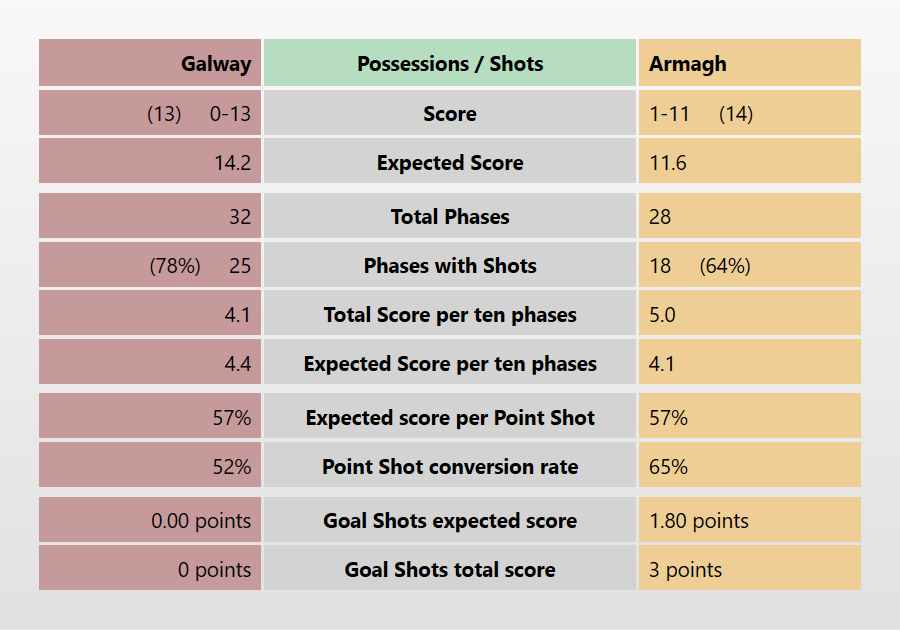
Full time stats
ARMAGH vs GALWAY
Expected Score of Armagh 11.6 vs 14.2 Galway
Poor Galway shooting in 2nd half and Armagh converting goal chance the difference
Armagh won Blanket Defence/sweeper wars with 1-11 from 25 (56%) to Galway's 0-9 from 24 (38%)...
But Expected Score into sweeper defences was only 44% to 42%
Galway getting four man-on-mans, two overlaps and two high turnovers and scoring 0-4 from them, compared to Armagh's mere two man-on-mans, kept them in touch.
But ultimately, shooting was the difference
*full analysis on THE SQUARE D tomorrow
#armaghvsgalway #armaghgaa #galwaygaa #Allirelandfootballfinal @m_brosnan@SeanMurph_1@dontfoul@TonyBambrick
Being positioned ball-side and goal-side as a defender is a fundamental defensive principle.
Here are 7 reasons why this positioning is non-negotiable.
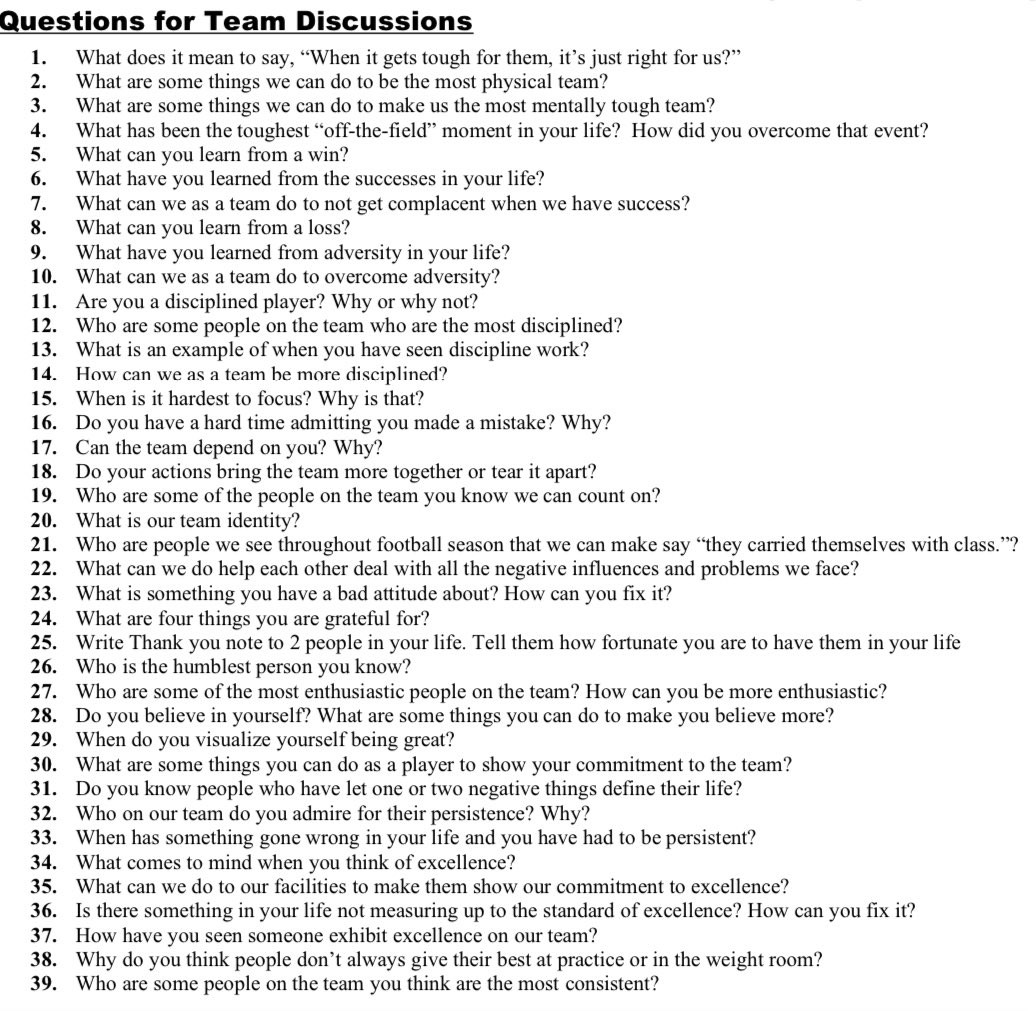
As a coach, you need to get your team talking. Here are some questions for team discussions. Maybe they can get you thinking on some discussions with your team.
𝐓𝐡𝐞 𝐜𝐨𝐚𝐜𝐡𝐞𝐬 𝐠𝐚𝐭𝐡𝐞𝐫 𝐭𝐡𝐞𝐢𝐫 𝐩𝐥𝐚𝐲𝐞𝐫𝐬 𝐭𝐨𝐠𝐞𝐭𝐡𝐞𝐫…𝐬𝐦𝐚𝐥𝐥-𝐬𝐢𝐝𝐞𝐝 𝐠𝐚𝐦𝐞…𝐚 𝐜𝐨𝐮𝐩𝐥𝐞 𝐨𝐟 𝟔 𝐯 𝟔…𝐛𝐮𝐭 𝐰𝐢𝐭𝐡 𝐚𝐝𝐝𝐢𝐭𝐢𝐨𝐧𝐚𝐥 𝐢𝐧𝐬𝐭𝐫𝐮𝐜𝐭𝐢𝐨𝐧𝐬…
“I’d like you all to pick a couple of action-based words. I’ll give you some examples: alert, alive, relentless, dominant, focused, positive, energetic, upbeat…
…I’d like you to pick two action words. And I’d like to see you play in the style of these words. Non-stop! No matter what!”
The coaches know what they’re doing. They’re trying to help their players experience what scientists call ‘approach behaviour’. And they’re trying to help players recognise when they’re experiencing something scientists call ‘behavioural inhibition’
Approach behaviour
Behavioural inhibition
Approach behaviour can be described as energy forward. In sports terms it could be considered the positive execution of actions. Picture players playing proactively…with purpose.
Behavioural inhibition can be described as energy back. In sports terms it could be considered the execution of actions in a hesitant and uncertain way.
And so…
…our coaches want their players to use a small-sided game to experience approach behaviour. The choosing of action-based words for players to enact and embody can help them experience the sensation of approach behaviour…
“Ok, so you’re gonna be UPBEAT & RELENTLESS. Show this to me…every action, every motion, every movement. If you feel yourself dropping away from UPBEAT & RELENTLESS I’d like you to return to them”
And now the coaches can use their session design to test the players’ ability to stick to their words. They can increase the difficulty of the activity (this is called ‘task difficulty’). They can add a consequence for some sort of failure (this is called ‘contextual interference’).
Perhaps most importantly, the coaches can use their voice to encourage players to stick to their action words. By doing so they help players become accustomed to the sensory experience related to the embodiment of the words.
And…and…
…they can ask the players in the team themselves to help each other stick to their words. This builds leadership and teamwork.
Players training mentally…as they train technically, tactically, and physically.
If you’re interested in this kind of idea then the compendium of Soccer Tough and Soccer Tough II may be of interest to you: https://t.co/QxPxBRoffd
Achievement Goal Theory…
In the green…
“When I compete at the weekend…I’m in charge…I’m in control…I’m going to focus on my responsibilities and on my responses in the game. Great body language…positive self-talk…stay in the game no matter what!”
In the orange…
“When I compete at the weekend I have few expectations for my performance. I will let that take care of itself. My job is to execute my responsibilities and on my responses in the game. Great body language…positive self-talk…stay in the game no matter what!”
You want to improve teacher recruitment?
-Focus on school behaviour so they are spaces of calm, safety and dignity.
You want to improve teacher retention?
-Focus on behaviour, so the teaching space is purposeful and free from disruption.
You want to support children with SEN?
-Focus on behaviour, so that their environment is one where they can flourish.
You want to focus on social justice?
-Focus on behaviour so that children learn how to conduct themselves civilly and kindly to each other, and children from all social strata co-exist harmoniously.
You want to promote inclusion?
-Focus on behaviour so that exclusions are less necessary.
No child flourishes in chaos, and the least advantaged child needs a calm, supportive school *more* than any other. Behaviour underpins all of these. The most inclusive and effective schools have:
1. A clearly taught Behaviour Curriculum
2. Support for those who need it
3. Clear boundaries and high expectations
4. Consequences for those who test those boundaries, ranging from mild penalties to pastoral interventions
5. High regard and high standards.
It all comes back to their behaviour. If that’s not right, nothing else follows. -Focus on behaviour :)
When the NFL player season prep phase started up 2 weeks ago this summer, I told myself that at the end of each week, I'd share some interesting anecdotes emerging from our learning environment. 1/
Feedback loops!
I’m starting to think there’s nothing more important in coaching than feedback loops related to learning and performance.
Especially around the performance piece!
How do you acquire feedback from players related to their subjective viewpoint of their performance? And how do you include the mental side of the game in that?
All of my clients have to give me performance and mindset feedback after every game. It’s compulsory! It’s compulsory because what I’ve experienced over the past 18 years is that engaging in optimal feedback loops:
-lowers negative emotion
-raises positive emotion
-manages feelings of confidence
-helps players become students of their game (and mindset), aiding learning and growth
-helps players gain awareness of, and control over, important personality variables such as conscientiousness (grit!)
-helps improve coach-athlete relationship
…and these really just touch the surface of the benefits of having feedback loops in your programme.
I’ve never walked into a programme and found it to have consistent feedback loops in place around the mental side of the game...across the team.
“Give me a mark out of 10 for mindset” - there’s a simple one, utilising scaling, that can help a player consider the quality of their mental game.
And the beauty of such a simple system is that it helps players become competitive against themselves when it comes to mindset.
“Last week I gave myself 7/10. I got distracted too often and didn’t engage in play too often. This week I’m determined to get to at least 8/10. Let’s think about what I have to do to accomplish that”
And so feedback loops help players to be self-referenced. They help players prepare in greater depth for the upcoming game.
Feedback loops should be a critical essential in your sport coaching toolbox…
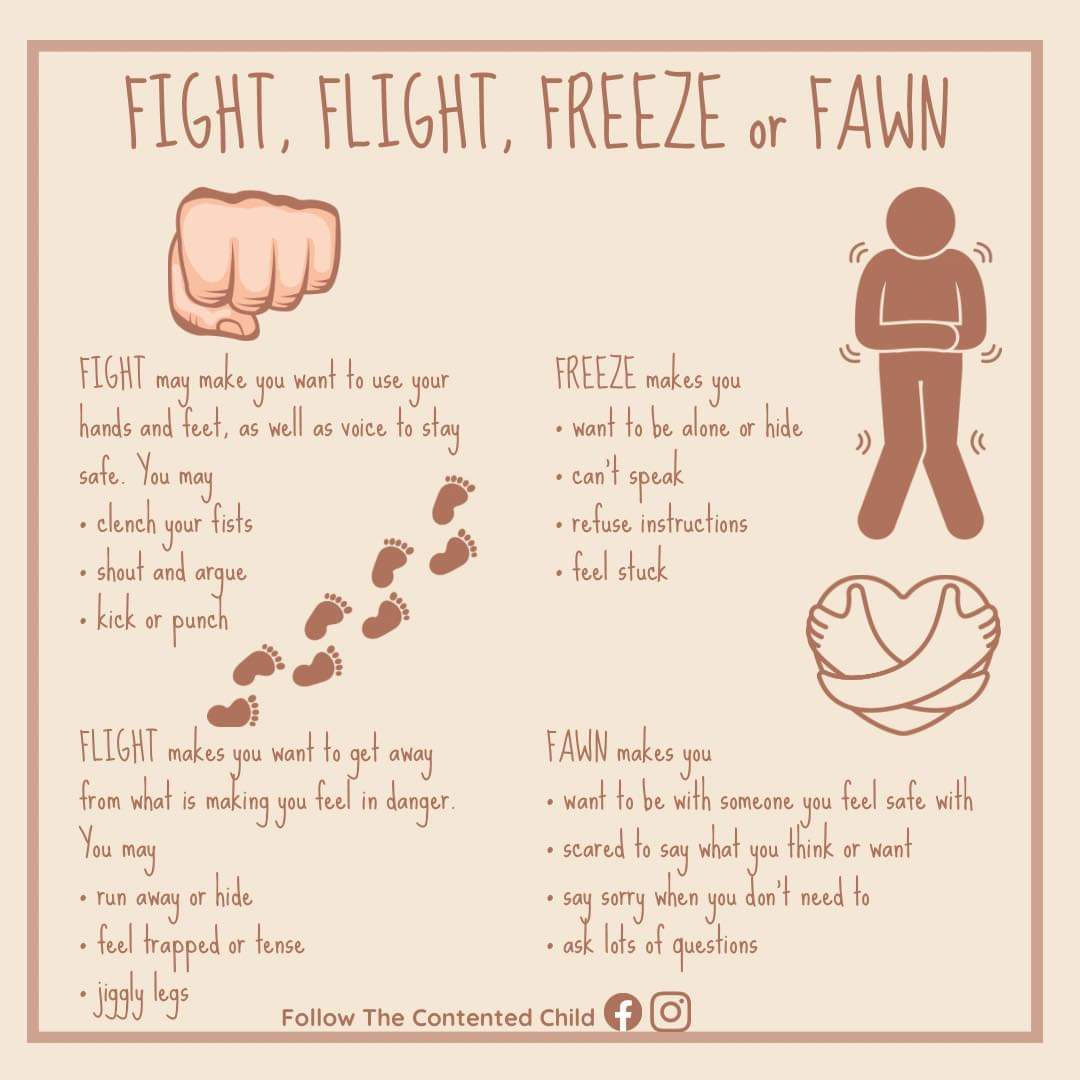
The edu behaviourists wouldn't understand this because they dismiss science.Our brains & nervous systems are related in relationships,we affect each others nervous systems. Our brain is a social organ also affected by relationships. How others act on us impact our physiology.🧠🌱
2. Environment is Everything
When I am surrounded by people who are stressed, unstable, volatile, and unpredictable, my body is going to respond to that environment.
Feeling anxious, overwhelmed, and on edge is the PROPER response of my body - not a disease.
Stop listening to Gabor Mate.
This is what Big Pharma wants you to think.
Studying Gabor Mate's work for the last 5 years helped me overcome anxiety and trauma, and changed my life (and helped dozens do the same).
Here are the 7 transformational concepts I learned from him:
The human brain can't learn if it's stressed or afraid,basic neuroscience.
A childs well-being & how they manage stress in the classroom environment is really important.
Create an environment of regulation.Power in little relational moments & they will feel your presence🧠🌱