Compute should start with the workload.
For research and AI teams, the first question is simple:
What are you trying to run?
From there, everything else should follow: the environment, the tools, the GPU access, the storage, the controls, and the workflow around it.
That is the direction we are building toward with AxonOS.
A more practical path from research workload to usable compute environment.
> be in crypto for 7 years
> get in for the cypherpunk stuff
> self-custody, no third party, "decentralization"
> watch lazarus drain $290m from kelp
> watch arbitrum move $71m of it out of the attacker's wallet
> without his private key, without his signature
> not a "freeze"
> it was a transfer. from someone's wallet. that the owner didn't authorize.
> start wondering what "decentralized" was actually supposed to mean
"so you staked your ETH on the Ethereum blockchain to earn yield?"
"yes, Dave"
"except you didn't want your capital to be locked up so you actually staked it with a liquid staking protocol called Lido?"
"that's correct, Dave"
"and Lido gave you a liquid staking receipt token called stETH in return?"
"yes, Dave"
"and then you didn't think that was enough, so you juiced the yield even further by depositing your stETH receipt tokens into a restaking protocol called Eigenlayer?"
"you are correct, Dave"
"and now you didn't want to lock up your capital, so you actually restaked with a liquid restaking protocol called KelpDAO who provided you with a liquid restaking receipt token called rsETH?"
"you got it, Dave"
"and then that was surely not enough juice, so you then deposited your rsETH tokens into a lending protocol called AAVE so that you could open a leveraged looping position that borrows ETH against the rsETH collateral and restakes the ETH into rsETH which is then deposited as collateral, except it turns out rsETH used a cross-chain bridge called LayerZero whose security is held together by a 1/1 toothpick, which was obviously hacked by north koreans causing rsETH to become undercollateralized and now these looping positions are stuck and unprofitable, and everyone is pointing fingers at each other, and also DeFi is a very serious industry"
"you are 100% correct, dave"
jfc.
This validates our existing thesis:
AI will be central to science, but its impact depends on researchers having simple access to compute, the right models, and infrastructure they can actually use.
That is the direction AxonDAO is building for.
AxonOS is now in private beta.
We are inviting qualified researchers to join the first test cohort and early grant pipeline.
Selected researchers may receive free initial compute grants on the first V100-backed stack as part of the initial rollout.
Apply here: https://t.co/kjKuVSMLq1
Trump failed crypto today.
Our politicians failed us today.
The entire industry showed up for him funded, supported, pushed for U.S. innovation and when it actually mattered, he folded to the same big banks crypto was built to replace.
Let’s be honest about what just happened:
Stablecoin yield was becoming real competition. Real alternatives. Real financial freedom.
So they killed it.
Not for “consumer protection.” Not for “risk management.”
But because it threatens a system that survives on control, fees, inflation, and gatekeeping.
Traditional banking doesn’t win in a free market so it rewrites the rules.
And Washington just proved exactly who they work for.
Meanwhile, politicians somehow outperform markets, insiders get rich, and we’re told this is all for our benefit.
Short term?
DeFi gets hit.
Projects die.
Innovation leaves the U.S.
Long term? You can’t stop open-source.
You can’t kill decentralization.
But today was a reminder:
They don’t want competition.
They want control.
Fuck every politician who sold out to big banks instead of protecting consumers.
NVIDIA @NVIDIAGTC has no shortage of big announcements.
But underneath all of that, the real story is still about compute, infrastructure, and what it actually takes to run serious AI and scientific workloads.
@Chris_AxonDAO and @greg_buron are on the ground this week, listening closely, and spending time in conversations that go beyond the conference floor.
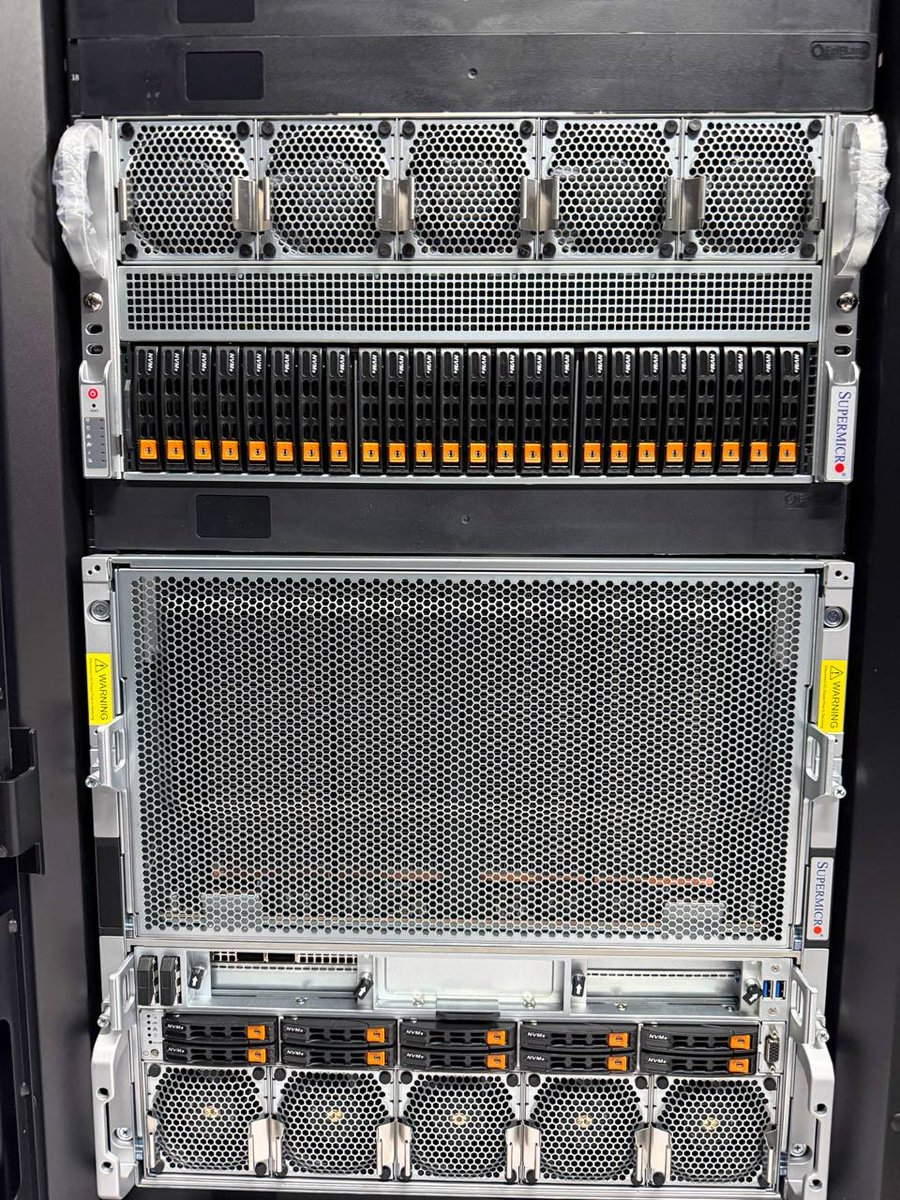
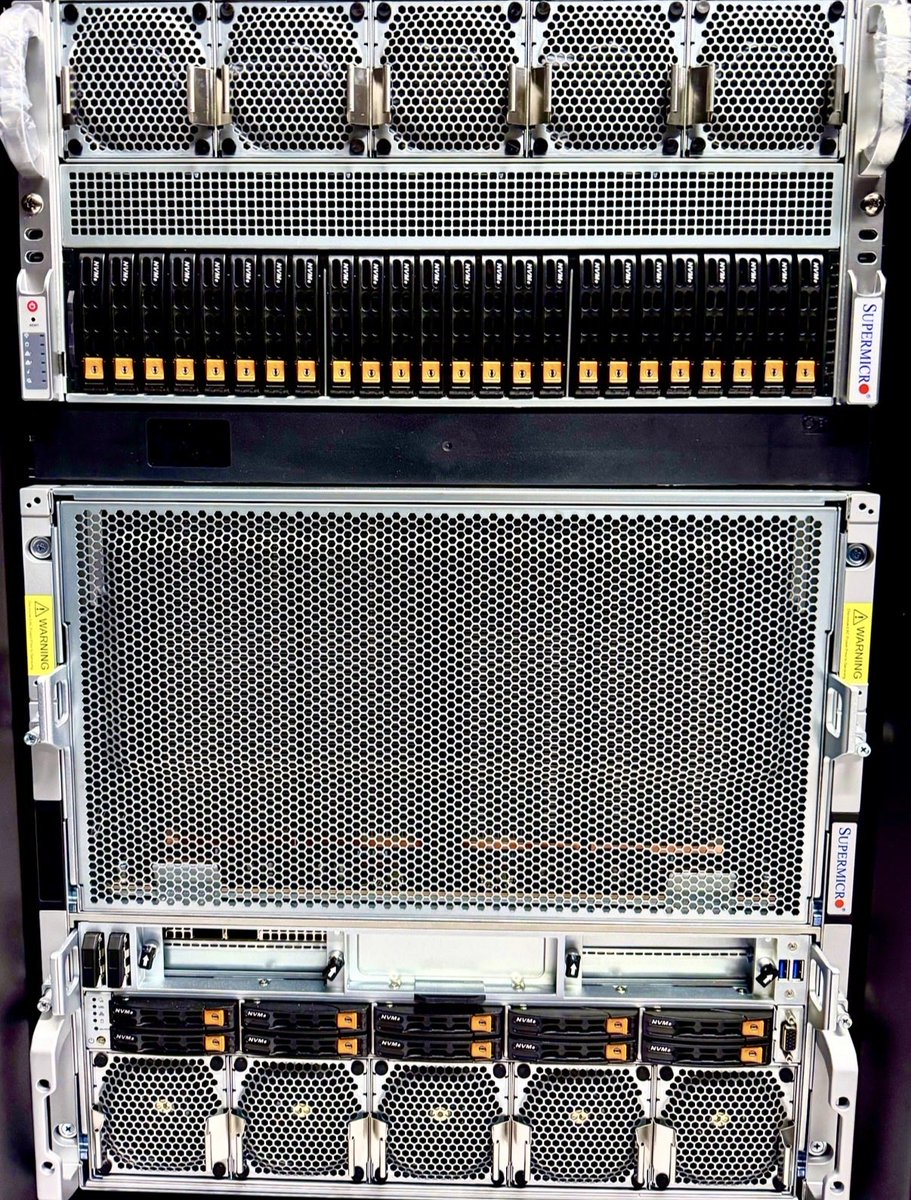
You’re looking at @AxonDAO’s brand new @NVIDIA Blackwell-generation AI cluster “brain.”
16x brand new GPUs total:
• 8× HGX B200
• 8× RTX Pro 6000
• ~2.2TB GPU VRAM
• ~3.8TB system RAM
These were custom built on the latest @Supermicro infrastructure by the experts @ICCUSA
Comparisons:
• Early ChatGPT AI models were trained on NVIDIA V100 GPUs (~125 TFLOPS each), while a single modern B200 delivers roughly 10–12× that compute in one chip.
• For more perspective, 2.2TB of GPU memory is roughly the working memory of about 100x new laptops or more than 1,000x smartphones.
• In 2018 would likely have required ~80–100 V100 GPUs costing roughly $ 1.5M–$3M in hardware alone.
Now in 2026, the need for sovereign AI is more than apparent than ever, add personal data valuation, and you now have the elements for DeSci to thrive.
$AXGT $ETH + Utility
Note: the plastic wrap on the handles, we couldn’t make ourselves tear it off yet.
It’s live.
AxonDAO’s GPU fleet is installed and will soon be rentable on the open market via @vast_ai.
Premium GPU capacity - 8x NVIDIA B200 and 8x RTX Pro 6000 - built for large-scale AI training, inference, rendering, and research workloads. 🧵
I've never seen crypto sentiment this bad.
And I've been here through it all:
📉 2018 bear market - Bitcoin fell 85% ($20K → $3K)
📉 COVID crash - 70% drop in days ($10K → $3K)
📉 2022 collapse - LUNA imploded, FTX went bankrupt, BTC fell 76% ($69K → $16K)
Every time, altcoins were down 90–98%.
Every time, timelines were full of fear.
Every time, people said crypto was finished.
But there was always some hope left.
A small group still preaching patience.
Still talking about the next cycle.
Still believing recovery was inevitable.
This time feels different.
Not because fundamentals are worse - but because the belief is gone.
I look around and barely see mid or long-term bulls anymore. Retail disappeared. Altcoins have bled for over a year. ETH never made a new high. Liquidity rotated into institutional Bitcoin bids while everything else quietly died.
That's why, in my view, the bear market already started with the altcoin top in Dec 2024 / Jan 2025.
And we're closer to the end of it than the start of it. That’s what gives me the most confidence.
Markets bottom when people are exhausted.
When nobody wants to hear bullish arguments anymore.
When conviction feels lonely.
The worst part of the cycle doesn’t feel dramatic - it feels silent.
And right now, all I hear is crickets...
People will be kicking themselves soon👀
$AXGT is now 2+ yrs old... They've been through hell and back, YET, they just stepped it up a notch..
8x NVIDIA Blackwell B200s and
8x NVIDIA Blackwell RTX Pro 6000s
@AxonDAO ganna blaze the Decentralized science trail! $1+ INCOMINGGGG!
How @AxonDAO GPUs will liberate Science:
1. Industrial-grade GPU clusters power large-scale simulations, training, and bioinformatics workflows.
2. A portion of the compute is continuously allocated to generate sustainable funding for research and governance.
3. Researchers focus on analysis, validation, and breakthroughs - not infrastructure or funding gaps.
4. The system sustains itself. The cycle scales.
#DeSci #AxonDAO
Health data is one of the most valuable resources people often don’t realize they should have more control over.
Pharma companies spend heavily on real-world data to support research and development.
Insurance models are shaped by health risk signals.
Tech platforms extract value from data at scale.
How much of that value flows back to the individual?
Often, very little.
DeSci is trying to build a different model, where data contributors are stakeholders, not just sources.
Compute is becoming a bottleneck in modern science.
In many fields, it’s not that ideas or talent are missing.
It’s that serious work increasingly depends on access to GPU infrastructure and the ability to iterate quickly.
When compute is scarce or concentrated, discovery slows.
AxonDAO is building toward a world where access to serious compute is less gated, and more researchers can run real workloads without waiting in line.