Field notes with worked examples on a goal engineering workflow I've been running and am excited about: instead of writing prompts & specs, I now focus on two checked-in markdown artifact per round of work.
The "goal" is capped at 4,000 chars (the same limit Codex's /goal command enforces). The "rider" is unbounded, with +/- eleven phases and named depth tests. I write them via a Skill included in the article. Looking for long running agentic turns, this is for you.
https://t.co/avLrfgZVjb
/teach is live
Learn anything, from rubik's cube to vocal harmonies to software fundamentals.
npx skills add mattpocock/skills --skill teach
Best skill I've ever built, video coming soon
https://t.co/GAv1jBFwsX
Respectfully disagree with Brian here, primarily on the skill claim.
"Exactly the same amount of skill" only works when you assume a session either teaches or it doesn't, and that working with an agent lands on "doesn't." That's not argued and just defined upfront in the premise.
Steering agents well has a very high skill ceiling, and learning to do it is non-trivial. It takes reps (volume) and the Socratic method (quality): a cooperative dialogue aimed at falsifying assumptions both yours and the agent's. Done well, it can absolutely
1. Sharpen your requirements
2. Surface how well you actually know the problem and where you don't
3. Improve quality
"More code, no smarter" is also a false trade because code output and understanding aren't zero sum. The output of a GREAT session might not result in any code but a sharper grip on the problem.
The simpler read on this meta problem is that the usage of tools (and people) will optimize for the task you're paying them to do. Whether one walks away smarter is mostly a choice left to the individual.
When your engineer finishes a session with a coding agent, they have more code than they started with and exactly the same amount of skill.
The agent produced output. It did not produce understanding.
You paid frontier prices to make your codebase bigger and your engineer no smarter. That is not an accident. It is a design choice, and it is worth remebering who it serves.
So many parallels to much of my own experience over the last two years. Not super voice pilled yet. But this near-to-last "hack" has become the most important.
This game was vibe coded in 2 days - INSANE how far we’ve come
Model used: muranyi-3: https://t.co/imHOUYRZXy
- Prompts: 39
- Token usage: $90 (so far)
- Starter prompt:
First world prompt for the game:
“Create the Foundation for a third-person 3D high medieval fantasy set in a mountainous open plain with a distant castle landmark.”
First prompt to make the character:
"Okay, I wanna start building a new game and just figuring out a really awesome character to start. A hooded purple wizard with a world-class third-person player and movement system. Decoupled camera versus walking direction, with jogging and walking in all directions with the camera behind the player.”
Tip from our best builders:
Start with 3 to 4 prompts just planning. Tell the AI what your game is, the core loop, the vibe, the genre. Don't rush into building yet. Let the model scope it out with you first.
Once that first output lands, that's when you start iterating. Tweak the animations, shape the world, adjust the UI, dial in the details.
The best games on Tesana aren't built in one prompt. They're built in one conversation.
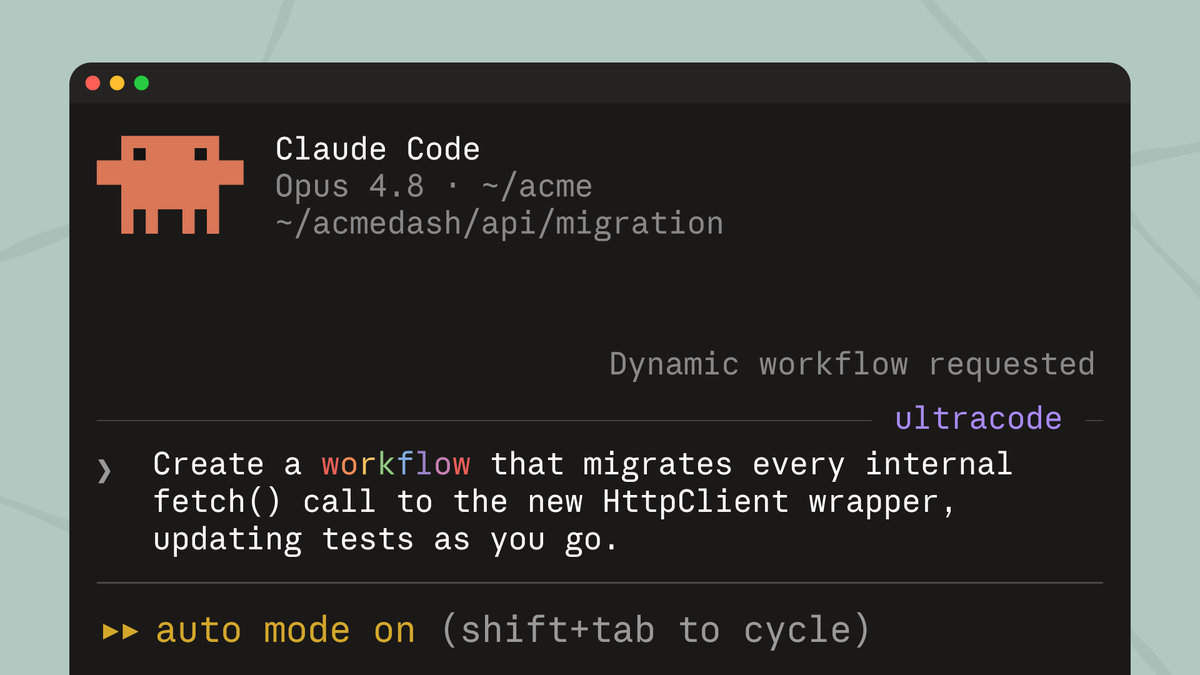
New in Claude Code (research preview): dynamic workflows.
Claude writes an orchestration script on the fly, then spins up a large fleet of coordinated subagents in parallel to take on your most complex tasks.
Use the word "workflow" in a prompt to get started.
@rauchg https://t.co/H4CTd1RKaY a realtime multiplayer build room where product teams ship from conversations. Humans and agents edit the same surface live, CRDT-synced to all locals with full version history and provenance. Built on Vercel.
Primarily Opus 4.6/4.7 and Codex 5.4/5.5.