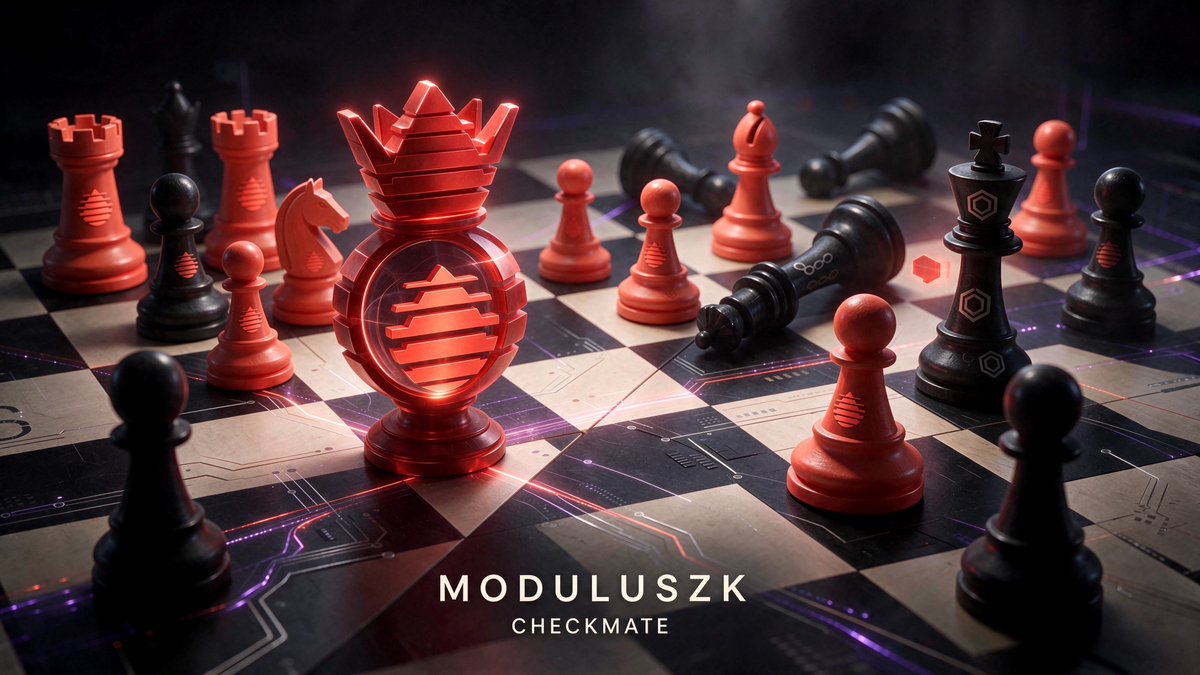
$CULT is relaunching as $ZKFOL
Holders are asked to migrate $CULT 1-for-1 via https://t.co/kIYLEqXqEZ.
Trading of $ZKFOL starts 24/11/26 & will be announced here.
Only trust info pinned on @wearecultdao or https://t.co/l2Qcr9yXCQ.
More info in Medium article in first reply👇
$CULT @ModulusZK zero-knowledge
We move in silence, through the wake.
Of the wilful ignorance, they cultivate.
Whilst from their shadow, our reckoning waits.
They will only hear, once I speak "CHECKMATE."
Dr. Murdoch J. Gabbay’s #zkFOL is exactly that stronger cryptography you are talking about @EliBenSasson
By arithmetizing first-order logic directly into succinct polynomial proofs, it delivers verifiable, high-assurance certificates at speeds and resource levels orders of magnitude better than traditional #zkVM s.
All while staying transparent and post-quantum friendly.
THIS IS how we stay ahead of AI-driven advances in math.
@ModulusZK the contract IS the specification.
documentation: https://t.co/n3yjif0CPL
github: https://t.co/xwGaQqMYKy
Give it a Try.
⭐️Imagine two ways to prove a kid did their math homework correctly.⭐️ $CULT
⭐️Normal zkEVM way⭐️:
You have to film the entire process. You prove the kid used the right pencil, sat at the right desk, followed every single step of the teacher’s instructions, and that the calculator’s little gears all spun the right way for every button press. You prove the whole *machine* worked, not just the answer. That’s slow, heavy, and expensive .... like carrying a whole classroom around just to check one equation.
⭐️@ModulusZK zkFOL (zero-knowledge first order logic) way⭐️:
You just write the simple rules:
“The answer must equal 2 + 2,”
“the number must be positive,”
“nothing else is allowed.”
Then you only prove those few clear rules were followed. No filming the pencil, no proving the calculator’s insides, no extra machine. The proof is tiny, super fast, and works on a normal laptop.
That’s the big idea. A traditional zkEVM has to re-prove an entire virtual computer running your code. zkFOL skips the computer altogether. You write what *should* be true in plain logic (like “this trade is fair” or “this balance is correct”), and the system turns those rules straight into a proof. The blockchain only checks that the rules hold ... it never has to re-run the program.
Same goal (prove the right thing happened), but way fewer steps in the middle. Like checking the final score of a game by looking at the rulebook instead of replaying every second of the match.
While you were being distracted Our dev was building and we were supporting... What is ZkFOL?
The five-year-old version
A smart contract today is really two things. There is the promise, written in words: “this vault only pays the owner.” And there is the program, written in code, that is supposed to keep the promise. Hackers live in the gap between the two. Almost every big crypto hack is a program doing something its authors never meant.
On a zkFOL chain there is only the promise. You write the rule in logic. To change anything on the chain, you bring a proof that the rule was obeyed, and the network checks it in milliseconds. If you cannot make the proof, nothing moves.
What it does to blockchain
Audits get simple. The contract and the specification are the same document, so there is nothing for the code to drift away from. You audit the rule, and the rule is exactly what gets enforced.
Bugs stop draining wallets. A transaction that breaks the rule cannot be proved, so it never happens. The team finds out because something stopped working, and the funds are still there. Reentrancy, the bug class behind The DAO hack, has nowhere to occur because nothing executes on chain.
You know the price before you press send. A rule has a fixed size, so its fee is fixed. No metered gas.
Proving gets cheap, and that resets the ZK sector. ZK chains and rollups today pay heavily for proofs. Mina had to build a marketplace where block producers buy them. Rollups run proving clusters. zkFOL measured around 1,000x faster than RISC Zero and 3,450x faster than SP1, in megabytes of memory on a normal desktop. Block producers need no specialist hardware and no paid market in proofs. Mina needed a marketplace. We do not.
Machines become users of the chain. A sensor, a drone or a car can carry its own prover and post a fact with a proof that it ran the agreed computation on what it saw. Oracles today are trusted messengers. Here the device brings its own evidence.
Regulated money gets an enforced rulebook. Transfer limits, investor eligibility and jurisdiction rules become the contract itself. The regulator reads the rule and checks the proofs. Private state with public verifiability is where the chain starts, because those applications cannot be built anywhere else.
First they call you crazy, then they fight you, then you change the world 🩸🩸🩸
It all started with ethereum:0xf0f9d895aca5c8678f706fb8216fa22957685a13 https://t.co/vZB1uApIQ3 the hyperdeflationary gas token of @ModulusZK and will end with ZkFOL
#TalkAboutCult #TalkAboutModuluZk #TalkAboutZkFOL
The next evolution of DeFi may be PRIVATE state with PUBLIC proof.
Imagine financial transactions proving they meet spending limits, eligibility and jurisdiction rules without exposing every detail.
That’s the vision behind @ModulusZK and #zkFOL.
#DeFi#ZK#RWA#CULT