The AI build-out in three numbers: $4.6T of hyperscaler capex 2022-2030, 120 GW of capacity by 2030, and roughly $2.6T a year of end-market spending needed to pay for it.
Our new BCG Institute paper on who pays, and why we think it's feasible.
https://t.co/bgwWhWYSe6
Anthropic’s best available models cannot do the job of an entry level consultant. They can do bits and pieces of the job, but they can’t do the job. And critically: the models don’t learn and hence can’t go from “entry level” to “experienced” in 1-2 years which is essential for our structure. We haven’t cut entry level hiring targets.
How do enterprises get to $1.8 trillion of AI spend by 2030? Our new BCG Institute paper models it worker by worker (chart below).
Coding is the killer use case today, and tech workers are the heaviest users. An onshore tech worker at a tech company comes in at about $21,200 a year. But the bulk of the TAM sits elsewhere. In the model, knowledge workers at nontech companies account for more than half of total enterprise spending (33.4% onshore, 19.2% offshore), at just $1,750 and $900 per worker. By our math, about 96% of knowledge workers in the model sit outside tech companies.
Three things stand out.
1) The spend per worker is reasonable. Blended across those two groups, it's about $1,300 a year, or roughly 2x today's Microsoft 365 E5 license ($60 per user per month).
2) It requires a shift in usage. Getting there means much greater usage, and value, from the typical knowledge worker, not just from developers. Heavy AI usage has to diffuse well beyond the technology industry.
3) That shift requires an evolution of harnesses. Coding took off because developers got harnesses built for how they work. Finance, legal, operations, sales and service will need many more fit-for-purpose harnesses of their own. The enterprise software industry can play a critical role in building them.
Paper: https://t.co/4B97aSPKyO
Why did prior infrastructure booms destroy equity? Our new BCG Institute paper lays out the pattern (chart below). High fixed costs, demand that arrives later than forecast and redundant capacity lead to price wars. Add heavy debt, and revenue falls before demand can absorb the asset base. Bankruptcies follow, and new owners pick up the assets cheaply.
AI shares some of that structure. What may be different this time comes down to three things.
1) Distribution and demand elasticity. Railroads and the early internet both had limited distribution. When supply exceeded demand and prices fell, as they do with low variable costs, there was no pickup in demand to match the lower prices. AI distributes through the global internet and mobile networks, which creates real potential for demand to respond as prices fall.
2) Debt levels. In 2000, telecom gross debt issuance was about 67% of capex. For the five largest hyperscalers, 2026 issuance is forecast at about 34%. Railroads in the 1880s were about 98% externally financed. Hyperscalers are borrowing, but far less of this buildout depends on it.
3) Who is building. About 75% of the AI build is expected to come from established, cash-flow-producing hyperscalers. In 2000, established operators accounted for only about 58% of telecom investment, and new entrants for the other 42%. Those entrants depended on outside capital. Level 3 and Global Crossing, for example, generated operating cash flow equal to only about 7% of what they spent on capex.
In the end, if an oversupply occurs, all that really matters is the elasticity of demand for intelligence and the cost of debt that the revenue needs to cover.
Paper: https://t.co/4B97aSPKyO
Goldman just blocked Claude code access for all employees that aren’t professional devs or quant traders. Why?
Citizen development is: expensive, not scalable, often redundant, vulnerable to cyber attacks, not maintainable.
I am sure some small businesses and entrepreneurs will do this. The enterprise trend is moving away from it.
Of course, dev teams in enterprises will continue to build.
@BrodyFord_ Hyperscale infra requires fewer heads per dollar than entperise software. But I can count the number of hyperscaler infra players on one hand. Don’t extrapolate this to the rest of tech please.
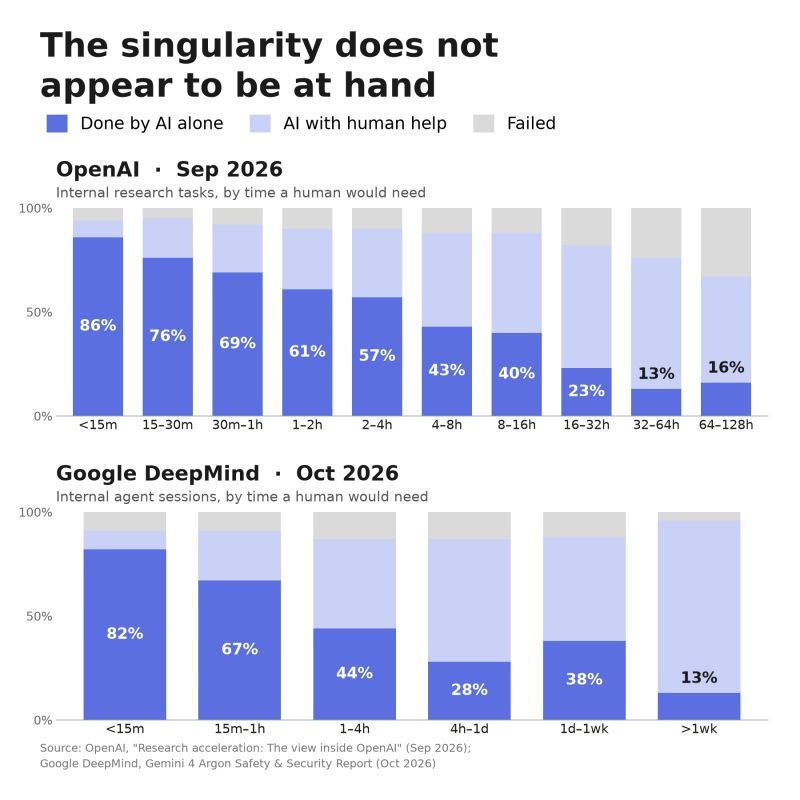
Every extremist AI perspective, from p(doom) to the jobpocalypse, requires AI to run long-range autonomous work outside the very narrow set of domains that are rapidly verifiable.
Recent publications from OpenAI and Google covering their path to RSI show just how hard this is, even with internal, non-commercial frontier models.
OpenAI: "Agents still require significant human steering to be successful, especially as task complexity rises."
Google DeepMind: "While the share of fully delegated pull requests increased from 7.5% in April to 11.9% in September 2026, about 88% of pull requests still require iterative multi-turn human steering or human code authorship."
The singularity does not appear to be at hand.
Great to see an official public filing basically show that all the alternative data being floated around X for the last 6 months is horseshit. Concentration isn’t all that high, frontier models have very high usage, margins are healthy, etc
@danwilliamsphil@NateWitkin “My buddies and I are the smartest people I know. We’re really good at math and coding. But we could easily do any white collar job since we’re so smart. The AIs are really good at math and coding. Therefore…” -your average ai researcher, probably
@1MainCapital@stevehou@GavinSBaker@MI_Investments Eh. Assuming high demand elasticity, model companies can significantly cut gross margins on their models while still funding their training costs. Airlines have a fixed number of seats per plane. This is where your analogy falls apart.
The premise that "AI must translate to higher revenue per FTE, or else we're in a bubble" is divorced from the reality of business.
Competitive dynamics, consumer surplus, employee surplus and lagged impact all mean that higher productivity doesn't necessarily show up as higher revenue per FTE.
Three examples:
1) A hospital rolls out Abridge. Doctors focus more on their patients during visits. They spend less of their nights and weekends on notes, and have a better quality of life. But the hospital can't charge more per patient, see more patients per hour, or cut doctors.
Consumer surplus. Employee surplus.
2) A law firm rolls out Harvey. It can't do an associate's job, but it helps the associate work faster, so they get more done in a billable hour. There is always more law to do. A senior partner proposes raising the hourly rate. A junior partner points out: "All the other firms have AI too, and our clients expect us to do more."
Consumer surplus. Competition.
3) A consumer goods company uses Listen Labs to increase the volume, frequency and depth of its consumer research. It spots a new product opportunity and gets to work building it. The product launches in late 2027.
Lagged impact.
None of these would show up in revenue per FTE this year. All of them are real value.
1) If market is supply constrained, market share will track compute. Big labs continue to lock in compute. As demand scales, they may choose to shift compute from training to inference and bring down GM on inference to compete with ow.
2) don’t discount how many enterprises don’t want Chinese models in their stack. US ow still in infancy.
1) badge for office entrance (maybe you don’t need one but people work in an office)
2) drivers license (you don’t drive but other people do)
3) air travel (tsa does not accept digital ID at all airports)
4) atm (yes there are some ppl out there that really want you to pay in cash)
5) corporate credit card (many are not compatible with apple wallet)
What matters is GM dollars per FTE.
You can be low (but positive) gm% if you are PLG and spending very little on sales and support. These are the high rev / FTE businesses.
If you are running enterprise sales and support and running sub 50 GMs (and declining) on mature client relationships you don’t have a business, you have a channel for VCs to subsidize your customers’ intelligence.
@ramez@econcallum@I_Am_NickBloom It’s cogs, not opex. Ai native companies are spending 10x the tokens on cogs that they are spending on opex. Opex is mostly coding of course.
@econcallum@I_Am_NickBloom Most spending is cogs not coding / opex. Cogs then gets redistributed to market. Harvey + Legora by definition route nearly all legal ai inference through their platforms. Hence concentration. It’s business structure not a problem.