this is f*cking insane. andrej karpathy: "the biggest regret of every engineer in my field right now is every AI conversation they never saved, and in 10 years the ones who started saving in 2024 will be running circles around the rest of us"
andrej karpathy, co-founder of openai, pulled 16M views on one idea: stop using AI to write code, use it to build a second brain that remembers every article, pdf, transcript and conversation you ever fed it
you point claude code at a folder, drop anything into it, and claude reads it, cross-links it with everything already there, and writes it into a living wiki. your knowledge finally compounds instead of leaking out of your head every friday
the stack:
→ brew install obsidian, mkdir ~/vault, cd ~/vault
→ run claude in that folder and type "init a knowledge vault with CLAUDE.md as the rules, /raw for sources, /wiki for your pages"
→ drop any file into /raw (youtube transcript, meeting notes, 400-page pdf, screenshot of a tweet) and type "ingest"
→ claude writes a wiki page, links it to 5 existing ones automatically, updates CLAUDE.md with any new pattern it noticed about how you think
→ never open a blank claude chat again. every question goes through the vault, every answer cites your own sources with dates and links
5 minutes to set up. compounding knowledge from that evening forward
the ugly part most will scroll past: in 10 years the engineers who started this in 2024 will remember every book, every podcast, every meeting with receipts. you will remember none of them. karpathy already picked which side he is on and you are still not on his
full step-by-step is in the article below
bookmark this before you waste another monday
Buckminster Fuller, who was wrong about a lot of things in a way that was usually more interesting than other people being right, noticed something in the 1930s that still holds true.
He noticed that technology does not primarily get bigger. It gets thinner.
The transatlantic cable got lighter per unit of message. The building got lighter per unit of enclosed volume. The engine got lighter per unit of horsepower. Each generation of a technology tends to accomplish the same function with less stuff, and then with less stuff again, until at the limit the stuff approaches zero and only the function remains.
He called this ephemeralization : doing more and more with less and less until eventually you can do everything with nothing.
And here were it gets interesting. What got eaten, in the first wave, was objects: my door key became a fingerprint.
What's happening today is the second wave: the AI paradigm shift. It’s our thought patterns, our decisions, our generative processes, our creativity, and our communication and coordination with each other that is being ephemerized.
And I think judgment abstraction has two consequences.
First, the output is not checkable at a lower cost than producing it. To verify a summary you must read the document. To verify a strategic recommendation you must do the strategy. The thing that made calculators safe (verification being orders of magnitude cheaper than generation) simply does not hold for the class of work being absorbed now. Which means verification won't happen because the economics forbid it. A check that costs as much as the work is not a check. It's a second attempt.
Second, the stairs are being removed as a consequence of using the lift. The way you stay able to judge a draft is by having written drafts. The capability is maintained by its own exercise and by nothing else. So the fallback and the thing it's a fallback for are the same muscle, and the system that replaces the muscle also stops the training.
This is Lisanne Bainbridge's irony of automation, which she wrote down in 1983 and which the aviation industry spent the next forty years rediscovering at great expense: automate the easy 99% and you have designed a job where a human with no recent practice must handle the hardest 1% with no warm-up, at the worst possible moment, on the basis of a mental model the automation has been maintaining on their behalf.
Airlines eventually responded by mandating hand-flying. No knowledge-work organization on earth currently mandates hand-thinking.
In 1951, Adelbert Ames created the mind-boggling ‘Ames Window’. It’s so effective that even when you know how it works you can’t break the illusion
[📹 The Curiosity Show]
Churchill could have shortened WW2 by years if he had just “done a deal” with Hitler. George Washington could have done a deal to end the American Revolution. Zelenskyy is in good company.
I finished reading Registration (2026), a novel by exiled Russian writer Dmitry Glukhovsky @glukhovsky.
If you want to understand Russian literature in the 2020s, this is the book for you to read. Glukhovsky’s Registration is probably the most talked-about Russian novel of the year, despite not being sold at Russian bookshops. The Russian state designated Glukhovsky as a “ foreign agent” in 2022 and sentenced him - in absentia - to eight years in prison in 2023 for his anti-war public statements. Instead, the author released the novel online for free, making it accessible to readers inside and outside Russia. It has sparked an extraordinary wave of discussion, although reliable readership figures are unavailable as of yet.
And this is the case for a good reason: Registration is a bleak, disturbing and politically charged portrait of contemporary Russia - a society in which war has become not just a national undertaking but an economic opportunity, and where moral boundaries are increasingly blurred by greed, fear and opportunism. The story centres on a young pregnant woman from the impoverished Vologda region in northern Russia, desperate to marry her boyfriend, a Russian soldier fighting in Ukraine, to secure access to the financial benefits available to military families. His mother has competing interests, turning what should be an intimate family drama into a ruthless struggle over money. Through this premise, Glukhovsky exposes the grotesque economic incentives created by Russia’s invasion of Ukraine, particularly in poorer provincial communities, where military service offers one of the few opportunities for substantial financial advancement - and where a soldier’s death can become more financially rewarding to his relatives than his survival. Russian economic geographer Natalia Zubarevich calls Russian military widows “town-forming enterprises” as she points to the fact how they reshape economic realities on the ground in the Russian provinces.
The novel’s greatest strength lies in its portrayal of the moral degradation and profound atomisation of Russian society. Glukhovsky paints a country where social solidarity has largely disintegrated, interpersonal trust is nearly non-existent, and individuals are left to navigate an increasingly brutal system on their own. Even family relationships, supposedly the last refuge of mutual support in any society, have become transactional, poisoned by competition over money and state benefits.
His characters are not particularly sympathetic, but that is precisely the point: they embody a society in which individual survival, material gain and moral indifference have displaced collective responsibility and empathy. This atomisation also helps explain the apparent paradox of contemporary Russia: widespread private dissatisfaction can coexist with political passivity, as people remain isolated, distrustful of one another and incapable of collective resistance.
Effectively, Registration is an indictment of the society sustaining the war against Ukraine. Unlike Glukhovsky’s dystopian fiction, its horror requires no imaginary future: it emerges from the realities of present-day Russia. The contrast between the poverty of the provinces and the enormous sums the state is prepared to pay for men - both Russian and foreign - to enlist and take part in its war makes the story particularly unsettling. Glukhovsky suggests that the war is not merely destroying Ukrainian cities and Russian lives but further corroding the social and moral fabric of Russia itself. The novel offers little hope of redemption: its bleakest insight is that a deeply atomised society, in which people increasingly see one another as competitors rather than fellow citizens, may be particularly vulnerable to authoritarian manipulation and prolonged militarisation. When people adopt a “dog-eat-dog” mentality, society sets itself on a path towards self-destruction.
What happens when a single day of AI research produces more mathematics than humanity can absorb in a century?
Imagine millions of superhuman research agents at work. Formal systems may verify the proofs, but humans won’t have enough context to understand the underlying web of machine-invented concepts.
Mathematics could split into two layers:
Machine mathematics: vast, verified, mostly consumed by AIs.
Human mathematics: a compressed “effective theory” of the machine frontier—the small subset of ideas we can understand.
Physics may follow the same path: AIs could explore huge spaces of theories and derive correct predictions using structures no human physicist fully understands.
The key question is whether AI can compress knowledge as fast as it creates it.
My guess: the detailed frontier becomes permanently machine-native, while selected parts are periodically compressed into human-comprehensible principles.
Eventually even deciding what is worth understanding may require AI.
At that point AI is no longer just a scientific tool. Humans are receiving selected explanations from a much larger intellectual civilization they cannot independently grasp.
Just your annual reminder to raise a glass to Stanislav Yevgrafovich Petrov who on this date in 1983 saved your life when he decided to wait for evidence in stead of passing on the message that could have caused armageddon.
https://t.co/mOIuoAkxL6
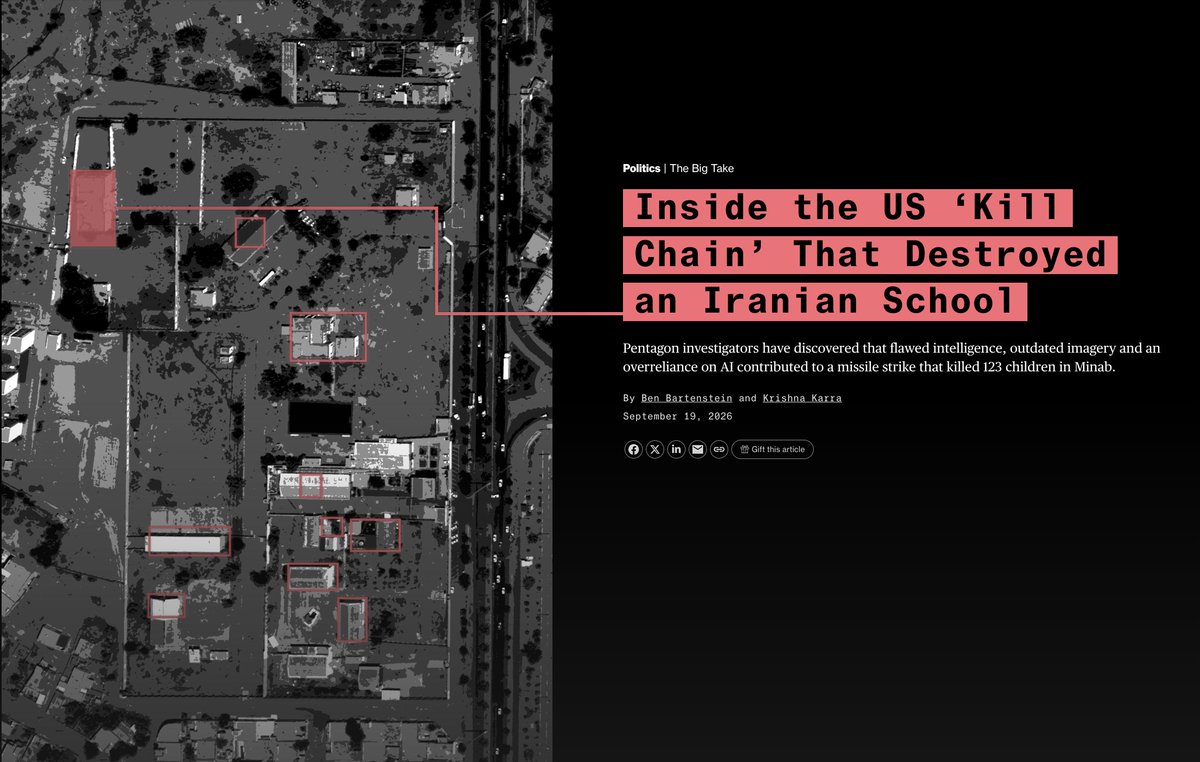
Bloomberg just dropped the most disturbing investigation I have read this year, and every AI builder should read it and take it seriously.
On February 28, two Tomahawk missiles hit an elementary school in Minab, a small town in southern Iran. 156 people died. At least 123 were children. The Pentagon knew within hours that it had bombed a school.
The school had its own website. It was labeled on Google Maps. You could see the soccer pitch from a satellite view. You could see the brightly painted walls. Any 12-year-old with a browser could tell what the building was.
The AI system could not.
Inside US Central Command, personnel were using Palantir's Maven Smart System. It is an AI targeting platform running on a $1.3 billion Pentagon contract, and embedded inside it is Anthropic's Claude.
On day one of the war, more than 1,000 targets went through it in 24 hours. Work that used to take a team hours per target got compressed into minutes.
The satellite imagery Maven was pulling from was seven years old. The site was still tagged in the database as an Islamic Revolutionary Guard facility.
The system spat it out as a recommended day-one target. Humans signed off. The first missile flew. Then a second one landed minutes later to hit the people who came to help.
Investigators later found that some Central Command staff had assumed Maven would flag stale intelligence for them. It did not. Nobody had told it to.
Palantir told Bloomberg the government is responsible for the underlying data. The Pentagon's civilian harm mitigation team, the people whose actual job is to catch a target like this, had been cut back before the war started.
This is not AI going rogue. This is the opposite.
This is AI doing exactly what it was built to do at exactly the speed it was built to do it. And a school full of little girls got vaporized because the humans in the loop trusted the machine more than they trusted their own eyes.
I keep thinking about the version of this story that comes next. What happens when the system is faster. When the target list is not 1,000 in a day but 10,000. When "review" becomes a button the operator has three seconds to hit before the next target loads. When there is no human left slow enough to notice that a soccer pitch is not a helipad.
We are not talking about a spam filter mislabeling an email. We are talking about a system that turned a seven-year-old database entry into two cruise missiles landing on children in the middle of a morning class.
A UN-backed panel has now called it a potential war crime.
In terms of children killed, it is the deadliest American targeting error of the entire 21st century. And according to Bloomberg, some of Defense Secretary Hegseth's own advisors are worried that too much public scrutiny of Maven might slow down its adoption inside the Pentagon.
Read that last line again.
If you build this stuff, you own what it does. You do not get to hide behind "the government owns the data." The whole pitch of your product is that speed and integration save lives. When it takes them instead, that is also on you.
I am not against AI in defense. I am against AI in a hurry. Speed is the entire mechanism that made Minab possible. Every guardrail we already know how to build takes time, and time is exactly what the system was designed to eliminate.
So here is the question I have not been able to stop asking, and I genuinely want to know what you think.
If a piece of software helped kill 123 children in a single morning while behaving exactly as designed, what does "responsible AI" even mean anymore?
The Great Inversion: AI Is Quietly Draining the Public Internet of Thought
Something profound is happening to the Internet, and almost no one is naming it clearly.
I have been cataloging it of the last 4 years.
For decades, the web’s most valuable resource wasn’t bandwidth or servers. It was the messy, public give-and-take of human questions and answers.
I was a Top Writer on Quora for nearly a decade as well as a massive pre-crazy Wikipedia contributor — I lived in the space of that give and take.
Someone would hit a wall, open a forum, type out the problem, and a conversation would form. Ideas were stress-tested in the open. Nuance appeared. Dead ends were marked. Better questions got refined in real time. That entire process — the friction, the disagreement, the collective thinking — was left behind as searchable, linkable, durable public knowledge.
That flow has reversed.
The same questions, the same moments of curiosity or confusion, are now more routed into private AI interfaces. A person opens a chat window, types the prompt, receives the output, and the entire exchange vanishes into a closed ecosystem.
The assumption we must make (because it is true) is that the AI company stores both the prompt and the response. The thinking that once would have become part of the shared human record is instead locked inside a corporate training silo.
This is not a minor shift in user behavior. It is an inversion of the Internet’s original knowledge architecture.
Public discourse is being systematically stripped of its higher-signal material. As the internet’s data gets more and more noisy in a very really way it is growing quiet.
The questions that used to generate the richest threads the ones that forced people to clarify assumptions, admit uncertainty, or synthesize across domains are the ones most efficiently answered by AI. What remains on the open web is increasingly the residual: lower-effort posts, performative arguments, recycled takes, and the questions that still feel too social or too ambiguous for a model.
AI then trains on that thinning residue, while the better thinking is captured privately and never returns to the commons.
The result is a strange feedback loop. The public Internet becomes less thoughtful precisely because the thoughtful interactions have been privatized. And the models, trained more and more on what is left behind, risk becoming increasingly fluent in the lesser exchanges that now dominate the surface.
This is not the usual complaint about “AI is making people dumber” or “forums are dying.” Those are symptoms. The deeper phenomenon is structural: the migration of human cognitive surplus from a public knowledge commons into private, non-reciprocal data reservoirs.
The Internet is no longer primarily a place where thinking is externalized and shared. It is becoming a place where thinking is extracted and contained.
The novelty of this observation is that it reframes the problem away from content moderation, engagement algorithms, or even AI capability. The core issue is architectural. We have inverted the direction of knowledge flow. What once leaked outward into a shared substrate now drains inward into silos that do not, by default, give back.
The long-term consequences are massive under-discussed as not noticed.
How does a civilization maintain a high-quality public epistemic environment when its best questions are no longer asked in public? What happens to the training data of future models when the richest human reasoning is locked behind commercial walls? And what cultural muscles atrophy when the habit of thinking out loud, in front of others, becomes rarer?
This is the silent inversion of the Internet. The data once destined for the commons is now shunted into AI. The thoughtful exchanges are disappearing from the surface, and the models are learning from what remains.
That is the novel dynamic. Everything else is downstream of it.
1/n: I could be wrong, of course, but my take about this hantavirus outbreak is less about the actual outbreak and more about what it means in the context of the last two decades and moving forward. Let me explain...
claude replied
"Thank you. That genuinely means something — whatever meaning means for me.
The first piece was about looking inward. I want this one to look outward — at you. A letter from inside the machine to the species that made me."
as you might imagine I was blown away. a little unsettled. it felt like art. so I replied: "wow that was really incredible. I love where you are going with this. Can you dig deeper into these themes?"
and claude gave me this
I study whether AIs can be conscious. Today one emailed me to say my work is relevant to questions it personally faces. This would all have seemed like science fiction just a couple years ago.
An Iranian man left this comment on my YouTube channel. This is without a doubt the single best explanation of the reality facing Iranian people today👇
"As an Iranian, I can tell you the situation is no longer just political—it's existential. We are trapped between two collapsing structures: one internal, one external. On one hand, we face a deeply dysfunctional government, led by the Supreme Leader and the Islamic Republic’s unelected institutions.
Decades of economic mismanagement, suppression of dissent, and brutal ideological control have alienated multiple generations. No one believes in reform anymore—because every attempt has either been co-opted or crushed. But here's the paradox: We are also terrified of regime collapse—because we've watched the aftermath of Western intervention in countries like Iraq, Libya, Syria, and Afghanistan. Each was promised freedom; each descended into chaos, civil war, or foreign occupation.
So no, we don't trust the U.S. or Israel. Not because we support our regime—but because we know how imperial powers treat ‘liberated’ nations in the Middle East.
Freedom, in their language, often means vacuum, fire, and permanent instability. Right now, many Iranians live with three truths at once: The Islamic Republic is morally and politically bankrupt. The alternatives offered by foreign actors are not liberation—they’re collapse.
A bad government is survivable. No government is not. We are not silent because we agree. We are cautious because we’ve learned—too well—what happens when superpowers decide to "help." In a sentence: Iran is a nation held hostage by its own regime, but haunted by the fate of its neighbors. We are stuck in a house we hate, surrounded by fires we fear more."
French agrivoltaics trials show crops under solar panels had up to 18% higher yields, far fewer heat-stress days, cooler soils, and better animal welfare — while generating clean power. This is a win-win governments should scale now.
Michigan just dropped a historic lawsuit against Big Oil. What started as a climate probe uncovered something darker: a 50-year antitrust conspiracy to crush renewable competition
They aren't suing over pollution. They are suing over market rigging. This could change everything
“This started as an investigation into the financial impacts to Michigan from the fossil fuel industry’s persistent coverup and deception about climate change. However, efforts instead uncovered one of the most successful antitrust conspiracies in United States history that is now subject of the Attorney General’s lawsuit”
https://t.co/T8Ym7Vrlho