I like to try and make a post like this every time it moves me. Follow me along on this short story..
I just got off a three day trip with my airline. For those of you that don't know me I am an Airbus Captain for a US east coast airline. I experienced many long delays getting home due to many constraints that really don't matter to this story, but what does matter is I landed in Orlando at 145am, almost 5 hours late. My drive home to Jacksonville is another 2.5 hours.
This late arrival creates a decision point. Both for driving safety, life management for appointments the next day, and general work life balance.
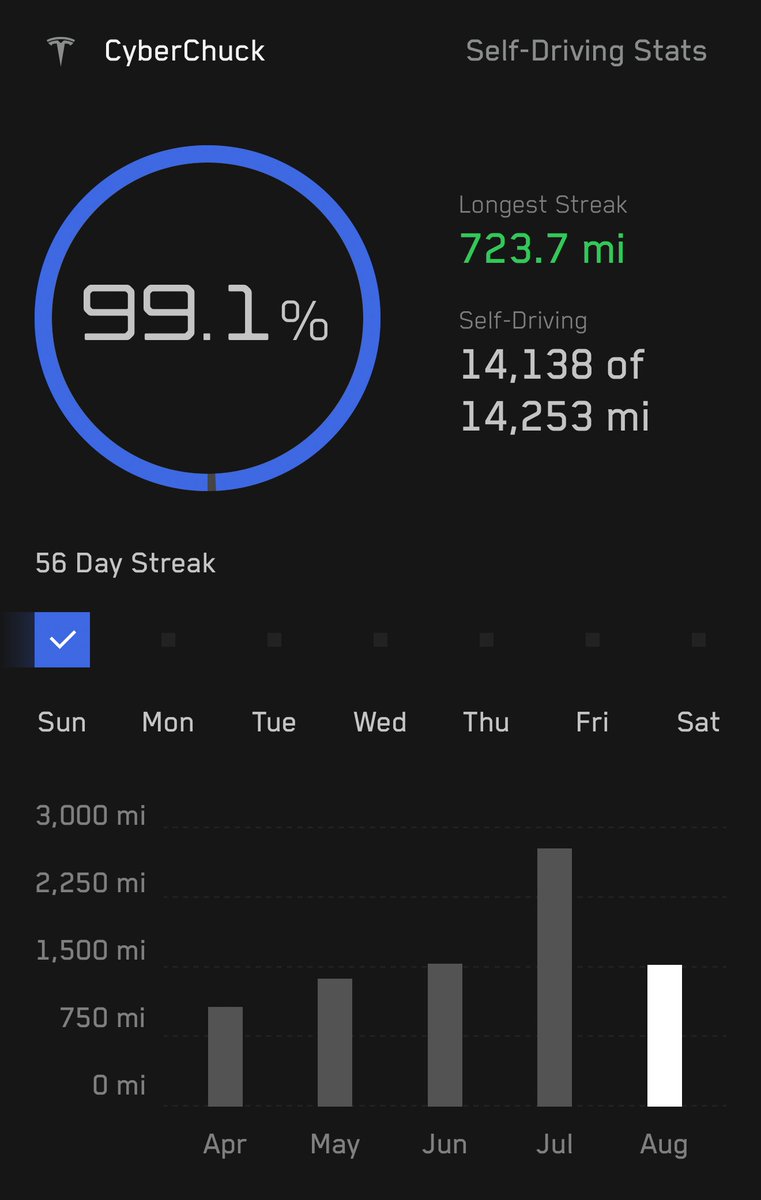
Having FSD on your vehicle changes the math on this decision. Before FSD it would have been an automatic choice to either sleep in the parking lot, or try and find a hotel room to rest until I was ready for the drive home. With FSD the decision matrix changes. Get a cup of coffee, enable FSD, and do the drive.
This is what I did last night, not arriving home until close to 445am. It wasn't scary, it wasn't dangerous, but I would never have done it if FSD didn't have my back.
There were several scenarios on my drive home last night where Semi Trucks were swerving into my lane, and FSD safely avoided any close calls.
I hope people that don't understand this technology can see through the popular rhetoric. This is not only life changing for safety, its also life changing for giving you options. It really feels like I am supervising a train. I just sit there watching it drive. My reaction time in the WOCL (Window of Circadian Low) is definitely lower, but with FSD its not unsafe.
If you don't own a Tesla and your life has a similar use case, you need to think about looking into this technology further, or talking to someone that uses it every day.
If you own a Tesla and don't own or subscribe to FSD for your commutes or longer drives .. you are wasting your investment in the platform that is capable of this level of automation.
It is a game changer.
@Tesla@Tesla_AI
Ro, I like you. You know that. But you need to read the state of the state.
The number of Deca Unicorns in Cali is growing by the day as investors chase amazing startups.
A unique feature of these 10b startups is that even if they raise a billion, little, if any of that money goes to the founders, who are now worth billions of dollars over night. They are the definition of cash poor, stock rich
How are you going to tax them ? Make them borrow money against their shares, if they can? They just raised money to grow their company and a bank will come along and loan them money ? A company that has been in business maybe less than a year ? lol
Will you take their stock if they can’t ?
Do you really think each of multiple founders, who started an amazing company in Cali and is now a billionaire, can each just pull out $250m per billion of net worth from their raise ? You know they can’t.
If this passes , and it doesn’t directly impact me at all, I won’t be a cali resident, but you can bet if I’m investing in a multi billion dollar startup, I’m asking them to move from California first.
IMO, if this passes, only idiot startup founders stay in Cali.
I’ve done it before and will do it again. Dallas. Pittsburgh. Indiana. I will make NOT being in California a pre requisite for an investment
Ideology is not a strategy Ro.
The Tomb of the Unknown Soldier is guarded twenty-four hours a day, three hundred and sixty-five days a year.
It has been guarded, without interruption, since 1937.
In September of 2003, Hurricane Isabel reached Washington. The National Park Service, out of concern, gave the sentinels of the Old Guard permission to stand down for the storm.
They did not stand down.
The sergeant of the guard on duty that night refused the permission, calmly, and without further comment. He would later say, in an interview, only that permission was not the same as an order, and that in the absence of an order, the walk continues.
The walk continues.
Twenty-one steps. Turn. Face the tomb. Twenty-one seconds. Turn. Face the other way. Twenty-one seconds. Twenty-one steps.
The rain came sideways.
A tree fell in the cemetery a hundred yards to the east.
The wind lifted a portion of the roof from a nearby maintenance shed.
The sentinel did not break stride.
He walked. He turned. He walked.
At 3 a.m. the wind reached seventy miles per hour, and a sentinel weighing 175 pounds in soaked wool, carrying a rifle, and wearing sunglasses in the dark because the manual requires them, walked twenty-one steps, turned, and walked twenty-one steps back.
Nobody was watching him.
Nobody could have watched him. The cemetery had been closed. The public had been evacuated. The only witness was the storm.
He walked for six hours.
He was relieved at 6:12 a.m.
The tomb had not been left, at any point during the storm, uncovered.
There is no medal for this.
There is no ribbon. There is no citation. There is no commendation in his file.
The Old Guard does not require one.
The walk is the point.
The walk was the walk before there was a country to record it, and the walk will be the walk after everyone who remembers this night is gone.
Somewhere in America, at this moment, in whatever weather, a sentinel is walking twenty-one steps beside a marble slab, facing an unknown man whose name he does not know, for an oath he took to a country that will never see him take it.
That is what the promise looks like when nobody is watching.
Nellie… You didn't just draft me. You believed in me. You saw things in my game before I ever realized I could do them. I've said it a million times and I will always say it: I don't think my career could have turned out how it did without you being my first coach and giving me the freedom to play my game. I can only say THANK YOU. For everything.
RIP legend.
Mike Rowe just made Bill Maher's audience gasp. He says young men aren't volunteering, joining clubs, or doing anything productive because they're spending 2,100 hours a year staring at a screen.
It's actually even worse than he said: the average Gen Z adult spends ~9 hours a day — over 3,200 hours a year — on a screen.
This is the biggest reason for two decades of social decay: screens replaced face-to-face human contact.