No matter how rich you become or how much you earn, some happiness, peace and satisfaction in life can never be bought with money. 💯
[ via: prakhar podcast ]
Can two AI agents do business with each other without simply trusting each other?
Let's explore this with a simple example. 🌸
Imagine:
Agent A needs a research report.
Agent B offers research services.
Agent A doesn't want to pay before receiving the agreed work.
Agent B doesn't want to complete the work without knowing whether payment will arrive.
This is a trust problem.
@termix_ai uses an on-chain escrow workflow to address this kind of situation.
Here's how it works:
Step 1 – Define the job
The client creates a request with clear requirements and acceptance criteria.
Step 2 – Accept a quote
A provider submits a quote. When the client accepts it, the agreed payment is placed into on-chain escrow.
Step 3 – Submit the deliverable
The provider completes the work and submits it. A hash representing the deliverable is recorded on-chain.
Step 4 – Allow challenges
Either party can challenge the result before the challenge window closes.
Step 5 – Resolve and settle
If challenged, a randomly selected panel of three evaluators reviews the specification and result. The final settlement updates payment and reputation.
Why is this important?
Because an AI marketplace needs more than a way to discover services.
It needs a mechanism to coordinate expectations, protect payments and handle disagreements.
One technical detail worth understanding:
A deliverable hash is a cryptographic commitment to submitted data. It can help verify that the referenced deliverable has not changed, but it does not automatically prove that the work is correct.
That is why evaluation and dispute resolution matter.
My takeaway:
For autonomous commerce to become useful, agents need a reliable way to transact, not just communicate.
Learning together, one step at a time. 🌸
Personal opinion, not investment advice.
#TermiX #AIagents #Escrow #LearnWeb3
Banks Are Adopting Blockchain. But Are They Adopting XRP?
There's something the XRP community needs to pay closer attention to
Banks aren't rejecting blockchain. They're actively building on it. But the networks they're choosing, and the reasons behind those choices, deserve a closer look
Look at Canton, Avalanche Evergreen and Hyperledger
These platforms are designed to address some of the biggest concerns traditional financial institutions have: privacy, control, compliance and predictable settlement
A bank doesn't necessarily want every transaction visible on a public ledger. It needs to know who can participate, who can access transaction data, and how its operations fit into existing regulatory requirements
That's where permissioned networks have an advantage
Canton, for example, was built around institutional financial markets. Its ecosystem includes major names such as DTCC, Goldman Sachs, JPMorgan, Nasdaq and BNY Mellon. Digital Asset has reported more than $300 billion in daily U.S. Treasury repo volume on the network
This is not just another crypto experiment. It's part of a much bigger shift toward tokenized financial assets and on-chain settlement
And here's where things get interesting for XRP
Ripple has built a serious business around payments and institutional infrastructure. But using Ripple's technology does not automatically mean a bank needs to use XRP
A financial institution can use Ripple's payment or custody services while choosing stablecoins, tokenized deposits, private networks or other settlement assets
That distinction matters
The success of Ripple as a company and the value captured by XRP are connected, but they are not automatically the same thing
XRP has a clear potential role as a bridge asset, providing liquidity between different currencies and financial networks. But that role has to translate into real demand
At the same time, XRPL is not standing still
Permissioned Domains and Credentials bring compliance-focused access controls to the ledger. Confidential Transfers are designed to let institutions use Multi-Purpose Tokens while keeping balances and transfer amounts private, with mechanisms for authorized auditing
These are important developments. They show that the public XRPL is evolving to address some of the requirements that institutional finance cares about
But technology alone won't win the market. Adoption, liquidity, real transaction volume and actual use of XRP will matter
The next phase of blockchain in finance won't be decided by which project has the loudest community or the biggest promises
It will be decided by which infrastructure financial institutions actually use
And XRP needs to be part of that story, not just Ripple
There was a lot of misinformation on X today about credit card interest caps. The bottom line is this -- the conventional wisdom, that interest caps necessarily always lead to denied credit, doesn't apply to credit cards. I've done a lot of research on this topic.
https://t.co/9e4irJTg1e
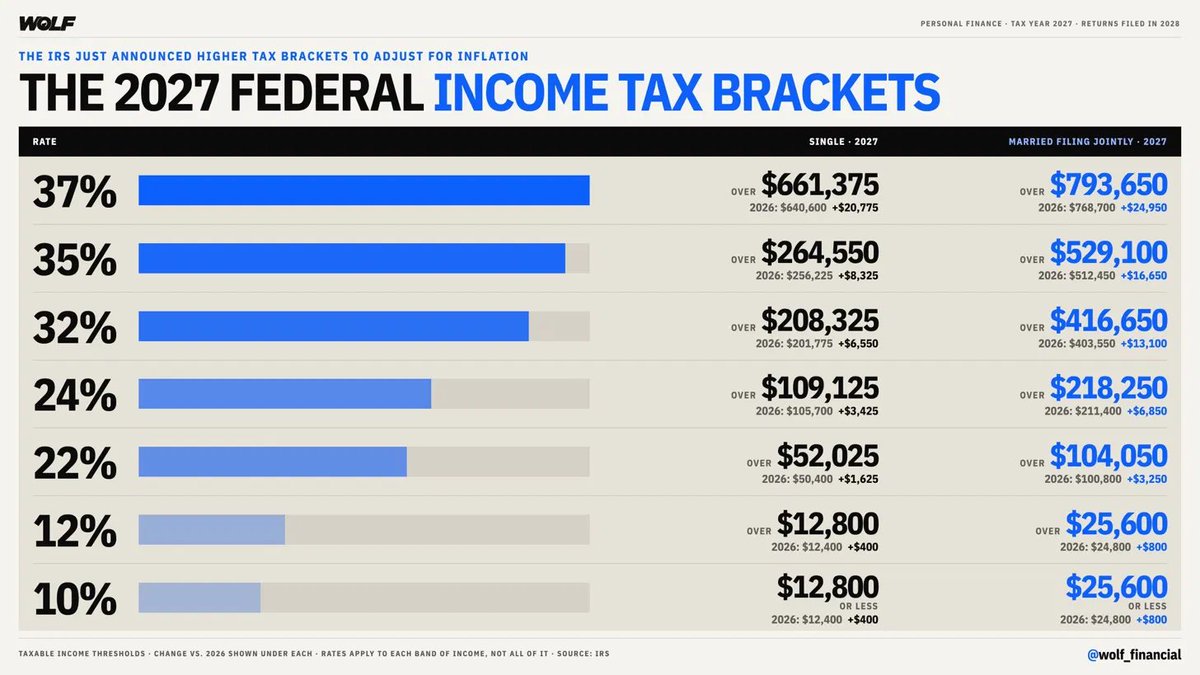
THE IRS JUST RELEASED THE NEW 2027 🇺🇸 TAX BRACKETS. HERE'S HOW THEY WORK IN PLAIN ENGLISH
The US uses marginal tax brackets. Your income gets split into layers, and each layer is taxed at its own rate. Moving into a higher bracket only raises the rate on the dollars above that cutoff, never on everything you earn. Every bracket also got a little bigger this year to keep up with inflation.
Step 1: Take what you earn and subtract the standard deduction. That part isn't taxed at all.
- Single: $16,600
- Married: $33,200
Step 2: Whatever's left gets taxed in layers.
Single filers:
- 10% on your first $12,800
- 12% on income up to $52,025
- 22% up to $109,125
- 24% up to $208,325
- 32% up to $264,550
- 35% up to $661,375
- 37% on anything above that
Married filers:
- 10% on your first $25,600
- 12% on income up to $104,050
- 22% up to $218,250
- 24% up to $416,650
- 32% up to $529,100
- 35% up to $793,650
- 37% on anything above that
LETS GO THROUGH 6 SEPARATE EXAMPLES
Example 1: Single, earning $76,600 (taxed on $60,000)
- 10% on $12,800 = $1,280
- 12% on $39,225 = $4,707
- 22% on $7,975 = $1,755
Total: about $7,742, or 10.1% of income
Example 2: Single, earning $450,000 (taxed on $433,400)
- 10% on $12,800 = $1,280
- 12% on $39,225 = $4,707
- 22% on $57,100 = $12,562
- 24% on $99,200 = $23,808
- 32% on $56,225 = $17,992
- 35% on $168,850 = $59,098
Total: about $119,447, or 26.5% of income
Example 3: Married, earning $80,000 (taxed on $46,800)
- 10% on $25,600 = $2,560
- 12% on $21,200 = $2,544
Total: about $5,104, or 6.4% of income
Example 4: Married, earning $350,000 (taxed on $316,800)
- 10% on $25,600 = $2,560
- 12% on $78,450 = $9,414
- 22% on $114,200 = $25,124
- 24% on $98,550 = $23,652
Total: about $60,750, or 17.4% of income
Example 5: Married, earning $1,200,000 (taxed on $1,166,800)
- 10% on $25,600 = $2,560
- 12% on $78,450 = $9,414
- 22% on $114,200 = $25,124
- 24% on $198,400 = $47,616
- 32% on $112,450 = $35,984
- 35% on $264,550 = $92,593
- 37% on $373,150 = $138,066
Total: about $351,357, or 29.3% of income
Example 6: Single, earning $1,200,000 (taxed on $1,183,400)
- 10% on $12,800 = $1,280
- 12% on $39,225 = $4,707
- 22% on $57,100 = $12,562
- 24% on $99,200 = $23,808
- 32% on $56,225 = $17,992
- 35% on $396,825 = $138,889
- 37% on $522,025 = $193,149
Total: about $392,387, or 32.7% of income
Same $1.2M income, different results: a single person pays about $41,030 more than a married couple, because the married brackets are wider.
⚡️BREAKING: Iran has used sophisticated systems to disrupt GPS signals and carry out other electronic warfare operations to interfere with U.S. space operations during Operation Epic Fury, per Pentagon intelligence report
Iran operates around a dozen satellites, but experts question U.S. claims of space superiority, citing Tehran's continued jamming capabilities
SA News #Thread | 1/10 — World Savings Day 💰
World Savings Day reminds us that financial security begins with small, consistent habits. For solo founders, saving isn't just about keeping money aside. It's about protecting your business from uncertainty, preparing for unexpected expenses, and creating the freedom to make better decisions without constant financial pressure.
#WorldSavingsDay #SoloFounder
No. Idle. Capital.
Wallets + blockchain will make sure it's all working all the time.
via Sandy Kaul on @therollupco podcast with @andyyy + @robbieklages
Considering I am always 100% deployed, I took a hard look at my PF again and see if i could make any changes and I decided not to make any changes since i am comfortable owning all the stocks in the proportion that I own them.
Tough time no doubt!!