The power of ecosystem collaboration
What makes the https://t.co/JJObGr7puR treasury proposal uniquely strong is that it is not a single entity project by a single , but a massive consortium of industry leaders combining their expertise to drive real-world utility on the Cardano Mainnet.
We are proud to bring together an incredible network of partners to make this vision a reality.
🟢Field Distribution & Scale: @SyngentaIND via Project Swaminathan, alongside the Global AE Academy (co-founded with @IFC_org, SAFIA, and @corteva)
🟢Technical Cohort:
DigiFarm (AI satellite imagery), Veridian (decentralized identity), @nmkr_io (tokenization), and robust smart contracts built by AIQuant and @AnastasiaLabs
🟢Application Paths: @andamio_teams (AE certification and reputation), @ZengateGlobal (traceability and EUDR compliance), and @Seedstars SIGMA (credit scoring and stablecoin loan infrastructure)
🟢Stewardship & Governance: https://t.co/JJObGr7puR Foundation as the neutral steward, with @Elkconnect_web3 GMBH and HashPoint Consulting handling technical coordination utilizing the battle-tested treasury smart contract framework developed by @SundaeLabs.
This is what an unusually strong, multi-country public good looks like. We have the tech, the partners, and the scale. "We sincerely apologize if we missed mentioning any partner or could not tag your handle due to search limitations on X!"
Time is running out (less than 16 hours), so please cast your YES vote today! Find the link in the first comment below.
imo the real question should be: which investments convert treasury capital into delivery → delivery into adoption → adoption into durable ecosystem value?
Ecosystem needs change over time, the missing piece is prioritization, measurement and learning loops. This is why I keep coming back to:
▫️Dedicated domains → capital direction
▫️Builder legibility → execution credibility
▫️Capital productivity → proof that spending converts into outcomes
▫️Layered KPIs → ability to separate activity, delivery, adoption and durable ecosystem value
@planetmaaz Agreed, “tx volume” is just a proxy for something never properly defined without a theory that defines:
1. what adoption is and means for the ecosystem
2. how it is created
3. which dependencies enable it
4. how progress is measured
5. how DReps should vote on it
The deeper issue is prioritization
Cardano needs a clearer way to connect strategy → capital allocation → measurable outcomes
That means a framework built around layered KPIs, capital productivity and better feedback loops before decisions become binary
https://t.co/8sxGiN3zBd
Cardano governance signal is getting pretty clear:
1. DReps overloaded
2. Builders under-visible
3. Treasury spending under pressure
4. Infra still needs adoption paths
5. Commercial work needs real outcomes.
This is why layered KPIs + capital productivity matter, not more noise
A better machine to turn capital → delivery → adoption → durable ecosystem value
this is a great post.
cardano's ecosystem funding architecture needs a revamp.
dedicated domain allocation + builder onboarding + layered KPIs
more on this soon
📌 Surfacing Innovation & Growth DAO Feedback and Misconceptions
Chapter 8: Budget, Operations Budget, and Treasury Efficiency
🔹 Misconception #7
Why is the DAO requesting this budget, and are operational budgets too high?
Answer 👇🏻
Before judging the budget, we should ask a basic question:
Compared to what?
The closest benchmark available in Cardano is not Y Combinator, or Techstars.
It is Project Catalyst.
Why?
Because Catalyst and Innovation & Growth DAO, despite some key differences, both involve:
🔹 Proposal assessment
🔹 Reviewer coordination
🔹 Treasury-funded grants
🔹 Accountability structures
🔹 Milestone verification
🔹 Governance participation
🔹 Ecosystem grant distribution
If we want a meaningful comparison, Catalyst is the benchmark.
1️⃣ Project Catalyst already operated with significant operations budgets
Between Fund10 and Fund12, Catalyst operated with approximately:
🔹 150M ADA total funding envelope
🔹 ~140M ADA effective pool for grants
At the same time, Project Catalyst allocated approximately:
🔹 19.5M ADA
or roughly:
🔹 ~$6.0M USD
to operations-related functions, including:
🔹 Reviewers
🔹 Moderation
🔹 Accountability
🔹 Fund Operations
🔹 Infra
🔹 Ecosystem Support Functions
This represented approximately:
🔹 ~14%
Operational Budget Ratio
In other words:
For every 100 ADA distributed in grants, roughly 14 ADA was allocated to reviews, accountability, operations, moderation, and infrastructure.
This matters because Cardano has already demonstrated that funding programs require much more than simply transferring ADA to projects.
2️⃣ Earlier Catalyst funds likely operated with even higher budget ratios
Historical context matters.
In earlier Catalyst funds:
🔹 ~5% was allocated to proposal reviewers
🔹 ~14% was allocated to voter incentives
Combined:
🔹 ~19%
And that excludes:
🔹 Operations teams
🔹 Program management
🔹 Accountability functions
🔹 Infrastructure
🔹 Internal staffing
🔹 Governance tooling
Reviewer and voter incentives alone already represented a substantial operational layer.
Once staffing, coordination, infrastructure, and accountability are included, a conservative estimate suggests early Catalyst operational budgets may have exceeded:
🔹 30% of the grants distributed between Fund 10 and Fund 12
This is not criticism of Catalyst.
It is context.
Cardano has historically recognized that review, participation, accountability, and funding operations require resources.
3️⃣ The Innovation & Growth DAO budget is far smaller in absolute terms
The Innovation & Growth DAO proposes:
🔹 12M ADA grant pool
and approximately:
🔹 2.3M ADA
or roughly:
🔹 $580K USD
for reviews, accountability, operations, administration, and infrastructure.
Compared to Catalyst's:
🔹 $6.0M USD
operations budget layer
Innovation & Growth DAO operates at roughly:
🔹 ~10%
of Catalyst's comparable operations budget scale.
Or stated differently:
🔹 roughly 10x smaller
in absolute operational budget terms.
This is an important point because percentage-only comparisons often ignore scale.
4️⃣ Economies of scale matter
This is where many comparisons become misleading.
Project Catalyst operated at approximately:
🔹 50M ADA per funding round
Innovation & Growth DAO proposes:
🔹 4M ADA per funding round
But smaller funding vehicles still require:
🔹 Proposal Reviews
🔹 Accountability
🔹 Oversight
🔹 Reporting
🔹 Treasury Tracking
🔹 Operational Infrastructure
🔹 Milestone Verification
🔹 Administration
These functions do not shrink linearly with the size of the grant pool.
A funding mechanism that is four times smaller does not automatically require four times less infrastructure.
That is precisely why percentage-only comparisons can produce distorted conclusions.
5️⃣ Not all budget categories are the same
Another common mistake is collapsing everything into a single "overhead" bucket.
These are not equivalent:
🔹 Setup costs
🔹 Reviewer incentives
🔹 Accountability systems
🔹 Administration
🔹 Contingency reserves
🔹 Reporting
🔹 Infrastructure
🔹 External Intersect administration fees
A contingency reserve is not the same thing as recurring operations.
Reviewer incentives are not the same thing as administration.
Externally imposed fees are not discretionary spending.
Budget categories matter.
Otherwise we end up comparing fundamentally different things while pretending they are identical.
6️⃣ Accountability is not administrative waste
A funding mechanism without reviews, milestone verification, reporting, and accountability will almost always look cheaper on paper.
That does not automatically make it better.
Review systems exist to improve funding quality.
Milestone verification exists to protect the Treasury.
Accountability exists to reduce waste.
Public reporting exists to allow scrutiny.
These are not luxuries.
They are safeguards.
The objective is not to maximize the amount distributed while minimizing oversight.
The objective is to fund responsibly.
7️⃣ The real question is whether Cardano still wants this funding layer
For years, Catalyst supported:
🔹 First-time builders
🔹 Experiments
🔹 MVPs
🔹 Grassroots initiatives
🔹 Community projects
🔹 Small teams
Today, Catalyst is paused.
Funds previously reserved for future rounds were returned to the Treasury.
Current efforts are primarily focused on administering grants from previous funds.
So the real question is not whether operations budgets exist.
Project Catalyst already answered that.
The real question is:
Does Cardano still want a funding path for early-stage builders, experimentation, and grassroots contributors?
I believe it does. 🌱
Innovation & Growth DAO is not trying to replace Catalyst.
It is trying to preserve part of the ecosystem layer that Catalyst once served.
And when compared against Cardano’s own historical benchmark, the proposal is far less extraordinary than some critics suggest.
#Cardano #Governance #DRep
Hello Dreps and Cardano Community
If anyone have questions about https://t.co/zHYX3EG6cp or wish to hear more, join us now
or every day at 12 UTC and 5pm UTC
https://t.co/ErlP3VE8Hd
📌 Surfacing Innovation & Growth DAO Feedback and Misconceptions
Chapter 4: About the DRep role and decision-making in the DAO
🔹 Misconception #3
How will DReps be selected, matched, compensated, and held accountable?
Answer 👇🏻
This is a fair question.
If the DAO is going to rely on DReps to review proposals, provide feedback, vote on funding decisions, and later assess milestone delivery, then selection, expertise, incentives, and accountability matter.
A lot.
The answer starts with a simple principle:
Participation in the DAO should not be based on voting power alone, personal proximity, or passive presence.
It should be based on active governance participation, relevant expertise, review quality, transparency, and accountability.
That principle has guided the design of the DAO from the beginning. 🎯
1️⃣ The DAO was designed as an open DRep initiative
Innovation & Growth DAO was conceived as an open collaboration process.
Many DReps were invited to participate. Around 30 already joined discussions, meetings, questionnaires, and proposal drafting activities.
The intention has never been to create a closed board to decide who receives funding.
The intention is to create a funding mechanism built and managed by DReps.
As the project evolves, community participation will remain an important part of refining the framework and governance processes.
2️⃣ Selection should be based on participation and quality, not voting power
One principle is already clear:
Voting power is not a reliable proxy for review quality.
Large stake does not automatically imply:
🔹 Expertise
🔹 Diligence
🔹 Accountability
🔹 Thoughtful governance participation
The DAO therefore intends to use participation-based signals as eligibility criteria.
Examples discussed include:
🔹 Governance Action participation rates
🔹 Consistency of participation
🔹 Governance activity over time
🔹 Public rationale publication
The exact thresholds may evolve, but the underlying principle remains the same:
DReps who help manage ecosystem funding should demonstrate meaningful participation in Cardano governance.
3️⃣ We aim to improve weaknesses observed in Project Catalyst and governance
The mechanisms being proposed were not invented in isolation.
DReps participating in this DAO have spent years reviewing proposals, evaluating milestones, writing rationales, and participating in governance, not only on Cardano ecosystem by the way.
Collectively, members of the group have reviewed well over a thousand Catalyst proposals and participated in numerous accountability processes.
Those experiences revealed strengths worth preserving and weaknesses worth improving.
The DAO is intended to incorporate those lessons into a more structured funding framework.
For example, I previously documented observations, identified gaps, and proposed improvements to the Catalyst Milestone Review process in an article focused on strengthening accountability mechanisms, check below 👇
https://t.co/gYDsbky2Cf
Likewise, @GrendelMarco, who is also part of this initiative, has written extensively about impact measurement frameworks, KPIs, and evaluation methodologies that can help improve how funded projects are assessed and monitored over time, including work such as:
https://t.co/XiEp5NyPTO 📚
4️⃣ Reputation is intended to become a core component of the system
One recurring governance challenge is that high-quality participation and low-quality participation often receive similar treatment.
The DAO intends to explore a reputation framework that rewards:
🔹 Participation
🔹 Consistency
🔹 Accountability
🔹 Review quality
🔹 Expertise
The goal is to create incentives for better governance behavior.
Reputation will influence access to review opportunities, accountability responsibilities, and proposal assessment roles.
The specific implementation will be refined through the DAO framework process.
5️⃣ Expertise matching is intended to improve decision quality
No DRep can realistically possess deep expertise across every domain.
Funding rounds may include proposals involving:
🔹 Software development
🔹 Governance
🔹 Education
🔹 Marketing
🔹 Research
🔹 Community initiatives
🔹 Open-source projects
Expecting every reviewer to evaluate every proposal equally well is unrealistic.
The DAO therefore intends to implement a matchmaking system between proposal categories and reviewer expertise.
The objective is simple:
Assign proposals to reviewers with relevant knowledge of the domain being evaluated.
This is not about replacing governance with experts.
It is about improving the quality of information available to DReps. 🧠
6️⃣ DRep Profiles are intended to support that matching process
One concept currently being explored is a DRep Profile framework.
This profile could include:
🔹 Professional experience
🔹 Certifications
🔹 Open-source contributions
🔹 Governance history
🔹 Technical expertise
🔹 Relevant track record
DReps would be able to associate evidence supporting areas where they claim expertise.
The board would then validate those claims and determine whether a DRep is qualified to review proposals in specific domains.
This creates a more transparent and evidence-based matching process than simple self-declaration.
7️⃣ Rotation should follow expertise and workload, not randomness
Another common question is how reviewer rotation will work.
The answer is that rotation should emerge from expertise matching and fair workload distribution.
For example:
If 10 marketing proposals are submitted and 2 DReps are qualified to review marketing proposals, workload should be distributed proportionally between them.
The same principle applies across other domains.
The objective is not rotation for its own sake.
The objective is:
🔹 Fair workload distribution
🔹 Reviewer diversity
🔹 Efficient use of expertise
🔹 Avoiding concentration of responsibilities
8️⃣ Compensation was based on research, not guesswork
The compensation model was not selected arbitrarily.
The team researched comparable roles such as:
🔹 Grant reviewers
🔹 Grant assessors
🔹 Auditors
🔹 Analysts
🔹 Oversight professionals
Across multiple regions/continents and industries.
That research was then combined with practical experience from DReps who have spent years reviewing proposals, governance actions, and milestones.
Questionnaires were subsequently used to refine those assumptions.
The resulting budget reflects estimated workload, expected responsibilities, and comparable market benchmarks.
9️⃣ Paying for accountability is not new in Cardano
There is often debate around whether governance participants should be compensated.
That debate is legitimate.
However, accountability work itself has never been free.
Catalyst has historically compensated proposal reviewers and milestone reviewers.
Treasury-funded initiatives also require oversight, verification, and accountability processes.
The real question is not whether accountability has a cost.
It does.
The question is whether that work should be transparent, structured, measurable, and tied to clear responsibilities.
The DAO answers yes.
🔟 Accountability should apply to reviewers too
Reviewers should not only evaluate others.
They should also be accountable themselves.
That means:
🔹 Public participation records
🔹 Conflict-of-interest mandatory disclosures to be individually verified by the Board.
🔹 Recusal requirements
🔹 Review quality expectations
🔹 Transparent activity tracking 🔍
1️⃣1️⃣ Community participation is a feature, not a weakness
One of the lessons many of us learned from Catalyst is that governance frameworks become stronger when the community has meaningful opportunities to shape them.
The DAO intends to create more space for community input regarding:
🔹 Governance processes
🔹 Reputation systems
🔹 Reviewer standards
🔹 Accountability mechanisms
🔹 Operational improvements
Rather than relying exclusively on top-down design.
The objective is not to create a perfect system on day one.
The objective is to create a system capable of learning, improving, and adapting while remaining grounded in active participation, expertise, transparency, and accountability. 🚀
That is ultimately what this proposal is trying to achieve.
#Cardano #Governance #DRep
@klimonchain 100% agree, execution is the real test.
I’d just separate the domains:
1. strategy defines what the ecosystem should prioritize
2. this framework defines how capital, builders, evidence and KPIs are organized so execution can be implemented and evaluated properly
▫️Dedicated domains → capital direction
▫️Builder legibility → execution credibility
▫️Capital productivity → proof that spending converts into outcomes
▫️Layered KPIs → ability to separate activity, delivery, adoption and durable ecosystem value
📌 Surfacing Innovation & Growth DAO Feedback and Misconceptions
Chapter 3: Innovation & Growth DAO uniqueness
🔹 Misconception #2
How will the DAO avoid overlap with Treasury Withdrawals, Project Catalyst, Builder DAO, Orion Fund, and other funding vehicles⁉️
Answer 👇🏻
This is one of the most common concerns surrounding the proposal.
It is also one of the most misunderstood.
The reason is simple:
The key differentiator is not the theme of proposals being funded.
The key differentiator is the maturity of the projects being funded, the size of the funding request, and the role that funding plays in the builder journey.
The question should not be:
"Does another funding mechanism exist?"
The question should be:
"Is there a meaningful funding gap that remains unaddressed?"
I believe the answer is YES. ✅
1️⃣ Different funding vehicles solve different problems
Not all funding mechanisms serve the same purpose.
A venture capital fund is not the same as a grant program.
A tooling fund is not the same as an innovation fund.
A program designed for mature teams is not the same as a program designed for builders who are still proving themselves.
The existence of multiple funding mechanisms does not automatically mean duplication.
What matters is the problem each mechanism is trying to solve.
2️⃣ The top-of-funnel funding layer is largely absent today
This point is critical.
"Top-of-funnel" means the entry layer of an ecosystem.
It is where new contributors, smaller teams, grassroots initiatives, MVPs, prototypes, educational efforts, governance experiments, and open-source ideas get their first real chance to prove value before becoming larger, more mature projects.
For years, Catalyst played much of that role in Cardano.
Today, that layer is largely missing.
Catalyst is currently paused. Public statements indicate that the budgets previously reserved for future funding rounds were returned to the treasury, while current efforts focus mainly on administering grants from previous funds.
Whether Catalyst eventually returns is unknown.
What matters is what exists today.
And today, Cardano risks spending another year without a broad funding path for initiatives that may not require massive budgets, but may still be crucial to keeping valuable contributors active in the ecosystem.
This is not about opportunistically framing a gap.
Personally, I would like to see more initiatives trying to serve this space.
But the reality is that very few groups have chosen to build a mechanism for it.
So the question is uncomfortable but necessary:
If Innovation & Growth DAO is not funded, what ecosystem-wide mechanism will support grassroots builders, small open-source projects, education, governance contributors, research, local communities, and early-stage experiments over the next year?
If the answer is "none", then this is not overlap.
It is a funding vacuum.
3️⃣ Catalyst evolved from an innovation fund into a full-funnel funding system
Catalyst originally emerged as Cardano's primary innovation layer.
Its purpose was to support:
🔹New builders
🔹Experiments
🔹Prototypes
🔹MVPs
🔹Grassroots initiatives
Over time, however, Catalyst expanded far beyond that mission.
The same mechanism began funding:
🔹Early-stage ideas
🔹Established projects•
🔹Infrastructure initiatives
🔹Scaling efforts
🔹Commercial ventures
🔹Large organizations
Grants that were once measured in thousands eventually became proposals requesting hundreds of thousands or even millions.
Catalyst became a one-size-fits-all funding system.
That brought benefits, but it also reduced specialization.
4️⃣ Treasury Withdrawals are not a top-of-funnel funding mechanism
Treasury Withdrawals are important.
But in practice they favor initiatives that already possess:
🔹Visibility
🔹Reputation
🔹Governance capital
🔹Social capital
🔹Established track records
Successfully passing a TWGA requires much more than having a good idea.
For new builders, experimental projects, or grassroots initiatives, Treasury Withdrawals are often a very difficult entry point.
That does not make TWGAs bad.
It simply means they solve a different problem.
5️⃣ Builder DAO focuses on scaling builders, not discovering them
Builder DAO addresses a different stage of the builder journey.
Its requirements generally assume:
🔹A launched product/application
🔹Demonstrated traction
🔹Market validation
🔹Commercial potential
Innovation & Growth DAO is designed for an earlier stage.
Not exclusively brand-new projects, but builders and initiatives that have not yet had repeated access to treasury funding.
A project that received funding once may still need support to validate itself.
A project that has already received multiple rounds of treasury funding should increasingly move toward:
🔹Sustainability
🔹Revenue generation
🔹Investment capital
🔹Mature funding mechanisms
The objective is not to create permanent grant recipients.
The objective is to help more builders become sustainable.
6️⃣ Tooling DAO and Orion Fund solve different problems
Tooling DAO focuses on a specific niche:
🔹Developer tooling
🔹SDKs
🔹Libraries
🔹Open-source infrastructure
Orion Fund operates under a venture-style investment model, focused on commercial projects.
Neither is designed to serve as a broad grassroots innovation layer.
They are complementary mechanisms, not interchangeable ones.
7️⃣ The DAO is intentionally adaptive
Another important distinction:
Innovation & Growth DAO does not have permanently fixed funding categories.
DReps participating in the DAO will decide priorities.
If another funding vehicle is already serving a particular area effectively, there is no reason to duplicate that effort.
Funding can instead be directed toward underserved parts of the ecosystem.
The mechanism is intentionally flexible.
8️⃣ The goal is not simply to fund projects
The goal is to fund more builders.
Over the last few years Cardano has developed funding paths that work relatively well for:
🔹Established teams
🔹Infrastructure providers
🔹Large organizations
🔹Repeat recipients
Those mechanisms are important.
But ecosystem resilience is not only about infrastructure resilience.
It is also about builder resilience.
It is about ensuring that talented contributors who are not already inside founding entities, large companies, or established organizations still have a path to participate and create value.
9️⃣ The real question
If a talented builder arrived in Cardano tomorrow with a promising idea and needed a modest amount of funding to validate it, what funding path would realistically exist today?
That is the question we should be asking.
Because if we continue funding infrastructure, mature organizations, and recurring recipients while leaving grassroots builders without meaningful support, we risk creating a healthier infrastructure layer while weakening the contributor layer that ultimately gives the ecosystem life.
The purpose of Innovation & Growth DAO is not to replace Catalyst.
It is not to replace Treasury Withdrawals.
It is not to replace Builder DAO, Tooling DAO, Orion Fund, or the Budget Process.
Its purpose is to complement the funding architecture by addressing a part of the builder journey that currently receives far less support than it once did.
The discussion should therefore not be:
"Does another funding vehicle already exist?"
The discussion should be:
"Do we still want Cardano to have a meaningful path for grassroots builders, experimentation, and new contributors to enter the ecosystem?"
I believe the answer is YES.
#Cardano #Governance #DRep
The coolest thing about https://t.co/lUmVz1UHG7?
It offers the opportunity for cardano startups (like @palmeconomy & many more) and funding instruments to:
1. coordinate around a critical vertical: food systems.
2. satisfy a clear demand for block space from legitimate global institutions.
This is a multiplier proposal that creates a real market opportunity all the cool initiatives & projects you love on cardano
Read it & chat to @YoramBenzvi if you have questions.
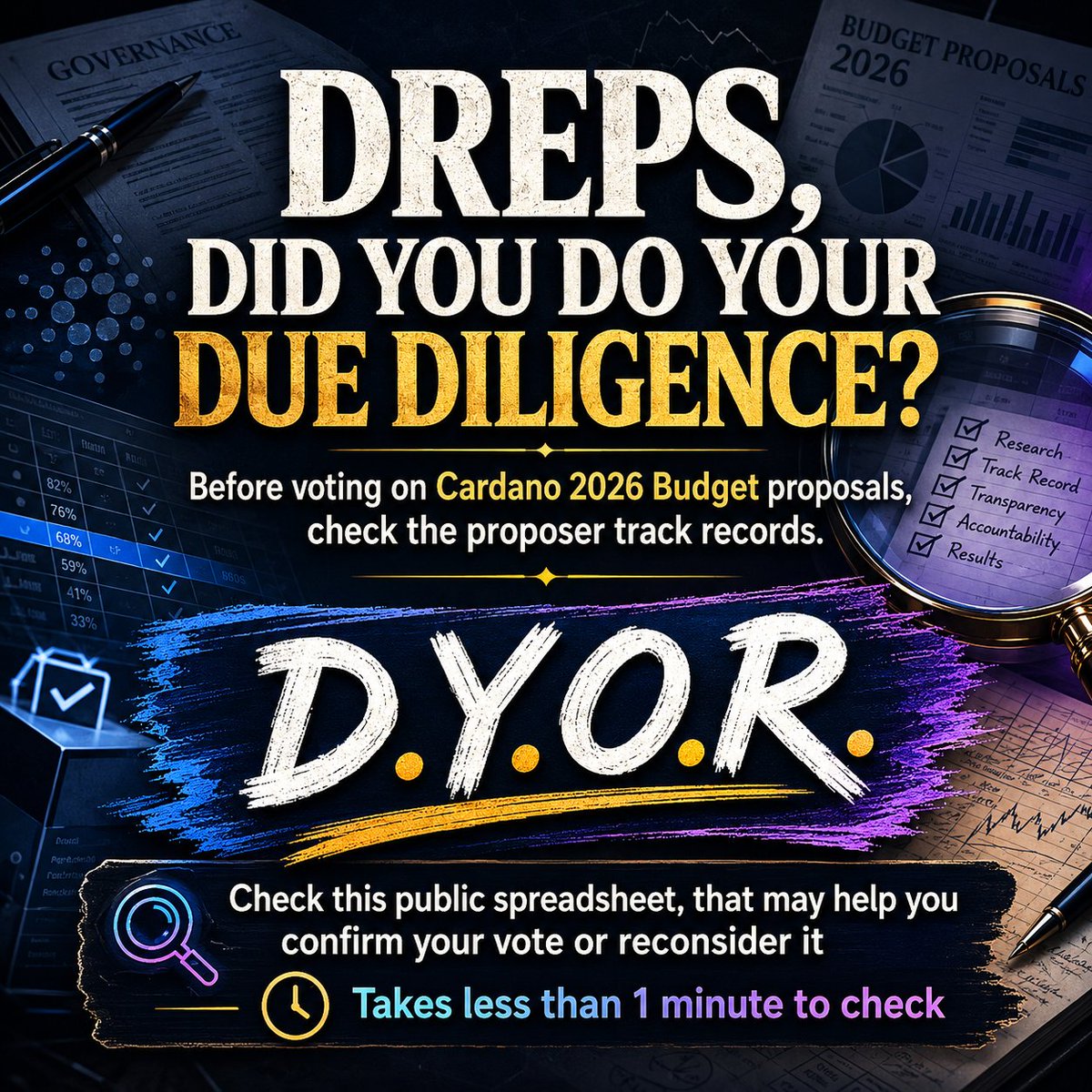
I published a public spreadsheet to help #dReps and the #Cardano community check proposer track records in the 2026 Budget / Treasury Withdrawal cycle.
Why does this matter⁉️
Because 50 different proposers submitted proposals through the Intersect Budget Framework.
The Budget Committee @IntersectCBC created a dashboard to show the track record of the proposers that uses APIs and automation to identify previous funding history. 💰
Roughly half of the proposers were already identified by the dashboard as having some prior funding record.
My additional contribution to the dashboard focused on the other side of the problem:
🔷 Cases where prior funding was not identified automatically.
I manually checked 26 individual proposers, mostly proposals that appeared to have no previous funding history in the dashboard.
The result:
👉🏻 10 proposers still appear to have no prior Cardano Treasury-related funding.
🔎 But in the other 16 cases, manual research identified historical links to 172 funded initiatives across different Cardano funding vehicles, including:
🔹 Project Catalyst
🔹 Intersect grants
🔹 Treasury Withdrawals
🔹 Cardano Builder DAO
🎯 That is exactly why manual reconciliation matters.
The reason the dashboard does not yet identify all of these cases is that historical links may exist under different names, companies, aliases, teams, or funding systems, meaning dReps may miss important context if those connections are not reconciled manually.
📌 This does not mean those proposers did anything wrong.
📌 It does not mean the proposals should be rejected.
📌 It does not mean every associated initiative was directly led by the same person.
👍🏻 It means proposer history in Cardano is fragmented and needs careful reconciliation.
This research is not:
- a ranking
- an endorsement
- a vote recommendation
- financial due diligence
- a subjective proposal review
It is simply a supplementary governance data layer.
The goal is to make proposer history easier to verify and help dReps make better-informed decisions during a constrained Treasury allocation cycle.
The first-stage dataset is now public:
🔹 Dashboard (by @radioastro):
https://t.co/pcwIT9qtIh
🔹 Spreadsheet (this is the main reference for consultation):
https://t.co/Oa0pqnP551
🔹Methodology:
https://t.co/0hFry2hbxS
🔹 Github for nerds:
https://t.co/FyKKUFLjjP
The GitHub repo and spreadsheet serve as public references for the manual reconciliation work.
📌 Surfacing Innovation & Growth DAO Feedback and Misconceptions
In #Cardano governance, proposals are often judged not only by what they actually say, but also by DReps’ and community members’ assumptions, prior frustrations, fears, expectations, and interpretations projected onto them.
The Innovation & Growth DAO proposal was submitted to the Intersect Budget Process a few weeks ago, and over this period we received community feedback on it, including comments on X and two reviews directly on the Intersect Hydra Voting platform from DReps outside the proposal’s core working group: @yutazzz and @SIPO_Tokyo
We responded to these comments both on X and on the Hydra Voting platform. You can check the proposal itself, the reviews, and many of the responses directly through the link below👇
https://t.co/iiUQfoklUt
However, instead of leaving the discussion scattered across tweets, DMs, and buried inside the Intersect Hydra voting app, which, despite good intentions, almost nobody reads consistently, let’s be honest 😅, I decided to surface and address the most recurring questions and concerns in a short public series on X over the next few days.
But before getting into the responses themselves, I think some additional context matters.
Misconceptions, assumptions, and incomplete interpretations have played a major role in Cardano governance discussions since the early #ProjectCatalyst days, and they continue to shape how people evaluate on-chain Governance Actions today.
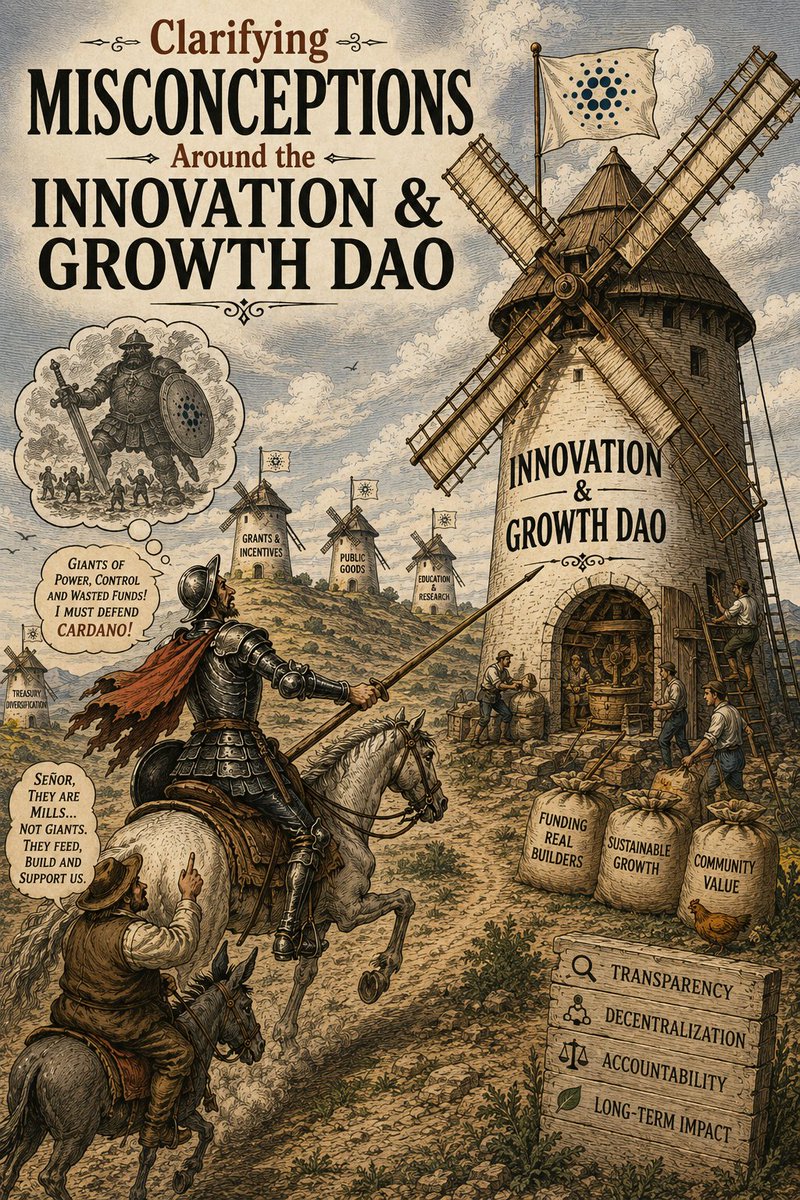
There is a reason Cardano’s governance testnet was named SanchoNet, it was a homage to Sancho Panza, Don Quixote’s grounded companion in Cervantes’ classic. 🏰
In Don Quixote, the famous scene is not only about a man fighting windmills. It is about perception: Don Quixote sees threatening giants where there are, in reality, windmills.
Governance discussions can work in a similar way. Every proposal has two versions:
🔸 The actual written proposal, with its stated purpose, scope, and definitions;
🔸 And the version each reader reconstructs through assumptions, skepticism, prior frustrations, fears, expectations, or ideals.
Sometimes the “giant” being debated is not the proposal itself, but an imagined version of what people fear it might be. ⚔️🌪️
That does not mean skepticism is wrong. Quite the opposite. Sancho Panza matters because he brings realism, common sense, and grounded judgment into a world of projections and dramatic interpretations.
As a DRep, I understand the skepticism. Our ecosystem has developed some scar tissue from past problems, and stronger scrutiny is a natural response. We are not trying to avoid criticism. Solid proposals should be challenged, refined, and improved through serious feedback.
Some questions and concerns reflect healthy scrutiny from an ecosystem that wants to avoid repeating past mistakes. Others seem to come from incomplete interpretations of the proposal’s purpose, design, and intended role within Cardano’s funding architecture.
At the same time, the Innovation & Growth DAO proposal was developed through an internal DRep collaboration process, including multiple meetings, questionnaires, and joint drafting work with experienced Cardano ecosystem contributors such as @JaromirTesar, @Cardanians_io, @jonahkoch, @triangleforces, @Lo_Ponch, @GrendelMarco, @genwealth_app, myself and others. 🤝
I am confident that the group of DReps involved in the @adaGrowthDAO has the experience needed to design, manage, and operate this project in a way that avoids repeating problems observed in Cardano’s funding history.
So in that spirit, this short series is my attempt to bring the discussion back from imagined giants to the actual windmills: what the Innovation & Growth DAO proposal really says, what it is trying to solve, and where legitimate concerns still deserve clarification. 🌾
📌 Here are the main recurring questions and concerns surrounding the proposal:
🔹 Why create a new funding mechanism or DAO if Treasury Withdrawals and the Intersect Budget Process already exist?
🔹 How will the DAO avoid overlap with Catalyst, Builder DAO, Cardano Tooling DAO, Orion Fund, and other funding vehicles?
🔹 How will DReps and “experts” be selected, matched, compensated, and held accountable?
🔹 Could this DAO become a group of people voting for themselves, and how will conflicts of interest be handled?
🔹 Who audits the DAO itself, and what happens if a funding round underperforms?
🔹 Who is eligible to participate, how to participate, and what are the requirements?
🔹 Why is the DAO requesting this budget, and are operational costs too high?
Over the next few days, I’ll publish tweets addressing recurring questions, concerns and misconceptions. 🧵
If we want serious governance, we need to evaluate what is actually being proposed, not only the versions reconstructed through fear, frustration, assumptions, or incomplete context. This is not unique to our proposal. It is a natural human bias that can affect how any proposal is interpreted, and we need to keep it in check to make better collective decisions.
#DRep #Governance #Intersect