Every ecosystem has a history.
But not every story gets told.
The successes. The failures. The disagreements.
The people who stayed, and those who left.
⛩️ Introducing Project Rashomon.
#Cardano's Untold Stories.
Some stories deserve to be heard.
⏳ More soon.
@dannyribar@Catalyst_onX Intersect will share a post and the document for feedback in a few days, likely next week.
@NicolasC3rny and @planetmaaz are aware of this too; I believe it’s a good opportunity for the Cardano Foundation to refine Catalyst for a potential next funding round.
just brainstorming out in the open the ongoing @catalyst_onX reform and where it just might fit the best - this is personal sketch of how i try to picture this in my mind - so let's test some assumptions
historically - for number of reasons - catalyst served the need of everything to everyone
which worked for a while until not as much as landscape has shifted with rapidly diminishing returns
with new era as times change - that model now can - actually must - iterate because there are other facets of the ecosystem that are taking (or have already) different responsibilities
this allows catalyst to finally - for the first time in years - to sharpen its focus. so let's see how this might work out
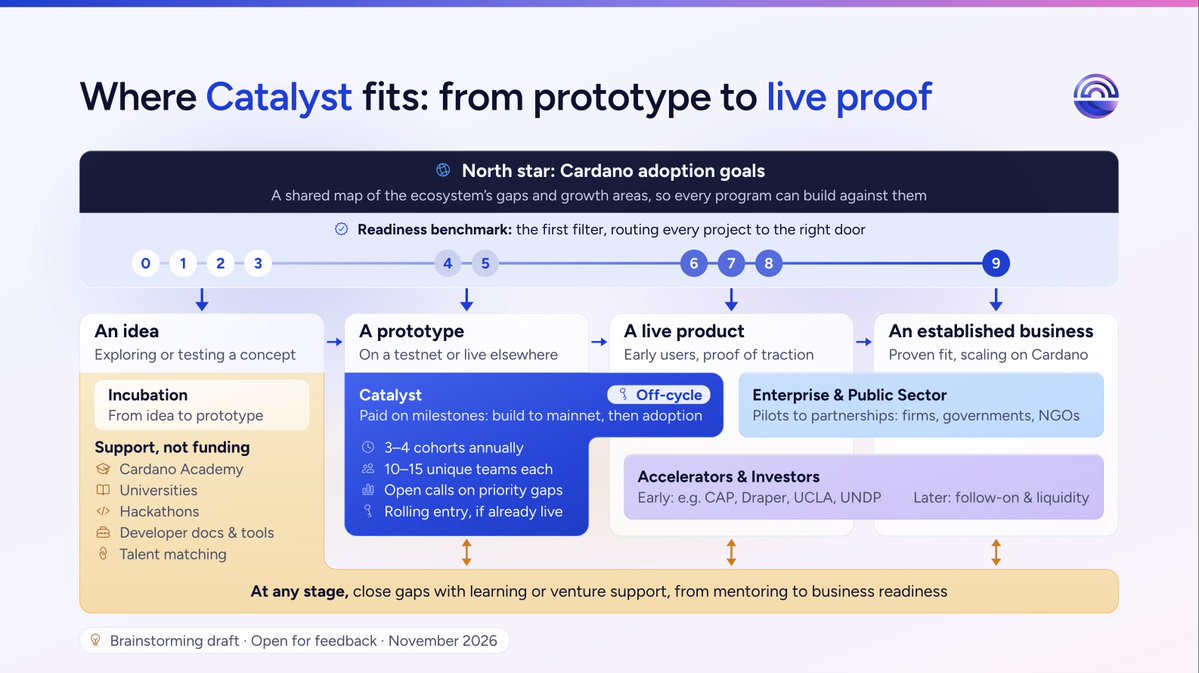
teams show up at really different stages, and one funding round can’t serve all of them well. so the sketch splits things into four stages (idea, prototype, live product, established business) and asks which door makes sense at each one
everything points at the same north star, cardano adoption, with a shared map of gaps and growth areas so every program and institution is pulling toward the same priorities. this is set by the ecosystem at large - not programs like catalyst in isolation
im less interested in having blanket responsibility for everything - but have programs be judged on a narrowly defined benchmarks/kpis tied to the specific program against specific adoption goals
so that we can all have same conversation / expectations about what success looks like with time passing
up top there’s a readiness benchmark from 0 to 9, based on the tech readiness levels catalyst already uses for cardano and trialled in the latest pilot. every project gets a level on day one, which routes it to the right door and saves reviewers time on stuff that isn’t ready yet
in this version catalyst picks up at the prototype and takes teams through to live proof
a big reason is...AI
going from an idea to a working prototype is way faster and cheaper than it used to be, so the funding gap at that stage has shrunk a lot. at that point money often isn’t what a team needs most. feedback and the right people around them usually help more
funding goes much further once there’s something real to build on imho
so funding would start around readiness 4-5, through open calls on priority gaps, and get paid out on milestones. first the build to mainnet, then actual adoption
thinking 3-4 cohorts a year with 10-15 unique teams each (following the agility and early pilot observations), so we can count and report what’s being done against each gap
if you’re already live with early users (6-8) and miss a cohort, you could still come in off-cycle on a rolling basis, but the bar is much higher there. you’d need real usage, a track record of shipping and a clear fit with a priority gap - a trade off against not missing an obvious opportunity if it pops up
ideas (0-3) wouldn’t get direct funding. incubation helps get them to a working prototype, with cardano academy, universities, hackathons, dev docs and tools, and talent matching around it. tho am conscious that this means that we need to - where missing - figure out as an ecosystem how best to serve those execution gaps as well - as catalyst can't be responsible for all, certainly not on its own
once there’s a prototype, the team applies to catalyst and off they go
further along, live products and established businesses move into pilots and partnerships with firms, governments and ngos, or on to accelerators and investors for early rounds, follow-on funding and liquidity. learning and venture support sit underneath all of it - that makes a lot of sense to me at least
the doors after catalyst matter a lot. legacy catalyst mostly worked like an island absent of active follow on pathways
a project got its grant, and when the money ran out it either fell off a cliff or came back for another round, and that loop doesn’t help anyone grow - in fact creates dependency layer that's counter productive long term
my desire is to see these early funding loops to lead somewhere and have a chance. teams that do great work should have a next step lined up, so good people stay in cardano and keep getting better each time they move up
and for that they need a map - a clarity of expectations and tangible programs that will bring them there - this is where coordination in this ecosystem becomes invaluable
if we tell this story coherently - it will be easier to convince talent to stay and equally to attract new one coming into the space - because they can envision for next five years could look like
innovation and adoption are extremely hard to navigate where failure rates are really high by default - so we really need to be honest about expectations versus reality
yet it's the only way how humanity has learned how to progress over millenia - try, fail, try agian, fail again, try once more (maybe even something else) until finally it sticks and levels us all up
rinse and repeat and i applaud everyone who relentlesly chips into that collective sense of humanity along the way
what's on your mind today? chip in below
I initially thought Catalyst's future direction would be more focused on products, especially given the recent pilot, which I found quite promising. The use of Technology Readiness Levels, documentation, checklists, initial screening, and expert panels seems to provide a robust framework for evaluating product-oriented proposals.
However, if Catalyst eventually supports other categories beyond products, it makes perfect sense that the documentation, requirements, and evaluation criteria would need to be adapted accordingly. I believe we have enough qualified people in the ecosystem to develop appropriate frameworks for different categories.
The bigger question, then, is where we should focus and how to avoid spreading Catalyst too thin.
I appreciate the openness you're demonstrating regarding Catalyst's future direction.
During DRep Council meetings this year, we discussed extensively what funding categories or vehicles might be needed to address the ecosystem's needs. I think this is particularly important given the brain drain we're witnessing across Cardano.
Of course, some people will inevitably leave during a bear market. But strategic and balanced resource allocation could help us retain valuable talent and capabilities within the ecosystem.
So I think the key challenge is identifying the actual gaps, understanding where existing funding mechanisms already operate, and ensuring Catalyst complements rather than competes with them.
I understand that the emerging direction seems to position Catalyst primarily at the top, or perhaps middle, of the funding funnel, and I see considerable value in that approach.
But before deciding which areas to prioritize, I believe we should conduct research and engage the broader community to understand which parts of the ecosystem are underserved, why those gaps exist, and whether Catalyst is the appropriate vehicle to address them.
How do you think these priorities should be identified and defined? What process would you envision for mapping the ecosystem's gaps and deciding which ones Catalyst should address?
I have some ideas myself. I'd start with the Cardano 2030 Roadmap, since it has already informed several governance decisions and received support from the majority of DReps.
However, I'd see that only as an initial scan. We'd still need a more granular assessment to identify specific gaps, distinguish between needs already covered by existing funding mechanisms, and ultimately define more targeted funding categories.
I'm curious how you envision this process working in practice.
🚨 Only 13 days left until EMURGO & Yoroi's de-registration!
What are your thoughts on their de-registration? 🤔
Hundreds of millions of ADA will need a new home.
Share your favorite DReps below! 👇
#Cardano
Cardano. Let’s talk about it.
We’re hosting a live AMA with the Cardano Foundation Executive Team this Thursday, 19 November, at 16:00 CET.
Drop your questions here, we’ll take as many as we can live. Link to Space is below.
As far as I know, this is the first Treasury Withdrawal Proposal that seeks funding retroactively for work already performed. It will be an interesting litmus test of the Cardano community for whether or not they believe in or are willing to pay people after the work is done.
first, how ADA was split at launch (2017)
out of every 100 ADA:
83 - public buyers
8 - IOG (meant to build the tech)
7 - EMURGO (meant to catalyse business & ventures)
2 - CF (meant to be the non-profit steward: standards, community, regulators)
no VC or investor allocation. the public got the lion's share
How can a decentralized, algorithmic stablecoin wind down? Shouldn't it be possible to just open source the contracts and let the math do the maths? I understand no longer operating a website to interface with it if you don't have a business case.