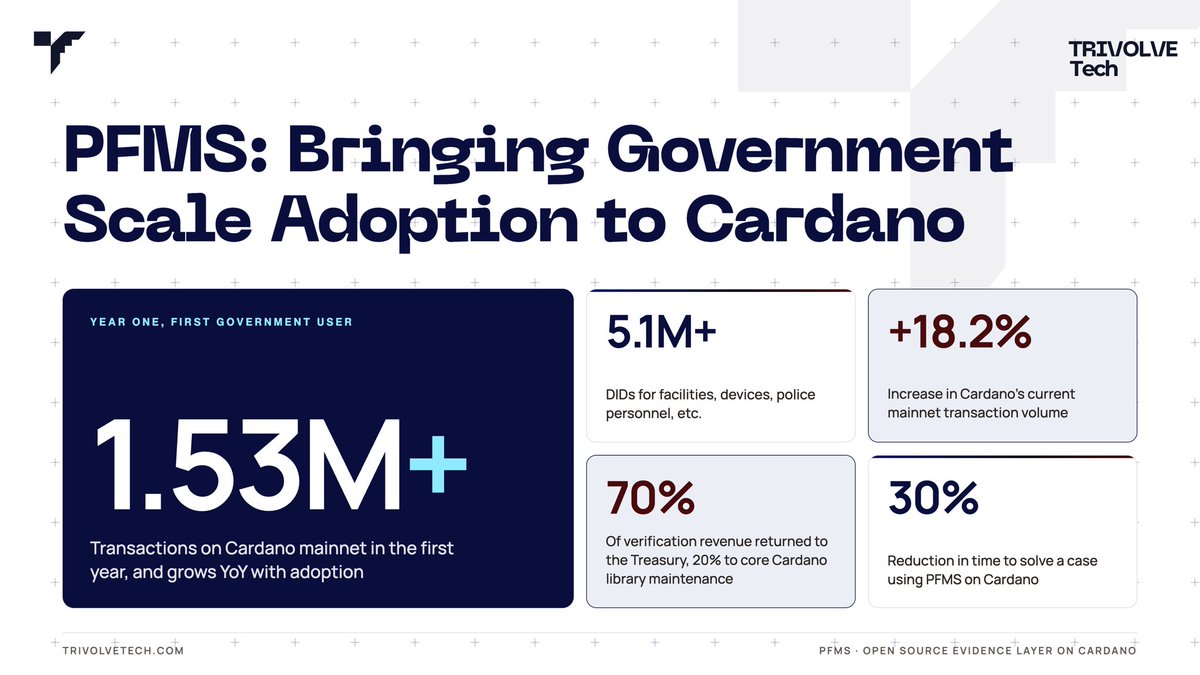
Introducing PFMS: Bringing Government Scale Adoption to Cardano by Trivolve Tech
A Treasury proposal which brings massive scale real world adoption to @Cardano with its first user being an Indian state government. PFMS secures the entire Chain of Evidence on Cardano. The scale of the project is such that once it is deployed, it will become the largest government scale project ever on Cardano.
PFMS will be built as an open source public good for policing and justice systems worldwide.
What PFMS brings to Cardano with just the first deployment:
→ 1.53M + Cardano mainnet transactions in year one and rising every year as adoption grows.
→ Grows the current Cardano mainnet transaction metric by +18.2%.
→ ~5.1M DIDs across 3,500 facilities, 1.81M devices, 113,000 personnel and 3.2M evidence items connected to Cardano.
→ Cuts down case resolution time by 30% using Cardano.
→ Generates revenue through PFMS’s evidence verification service.
→ 70% of verification revenue returned to the Treasury, 20% to core Cardano library maintenance & 10% to Trivolve Tech.
→ Open source core (Apache 2.0) as a public good, designed for reuse across the world.
The ask: ₳9,600,000 over 15 months.
Here’s how we’re doing it 👇🧵
PFMS is not being built for one specific state. ❌
PFMS is being built as an open-source public good for the whole world to adopt, with the first user being an Indian state government. ✅
PFMS will not just bring in millions of transactions and revenue to the ecosystem. PFMS opens doors for multiple other governments to use Cardano, just like how our previous successful project, FMS, has opened doors for PFMS.
PFMS is designed in a modular way, keeping in mind the needs of the
Police systems across government’s worldwide to use it as an evidence layer.
The support of the entire Cardano ecosystem will bring:
- Real world adoption
- New users (governments)
- New money via verification revenue
This will become the biggest government blockchain project ever on Cardano.
Your support matters a lot to us in making this a reality.
Thank you. 🙏
@yeck_ryan Thank you so much for the support.
PFMS will bring in government scale adoption to Cardano and we’re quite sure our ecosystem will support the proposal. 🤝
@Cardano_CF Thank you @Cardano_CF .
The success of this project, Forensic Management system(FMS) has opened doors for our next big project, PFMS(Police Force Management System).
Please check below for full details.
Introducing PFMS: Bringing Government Scale Adoption to Cardano by Trivolve Tech
A Treasury proposal which brings massive scale real world adoption to @Cardano with its first user being an Indian state government. PFMS secures the entire Chain of Evidence on Cardano. The scale of the project is such that once it is deployed, it will become the largest government scale project ever on Cardano.
PFMS will be built as an open source public good for policing and justice systems worldwide.
What PFMS brings to Cardano with just the first deployment:
→ 1.53M + Cardano mainnet transactions in year one and rising every year as adoption grows.
→ Grows the current Cardano mainnet transaction metric by +18.2%.
→ ~5.1M DIDs across 3,500 facilities, 1.81M devices, 113,000 personnel and 3.2M evidence items connected to Cardano.
→ Cuts down case resolution time by 30% using Cardano.
→ Generates revenue through PFMS’s evidence verification service.
→ 70% of verification revenue returned to the Treasury, 20% to core Cardano library maintenance & 10% to Trivolve Tech.
→ Open source core (Apache 2.0) as a public good, designed for reuse across the world.
The ask: ₳9,600,000 over 15 months.
Here’s how we’re doing it 👇🧵
Dori, thank you again for the detailed response. Please allow us to clarify:
1. PFMS is not being designed around Telangana as a one off system.
Firstly, The design of PFMS core is not confined to a single state or a country. It is designed for worldwide usage. The open source core released as a public good is architected in a modular manner considering major international police system requirements so jurisdiction specific integrations can sit on top of the same six engines, smart contracts, identity layer, verification layer and evidence model.
That is also why the record definitions are versioned and configurable. A new jurisdiction does not require the core system to be rebuilt. Its record definitions and connectors can be adapted to its own processes while reusing the same underlying infrastructure.
Secondly, the police landscape across India is highly repetitive in terms of the underlying workflows and infrastructure: police stations, control rooms, CCTV/DVR/NVR systems, ANPR, station diaries, armouries, evidence storage, forensic laboratories, prosecution and courts.
The state specific pieces are the connectors and configurations required to integrate with the systems a particular jurisdiction already operates.
2. On Cardano’s role, I think there is one misunderstanding from our previous reply.
When we discussed IndianChain, we were explaining the architecture of IndianChain specifically. Indianchain operates as partnerchain. In our previous reply, the smart contract part we explained was meant for PFMS.
In PFMS, Cardano is not only receiving hashes.
The proposal includes stage specific smart contracts on Cardano mainnet that enforce rules around the evidence lifecycle.
For example:
- Capture rules verify that records come from authorised devices and valid capture windows.
- Transit rules govern evidence handovers.
- Custody rules enforce the state of exhibits in the Malkhana, including whether an item can be issued, returned or destroyed.
- Filing rules preserve versions of prosecution records and ensure the chain of evidence remains consistent.
If an invalid state transition is attempted, such as trying to issue an exhibit that has not been returned, the custody state does not simply move forward. The rejected attempt remains recorded and verifiable.
The verification layer then checks the record, its proof, the relevant identity state and the Cardano transaction that committed it.
So the design is:
record → source validation → device/officer identity → fingerprinting and completeness checks → stage specific state transition → Cardano commit → verification
3. On the 1.53M mainnet transaction projection:
The proposal does not assume one transaction for every individual record. Records are batched.
But the batching windows are deliberately designed according to evidentiary requirements.
The longer a batch remains off chain, the longer that evidence remains dependent on the integrity of the local system before it receives an independent Cardano commitment.
For that reason, the batching policy is designed around how quickly different classes of evidence need to be secured. The intervals are also randomised so that a source does not commit on a predictable schedule.
The 1.53M figure was therefore calculated from the expected operational volume of the underlying sources after applying that batching model.
4. On the government paying the operating costs:
We mentioned it because it is part of the structure that was agreed for PFMS. The Treasury is being asked to fund the reusable open source infrastructure once. The adopting government then pays the recurring costs of actually operating it: its infrastructure, its transaction fees and its maintenance. On top of it the revenue generated by PFMS doesn’t belong to any government.
That distinction is important to communicate how PFMS is structured.
Thank you for having this discussion. We completely respect your opinion.
Thank you.🙏
Thanks esco, love this question 🫶
You’re right, “anchored” and “fully on chain” are different things.
The actual records (farmer details, case files, evidence) stay with the government, because that’s citizen data and it has to stay private. What goes on Cardano is a unique fingerprint of each record, called a hash. It reveals nothing about the record, but if even one letter of the record changes, the fingerprint changes too.
The data stays private. The seal is public and permanent. And it can be checked whether a record is still exactly the same as the day it was sealed.
With Indianchain, the system don’t put one record in one transaction. It takes 100 records, combine their fingerprints into one seal (a Merkle root), and write that seal into one Cardano transaction.
Indianchain has been live on mainnet for only around a month. Since then, 1,820,900 records have been anchored using 18,209 transactions.
Based on the projected adoption rate, Indianchain is expected to reach breakeven in less than three years.
Thank you Esco! You have been a great support to us throughout. We really appreciate it 🫶
Our Treasury withdrawal proposal
PFMS: Bringing Government Scale Adoption to Cardano by Trivolve Tech,
is live.
Police Force Management System (PFMS) will bring massive government scale adoption to Cardano.
Here’s what this means for Cardano:
→ 1.53M+ transactions on Cardano Mainnet in the first year, growing year over year with adoption.
→ Improves the overall Cardano Mainnet transaction count by 18.2%.
→ Generates revenue through PFMS’s evidence verification service. All of this revenue is new money coming into Cardano from outside.
→ 70% of the entire revenue goes back to the Treasury, 20% goes toward core Cardano library maintenance, and 10% goes to us.
→ Open-source core (Apache 2.0) as a public good, designed for reuse across the world.
→ ~5.1M DIDs across 3,500 facilities, 1.81M devices, 113,000 personnel, and 3.2M evidence items connected to Cardano.
→ Cuts down case resolution time by 30% using Cardano, reducing the average case timeline from 7.5 years to almost 5 years.
Our proposal, PFMS, will not just bring transactions and revenue to Cardano.
PFMS will solve real problems and save people from being wrongly accused.
This is Real World Impact by Cardano.
The ask: ₳9,600,000 over 15 months.
Your support matters the most in making this possible.
Thank you! 🙏
On the question of value flowing back to Cardano
With just the first user, PFMS is projected to generate 1.53 million Cardano mainnet transactions in the first year. This grows year on year with adoption.
Those transactions are generated by real time government activity, evidence creation, custody movements, prosecution records, court verification and other operational events rather than by market speculation. These transactions will keep happening irrespective of a bull or bear market.
PFMS also creates a separate revenue stream through the verification layer: 70% of the revenue is returned to the Cardano Treasury, 20% funds core to Cardano library maintenance and 10% goes to us. The government pays its own infrastructure, ongoing maintenance and 100% of the Cardano transaction costs.
So our thesis is not that putting hashes on-chain is technically novel by itself.
It is that taking Cardano into a production government environment at this scale, integrating millions of devices and records, enforcing evidentiary workflows through onchain smart contracts, surviving real world failure conditions, making the core reusable and open source for the policing systems across the world, and then generating sustained mainnet activity and recurring Treasury revenue.
We really hope that the context provided would help in reconsidering your vote.
Thank you 🙏
Hi Dori, thank you for continuing to engage with the proposal and for taking the time to look closely at the technical side of it.
We understand it is a long reply but we think it is necessary to provide the context.
Yes, hashes ultimately reach Cardano. But the difficult part of PFMS is not simply taking a hash and putting it into a transaction.
To begin with, most of the work in PFMS isn’t just writing code. It’s making that code work against real police hardware and legacy systems.
A single device type has many makers (Hikvision, CP Plus, Dahua, etc.) and many firmware versions, a lot of which are old and undocumented. Our engineers build and test an adapter for each one, on site, against real devices like DVRs, NVRs, bodycams, handhelds and ANPR cameras. The same goes for every police system we read from: CCTNS, the Dial 100 control room, the station diary and the armoury.
Every piece of code goes through the same cycle: build it, break it on purpose with multiple scenarios (cut the network, cut the power, reset the device clock, tamper with a video), fix it, test it again, and submit the results to the independent assurer and our admin, Cardano Foundation. This process is repeated across hundreds of devices, systems and scenarios, this cycle is where work and the cost go.
On top of that, there is security testing, as well as legal fit under the Bharatiya Sakshya Adhiniyam. Everything is then packaged as reusable adapter kits, so the next state or country starts from there, not from scratch.
The system therefore includes a Source Engine, edge Capture Engine, Identity Engine, Stamping Engine, Cardano Commit Engine and Verification Engine. The capture layer is explicitly designed to continue operating when connectivity fails, preserve ordered records locally, detect gaps and submit them once connectivity returns. The identity layer binds records to the identity of device and authorised officer that produced them.
It is funding the engineering required to make that architecture operate across a real state scale justice environment, along with security testing, assurance, five operational stages of chain of evidence, open source release and deployment tooling.
There is also an important distinction regarding IndianChain.
Its architecture is an application specific Cardano PartnerChain for government agricultural settlement, record verification and credit workflows. The system has its own execution environment, validator architecture and high frequency operational layer, while Cardano acts as the final settlement and security anchor.
The architecture includes PartnerChain validator nodes, deterministic transaction ordering, state transition execution, canonical hashing, settlement services, Cardano transaction submission, proof resolution and replay verification.
The PartnerChain handles operational state and workflows; Cardano provides the independently verifiable settlement layer. The architecture anchors important state hashes and audit points so that historical state can later be reconstructed and checked against Cardano.
In the case of PFMS, The commit engine enforces stage specific rules around capture, transit, custody and filing through on-chain smart contracts. For example, custody rules can prevent an exhibit from being reissued while already checked out, and invalid transitions remain visible rather than silently changing state. The verification layer then allows prosecution, defence and the court to independently check the same record against Cardano and receive the same cryptographic result. That is why we see Cardano's role here as much more than generic timestamping. It becomes the independent trust and settlement layer underneath a government evidence system.
Thanks for digging into this, and giving us the opportunity to provide the context. Here’s why the patterns look the way they do.
It is worth separating the two deployments first because they work very differently.
FMS’s 160K+ transactions represent each step included inside the chain of custody. The steps include data collection from live scene, caseID generation through CCTNS, generation of secure QR, creation of aliases and subaliases for evidence exhibits, transportation of evidence boxes to regional forensic labs (RFSL) for sample collection, chain of custody check, chemical test, biological analysis, toxicology screening and final report sign off.
Details of the cases and police personnel involved in the case are private and confidential to the government. Delays, skips and reopens are tracked off chain in the govt system, the chain proves each completed stage hasn't been altered.
The 40 wallets don't represent the officers using FMS but these 40 wallets exist to pay Cardano transaction fees and this is by design to handle throughput. At the end of every month the government pays 100% of the transaction costs in fiat.
Indianchain has anchored 1,777,600 records (1,316,058 farmer records, 358,341 agricultural records and 103,201 credit applications). These records contain farmer ID, government ID hash, contact/address information, identity proof information, verification status, land parcel, crop, variety, season, crop year, sowing date, irrigation method, linked agricultural records, loan type, requested amount, lender, tenure, interest rate, purpose and decision status. They are batched 100 records per transaction by design. Every 100 events are rolled into a Merkle root and anchored on Cardano.
The infrastructure is hosted and run by the government. That's why transactions majority of the time follow government working hours. On chain time is when a record syncs, not when the field event happens.
FMS and Indianchain are creating real world impact all because of the support we got from the cardano ecosystem. While FMS success is the first step, we believe PFMS will be a giant leap towards cardano’s adoption at government scale.
Thank you and please let us know if you have any more questions. We are happy to answer them. 🙏
Thank you for following up. We appreciate the opportunity to clarify this.
eSakshya is one of the many examples of that institutional mindset changing. Governments are actively embracing digitisation and investing in modernising the justice system. This is precisely the shift we described.
Regarding the funding, yes, a conventional government funded development contract was part of the initial discussions.
But PFMS did not arrive at its current structure in one meeting. Over multiple discussions and iterations with government officials of multiple states, we worked through different commercial and technical models, and the structure in the proposal is the model that was ultimately agreed upon.
A government could fund open source software, but the source of development funding is only one part of what makes a system neutral. The architecture, ownership, transparency, and the ability of independent third parties to verify it are equally important.
That is the reason we arrived at the current structure:
PFMS is not being designed as proprietary software belonging to Telangana. Telangana is simply the first user.
The Treasury is funding a reusable, open source PFMS core with the six engines, smart contracts, identity layer and verification infrastructure which is released under Apache 2.0 as a public good and can be reused by other states, countries and use cases.
The state, meanwhile, pays for what is specific to its deployment: its infrastructure, 100% of the Cardano transaction fees and ongoing maintenance while the revenue generated from PFMS doesn’t belong to the government. 70% of the revenue goes to Cardano treasury, 20% to core cardano library maintenance and 10% to us.
From our perspective, the broader consideration for the Cardano community is:
“Does it make sense for the Cardano Treasury to fund a reusable open-source Cardano infrastructure layer, when a government is prepared to become its first user and pay the ongoing infrastructure, transaction and maintenance costs?”
Our view is yes, because the Treasury is not subsidising one government's internal software.
It is funding infrastructure that becomes available to the entire ecosystem, while the first government deployment creates real usage, real transaction fees, a government reference case, and a pathway for further deployments.
We genuinely appreciate the thoughtful questions.
We are grateful for the conversation and for the time you have spent reviewing our proposal.
Thank you. 🙏
Thank you, @InputEndorsers , for taking the time to review our proposal so carefully. We truly appreciate it, and we respect the questions you have raised.
You are right that this was never only about technology. It is also about trust and political will. For many years, governments were reluctant to change decades old systems. Even when those systems were inefficient, they still worked, so there was little push to replace them. In recent years, this has changed. The Government of India has been very proactive in bringing digitisation to old legacy systems. But even with digitisation, one problem remained unsolved for the police department, and that problem is trust. Every time the integrity of evidence was questioned, cases dragged on, and the government spent a lot of money trying to resolve them. Today, we are seeing a real shift in mindset. Our previous project, the Forensic Management System (FMS), was the first step. When the government saw the real results FMS delivered, it changed how they look at technology in the justice system. That trust is what brought PFMS to this stage. FMS was the first step, and PFMS is the next big leap.
The Cardano Treasury is not paying for one state’s software. It is funding an open source PFMS core, released under Apache 2.0, as a public good. Any state or country can reuse it without asking the Treasury to fund the core again.
A conventional commercial contract where the government funds it does not solve this problem because it would defeat the purpose of this solution. If the police department builds and owns the system, it is still the same department proving that its own evidence was not changed. That is the conflict of interest you describe. The department does not want to carry the burden of proof itself. It wants a neutral system to carry it. That is why the government chose to use an open source core. Transparency is the core reason for this approach.
With PFMS, the state pays 100% of Cardano transaction fees and for the infrastructure for deployment. None of the revenue generated by PFMS belongs to the government. 70% of the revenue goes to the Cardano Treasury, 20% to core Cardano library maintenance, and 10% to us.
The government actively wants this change. Today, the burden of proof sits on the police. A small doubt can put the whole chain of evidence in question, cases take much longer, and the state spends a lot of money on these delays.
PFMS solves these real problems. It proves that evidence has not been changed, quickly, and without anyone having to trust the department that holds it. It is one clear piece of the bigger problem, and these kinds of use cases are exactly where blockchain technology plays a vital role.
FMS was only the beginning. It was the first real step toward proving that Cardano can help transform the public systems people depend on every day.
Now, we stand at a far more important moment. We have the opportunity to move Cardano from proving what is possible to becoming a frontrunner in solving real, complex, human problems at scale.
We’re very grateful for your time, consideration, and thoughtful questions, and we sincerely hope the additional context we’ve provided will encourage you to reconsider supporting this proposal.
Thank you. 🙏
Trivolve Tech (@trivolvetech) has submitted a treasury withdrawal to build and deploy its Police Force Management System (PFMS).
We are the administrator for this action. If DReps approve it, we will ensure funds are released when each milestone is delivered and verified.
Proposal: https://t.co/UTb7q2fot9
Thank you for the question.
In the case of PFMS, delays in rollout could be caused by difficulties in obtaining access to government’s data. We have mitigated this risk by already acquiring all the necessary data required to build PFMS.
Also, the tranches for milestones 1–4 will be released only after verification by the independent third party assurer and the Cardano Foundation, as the administrator, which will ensure that funds are released only when each milestone has been delivered and verified.
Thank you for taking the time to review the proposal, @BKINDSPO .
We truly appreciate it.
To clarify, we receive no payment from the state for the initial PFMS build. We do have a maintenance agreement with the first state user for PFMS bug fixes and support.
The Treasury funding is for the one time development of the open source PFMS core, released under Apache 2.0. Any future state or country will reuse the same infrastructure without asking the Treasury to fund the core again. Because the core is open source, the client (government) is not locked into us and can choose another vendor for maintenance and support. The same applies to any future government deployment.
PFMS also generates revenue through the verification layer. 70% of this revenue will go back to the Cardano Treasury, 20% to core Cardano library maintenance, and 10% to us.
The state covers the costs of its own infrastructure and pays 100% of Cardano transaction fees. We take no margin on these fees.
Your vote really matters to us, and we hope this clarification gives you a stronger basis to reconsider the proposal.
@Juno_stakepool@rich07840@Cardano Thank you so much, Ron.🙏
This genuinely means a lot to the whole team.
Thank you for taking the time, and for the kind wishes.
Introducing PFMS: Bringing Government Scale Adoption to Cardano by Trivolve Tech
A Treasury proposal which brings massive scale real world adoption to @Cardano with its first user being an Indian state government. PFMS secures the entire Chain of Evidence on Cardano. The scale of the project is such that once it is deployed, it will become the largest government scale project ever on Cardano.
PFMS will be built as an open source public good for policing and justice systems worldwide.
What PFMS brings to Cardano with just the first deployment:
→ 1.53M + Cardano mainnet transactions in year one and rising every year as adoption grows.
→ Grows the current Cardano mainnet transaction metric by +18.2%.
→ ~5.1M DIDs across 3,500 facilities, 1.81M devices, 113,000 personnel and 3.2M evidence items connected to Cardano.
→ Cuts down case resolution time by 30% using Cardano.
→ Generates revenue through PFMS’s evidence verification service.
→ 70% of verification revenue returned to the Treasury, 20% to core Cardano library maintenance & 10% to Trivolve Tech.
→ Open source core (Apache 2.0) as a public good, designed for reuse across the world.
The ask: ₳9,600,000 over 15 months.
Here’s how we’re doing it 👇🧵