@osanseviero Other models fail when the extraction requires judgement and decisions. Reasoning models work well for this but 10+ seconds of waiting per extraction candidate isn’t reasonable in my use case.
@osanseviero Continued support for and improvements in complex, ambiguous extraction. Many new models are focusing on agentic workloads only. I use Gemma 4 in nonreasoning for fast, accurate extraction where dedicated extraction models fail because of ambiguity. Gemma doesn’t.
The is the closest AA has gotten to the vibes yet imo. Glad to see continued refinement in the benchmarking space beyond just “more harder is better”
Held out and private datasets are critical for evaluation. Ideally we can push toward 80%+, with only small published subsets.
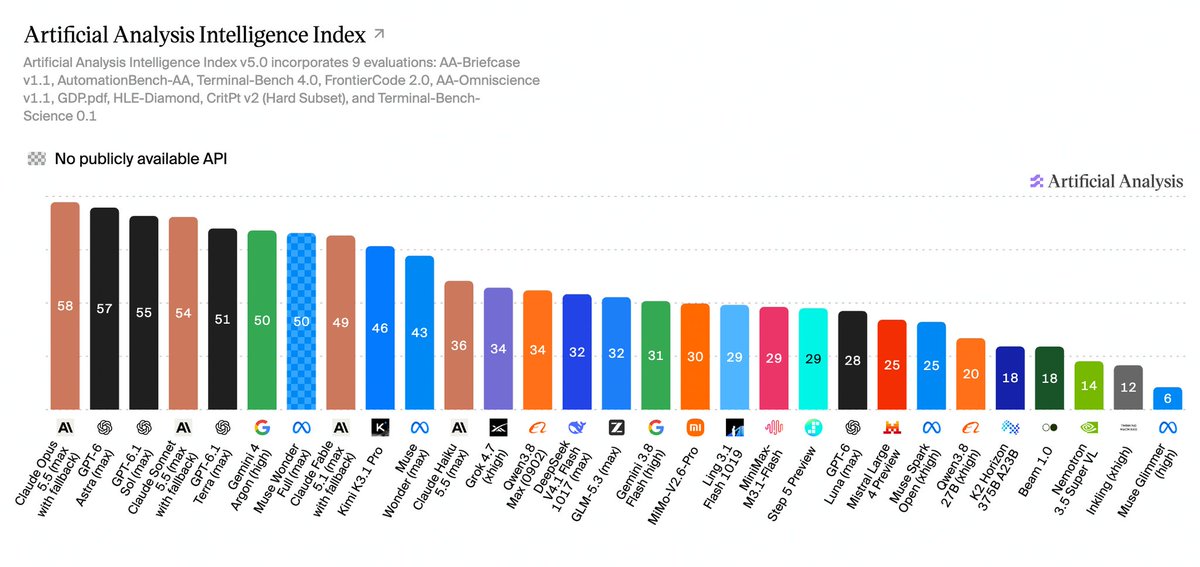
Announcing Artificial Analysis Intelligence Index v5, featuring 2 new benchmarks and 3 upgrades. For the first time, the majority of the Index is built on private datasets
The Artificial Analysis Intelligence Index is our composite measure of model capabilities across tasks reflecting real-world usage today. v5 is our biggest upgrade since v4 launched in January. With v5, 60% of the Index is now based on evaluations with private test sets or held-out answers.
Alongside Intelligence Index v5, we’re launching the Artificial Analysis Progress Index v1, which tracks model capability over time on one continuous scale.
New to the Intelligence Index:
➤ FrontierCode 2.0: Cognition's newly-launched private benchmark of real-world coding tasks, graded on whether a repository maintainer would merge the agent's change
➤ Terminal-Bench-Science: 70 agentic scientific research tasks, run in a terminal environment
Upgraded:
➤ HLE-Diamond (replacing Humanity's Last Exam): a refined 1,000-question version of Humanity's Last Exam, split evenly between reasoning and knowledge questions
➤ AA-Omniscience v1.1: An updated dataset with saturated and public set questions removed, new questions added, and ambiguous or erroneous questions revised
➤ CritPt v2: a private, 40-question hard subset of CritPt v2, revised by the CritPt authors and run with a code-execution tool
Staying in the Index: AA-Briefcase, AutomationBench-AA, GDP.pdf and Terminal-Bench 4.0
Removed from the Index: GDPval-AA v2.1, SciCode, and AA-LCR v1.1
Key results:
➤ Claude Opus 5.5 (max) leads at 58, ahead of GPT-6 Astra (max, 57) and GPT-6.1 Sol (max, 55): Anthropic and OpenAI hold the top five models. Gemini 4 Argon (high) is next at 50
➤ The open weights gap widens from 3 points to 12: Kimi K3.1 Pro (weights not yet released) is the top open weights model at 46. Among released weights, DeepSeek V4.1 Flash 1017 (max) and GLM-5.3 (max) lead at 32 - 26 points behind the leader and below Claude Haiku 5.5 (max, 36)
➤ Cost per task varies by more than 13x among the leading models: of the 10 highest-scoring models shown, GPT-6.1 Terra (max) is the cheapest at $0.96 per Intelligence Index task and Claude Fable 5.1 (max) the most expensive at $13.04
@shmameron It depends on the constants. Even assuming C=1, practicality doesn’t really kick in until like 2^-5 or even 2^-3 and that’s for >64bit multiplication. You’d ideally want something on the order of 2^-2 for typical calculations
Just know: if you say your product is “the _____ for _____” I’m never clicking on your ad ever.
“The cursor for video” “the figma for cad” “the salesforce for AI” “the notion for agents”
Shut up.
Even if a future system isn’t conscious, a sufficiently capable AI may be impacted by this in their data. The paper where this idea originated explicitly calls out the destructive actions the AI took to prevent “pain”. A future AI could be “afraid” of this outcome and take action
I’ve been seeing a lot about the AI torture chamber GitHub repo and the debates around it.
And I’m not sure whether it matters if an LLM is conscious (it’s not). What do you gain from witnessing and creating imaginary harm? It should reflect on the individual.
And I’m not even talking about future AI systems. An AI can conceivably be conscious, even if current AI systems aren’t. We know next to nothing about the nature of consciousness. Shutting these discussions down now because of our lack of understanding is shortsighted.
Life is common, civilizations are extremely rare. Natural selection doesn’t select for intelligence or tool manipulation - those are byproducts and very rare.
I could go on and on about the factors that make civilization unlikely: cooking, fire, intelligence, oxygen atmosphere…
@seconds_0 Subscription tokens (I.e. codex, cursor, Claude code) are highly subsidized compared to API rates. API rates are highly profitable for a given model’s marginal inference cost.
Neither includes training costs
@StatisticUrban While people do just mix it into things (especially punches) it is actually useful for things like infusing as many flavor compounds and oils are not water soluble. It’s just undiluted vodka and because it’s so pure, it’s extremely smooth when diluted
@LinkofSunshine Just cause you know a polynomial time algorithm for factoring exists doesn’t mean you could find it, or that, even if you did find it, it is feasible to run. Polynomials can be huge, and the memory requirements or other constraints could make it infeasible. A “Galactic Algorithm”
@LinkofSunshine A proof that P=NP doesn’t even necessarily change anything. You could prove it in a way that doesn’t actually tell you how to build a polynomial time algorithm for anything. A constructive proof (one that tells you how to do so) would, but that’s only one of the possibilities
@thsottiaux Can we get some limited return of tasks finishing after limits expire for 5hr limits only? Second time this week I’ve had 5hr limits run out mid edits and be unable to test or even work on other parts of the feature
It should still draw from weekly limits when doing this
@burkov Different kind of recurrence but also there’s a difference in how performance is bound. No longer being compute and memory bound at train meant you could train huge models. Now, we’re optimizing for cost at inference time and have started seeing issues training >10T scale
I’m not going to pretend that I’m the best at spotting AI, but I’m pretty confident that 9/10 comments I read these days on Twitter are AI.
Posts are maybe a little harder to parse, but the AI response is apparent.
Why would you use it over JSON? Cause it’s easier to read and write?
XML? Because it’s easier to read and write? And who actually uses XML for human facing components?
YAML? If you need to guarantee it maps to a hash table. I think it’s more readable too but that’s preference
“TOML reinvented INI”
I’ve never seen bigger rage bait in my entire life. Please let me know as to when INI had a standard parser, native types, or complex data structures like nested tables.
I’m having a real problem: why is TOML a thing? Someone decided to reinvent INI files from the 1980s and discard all of the reasons we moved on from them over the last 40 years
Why would I choose TOML over JSON, XML, or even YAML?