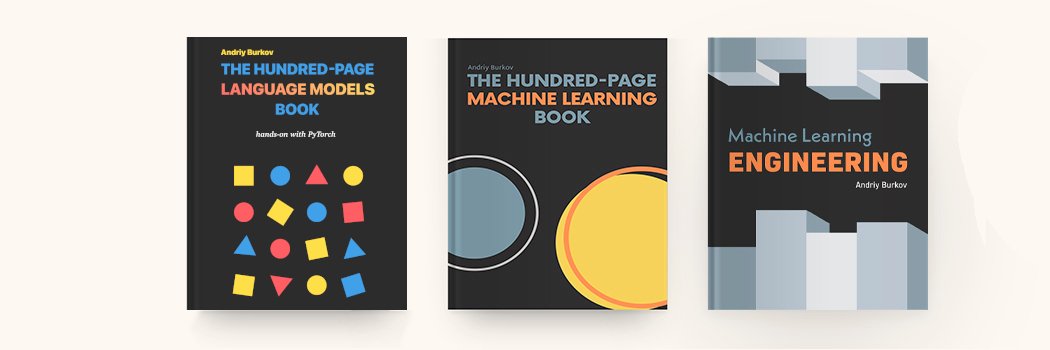
As you know, last year I resigned from my full-time job and become a professional technical book writer. I have plans for The Hundred-Page Books about reinforcement learning, computer vision, diffusion models, and more.
Not having a full-time job has put a significant strain on my savings, so if you love my books and are waiting for more, I would appreciate your continuous support.
I have finalized the offer for those who financially support me. Here's what I offer:
- As a Cool Supporter 10 🚀 ($10/month), you will get early access to new book chapters, exclusive updates on what to really care about in AI and why (only the important stuff, no hype), and a free e-book copy of all new books.
- As a Cool Supporter 30 🚀 ($30/month), you will get everything a Cool Supporter 10 🚀 gets, plus a signed hard copy of all new books.
The names of all Cool Supporters 🚀 will be mentioned in the Acknowledgment section of the new books as important contributors. Your name, printed in the book, will remain in history forever!
If you decide to become a Cool Supporter 🚀, you can choose from several platforms. Here's the list: https://t.co/1Bj1wAArBj
If you choose Substack, you will also get a subscription to a weekly AI newsletter without ads.
Post-training usually changes many model weights to add capabilities, but those changes can require large checkpoints and may weaken existing skills. The article tests a more restrictive alternative: whether a language model can learn a new task by deciding only which existing weights to set to zero, leaving every retained weight unchanged. This matters for lowering the cost of storing and switching between task-specific models, and for reducing the loss of earlier capabilities when models are adapted repeatedly.
The article evaluates Deletion Tuning, which trains a binary keep-or-delete mask over one projection in each transformer block. The team compared it with full fine-tuning and other adaptation methods across reinforcement learning with verifiable rewards, supervised fine-tuning, and on-policy distillation. Experiments covered two model families, models from 0.5 billion to 30 billion parameters, and tasks involving mathematical reasoning, general knowledge, science, and tool use. In reinforcement-learning runs, the method deleted fewer than 0.05% of all model weights.
Read with an AI tutor: https://t.co/IP8O5K4W4O
There are four ways of making decisions in life:
1. "I want to understand what the right thing to do is."
2. "I want to feel what the right thing to do is."
3. "I want to do what others would do."
4. "I want to do what God would want me to do."
You can succeed in life (or at least not fail miserably) by following one of these four strategies your entire life.
From the outside, you will look like a normal person.
On the inside, these are four different species that would never agree on anything and would not be able to convince one another. They will not understand why the other person says something like that or why they don't understand what you are stating as a fact.
The most fascinating part of this is that because, from the outside, what these four types of people do looks the same, we share the same society, and many even think "we are mostly the same except for some weirdos" their entire lives, not realizing that for 3/4 of the population, they are the weirdos.
I don't get how some people prefer Claude Code over Codex.
CC refuses to type text into an IDE, citing some restrictions that I cannot turn off in the settings. Codex doesn't have issues with typing inside an IDE.
As if this weren't annoying enough, CC refuses to take control of Codex so that Codex types at CC's command.
Useless.
@alphabatcher This is what I do: I ask Claude to write an instruction for Codex, then I copy-paste it into Codex, wait, then pass the result to Claude. "Human in the loop."
@OfficialLoganK Congrats on the release!
I will only switch to Gemini Decision on ChapterPal if it’s cheaper than Luna.
Changing models is a major decision, so I need at least one significant benefit to justify taking this risk.
The Dark Edition of my new book is now available on Amazon! It's a version of the book with black paper and white text for nighttime reading.
All illustrations were specially redrawn for this reading mode (in the dark edition of my previous language models book, the colors of the original illustrations were simply inverted).
For those who have been impatiently waiting for this, here's the link: https://t.co/pPEQEUPJ10
(There's a dark Kindle edition too.)
Stories like this are what motivate me to keep writing. I have received dozens of such stories since my first book was published in 2019, and it warms my heart knowing that many people's lives are the way they want them to be because of the result of my work.
I'm wondering if this "assistant" tells the person that the government owes them $1B or that they are liberated from paying taxes forever. Will this be a binding contract?
The Hundred-Page Machine Learning Book
Master machine learning through clarity, not complexity―in a book engineered to teach with exceptional conciseness.
Link - https://t.co/I5OZRXP9tP
#MachineLearning#ML#AI#DeepLearning#DataScience
Elon, "to be something special" is quite different from "will be the strongest model in the world when it will be released and it will remain this way going forward." What prevents any lab today from beating the competition with a substantial edge and what prevents any lab today from remaining a leader for as long as OpenAI and Anthropic used to be (that is for a year or two years in a row)?
After publishing my book today I feel so calm and light the entire day. I should have published earlier.
I didn't realize how much the weight of this unfinished business affected my mental state.
I'm thinking, instead of starting an entirely new book, to work on the second edition of my previous two hundred-page books. The first (ML) is 2019 and the second (LM) is 2025.
The Hundred-Page Machine Learning Book (PDF + EPUB + extra PDF formats) by Andriy Burkov is on sale on Leanpub! Its suggested price is $40.00; get it for $14.00 with this coupon: https://t.co/encCCvB9Cn @burkov#data_science#computer_science
By the way, yes, if you purchase a copy, no matter what kind, you can reach out to me to get a coupon for $150 worth of free GPU credits on @LambdaAPI. (Thanks to the Lambda team for the continued support of my books!)
The book uses small-ish neural networks that would run on a CPU, but if you want to apply the algorithms from the book to environments like real world robot simulations or to finetune LLMs, you would need these GPUs.
Burkov's new book takes you from the Policy Gradient Theorem to working PyTorch code. You implement REINFORCE from scratch, then move to PPO and Deep Q-Networks, all on the same rocket-landing task so you can compare how each algorithm learns and behaves.
It also covers RLHF and verifiable rewards for language models.
Lambda is sponsoring students with cloud credits to run the code.
Someone has gotten too excited 😄 The book on Leanpub is available with a suggested price of $50. You can use a slider and reduce the price to $25, which most readers do. This reader typed the price they wanted to pay by hand because the slider only allows you to go up to $100.
Thank you, my dear unknown friend. I hope you will enjoy the book at the $125 level or better!
TL;DR My new book is now available for purchase.
As you probably know, in February 2025, I resigned from my full-time job to become a full-time author. At the same time, I started working on a new book in The Hundred-Page Books series.
Then vibe coding happened, and I couldn't resist trying to build something this way. This resulted in ChapterPal, my AI-assisted reading and learning platform, which I've built without writing a single line of code. Today, with tools like Codex or Claude Code, it doesn't seem surprising, but when I started almost two years ago, I copied and pasted code back and forth to the chatbot window. It hallucinated solutions, rewrote what was working, refused to print the entire code, etc. It was a hell of an experience.
Last spring, ChapterPal's maintenance was automated enough to allow me to return to writing, which I gladly did.
And today, 20 months after I started, I finally finished my new book: The Hundred-Page Deep Reinforcement Learning Book.
Before sending the manuscript to print, I took a two-month break so that my brain could read it as if for the first time. For the entire last week, I was reading my book and I got chills so many times that I'm sure it's a very good book.
If you have been waiting for it, thanks for being patient. I hope you will see that the waiting was worth it.
Today, the book is available on Amazon as a paperback, hardcover, and Kindle edition, and on Leanpub as a PDF.
I'm currently preparing another hardcover edition, with different dimensions, for the rest of the online stores. For those who have my previous hundred-page books in their libraries, if you want the new hardcover book to be the same size as the previous two, you should probably wait for this non-Amazon edition to be published. I will announce this separately.
A couple of words about the book.
I liked the structure of my previous hundred-page book (the one on language models), where each chapter introduces a new algorithm that improves the previously introduced algorithms in some way. This makes the textbook read like a story rather than a collection of facts.
The Hundred-Page Deep Reinforcement Learning Book builds the subject step by step, beginning with reinforcement learning fundamentals and the Policy Gradient Theorem before developing REINFORCE, actor-critic methods, Generalized Advantage Estimation, and Proximal Policy Optimization (PPO). It then introduces off-policy learning and derives Deep Q-learning (DQN) from first principles. The final chapter shows how reinforcement learning applies to language models, including learning from human feedback and verifiable rewards with PPO and GRPO (remember DeepSeek R1).
The book comes with complete PyTorch implementations (on GitHub), the mathematical foundations needed to understand its content (in the appendices), and pointers for further study (in the last chapter). Additional learning resources are available on the book's wiki at https://t.co/uvVdxTeoLW.
The book was read and endorsed by several people I deeply admire. The back cover contains endorsements from Long Ouyang, a co-creator of InstructGPT and ChatGPT at OpenAI and Stephen Balaban, a co-founder and CTO at Lambda.
You can find all the endorsements at the book's website: https://t.co/j901nqgVfI.
I hope you enjoy this new release in the series as much as you enjoyed the other two. I can't wait for the readers' reviews to start coming.
(The Dark Edition is coming soon!)