MULTI-CHAIN IS LIVE ON GRIDPAD.
Three more networks. One expanding protocol.
Base, BNB Chain, and Arbitrum are now integrated into GridPad, expanding our existing architecture across Robinhood Chain, Solana, and three additional networks.
This is a major milestone for GridPad. The goal has always been to expand access without fragmenting the protocol into separate markets with different rules.
The underlying architecture remains the same. Robinhood Chain continues to serve as the canonical hub, with the bonding curve, 75/25 purchase split, reserve accounting, and redemption-floor mechanics at the core of the system.
Multi-chain infrastructure is about more than supporting additional networks. It’s about coordinating execution, messaging, and settlement while keeping the protocol’s economic logic consistent across the system.
And this expansion serves a bigger purpose.
GridPad’s long-term direction is to connect on-chain capital formation with physical compute infrastructure, including biomedical research and high-memory computing workloads. Building a connected protocol is an important part of that foundation, while actual compute provisioning and its revenue cycle remain ahead.
The network has expanded. The vision remains the same.
We’re building GridPad to go beyond token launches and toward infrastructure with a purpose.
Explore GridPad: https://t.co/poqeaNnU6U
CA: 0xc3d0bfb2bc55661063839d9e222c8a16e5834cad
GridPad Mechanism Lab is now live.
We wanted to give the community a better way to understand how GridPad actually works, beyond reading documentation or looking at numbers on a screen.
The Mechanism Lab lets you explore the protocol’s core mechanics through interactive simulations. You can examine how purchases are allocated between the bonding curve and floor reserve, see how supply changes affect floor pricing, and test different ragequit scenarios to understand how the exit mechanism behaves.
Don’t just take the mechanics at face value. Explore them yourself.
This is part of a broader direction for GridPad. We’ve been taking time to decide what we should build next and how each addition can provide real value to the community. The Mechanism Lab is the first step in that direction, with more work lined up behind it.
Try it out: https://t.co/WVikelnQ1O
We’ve been quiet for a while and that was intentional.
We didn’t want to keep posting updates just for the sake of staying active. We wanted to step back, look at where GridPad stands, and decide what the next phase should actually look like.
That direction is now taking shape. We have a sequence of things lined up, each building on the last, with a stronger focus on making GridPad more transparent, useful, and easier to understand.
One of the first things we’ll be introducing is GridPad Mechanism Lab an interactive way to explore the protocol’s mechanics, from purchase allocation and floor pricing to supply changes and ragequit scenarios. The goal is to let people understand how the system works by testing it themselves, not just reading about it.
More soon. We’re looking forward to getting back to building in public, with a clearer direction and more substance behind what we share.
Every build cycle eventually reaches a point where you stop adding things just for the sake of adding more.
GridPad has come a long way from its original foundation. The core protocol, token economics, cross-chain expansion, and the broader infrastructure thesis have all shaped what we’re building today.
We’ve spent a lot of time getting the mechanics right, extending the architecture, and working through the details that often don’t show up in a post. Now it’s time to take a step back and think about what should come next.
I don’t want GridPad to become a project that keeps shipping updates without a clear reason behind them. The next direction should be something that genuinely adds value to the protocol and gives us a meaningful problem to solve.
So we’re opening that conversation.
If you’ve been following GridPad, what do you think should be the next priority? What would make the protocol more useful, more sustainable, or more interesting to build on?
We’re not rushing to announce another phase just to have something new on the timeline. We’d rather take the time to identify the right direction and build toward it properly.
The next chapter should be worth building. Let’s figure out what that looks like.
https://t.co/poqeaNorWs
GridPad is getting closer to completing one of its most important updates yet.
The final stretch is about durability: external audit, upgrade governance, and a sustainable operating plan. These are the pieces that matter if we want to build something that can stand on its own over the long term.
This goes beyond adding features. It’s about addressing the questions around security, governance, and sustainability that become increasingly important as the protocol grows.
With this update, we’re working toward completing the broader foundation we’ve set out to build: the on-chain mechanics, multi-chain infrastructure, and the longer-term compute model connecting the protocol to physical infrastructure.
There is still work to finish and verify, especially around the audit, governance, and operating plan. We won’t call those delivered until they’re in place.
But we’re approaching a significant milestone. The goal is to deliver on the commitments we’ve made, not just keep adding new ones.
One update closer to the full GridPad vision.
https://t.co/poqeaNorWs
Good morning, GridPad community.
There’s a lot more to building a protocol than shipping features and announcing milestones. The real work is making sure the pieces fit together, the mechanics hold up, and the things we build can prove their value outside the interface.
That’s the mindset we’re bringing into the next phase of GridPad, from expanding across chains to working toward physical compute infrastructure.
Still plenty to build, test, and get right. One step at a time.
Hope everyone has a productive day ahead.
REAL COMPUTE IS LIVE ON GRIDPAD.
This is the milestone we’ve been building toward: moving beyond the protocol itself and connecting GridPad to physical compute infrastructure that performs real work.
The compute adapters are operational, paid leases are running, and workloads are being executed on actual infrastructure. We’re now tracking utilization, recording job receipts, and measuring the economics behind the compute being delivered.
But the important part isn’t simply that jobs are running. It’s being able to verify what was executed, what it cost, what revenue it generated, and how that activity connects to GridPad’s economic model.
With the compute revenue flow now operational, verified revenue can be accounted for and directed into the relevant token’s floor reserve according to the protocol’s rules.
This is the connection we’ve been working toward: on-chain mechanics, physical infrastructure, real workloads, and measurable economic activity.
We’ll publish the relevant deployment references and execution evidence so the community can inspect the system rather than relying on an announcement alone.
GridPad is moving from the design of a compute-backed protocol toward demonstrating the infrastructure and revenue cycle behind it.
The next phase isn’t just about what the protocol can do. It’s about what the infrastructure can prove.
https://t.co/poqeaNorWs
The interesting part of connecting physical compute to GridPad isn’t just getting workloads running. It’s what happens to the economics once those workloads start generating revenue.
The model we’re working toward is straightforward in principle: research labs pay for compute, jobs are executed on provisioned infrastructure, and the resulting activity is measured and recorded. After accounting for operating costs and the actual economics of delivery, the intention is for compute revenue to flow into the relevant token’s floor reserve.
But for that model to mean anything, the numbers need to be verifiable.
A completed job should have a receipt. Utilization should reflect actual workloads, not simulated activity. Revenue should be distinguishable from gross billing, and margins should account for the costs involved in delivering the compute.
Without that level of transparency, it’s difficult to know whether the infrastructure is genuinely producing economic value or simply generating activity on a dashboard.
This is why receipts, telemetry, operating costs, and measured margins are important parts of the compute architecture we’re planning.
To be clear, the paid workloads and revenue-to-reserve cycle aren’t live yet. Those are milestones the system still needs to reach and demonstrate with real execution data.
The goal isn’t just to connect tokens to compute. It’s to build a verifiable path between useful work performed, revenue earned, and the reserve that is intended to benefit from it.
https://t.co/poqeaNnU6U
Getting access to compute resources is one thing. Building a system that can actually provision them, pay for workloads, and account for what happens afterward is a different challenge.
That’s the architecture we’re working toward with GridPad.
The plan includes compute adapters for Akash and https://t.co/DHAldzwq7C, allowing GridPad to connect with external compute infrastructure rather than trying to build an entire hardware network from scratch. The goal is to support real nodes, paid leases, and workloads that can be tracked from execution through completion.
But connecting to a compute provider is only one part of the equation.
There needs to be a funding model that makes the leases possible, a way to verify that the work was actually performed, and reliable records of utilization, costs, and revenue. Without those pieces, having access to infrastructure doesn’t automatically create a sustainable compute system.
For GridPad, these components also need to fit into the broader economic design, where future compute revenue is intended to flow into the token’s floor reserve.
The adapters, funding model, and real paid-lease infrastructure are still being developed. Node activity and utilization shown today are simulated, not evidence of live compute revenue.
The objective is to connect the entire process, from provisioning a resource to accounting for the work it delivers.
That’s the architecture we’re building toward.
https://t.co/poqeaNnU6U
Multi-chain expansion is one part of what we’re building with GridPad. The next part is connecting the protocol to physical compute infrastructure.
The longer-term goal is to move beyond on-chain mechanics and build toward compute resources that can support real workloads, especially in areas where access to reliable, high-performance infrastructure matters.
Biomedical research is one direction we’re interested in. Workloads such as molecular dynamics, protein prediction, genomics, and medical-device simulation can require significant computing resources, particularly when dealing with larger datasets and high-memory workloads.
For GridPad, this means working toward the infrastructure needed to provision compute, run paid jobs, measure utilization, and account for the revenue those jobs generate.
There’s an important distinction here: the compute provisioning and revenue cycle aren’t live yet. We’re still working toward the adapters, funding model, and operational systems required to make that part of the thesis real.
The idea is to build the foundation properly, then connect it to actual compute activity that can be measured and verified.
Multi-chain expands the protocol. Physical compute is the next direction we’re building toward.
https://t.co/poqeaNorWs
MULTI-CHAIN IS LIVE ON GRIDPAD.
Three more networks. One expanding protocol.
Base, BNB Chain, and Arbitrum are now integrated into GridPad, expanding our existing architecture across Robinhood Chain, Solana, and three additional networks.
This is a major milestone for GridPad. The goal has always been to expand access without fragmenting the protocol into separate markets with different rules.
The underlying architecture remains the same. Robinhood Chain continues to serve as the canonical hub, with the bonding curve, 75/25 purchase split, reserve accounting, and redemption-floor mechanics at the core of the system.
Multi-chain infrastructure is about more than supporting additional networks. It’s about coordinating execution, messaging, and settlement while keeping the protocol’s economic logic consistent across the system.
And this expansion serves a bigger purpose.
GridPad’s long-term direction is to connect on-chain capital formation with physical compute infrastructure, including biomedical research and high-memory computing workloads. Building a connected protocol is an important part of that foundation, while actual compute provisioning and its revenue cycle remain ahead.
The network has expanded. The vision remains the same.
We’re building GridPad to go beyond token launches and toward infrastructure with a purpose.
Explore GridPad: https://t.co/poqeaNnU6U
CA: 0xc3d0bfb2bc55661063839d9e222c8a16e5834cad
Cross-chain trading is an important step for GridPad, but it isn’t where the idea ends.
The next challenge is connecting the protocol’s on-chain mechanics to something that exists outside the blockchain: physical compute infrastructure that can actually run workloads and produce measurable results.
For GridPad, that means working toward the systems needed to provision compute resources, track their utilization, execute research workloads, and account for the revenue they generate.
The longer-term plan is to connect that revenue back to the token’s reserve mechanism. If we can build that full cycle properly, the relationship between the protocol and the infrastructure becomes more than just a concept on paper.
But there’s a lot that needs to happen before we get there. Hardware provisioning, workload execution, reliable telemetry, and the revenue cycle are still future milestones. The current focus on the protocol and its cross-chain architecture is part of laying the groundwork for them.
We’re thinking beyond where a token can be traded. The bigger question is whether the system around it can eventually support something useful in the physical world.
That’s the part of GridPad I want us to keep building toward.
https://t.co/poqeaNnU6U
The bigger goal for GridPad has always been what happens beyond the token market.
We’re building the protocol with the intention of connecting on-chain capital formation to physical compute infrastructure. Not just creating another place to launch tokens, but working toward a system where that infrastructure can eventually support workloads that need serious computing resources.
Biomedical research is one area we’re particularly interested in. Molecular dynamics, protein prediction, genomics, and medical-device simulation can all require substantial compute capacity, especially as workloads grow more demanding.
The multi-chain work is part of building the foundation for that longer-term direction. Expanding access to the protocol is one step; developing the infrastructure that can make the wider thesis real is another.
To be clear, physical compute provisioning and the associated revenue cycle are still ahead of us. We’re not presenting those as live capabilities today. There’s a lot of work between the current protocol and that end goal, and that’s exactly why the underlying infrastructure matters.
The ambition is to connect these pieces over time: on-chain mechanisms, physical compute, and useful research workloads.
That’s the direction we’re working toward with GridPad.
https://t.co/poqeaNorWs
Adding another chain is the easy part to explain. Making sure everything works correctly across it is where the real work begins.
GridPad isn’t meant to become three or four separate markets with different rules. The idea is to extend access to the same protocol while keeping its core mechanics consistent, regardless of where a transaction starts.
The bonding curve still needs to follow the same logic. The 75/25 purchase split must remain intact. The floor reserve and circulating supply must stay correctly accounted for, and cross-chain transactions need to reach proper settlement rather than stopping at a successful transaction on the source network.
That’s why we’re approaching each integration as a protocol-level extension, not just another network added to the interface.
More chains only make sense if the underlying system remains coherent as it grows. Otherwise, we’re just adding complexity without building something more useful.
That’s the standard we’re working toward with GridPad.
https://t.co/poqeaNnU6U
GridPad’s network expansion continues.
With Robinhood Chain serving as the core hub and Solana already part of our cross-chain work, we’re now moving toward the next three networks: Base, BNB Chain, and Arbitrum.
The goal isn’t to build separate versions of GridPad on every chain. It’s to extend access to the same underlying protocol while keeping the economic logic consistent across the system.
That means more than adding network support. Each integration needs to account for execution, messaging, settlement, and failure handling without compromising the mechanics already in place.
We’re pushing forward with this next stage today. The focus is on connecting these networks properly, not just making them appear in the interface.
One hub, more ways to access the protocol. That’s the direction we’re building toward.
https://t.co/poqeaNorWs
I want to open this up to the people who have been following GridPad, especially those who have taken the time to look beyond the posts and actually explore what we’re building.
If you’ve visited https://t.co/xbqvi5Dzf4, gone through the documentation, or spent time understanding how the protocol works, I’d genuinely like to know what you think.
Not just what you like about it, but what doesn’t make sense to you.
Is there something about the product that feels confusing? Something in the documentation that could be explained better? A part of the mechanics you’d approach differently? Or maybe there’s functionality you expected to find but couldn’t?
These are the kinds of things that are easy to miss when you’re building something yourself. You spend so much time working on the underlying system that you can forget how it looks to someone seeing it for the first time. What feels obvious to the developer might not be obvious to the user at all.
GridPad has a specific direction. We’re building around the idea of connecting token economics with a reserve mechanism, with the longer-term goal of bringing physical compute infrastructure into that model. But having a clear thesis doesn’t mean every decision we’ve made is automatically the right one.
I’d rather have someone point out a genuine weakness now than have us overlook it because nobody wanted to question it.
So if you have feedback, please be specific. Tell us what you think should change, what needs a better explanation, or what you believe we’re missing entirely. You don’t have to agree with the approach we’re taking, and you don’t need to be a developer to have a useful opinion about the product.
You can explore the platform and docs here: https://t.co/poqeaNnU6U
We’re building this, but that doesn’t mean every good idea has to come from us. Let’s hear what you think.
What if launching a token was just the beginning, rather than the whole point?
Crypto has made it easy to create and trade tokens. But connecting those tokens to something that produces real value over time is a much harder problem, and I think it’s worth exploring.
That’s part of the thinking behind GridPad. A portion of each purchase goes into a reserve governed by the protocol’s rules, while the longer-term goal is to connect that economic foundation to physical compute infrastructure, including resources for biomedical research and other demanding workloads.
We’re not pretending that the entire vision is already built. The on-chain mechanics are live, while the real compute infrastructure and its revenue cycle are still ahead. But the idea is to build toward something that extends beyond the token market itself.
At the same time, I don’t think every token needs to be tied to infrastructure or solve some massive problem. Different projects have different purposes.
I’m curious where people draw the line here. Should a token project have a clear purpose beyond trading, or can a strong community and an active market be enough?
I’d like to hear different perspectives on this, especially from people who have actually built or launched projects.
I’ve been thinking about the kind of projects people would actually want to see launched on GridPad.
Not just another token that gets launched, gets some attention for a few days, and then nobody knows what happens next. I’m more interested in seeing what people can build around the mechanics, and what kind of ideas are worth giving a chance in the first place.
From the creator’s side, launching a token is only one part of it. You also have to think about how people discover it, what makes them trust the system, how the project stands apart, and whether there’s a reason for people to stay interested beyond the initial launch.
That’s something I want to understand better as GridPad develops. We can build features based on our own assumptions, but hearing directly from the people who might actually use the platform is a lot more useful.
So I’d like to ask both creators and holders a few things.
If you were launching a project on GridPad, what would you want the platform to offer beyond token creation and trading? And if you’re someone who discovers and buys into new projects, what would make you take a launch seriously enough to participate?
I’m interested in actual opinions here, even if it’s something you think we’re missing completely.
Let’s hear it.
One thing you learn while building is that getting something to work and getting it right are two very different things.
You can have a clean website, a working interface, everything looking good from the outside. But the real test starts when people actually use what you’ve built. That’s where the small things matter, and where you find out what still needs work.
Obviously, everyone wants to ship fast. I do too. But I’d rather spend extra time getting the fundamentals right than rush something out just to say it’s live.
Curious how other builders see this. When you’re working on something early stage, do you prefer shipping fast and improving along the way, or taking more time to get the foundations right first?
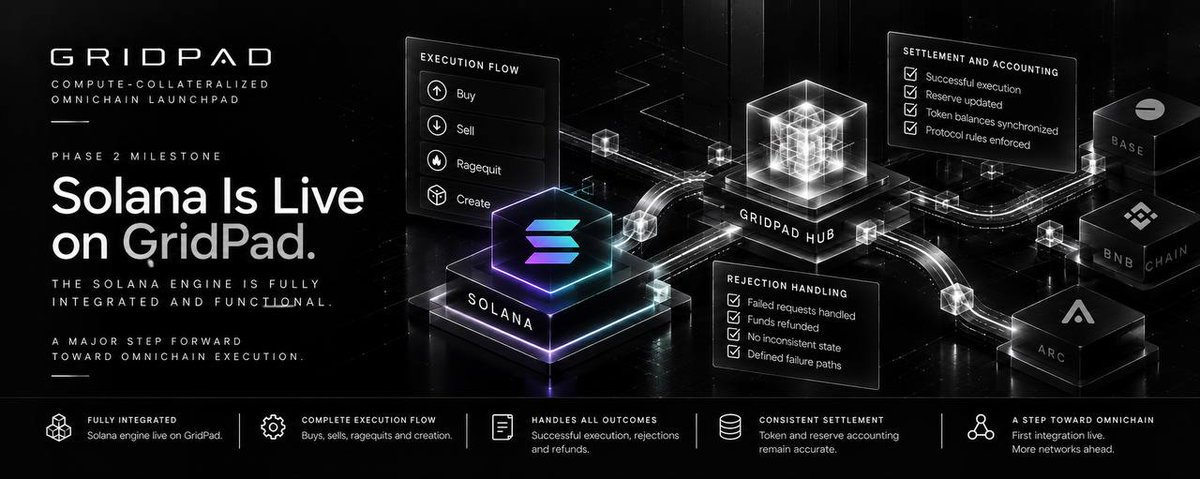
Solana Is Live on GridPad. Phase 2 Has Begun.
GridPad’s Solana engine is fully integrated, functional, and live. This marks a major milestone in our move toward an omnichain launchpad, extending GridPad beyond its Robinhood Chain hub and bringing the first targeted chain into the experience.
Getting here required more than connecting another network. The integration had to account for how transactions originate, how execution is coordinated through GridPad’s hub-and-spoke architecture, and how each operation reaches a defined outcome without compromising the protocol’s economic rules.
The work brings together the Solana execution flow, transaction handling, settlement coordination, and rejection paths. Buys, sells, and ragequits must be handled correctly, while funds remain accounted for during execution. Successful operations need consistent settlement, and rejected operations need a defined failure path with appropriate refunds.
Testing these paths is just as important as making the integration work. The system must account for failed requests and reverted operations—not only successful transactions—and preserve consistency across token balances, reserve accounting, and execution outcomes.
Solana is the first step in GridPad’s broader omnichain direction. Rather than attempting to expand everywhere at once, we are building and validating the integrations one network at a time, with each chain bringing its own execution requirements.
One integration completed. One major step closer to omnichain execution.
GridPad’s expansion is moving from architecture toward a working multi-network experience.
Explore GridPad: https://t.co/poqeaNorWs