Curtailment Mitigation for PCLRs: Modeling the Effects of Front-of-Meter Netting
published byAurora Energy Research
@AuroraER_Oxford
https://t.co/1PqT7BKute
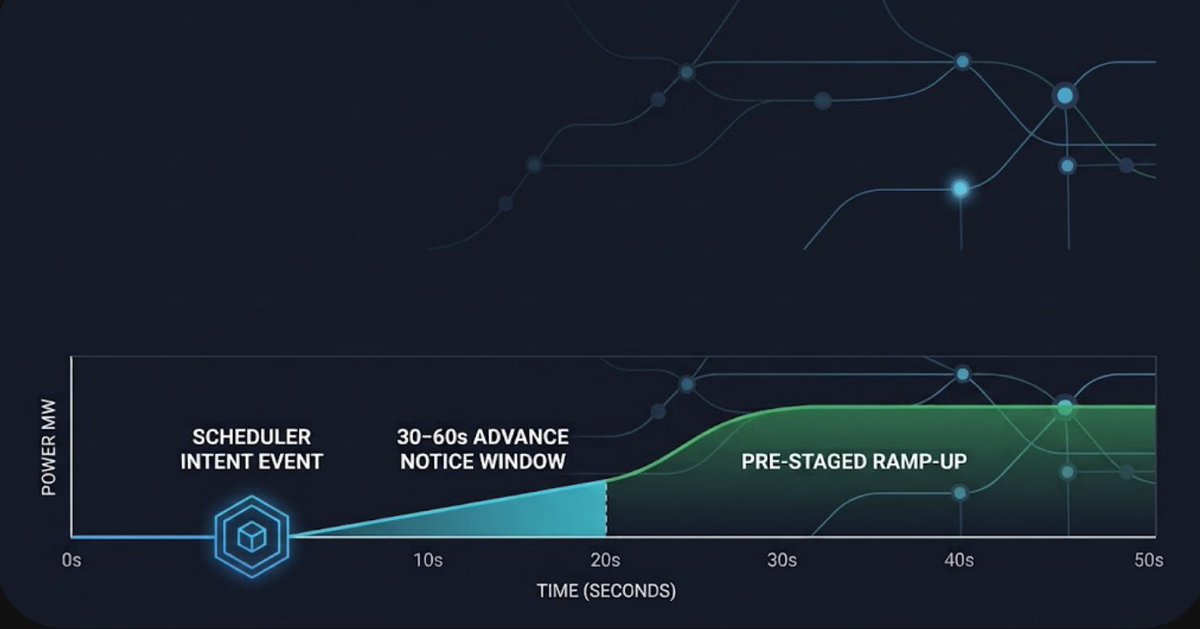
Your job scheduler already knows a power spike is coming — 30 to 60 seconds before your meters do.
That's not a marketing number. It's a physical one.
When a training job or a large inference batch gets committed to the queue, that's a decision that's already been made. The power draw that follows is a consequence, not a surprise — it just hasn't happened yet.
Meanwhile, the systems that actually respond to that draw run on their own clocks. Generators and switchgear can ramp in seconds once triggered. Cooling systems notice the heat rise on a slower, separate clock. Today, almost everything downstream waits for the meter to see the spike before either clock starts moving — reacting to something that was already knowable.
That gap between "the scheduler committed the work" and "the meter saw the draw" is the whole opportunity. It's advance warning that already exists in data centers' own systems, going unused.
That's the gap GridSignal reads. https://t.co/7D19ISBaQB
#DataCenters #AIInfrastructure #PowerManagement
For 50 years, power demand held roughly flat. Then AI broke that.
Most data center teams find out about a power spike the same way they always have: after it happens. But the warning was often already sitting in their own job scheduler, unread.
We built the GridSignal X-Ray Report to answer one question with evidence instead of guesswork: how much advance warning did your power infrastructure already have, and what did it cost you to miss it?
It's a free, one-time diagnostic. No integration, no system access — you send us 90 days of your own scheduler and power data, and we compute six figures: lead-time opportunity, capacity utilization, peak events, demand-charge ratchet risk, recoverable stranded capacity, and the full method behind every number, written out for your engineers to check.
Evidence before assumption. That's the whole idea.
If you run AI infrastructure and want to see what your data is already telling you, request your complimentary X-Ray Report here.
https://t.co/nWrnl711Bk
Another theme that emerged from our Q2 tour of datacenter industrials is that modular capacity is sold out, with demand growing faster than the pace of capacity bring-up. Modular is gaining share because it addresses the two biggest constraints on datacenter construction: time and field labor. Power and cooling systems can be assembled in factories while the shell goes up on site, compressing delivery timelines by up to 40% and reducing on-site man-hours by up to ~70% for some parts of the build. We broke down the different approaches—and the schedule, labor and cost savings—in our recent newsletter (1/4)🧵 https://t.co/7I01B8Udo9
@Cptn_Viridian@liverisnick@archpng In 1931, air quality was impacted by the burning of coal and oil for power plants, building furnaces, and factories. Residents cleaned dark gray soot from sidewalks and window sills every morning. Sulfur Dioxide was in the air, with a rotten egg smell.
@OpenAI This works "like a charm"! Can this be performed using the OpenAI APIs?
Ideally, I would like to invoke "@ChemistryCompanion" through an API call.
Watch List 2023: Main - Always Holding Some Long-Term + Trade Some Continuously All Year $SFLM $INQD $ENZC $DGWR $APRU $PSRU Watch For Catalysts + Repeat Profits On Surges $AHIX $OTTV $IJJP $CBDD $AURI $ECOX Watch For CEO Updates Off Bottom: $PRPM $SUTI $INCC
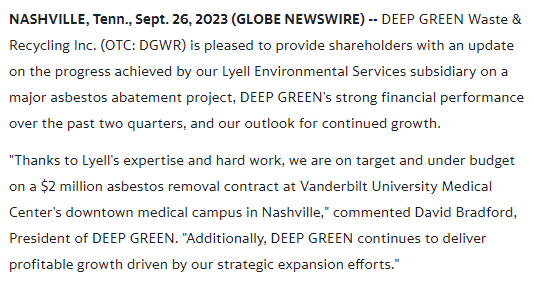
$DGWR Shareholder Update: DEEP GREEN Seeing Growth Driven by $2M Nashville Asbestos Project and Strategic Expansion
https://t.co/yJofl8wqyZ
#MarketBuzz
$DGWR Shareholder Update: DEEP GREEN Seeing Growth Driven by $2M Nashville Asbestos Project and Strategic Expansion https://t.co/Ol814MRZkK
Expansion.html
#GreenNews#Expansion#Nashville