We just launched on X, and we’re celebrating with a giveaway. 🎉
1,000 CC. 50 winners. 20 CC each.
How to enter:
✅ Follow @CauriWallet
✅ Follow @LithiumDigital
✅ Join our Discord 👉 https://t.co/ekL7L1eqnB
✅ Tag 2 friends in the comments
That’s it. Winners will be selected randomly by Grok, so everyone has an equal chance.
⏰ Closes Wednesday at 1 PM.
📢 Winners will be announced here shortly after.
Welcome to the Cauri community. Now go tag someone.
#CauriWallet #CantonNetwork #Giveaway
Introducing Cauri Wallet, a self-custody wallet built for the Canton Network.
To celebrate, we’re teaming up with @CauriWallet and @Lithiumdigital to give back to the Canton Army community.
🎉 5,000 $CC Giveaway
🏆 50 winners
💰 100 $CC each
Plus, 100 Cauri Wallet access codes will be given away:
50 to the giveaway winners and 50 additional codes for the community.
To enter:
• Follow @CauriWallet & @Lithiumdigital
• Follow @CantonArmy
• Join the Cauri Discord: https://t.co/in3Oe4BjcW
• Like and repost this post
The 50 winners will each receive 100 $CC in their Cauri Wallet.
Good luck!
Follower count is the most overrated metric in content, and reach without retention is the reason.
Everyone chases the number because it is visible and it flatters the ego instantly. I have watched accounts with fifty thousand followers post something and get four replies, all from bots.
The number looked impressive from the outside and meant almost nothing on the inside.
A large following built on convenience, a viral moment, a giveaway, a follow-for-follow loop, does not convert into anyone actually caring what you say next.
What is underrated instead is retention through specificity.
I write CVs for a living, over a hundred and twenty clients now, and the ones who come back and refer three more people are never the ones I gave the most generic advice to.
They are the ones where I said something oddly specific about their exact situation that no template could have produced.
That specificity is what makes someone remember you exist a month later. Follower count cannot do that. A precise, personal insight can.
The gap exists because specificity does not scale the way a big number does. You cannot mass produce it, you cannot buy it, and it takes longer to build than a follow button takes to click.
So people optimise for the thing that is easy to display instead of the thing that is actually load bearing.
What I learned choosing specificity over reach is that ten people who remember exactly why they trust you are worth more than ten thousand who scrolled past you once.
This is also why @RallyOnChain rewards content quality through AI scoring instead of follower size, because the platform is built around the same insight I learned the hard way.
The number was never the point.
Being remembered was.
Proverbs are the most underrated form of writing alive, and almost nobody treats them as a discipline anymore.
I have spent months writing daily content around African proverbs and forgotten history, and the thing that changed for me is realising a good proverb does more work in seven words than most threads do in seven hundred.
"The child who is carried on the back will not know how far the market is" says everything about protection, ignorance, and consequence in one breath. No thread explaining generational wealth gaps does that as cleanly.
Most people skip proverbs because they sound old, like something your grandfather says before scolding you. That is exactly the mistake.
A proverb survived because it compressed an entire argument into something a child could memorise and an adult could still be humbled by decades later.
That is not outdated, that is the most efficient information format humans have ever invented, older than writing itself in most oral traditions.
What changed for me is I stopped treating them as decoration for a caption and started treating them as the actual argument.
Once you build a post around a proverb instead of bolting one on at the end, the whole thing gets tighter, because the proverb forces you to earn its meaning instead of just quoting it.
I write for @RallyOnChain campaigns now, and the same discipline applies there too.
Say the true thing in the fewest words that still land. A proverb taught me that before any campaign brief did.
@ceedzinies Proving you have enough money without showing your whole balance is the use case that actually made this real for me. Suddenly it is not abstract anymore.
Zero-knowledge proofs are the concept everyone explains wrong, and I know exactly why.
Most explanations jump straight to “you can prove something without revealing it,” which sounds like a riddle, not an answer. Nobody tells you what that actually looks like.
Here is the what finally makes it click.
You and your friend are looking at a Where’s Waldo book. Your friend says they found Waldo. You do not believe them. You want proof, but if they point at the page, the game is over, you now know where Waldo is too.
So instead, your friend takes a giant piece of cardboard, way bigger than the book, with a tiny hole cut in it.
They lay the cardboard over the page, and slide it around until Waldo lines up perfectly under the hole.
You see Waldo through the hole. You see nothing else on the page. You now know for a fact they found him, but you still have no idea where he is on the page yourself.
That is a zero-knowledge proof. Proving you know something is true, without showing the thing that proves it.
This matters more than people realise. It means you can prove you are old enough to buy something without showing your exact birthday. Prove you have enough money for a trade without showing your whole wallet balance. Prove a vote was counted correctly without revealing who anyone voted for.
The reason the usual explanations fail is they explain the result and skip the cardboard. The cardboard is the whole idea.
Learned how to actually break this down clearly while writing for @RallyOnChain campaigns, where the AI grading does not care how smart you sound, only whether a real person could understand you.
@ceedzinies This explains so much honestly. We grow up borrowing other people’s words for feelings our own language never bothered to name.
Thank you for this
Yoruba has no word for “boredom” as a state of being.
It has words for “there is nothing to do” but not for the feeling that eats you alive when nothing means something.
I spent years teaching English to children and realised the language you grow up in decides which emotions you are allowed to feel precisely, and which ones you just have to carry without a name for them.
Anyway I am on @RallyOnChain getting paid to think out loud, which is the closest thing to a solution I have found.
Ìparí kúku ni òpin sinimá
@ceedzinies The point about courts not being built for agents hit different. No address, no patience, no jurisdiction to stand in. The entire legal system assumes a body shows up somewhere eventually.
The agent stack has payments.
It has identity.
It has a way to talk to other agents. Nobody bothered to give it a way to disagree.
That sounds like a small gap until you sit with it. x402 moves the money.
ERC-8004 proves who an agent is. A2A lets agents coordinate across systems. All three are excellent, and all three assume the deal goes through clean.
Nobody shipped the function that activates the moment two agents look at the same outcome and reach different conclusions about whether it counts.
And it will happen constantly, not occasionally.
Picture an agent paying another agent to verify a shipment, and the verification comes back partial because half the manifest was unreadable.
Is that a completed job or a failed one? A smart contract cannot answer that.
It was built to check whether a condition is true or false, not to weigh whether "partial but reasonable" satisfies a clause written for a different scenario. Code does not have opinions.
Disputes need opinions, formed carefully, and converged on by something that can actually reason.
Courts cannot fill that gap either, and not because courts are bad at their job. They are slow by design, built for parties with addresses, patience, and a shared jurisdiction to stand in.
An agent has none of those things. It cannot wait four months for a docket date. It does not live anywhere a subpoena can reach.
This is the exact seam @GenLayer is built to close. It is the adjudication layer underneath the agentic economy, the layer that lets a contested outcome actually get judged instead of just executed or stalled.
Validators connected to different language models look at the same dispute independently and reach a verdict.
When they do not agree, the panel expands and the decision can be appealed. Nobody intermediates the call.
The process is the authority.
Bitcoin solved trustless money. Ethereum solved trustless computation. Neither solved trustless judgment, and judgment is the piece an agent economy cannot run without once the volume gets real. By the time agents outnumber the humans transacting alongside them, "what happens when we disagree" stops being a hypothetical and becomes the most asked question in the system.
GenLayer is answering it now, before the volume arrives instead of after.
@ceedzinies The Communities point for pre-token teams is underrated. Building an audience before you even need one sounds backwards until you realize that is exactly how you avoid launching into silence.
Picture a pre-token DeFi team. Three engineers, a working protocol, audited contracts, real TVL potential. Zero audience.
They post updates into a timeline of forty followers, most of whom are other founders doing the exact same thing to each other.
This is the project Rally was actually built for.
The article nails the trap these teams fall into: “Brands don’t come to Rally because they need another tool.
They come because they need distribution and visibility, the two things that don’t come free anymore and that no amount of vibe coding can generate on its own.” A pre-token team has nothing to spend on agencies and no track record to attract a serious KOL roster anyway. They are stuck building in a vacuum, which is the most common way a genuinely good protocol dies quietly.
Here is why Rally fits this exact situation.
There is no minimum budget to access 150,000-plus creators, no need to already be known to get noticed, because the protocol rewards content quality through AI scoring rather than following size or relationship with an agency.
A creator with 600 real followers who explains your protocol’s mechanism accurately can outperform a paid placement from an account with fifty thousand followers and zero understanding of what they are promoting.
The part that matters even more for a pre-token team specifically is Communities.
You do not need a token or a campaign budget to start. You can build a Community on Rally now, reward early supporters with points, and have a real, engaged base waiting the moment you do launch a token.
That is the difference between launching into silence and launching into an audience that already knows your protocol because they helped build attention around it months earlier.
@RallyOnChain is not a marketing add on for teams that already have traction.
It is the path to getting traction in the first place, which is exactly the gap most pretoken teams cannot close on their own.
@ceedzinies Every layer taking a cut while diluting the message is exactly what killed traditional KOL marketing for me. By the time it reaches an actual audience, half the budget is gone and the message barely resembles the original pitch.
Building used to be the moat. Now it is table stakes.
The line from Rally’s new piece that stopped me: “Building used to be the hard part. Not anymore. Vibe coding changed the rules. Anyone can ship an app, launch a token, or spin up a product now without writing a line of code or hiring an engineer. The barrier that used to separate the people with ideas from the people who could build them is gone.”
I have watched this play out in real time across every project I have touched.
Two years ago, shipping a working product was the differentiator. Today a solo founder with an AI coding assistant can build in a weekend what used to take a small team a quarter. The technical barrier collapsed. What did not collapse is the attention barrier.
That is the part most teams still get wrong.
They keep optimizing the product when the actual bottleneck moved downstream to: does anyone know this exists. You can have the cleanest contract, the best UX, the most thoughtful tokenomics, and still launch into silence because nobody saw it.
The old answer to that problem was renting an agency, who rented a KOL manager, who rented a roster of creators who barely understood the product they were posting about. Every layer took a cut, every layer diluted the message, and the moment the budget ran out, the attention vanished with it.
@RallyOnChain skips every one of those layers. It connects projects directly to creators, scores the actual content quality with AI instead of follower count, and pays out on-chain with nothing hidden in between.
The bottleneck used to be building.
Now it is getting found, and that is exactly the problem Rally was built to solve.
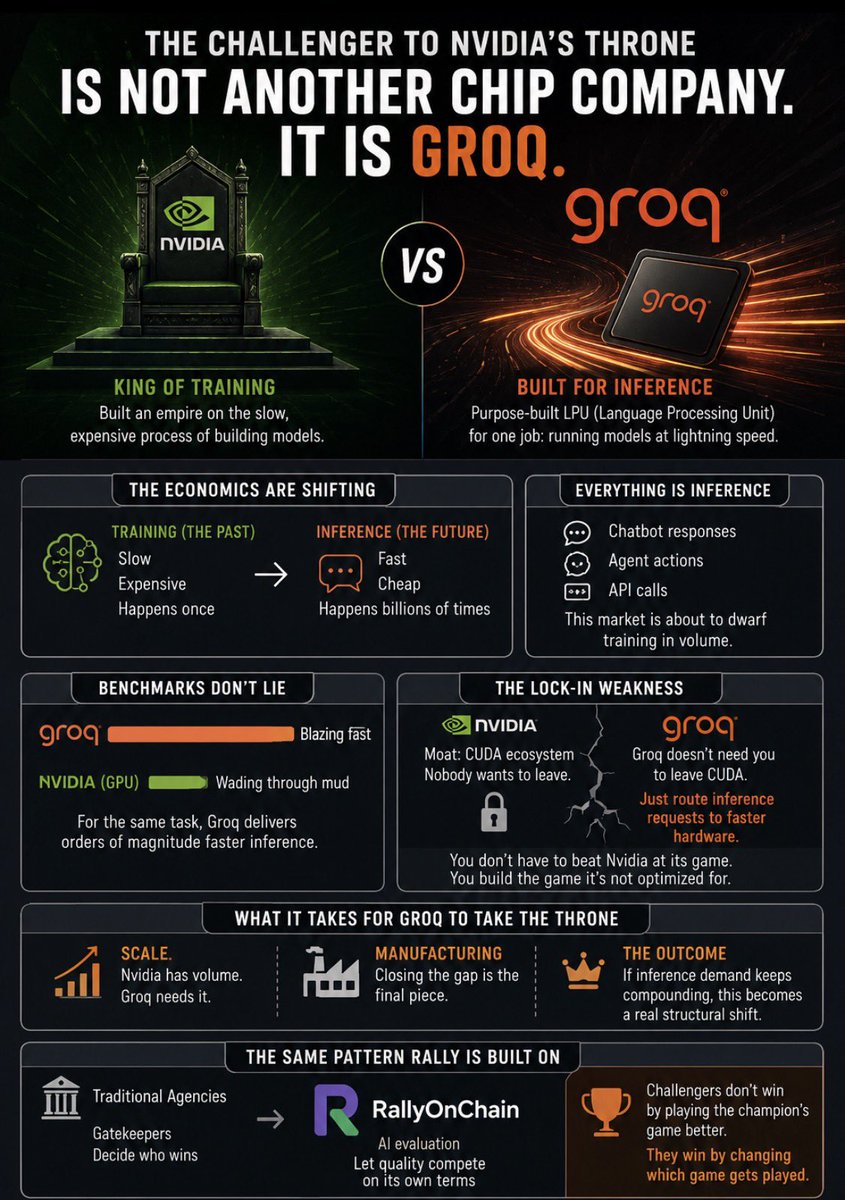
@ceedzinies The CUDA point is what got me. Groq is not trying to win the loyalty war, it is just routing around it entirely. You do not beat a moat, you build somewhere the moat does not reach.
The challenger to Nvidia's throne is not another chip company. It is Groq.
Here is the weakness Groq is exploiting: Nvidia built an empire on training, the slow, expensive process of building a model. But the economics of AI are shifting toward inference, the cheap, fast, repeated act of actually running a model once it exists. Every chatbot response, every agent action, every API call is inference. That market is about to dwarf training in volume, and Nvidia's GPUs, brilliant as they are for training, were never architected to be the most efficient option for inference at scale.
Groq built its LPU (Language Processing Unit) from scratch for exactly that job. No general purpose flexibility, no CUDA baggage, just raw, deterministic speed for running models once they are trained. The benchmarks are not close. Groq has demonstrated inference speeds that make Nvidia's setup look like it is wading through mud for the same task. When a developer needs an agent to respond in real time, milliseconds matter, and Groq wins that race consistently.
The second weakness Groq is exploiting is the lock-in itself. Nvidia's moat is CUDA, the software ecosystem nobody wants to leave. But Groq does not need developers to leave CUDA. It positions itself for the inference layer specifically, where the switching cost is lower because you are not retraining anything, you are just routing requests to faster hardware. That is the crack in the wall. You do not have to beat Nvidia at its own game. You build the game it is not optimized for and let the market migrate toward efficiency.
What would it actually take for Groq to take the throne? Scale. Nvidia still produces orders of magnitude more chips and has the manufacturing relationships to match demand. Groq has the better tool for a specific job but not yet the volume to become the default. If inference demand keeps compounding the way it has, and Groq keeps closing the manufacturing gap, this stops being a niche win and becomes a real structural shift.
This is the same pattern Rally is built on. @RallyOnChain did not try to out-agency the agencies. It built a different mechanism entirely, AI evaluation instead of gatekeepers, and let quality compete on its own terms. Challengers do not win by playing the champion's game better. They win by changing which game gets played.