@probaaron@realTomBayes Regulatory risk is there to an extent. Sports is under fire because of states & the books. Nothing will change until the Supreme Court gets involved. By then, perps will lead in volume.
CME is just upset they’re slow.
The historical bottleneck for institutional risk transfer is liquidity.
The bottleneck for liquidity is having a price benchmark for each relevant risk (eg. WTI for oil).
Kalshi has built a large community of superforecasters who are the best in the world at pricing risk. This enables us to have a price benchmark for a much broader set of questions that people and institutions face.
Institutional adoption has started through ingesting these price benchmarks into traditional asset pricing model. While there is more work to be done, we're seeing a rapid expansion of data use-cases and integrations.
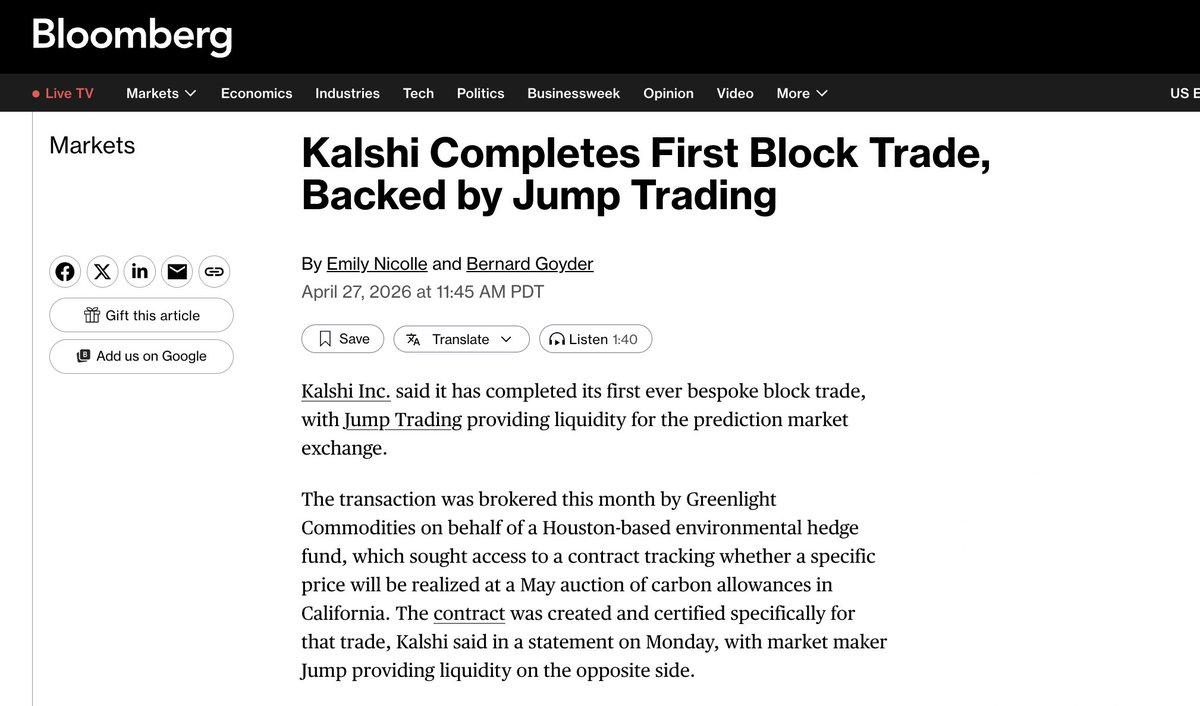
The next phase is using price benchmarks to offload risk through block trades and RFQ. This phase is in its early innings but it's starting to take shape.
It is hard to estimate the size of the market for risk transfer on non-traditional financial underlyings. The closest proxies are the re-insurance market and derivative desks at banks:
- re-insurance ~700B
- insurance-linked securities and parametric insurance (eg. cat bonds) ~$120-135B
- bank derivatives (structured products, dealer-to-dealer, exotics, etc.) ~200-400B
The current market is in the 1-1.5T range, but it's mostly illiquid and over-the-counter (OTC ie. you're trading against one counterparty).
Every time a major OTC market moved to exchange-traded, the market grew because a price benchmark got established, big-ask spreads collapsed, access stops being gated by Wall Street elites, and entirely new classes of participants enter: interest rate swaps (10-15x), equity options (20-30x), energy derivatives (5-8x).
The institutional use case for prediction markets could be a 10-15T market, with upside beyond that depending on how much they democratize access to products that are currently exclusive to Wall St.
Prediction markets are here to stay and under my leadership, I’ll protect the agency’s jurisdiction over these markets and allow them to flourish in the US.
Polymarket vs Sportsbooks: Why Betting Apps are Toast
On E248, Chamath and Friedberg discussed why prediction markets like Polymarket are killing traditional sportsbooks.
Friedberg:
“I think gambling generally, as we call it, should be decriminalized.”
“And I don't like this state-by-state set up with gambling.”
“I think we should have a federal regulatory body.”
“This is not going away. People love to bet on stuff. This is part of sports, this is part of the culture.”
Chamath:
“ Look at Polymarket.”
“Polymarket raised at, whatever it was, $1-2B at $9B. Then the next weekend they announced sports betting and now they're raising money 30 days later at, allegedly, $12-15B.”
“And you can see, by the way, the way that DraftKings and FanDuel stock have reacted to this, those companies are toast.”
Friedberg:
“ The Polymarket model is the best model because it creates a market.”
“And so as information flows in, that market will dynamically adjust and everyone will get a more fair price.”
“Polymarket actually has the news before the news does.”
“And this is one of the most powerful outputs of Polymarket, is they're actually getting a read on what's going on in the world before the media recognizes it, before the public recognizes it.”
“When you put money up, it actually turns out that when people have incentives, that market will find the truth.”