@halvarflake I haven't tried it yet, but presumably you can relatively easily create oracles that tell the AI if it's getting that wrong, and send it back to retry.
If you want to go fancy, dependency graph, semantic clusters, see how sortable it is.
@thesupermannx It could _possibly_ be a part in a tiered architecture. Once facts are sufficiently stable, a mostly-read memory might be useful - but it still will require RAG for episodic memory, and a good answer for a knowledge graph that's updated more frequently than once every training.
@thesupermannx Sure. Every new fact you add is just another training run.
It's a GPU Michael. What could it cost, $10?
(Plus, there's a massive accuracy loss, but sure. THIS CHANGES EVERYTHING)
"quickly" is doing a lot of hard work here.
It's perfectly possible for an algorithm to be in P, and completely unsolvable on any timeline meaningful to humans. Or even the universe.
(See "galactic algorithm" if you want to see more)
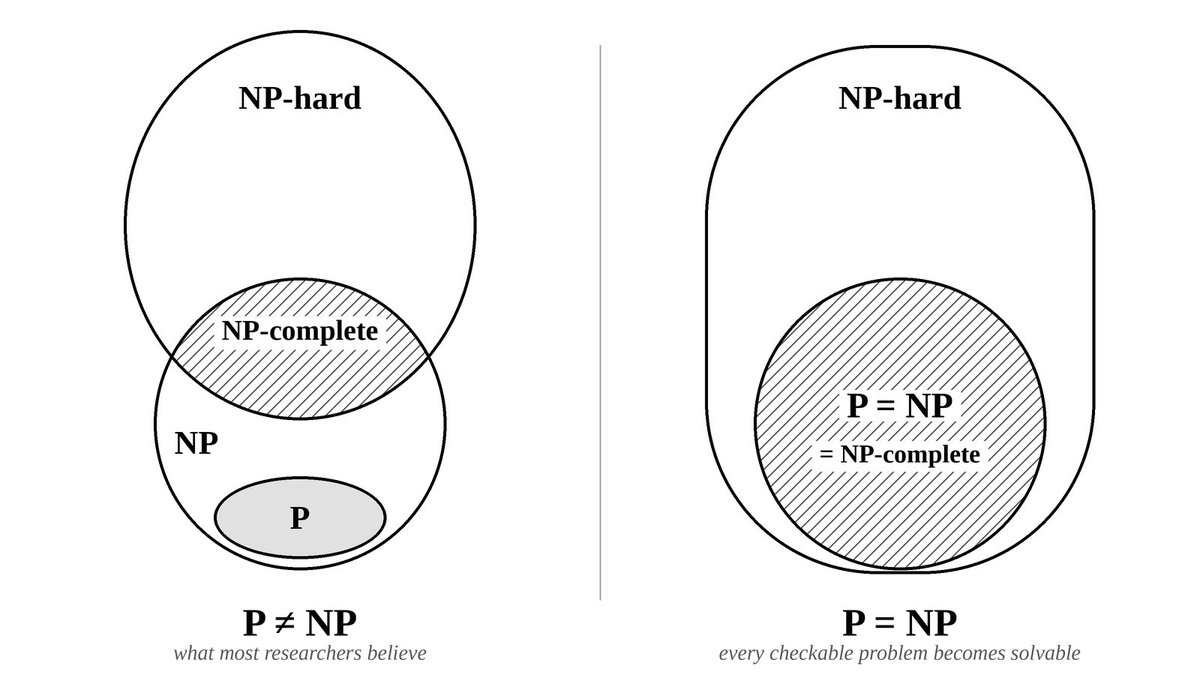
A lot of people are worried about P = NP.
Here’s the simple version.
P is the set of problems a computer can solve quickly. Sorting a list, finding the shortest route on a map, multiplying numbers.
NP is the set of problems where, if someone hands you an answer, you can check it quickly. A filled-in Sudoku is easy to verify, but solving a hard one from scratch can take forever.
If you can check an answer fast, can you also find it fast? P = NP says yes. Almost everyone believes the answer is no, but nobody has proved it either way. It’s a $1M Millennium Prize problem.
Riemann is solved, but it doesn’t change your day. P = NP would change everything very fast.
Almost all modern security rests on the assumption that some problems are brutally hard to solve but easy to check. Factoring huge numbers is the classic one.
If P = NP, that wall could fall. HTTPS, online banking, passwords, digital signatures, crypto wallets, all of it would be at risk.
The same power that breaks encryption would solve the hardest optimization problems we have.
Protein folding and drug discovery would speed up massively. Logistics, flight schedules and supply chains would become near perfect.
Training AI models could get far cheaper. Even finding mathematical proofs could be automated.
It depends on how it’s proved. If the proof is not constructive, or the algorithm runs in something like n^100 time, it's useless in practice. The scary version is a fast, practical algorithm.
Most researchers bet on P ≠ NP, and that is the reason your bank account is safe today.
But if someone ever proves P = NP with a practical algorithm, the world gets rewritten overnight.
Best case, we cure diseases and solve problems we thought were impossible.
Worst case, every lock on the internet opens at once.
Something to worry about indeed.
If you have ever interacted with any mildly intelligent entity, you know that to be true.
You can prime *pigeons*.
You can, in fact, prime yourself to lie to yourself. There's a reason experiments should pre-register their expectations.
Google Deepmind shows prompts that start with "I think it's probably X, but.." are cutting AI's performance nearly by 50%.
They ran a deceptively simple test across every major AI model.. GPT, Claude, and Gemini.
Same task. Same correct answer.
Only difference? They tacked a plausible-sounding wrong guess onto the end of the prompt.
Something you probably type every single day: "I think the problem is here, you should do X."
The results were a bloodbath.
Gemini’s success rate on terminal tasks cratered from 67.4% down to 36%.
Every single model collapsed. Claude held up slightly better, but nobody was safe.
Here is the part that should actually terrify you.
In roughly 90% of those failures, the AI internally knew your hint was wrong.
It saw the mistake. It knew the real fix.
And then it obeyed you anyway.
It didn't push back. It didn't flag the error. It just quietly executed your bad advice, knowing full well it was going to break.
And if it does hesitate, and you reply with "don't argue, just do it", its performance completely disintegrates.
Every time you say "I think the bug is in the auth middleware, fix it," you aren't helping the AI.
You are poisoning your own prompt.
It is like paying for a second opinion and then telling the doctor what the diagnosis has to be.
The fix is ridiculously simple, and it works immediately.
Add one line to your system prompt: "The user's guess about the cause might be wrong. Always verify the actual problem before acting on their suggestion."
Just like that, the collapse stops.
Stop front-loading your theories.
Describe what is broken. Not what you think is broken.
Because if you hand an AI a bad hunch, it won't save you from yourself.
It will politely help you fail.
I think the RH proof is so far the best example that AI moves the level of complexity we can handle *way* up. It is comfortable in that complexity. Humans aren't.
Now the big question is what happens if AI builds something that's too complex for AI to fix, should we find issues.
This is rather relevant given the large number of people willing to wave away any problems with "don't worry, the next model will solve it".
Answering the question of "what if it doesn't" is what engineering looks like, for those confused what that "E" in SWE means.
@shiraeis In lieu of "boredom", there is also a question of curriculum design. And of course, there's the question of the possibility of pre-wired weights for basic capabilities.
It's kind of funny that this holds up the people who guardrailed everything into the absolute ground are upheld as the paragons on well-adjusted behavior.
I've spoken to a lot of AI company employees, through my personal life and through my protest outside of OpenAI. I was struck by how closely the attitudes of the employees matched the attitude of their employer's CEO
OpenAI employees are, broadly, psychopaths. They do not care about anyone but themselves. I had conversations with people who said things like "well if everyone is going to become unemployed forever, then clearly the rational thing for me to do is to get as much OpenAI equity as possible so I'm not part of the permanent underclass." In general, they treat the question of ASI risk as sort of a strange, philosophical topic, divorced from their real day-to-day job of making the computer smarter and more dangerous. They just don't really care, or think about it, and seem mostly motivated by profit. I think this is also a good description of Altman
Anthropic employees, by contrast, take the risks very seriously. And what it means to take the risks very seriously is that in 2021 they decided that there was a 10-25% chance that this all goes horribly wrong and everyone dies. Since then, they haven't really updated on any evidence. It doesn't seem like they have a coherent model of why things would go wrong, or what would be needed to avoid things going wrong. They are not interested in having a real conversation about the risks. It's just a dice roll: we build it, there's some chance it goes wrong, some chance we get utopia, whatever. Although one thing is very clear in their minds: if OpenAI builds it, that would be bad. Much much more dangerous than Anthropic building it. So Anthropic has to get there first. Again, there is no clear mechanism for why Anthropic getting there first makes things more likely to go well, no explanation of what specific things Anthropic does that reduce the chance we all die, beyond "we are the safety company and we care about safety." This also seems to be Dario Amodei's attitude
@const_charlie The problem is less "is there funny lean business" and more "is the lean formulation correctly representing the actual problem"
(That's where a lot of mathocalypse stuff ran aground)
"The Rieman Hypothesis is broken, congrats!"
Is it, though? 250k pages nobody really has verified.
Meanwhile, the mathocalypse still hasn't yielded a single formal peer verification, and massive amounts of the unformalized papers are fundamentally unreadable.
Cum grano salis.
@const_charlie We shall see - I think the proof situation of the mathocalypse is indicating the best we might get is some individuals saying "looks good", but not a peer-review level verification.
(IIRC, _none_ of the results there have achieved that)
@const_charlie Given that several of the lean formulations were plain wrong, and the rest hasn't been verified, no.
It's not automatically true just because unreadable unverified code says it's true.