I often like Ray Dalio's takes on China but he gets quite a lot demonstrably wrong in this FT article on the "tribute system."
China's ancient tribute system - called 朝贡 (cháogòng) in Chinese - is typically very misunderstood in the West: we typically think it involved tributary states paying some form of "tribute" to China in exchange for protection - the way medieval vassals would pay fealty to a lord in Europe.
In reality, it had little to do with that. In fact, it was almost the opposite: in the Chaogong system, it was actually China paying the "tributary states."
The system was basically a quid-pro-quo where China would get "得名" (dé míng, literally "getting name/prestige") while tributary states would get "得实" (dé shí, literally "getting substance/material benefit") in exchange. It was about China paying huge amounts of money and other material benefits for the recognition of its centrality.
That's what makes it so alien to the Western framework, where tributary states are paying UP to the center, and security is enforced through military presence. The Chaogong system was almost exactly the inverse on both counts: China was paying DOWN and regional order was maintained not through the military but through generosity.
The core guiding principle of the system was established by the Hongwu emperor, the founding emperor of the Ming dynasty (incidentally one of the most interesting emperors in Chinese history since he is the only founder of a major dynasty who started off in life as a wandering beggar).
The principle he set in place was 厚往薄来 (hòu wǎng bó lái) - literally "generous outflow, modest inflow": giving out much more than you take in. This wasn't a byproduct of the system - it WAS the system. The entire architecture of Chaogong was built on this principle of asymmetric generosity.
Very concretely the way it worked is that tributary states would pay largely symbolic tribute to China (like local specialties and curiosities, the system codified that tribute should be "easy to obtain and not costly", 必易得而不贵) and they would in exchange receive 3 layers of economic benefits:
1) Immediate payback in the form of money and expensive goods (silk, brocade, porcelain, tea, silver, etc.), which value was typically dozens of times the value of the tribute received by the emperor
2) The right to trade during their tribute visit: the envoys' entourage could trade with specially licensed Chinese merchants at the Huitongguan (the official guesthouse in the capital)
3) Most importantly, and that's where the real money was, they would be granted the right to trade at Chinese ports. Under the Ming maritime prohibition, tributary status was the only legal entry point into the Chinese economy
China being China, this gave rise to some pretty funny hustles. The deal was so good that people started inventing entirely fictitious countries just to get in on it. There are several documented cases of people fabricating countries and showing up as "envoys" at the imperial court just to claim the privileges (https://t.co/nlJB8yWblv).
Another funny one is that there are several cases of Fujian merchants who would sail to Southeast Asia, get themselves appointed as minor officials by local rulers, then sail right back to China as "foreign envoys" - carrying huge commercial cargoes. In 1438, three members of Java's tribute delegation turned out to be guys from Fujian (https://t.co/QBES0IVprC).
The scam got so widespread that the Ming had to invent a credential system (勘合, kānhé) specifically to verify that tribute envoys were who they claimed to be and that the countries they came from were real.
More seriously though, the Chaogong system also led to big domestic tensions in some of China's neighboring countries, notably Japan which was permitted only one tribute mission per decade. The stakes were so high that the 2 most powerful feudal clans at the time (the Ōuchi and the Hosokawa) fought a shadow war over who controlled the trade license.
This culminated in the Ningbo Incident of 1523 (https://t.co/TgKtlc7zlO): two Japanese delegations from both rival clans arrived at the port of Ningbo and got into a dispute over whose credentials were legitimate, which ended up in a pitched battle on Chinese soil. They ended up rampaging through the city, killing Ming military officers, and altogether terrorizing the local population - all over who got to trade with China.
The aftermath of the Ningbo Incident led to the total breakdown of Japan-China trade. If that sounds familiar, it should...
Which brings back to today and Ray Dalio's description of China's tribute system, as well as his claim that we're facing some sort of modern revival of it in Asia.
First of all, some parts of his article are correct: there is indeed a significant power shift happening in Asia, with countries hedging by building closer ties with Beijing, and the US progressively withdrawing and altogether losing ground.
He is also completely right that Chinese strategic culture genuinely differs from Western strategic culture: as he writes they indeed play Go (WeiQi) and not chess.
He is however wrong to describe the tribute system as one based on pressure and intimidation. As we've just seen, it was pretty much the opposite: the basic idea was to be so generous that everyone wants in (to the extent that countries would literally fight to be tributaries), not so threatening that nobody dares leave.
He also - weirdly - seems to conflate the tribute system with the Art of War, treating them as two faces of the same Chinese playbook, when they've got strictly nothing to do with each others. They're not even from the same school of thought: the Chaogong system is fundamentally Confucian (以德服人, "winning people through virtue") whereas Sun Tzu is from an entirely different Chinese intellectual tradition - the Strategist school (兵家) - which is about as far removed from Confucian thinking as Machiavelli is from the Bible.
Mashing them together reads like someone who has picked up a handful of Chinese cliché references and treats them as interchangeable ingredients in a single "Chinese strategic culture" soup.
All in all, he makes the error WAY too many Western commentators do with Chinese concepts: he uses them as exotic wrapping paper for a fundamentally Western analysis. Strip away the Chinese terminology and his argument is actually pure Western thinking: what he is claiming is that China, as a rising power, is using its growing economic and military weight to reshape the regional order, weaker states are bandwagoning, and the declining hegemon can't stop it.
He is essentially taking Graham Allison's "Thucydides Trap," awkwardly draping it in misunderstood Chinese concepts, and presenting it as if it were Chinese thinking.
That being said, he is ironically correct - I think - that there is some form of revival of a tribute-like system but not in the way he understands it: China will (and does) use trade - its "generosity" - as a gravitational force to pull countries into its orbit. Not by threatening to cut them off, but by making the relationship too valuable to walk away from. THAT is much closer to how the actual Chaogong system worked.
It doesn't mean that the system is purely benevolent. The flipside of generosity is the absence of it: in the original tribute system, you could be cut off the way Japan was after the Ningbo Incident in the 16th century. And it's also what's happening - to some extent - to Japan today: after PM Takaichi declared that Japan would go to war with China over Taiwan, China has systematically restricted trade with Japan. Same story with what happened, for instance, to Australia in 2020 over PM Morrison's declarations on Covid.
The pattern is the same: the reward for participation is trade, and the punishment for hostility is its withdrawal. Essentially in the tribute system there is no stick, just a carrot: the stick is taking the carrot away.
Which, incidentally, is why you can be extremely confident that China will go to enormous lengths to develop its internal market, and why the current situation where China runs huge trade surpluses is facing mounting pressure to change from within China itself. If countries don't feel they're benefiting enough from trade with China, the entire logic collapses. That's why developing domestic demand isn't some target China sets itself to assuage Western demands, as some claim: it's genuinely a strategic imperative.
It's also why it's ironic that the West is so keen on pushing China to boost domestic consumption: in effect, it means we're already in a de-facto Chaogong-like system and they're asking that the carrot be bigger.
-----
I also wrote a Substack version of this post, which you can find here: https://t.co/jBUIVbDT9C
It is a busy time in our City - but our Officers, Detective and BPD Cadets are out keeping residents and visitors safe.
This BPD Cadet took time to see a gentleman across a busy intersection, have a quick chat, and introduce himself.
Community Policing takes many forms!
MA / Boston must-watch. Will make your day. Trust me.
If you ever forget why so many of us stay here, fight hard to keep this place amazing.
#magov#bospoli#magov
Canada is rapidly losing farmland to urbanization and development.
Every single day, Ontario loses 319 acres of farmland. The country loses 2,700 acres of farmland.
Once you build on farmland, it's gone forever. You can't replace it.
This is a crisis that basically nobody is talking about.
🚨 JUST IN: Trump EPA Chief Lee Zeldin just moved to AXE cruel DOG and ANIMAL testing *permanently*
Why would a Democrat oppose this?!
"We announced 13 new approach methods having that approval from our agency, which allows us to continue that process of phasing out animal testing permanently. We're excited to do it!"
Massachusetts could soon have 3 AM last call.
The House voted 147-0 to approve a bill allowing cities and towns to extend bar hours by up to one hour through July 31.
The proposal now heads to the Senate.
Another single, childless man over 40 giving sleep advice.
Show me a married man with kids and a full time job who stays physically fit and crushes life…
Those are the men we should be listening to 🤝
This is genuinely incredible and says SO SO MUCH about the perception of China in the West.
This is the #1 news show in France, and the host - David Pujadas - asks the pundits around the table (a sample of the top media figures in France) if they can name 3 living Chinese people.
That's it: they just need to say the names of 3 living Chinese people, anyone. This should be extremely easy.
Yet not of a single one of them can name a single Chinese beyond Xi Jinping. They do not know a single living Chinese person beyond the president.
That's the level of ignorance of China we're dealing with in the West today, in 2026.
This is the source for the video: https://t.co/9UnWyu63g8 Aired live yesterday 28th of May 2026.
This is actually huge.
I keep hearing the narrative that many people in China don't have social insurance: that's not true, virtually everyone in China does, BUT - up until now - you were only covered in your Hukou, your official hometown on paper, even if you hadn't lived there in decades.
Which was a big issue for the 357 million migrant workers in China who - if they had a health issue - either had to go back home to get their healthcare covered or pay out of pocket where they lived.
This is now over 👇: China's State Council just announced that workers can now enroll in social insurance wherever they work, regardless of their hukou. 357 million people just got healthcare where they actually live.
It's also huge with respect to what this means for the Hukou system overall: every reform like this chips away at it further. The direction is now unmistakable: the hukou is being dismantled, one benefit at a time.
Two hundred and fifty years ago today — on May 17th, 1776 — the Second Continental Congress called for a day of humiliation, fasting, and prayer.
Today, exactly 250 years later, we gather to do the same. To humbly ask once more for God's mercy and guidance — as we enter the next 250 years of this republic.
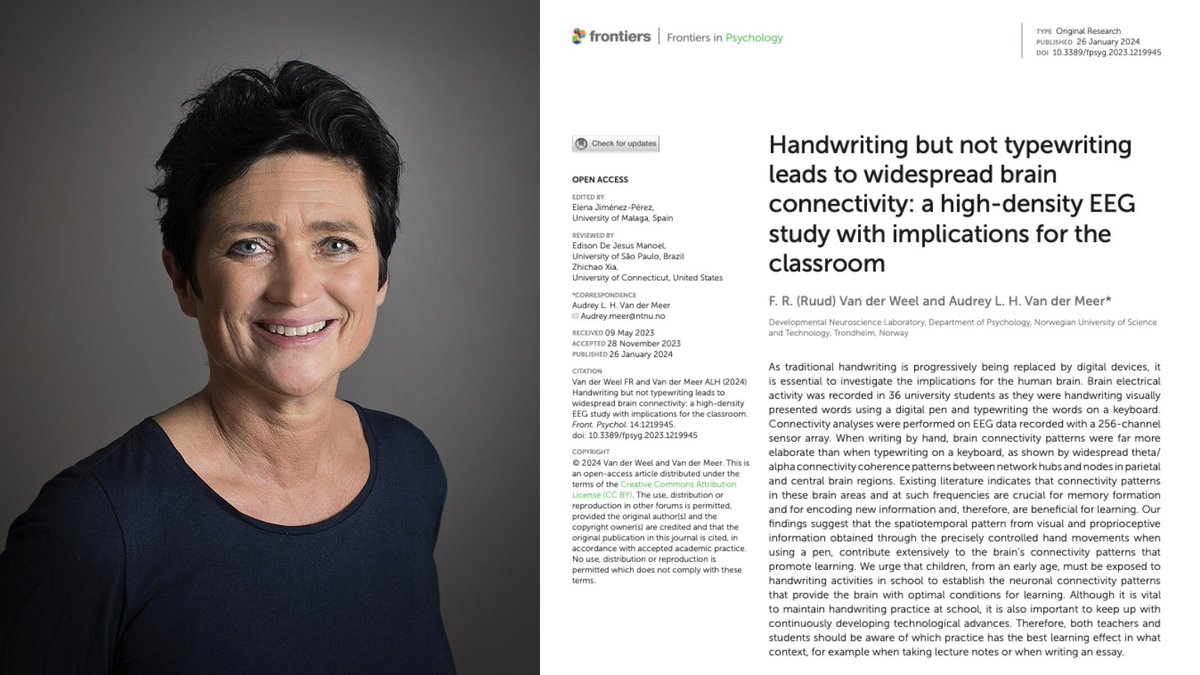
A Norwegian neuroscientist spent 20 years proving that the act of writing by hand changes the human brain in ways typing physically cannot, and almost nobody outside her field has read the paper.
Her name is Audrey van der Meer.
She runs a brain research lab in Trondheim, and the paper that closed the argument was published in 2024 in a journal called Frontiers in Psychology. The finding is brutal enough that it should have changed every classroom on Earth.
The experiment was simple. She recruited 36 university students and put each one in a cap with 256 sensors pressed against their scalp to record brain activity. Words flashed on a screen one at a time.
Sometimes the students wrote the word by hand on a touchscreen using a digital pen, and sometimes they typed the same word on a keyboard. Every neural response was recorded for the full five seconds the word stayed on screen.
Then her team looked at the part of the data most researchers had ignored for years, which is how different parts of the brain were communicating with each other during the task.
When the students wrote by hand, the brain lit up everywhere at once.
The regions responsible for memory, sensory integration, and the encoding of new information were all firing together in a coordinated pattern that spread across the entire cortex. The whole network was awake and connected.
When the same students typed the same word, that pattern collapsed almost completely.
Most of the brain went quiet, and the connections between regions that had been alive seconds earlier were nowhere to be found on the EEG.
Same word, same brain, same person, and two completely different neurological events.
The reason turned out to be something nobody had really paid attention to before her work. Writing by hand is not one motion but a sequence of thousands of tiny micro-movements coordinated with your eyes in real time, where each letter is a different shape that requires the brain to solve a slightly different spatial problem.
Your fingers, wrist, vision, and the parts of your brain that track position in space are all working together to produce one letter, then the next, then the next.
Typing throws all of that away. Every key on a keyboard requires the exact same finger motion regardless of which letter you are pressing, which means the brain has almost nothing to integrate and almost no problem to solve.
Van der Meer said it plainly in her interviews.
Pressing the same key with the same finger over and over does not stimulate the brain in any meaningful way, and she pointed out something that should scare every parent who handed their kid an iPad.
Children who learn to read and write on tablets often cannot tell letters like b and d apart, because they have never physically felt with their bodies what it takes to actually produce those letters on a page.
A decade before her, two researchers at Princeton ran the same fight using a completely different method and ended up at the same answer. Pam Mueller and Daniel Oppenheimer tested 327 students across three experiments, where half took notes on laptops with the internet disabled and half took notes by hand, before testing everyone on what they actually understood from the lectures they had watched.
The handwriting group won by a wide margin on every question that required real understanding rather than surface recall.
The reason was hiding in the transcripts of what the two groups had actually written down.
The laptop students typed almost word for word, capturing more total content but processing almost none of it as they went, while the handwriting students physically could not write fast enough to transcribe a lecture in real time, which forced them to listen carefully, decide what actually mattered, and put it in their own words on the page.
That single act of choosing what to keep was the learning itself, and the keyboard had quietly skipped the choosing and skipped the learning along with it.
Two studies. Two countries. Same answer.
Handwriting makes the brain work. Typing lets it coast.
Every note you have ever typed instead of written went into your brain through a thinner pipe. Every meeting, every book highlight, every idea you captured on your phone instead of on paper was processed at half depth.
You did not forget those things because your memory is bad. You forgot them because typing never woke the part of the brain that would have made them stick.
The fix is the thing your grandmother already knew.
Pick up a pen. Write the thing down. The slower road is the faster one.
Friedrich Merz schafft es schlichtweg nicht, mal auf einer Bühne zu sitzen, ohne vollkommen unprovoziert riesige gesellschaftliche Gruppen runterzuputzen. Nun macht er ausgerechnet das Ehrenamt nieder, bezeichnet zum Beispiel Engagement im Sport als "punktuell". Merz: "So ehrenwert das alles ist, Musik, Sport, Umweltschutz, alles gut, alles richtig..." Laut Merz ist das aber alles nicht so viel wert wie Engagement in einer politischen Partei. Merz versteht das Land nicht. Er weiß offenbar nicht, dass solches Ehrenamt nicht punktuell ist, sondern Menschen oft Jahrzehnte lang im Regen auf Sportplätzen stehen, um Kinder zu trainieren und der Gesellschaft etwas zu geben. Vollkommen unbegreiflich, wie man so herablassend darüber reden kann.
Cheryl Hines says there’s a reason MAHA Moms are so effective in DC.
Because their sole mission is keeping their families healthy — something politicians can’t argue against.
“The MAHA Moms are too strong, they’re too smart, they are too knowledgeable, and they are too loud to be ignored.”
“They get a lot of stuff done because they are true to their one mission: to keep their families healthy.”
“The politicians can’t argue that.”
“Who is arguing against having a healthy family? It’s impossible.”
“They care about the policies that are being made that are impacting their family’s health.”
🔥 @theisabelb takes down America’s “death culture.”
“For women under 35, those of us who are married with children are 3x happier than our unmarried and childless counterparts, and for men that's a 2.6x gap.”
“Motherhood is not a death sentence, and babies are not a burden. It is always a blessing.”