@SadaaShree It holds one of the few Shivaji statues where he's not holding his sword. It was installed at a comparatively pacifist time in Maharashtra politics, and hence it was felt that the statue holding a sword would be provocative.
Bhendi Bazaar isn't named because it's 'Behind' the Crawford market (Bazaar), nor is it about the humble okra. The name of the Indian Tulip is 'Gulbhendi', and it flowered there, hence, Bhindi Bazaar.
A belief said that someone dead would haunt as a ghost until it was tied to a post in a secluded spot. It was called a 'khamb' locally. One hill in Bombay had so many posts it was called Khambalaya. The British just brutalised that name to Cumballa Hill.
Pirates from Malabar would hide their ships in the current Chowpatty area, waiting to attack British ships coming from Surat into the Mumbai Port/Fort. The hill they would post their lookouts on to signal when the British approached is now known as Malabar Hill.
Bombay's traders speculating in cotton under a Banyan tree in the 1850s would birth not just today's BSE, but also one more: hungry late at night, they'd ask the local food sellers to mix leftovers and heat them with spices to eat with bread, thus inventing the humble Pav Bhaji.
@sumeetkhanna@TALLkaholic@mumbaiheritage From my research, it's based on 'Andhaar', ie darkness, blackness. The hill itself is completely a black basalt monolith, so that's not too far.
Unless the hill was mined for sulphur, (of which no records are available) this etymology is stronger.
Andheri is not named after Udayanagari (aka the Mahakali Caves hill) but after Gilbert Hill, in the then Undheree Village, known first as Andhakagiri, then Andhragiri, and later Aandheree, before the British renamed it after a random white officer/geologist. It means 'Dark Hill'.
@TALLkaholic@mumbaiheritage Gilbert Hill was originally called Andhakagiri, which was slowly converted into Andheri by the local language speakers. The British colonizers changed the name from Andhragiri (or whatever it was called by then) to Gilbert Hill, a name that continues till today.
While one corruption of Mumbai was Bombay, it's erstwhile name, there is no scientific reason for the so-called 'bom baim' or 'good bay' in Portuguese being the source of Bombay. The closest is 'boa bahia' in Portuguese or 'bonne baie' in French, which are not the sources either.
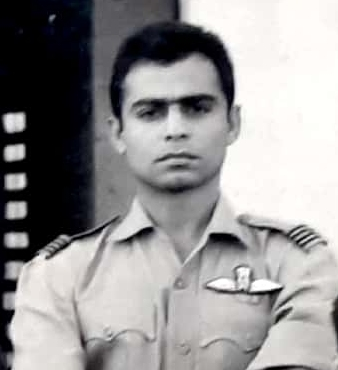
How do you land a fighter jet when you can barely see and are bleeding from your face? Every time I read this, it still leaves me in awe.
On 4 Sep 1970, Flt Lt Boman Rashid Irani, a pilot from No. 32 Sqn, was on attachment to No. 222 Sqn and leading a three-aircraft low-level tactical training mission. After completing a turn at 900 kph, a bird struck his Sukhoi Su-7.
The impact was catastrophic. The right quarter light shattered. The front windscreen and left quarter light cracked and went completely opaque. Broken glass and parts of the bird hit him on the right side of his face. The injuries caused bleeding and completely obscured the vision of his right eye. Air was rushing in through the shattered panel. He had no forward vision at all.
In pain, partially blinded, and flying a badly damaged Su-7, he kept the aircraft under control, climbed for height, and read the radio compass to navigate toward base. Peering through the broken quarter light frame with his one functioning eye, he pinpointed his position, set up a Marker Beacon approach, guided by Sqn Ldr TRJ Osman, a fellow member of the formation, found the runway, and landed safely.
His Vayu Sena Medal (Gallantry) was announced on 26 January 1972. No. 222 Sqn Commanding Officer wrote, “He displayed a very high degree of skill and airmanship in landing the aircraft safely in circumstances which could have led a less able and confident pilot to abandon the aircraft.”
Boman Rashid Irani was commissioned on the 81st Pilot Course and was by all accounts an exceptional aviator. He had trained with the USAF Advanced Fighter Course on the T-33 and F-86 at Lackland and Randolph , the kind of pedigree that marked out the finest fast jet pilots of his generation.
The cruel irony is that the very act of courage that earned him his gallantry award also ended his flying career. The injuries sustained that day led to his invalidation from service in 1977.
#IAFHistory @IAF_MCC