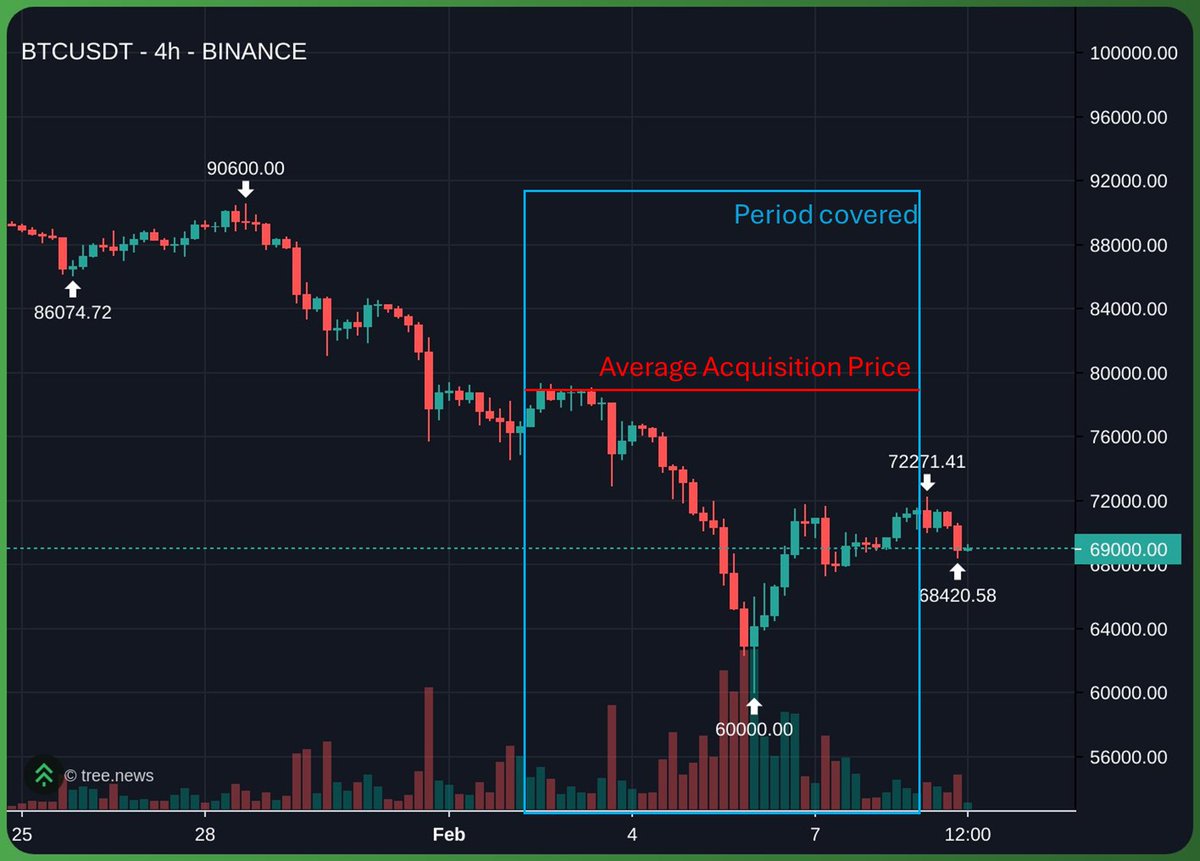
The STRC crisis will play out in a few phases 1) doesn't reach par between ex-div's 2) Strat boosts div payment to draw in more capital which ironically hastens the crisis 3) BTC weakens on weakened STRC demand, weakening all STR(x) products, causing dividends to start being paid from cash reserve rather than fresh incoming capital 4) at this moment the clock starts ticking. cash runway is far shorter than most realized. Strat refuses to sell BTC at a loss so they halt div payments. MSTR and all STR(x) products significantly repricing lower. This reverberates through BTC and crypto markets.
For me it's not a question of if, but when. The hope is that this is some far off event, but it may not be. If not then this crypto bear market could be a lot longer and more painful than many are prepared for.
@thedefivillain No the problem is that when the biggest public bidder in the market becomes sidelined , and everyone has been frontrunning him or copy-trading him , one has to wonder what’s going to happen with the bid side if the market starts to go down…
A 22-year-old graduate student in Kazakhstan got so angry at journal paywalls in 2011 that she built a pirate website holding 88 million scientific papers, and last month she turned the whole thing into an AI that lets you ask one question and get the actual research as the answer.
Her name is Alexandra Elbakyan, and the website is called Sci-Hub.
The AI she just launched is called Sci-Bot. It lives at https://t.co/6w0IBtOEYB and almost nobody outside academia knows it exists yet.
Here is the story, because it is one of the strangest things to happen in science publishing in the last 50 years.
Elbakyan was born in Almaty in 1988, the year the Soviet Union started to collapse. She taught herself programming at 12. She read Soviet science books that explained things her family used to call miracles. She got into computer security at university and graduated in 2009 with a degree she barely needed because by then she was already a serious hacker.
Alexandra moved to Moscow that fall. Then Germany. Then a research internship in the United States. She was working on brain-computer interfaces, the kind of research that requires you to read hundreds of papers a year just to keep up with the field.
And every single one of those papers was locked behind a journal paywall that cost between 30 and 50 dollars to read once.
She did the math. A graduate student in Kazakhstan could not afford to read science.
The first thing she did was learn how to get around the paywalls one paper at a time. She passed the trick around to other students. They asked her for papers constantly. She got tired of doing it manually.
So in September 2011, in three days, she wrote a script that automated the whole thing. A user pastes a DOI. The script logs in through a donated institutional credential. The paper comes back free. The website caches it.
The next person who asks for that paper gets it instantly because the previous request already saved a copy.
That was Sci-Hub. Three days of code. One graduate student. Done.
15 years later, the cache holds 88 million scientific papers. Almost every piece of scholarly literature published before 2020 is sitting on her servers. Researchers in 190 countries use it. Studies in Nature have shown that roughly half of all academic paper downloads worldwide now go through Sci-Hub, not the publishers who actually own the copyrights.
Elsevier sued her in 2015 and won a 15 million dollar judgment. She did not pay. The American Chemical Society sued her and won an injunction. She did not comply. Courts in India, France, Russia, and the UK have tried to block the domain. She just moves it. https://t.co/3sAWJzNe8I. https://t.co/tGIETesZ8i. https://t.co/H5WQ1f9lqR. The site has had over 20 domains and is still up.
Nature put her on its list of the 10 people who mattered most to science in 2016. The New York Times compared her to Edward Snowden. The Verge called her the pirate queen of science.
She has not been to the United States in over a decade because she would be arrested at the airport.
The Sci-Bot launch in April 2026 is the part that nobody is talking about.
She took the 88 million paper database and put a small language model on top of it. You ask a question in plain English. The model searches the entire shadow library, pulls the relevant papers, synthesizes an answer grounded in real citations, and links you to the full text of every source. Free. No login. No institutional credential. No paywall.
Three real scientists tested it for a Chemical and Engineering News article last month. They asked it medical and chemistry questions. The radiologist said the answer he got was usable. The chemist said the gaps in recent literature were obvious but the older science was solid. The publisher community is furious.
What she built is what the paid academic AI tools are trying to build. Except the paid ones are limited to what their parent publisher legally owns. Hers is limited to almost nothing.
Alexandra still lives somewhere in Russia. She does not give her address. She does not do video interviews. She gives talks over Skype with the camera off. She runs the largest illegal library in human history from a laptop and a donation page.
A graduate student who could not afford to read science built the system the entire scientific community now quietly depends on.
The publishers have spent a decade trying to shut her down.
She just shipped an AI that makes their entire business model outdated.
@dampedspring Question would your beta portfolio would be different if you were based elsewhere like in Europe or Japan for example ? For example benchmark to Eurostoxz or Nikkei instead of SP etc… and buy the dip in Euro bonds instead of TLT
Or you’d say fuck Europe , US is the true market
Aristotle tutored Alexander the Great.
And he took over the world.
For 2,000 years, that was the deal. 1-on-1 tutoring was the cheat code, and only the royals afforded it.
Bloom proved it in 1984. 1-on-1 tutoring routinely lifts learners from the 50th percentile to the 99th.
Now with AI, you have a tutor for anything you want to learn. Quantum mechanics at 2AM. French conjugation. How the postgres query planner works. How to negotiate a term sheet. Literally everything.
The upside is that it's infinitely patient & infinitely knowledgeable. It also cost less than most of the subscriptions you will get.
Learning has never been this easy in human history. It's in fact now your fault if you are not learning something new everyday.
Marc Andreessen on what just changed:
Based on the last week and parabolic moves of the past 48 hours ill say it now We are now in a bubble specifically a bubble in picks and shovels akin to the bubble in fiber and chips in 2000 or residential real estate in 2007.
Like those periods the bubble in the specifics also dragged all stocks up and the bubble popping drove all stocks down
Unlike George Soros who says when you identify a bubble you jump in long I am not George Soros and think he identifies it way earlier than me. So I am not going to join his protege and buy into the bubble.
I speak from my experience in the 1987 LBO bubble, the Tech bubble, the housing bubble and the bond bubble. I could be wrong but feel it necessary to share my views. I don’t use the term lightly. I have specifically said we are not in a bubble until today.
My options are to fade it or stay out of its way. I have some small risk remaining as my puts have fallen rapidly but I have NO intent of fading this in any more size. Happy to short down 5 or even 10% on the other side of the peak. Lots of opportunity in non equity macro today. But over the past week this has gone into territory I have no edge in capturing. IT will end very very badly but when and from where is unknown. But it will end with SPX below 6000 and NDX below 20,000 and Semiconductors at half of current spot. But that could be a wild and longer path than I can predict.
japan just cut crypto tax from 55% to 20% effective april 10. 35 percentage points of friction removed for 125m people overnight. japanese corporations hold $3t+ in cash. even 0.5% allocation is $15b in new demand. for context, when GPIF got clearance to allocate to alternatives in 2014 they moved $226b. japanese fiscal year started april 1, meaning institutions have 11.5 months to deploy under the new regime. watch for japanese BTC and ETH ETF filings in Q2-Q3 2026. south korea still taxing crypto at 45%+, they will fold next. the asia domino effect on capital flows is just starting
It’s pretty obvious there is a huge kickback scheme enriching Saylor.
That’s why he is executing BTC buys as soon as he gets funds
Every week when people buy MSTR he buys himself a new boat.
NEW: Polymarket hit with a nationwide class action lawsuit in the SDNY for operating "an illegal online sports gambling platform that is marketed as a 'prediction market,' but in reality, is an unlicensed sports betting enterprise prohibited under various state laws."