Real solutions don’t stop at installation.
They work on Monday mornings, during inspections, and when volumes change.
That’s the difference.
#Greenstar#WasteToValue#AgOperations
Waste problems always show up on the balance sheet.
Disposal fees.
Labor hours.
Downtime.
Compliance risk.
If waste is treated as an afterthought, it becomes a cost center.
If it’s managed correctly, it becomes an operational advantage.
#WasteToValue#AgOperations
Compliance shouldn’t feel like a moving target.
When waste is unmanaged, compliance gets harder.
When compliance gets harder, costs go up.
And when costs go up, operations suffer.
Manage waste correctly, and compliance becomes simpler and predictable.
#WasteToValue#AgOperation
Technology doesn’t fail.
Bad fit does.
Most waste systems fail because they weren’t designed for the operation they were dropped into.
One-size-fits-all doesn’t work in agriculture or food processing.
Design around the operation. Performance follows.
#SustainabilityThatWorks
Waste isn’t an engineering problem.
It’s an operations problem.
A compliance problem.
A cost problem.
That’s why Greenstar doesn’t start with equipment.
We start with the operation.
Solutions that work in the real world — not just on paper.
#WasteToValue#AgOperations
Not all waste is trash.
Some of it is just unmanaged.
Nutrients, organic matter, energy — hauled away every day.
The goal isn’t magic. It’s usefulness.
#AgBusiness#WasteManagement#CircularAg
Disposal reacts to waste.
Control changes the operation.
Fewer handoffs. Fewer surprises. More flexibility.
Waste control isn’t about buzzwords — it’s about running a tighter system.
#AgBusiness#WasteManagement#OperationalEfficiency
Sending waste off-site doesn’t eliminate risk — it just delays it.
If you generate it, you’re still tied to it.
Compliance works best when waste control starts on-site.
#AgBusiness#ComplianceMatters#WasteManagement
Most operations know what disposal costs. Very few know what waste really costs.
Labor. Downtime. Odors. Compliance risk. Lost flexibility.
At Greenstar Group LLC, we start with control — not buzzwords.
Waste isn’t just a disposal problem. It’s an operational one.
#AgWaste
From waste… to value.
U.S. processors generate 30–40B lbs of offal a year—but it doesn’t have to be a liability.
GreenStar converts organic waste into fertilizer, soil products, and renewable energy.
Turn your waste stream into a revenue stream. #WasteToValue#Sustainability
Wastewater is the #1 compliance risk for processors. High BOD/COD, fats, pathogens, and inconsistent flows = fines, fees, and headaches. GreenStar delivers pretreatment, fat recovery, and recycling systems that KEEP facilities compliant.
Manage wastewater—before it manages you.
THIS is the waste problem no one talks about.U.S. processors generate 30–40B lbs of offal every year… and most still pay to haul it away.GreenStar turns waste into fertilizer + energy, cutting hauling and odor while creating new revenue.Waste isn’t the problem. Not using it is.
Most facilities don’t have a waste problem — they have a dependence problem.
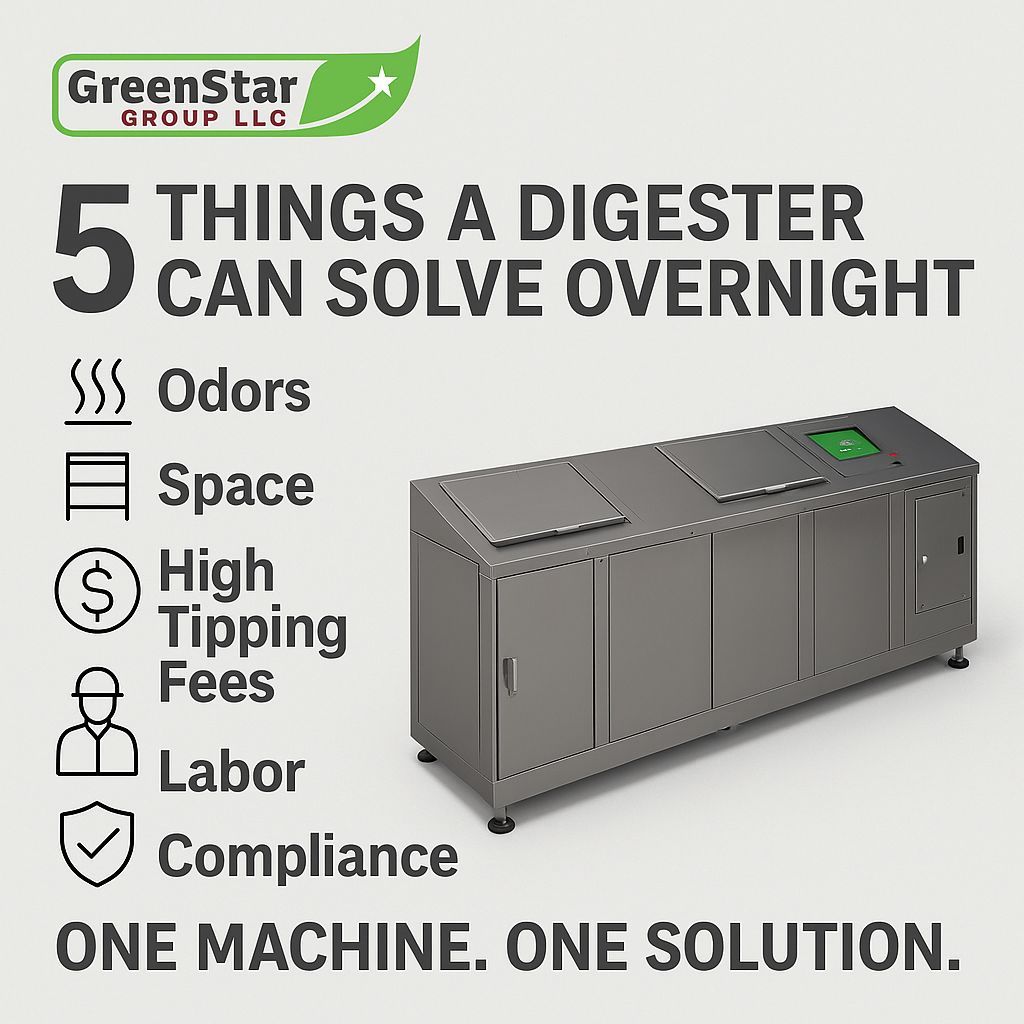
On-site digestion replaces dependence with control and consistency.
Which part of your waste stream would you make self-reliant?
#WasteManagement#AgTech#FoodProcessing#WasteToValue#Sustainability
Processors live under strict waste rules.
Renderers and haulers don’t — yet operations depend on them.
That imbalance is the biggest risk.
On-site digestion removes the dependency.
Every pound of organic waste costs money — hauling, tipping, storage, compliance.
On-site digestion turns that expense into value.
What waste stream hits your budget the hardest?