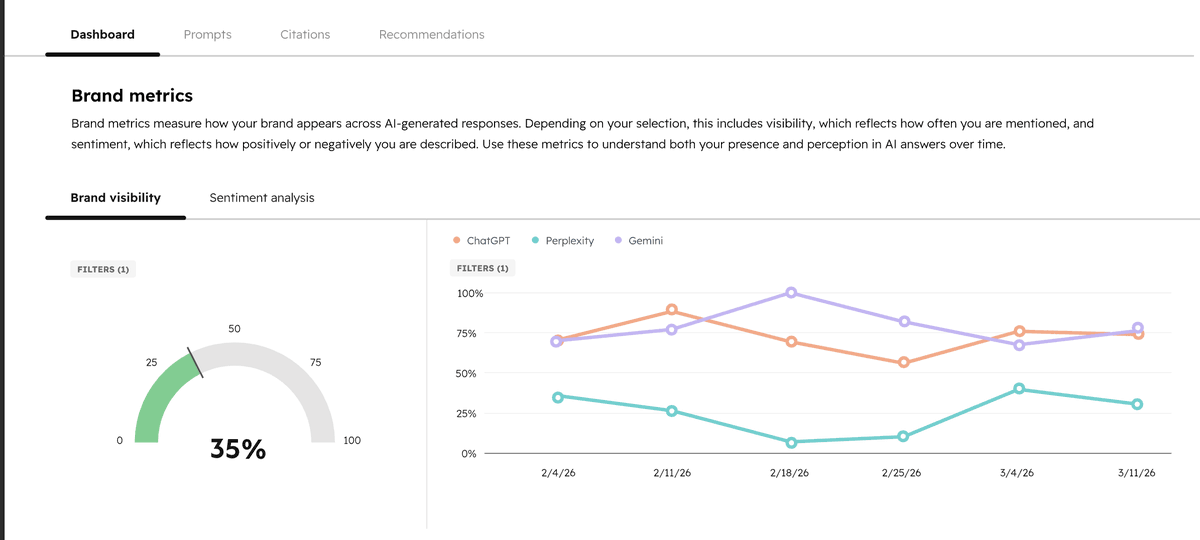
@HubSpot add-on in Marketing - AEO (Answer Engine Optimisation), pretty impressive and simple start with AI marketing-ops from an operator's perspective.
And add-on next SEO, #AEO would be a window for realtime impact tracking, adjustment suggestions and reporting. I'm sure there is much more in depth, but with a quick test and play highlights key AI enablements in nutshell :
+ Tracking brand visibility score across AI engines (@ChatGPTapp , Gemini, @perplexity_ai )
+ Shows sentiment are mentions positive, neutral, or negative?
+ Surfaces which prompts are triggering your category and whether you're in the answers
+ Reveals which domains AI is citing in your space (your competitors likely already know)
+Turns all of that into prioritized, actionable recommendations
Why it matters operationally:
AI visibility is becoming a pipeline metric, not just a branding one. This would one way to connect the dots of direct or indirect impact of AI citations on your brand, and sentiments at the earliest stage of the buyer journey. Before intent. Before your SDRs ever get a shot.
(attached- test views)
Operator hat-on : the pattern I'm tracking that teams build a lead/ engagement score, feel good about it, and never touch it again.
That's not a scoring model
That's a false sense of pipeline clarity
Here's what a real model looks like:
- ICP Fit tells you WHO deserves attention
- Engagement tells you WHEN to act
- Decay scoring kills false positives automatically
- The matrix (A1 to C3) tells your sales team exactly where to spend human energy
In this build: 23,995 contacts. Average score: 8 out of 200.
9,992 sitting in C3 -> low fit, low engagement.
That's not a data problem.
That's a prioritisation problem in disguise.
Fix the model → fix the pipeline → fix the Monday morning Sales vs Marketing argument.
It's never a fixed model. It evolves as your buyers evolve.
Treat it like a product, not a setting.
Spent 3 hours inside a client's HubSpot portal last week.
Their pipeline had 140 open deals.
+ 47 had no activity in 90+ days.
+ 31 had no contact owner.
+ 19 had close dates from last year never updated
They told me their CRM "wasn't working."
Their CRM was fine
Their process had stopped at deal creation
Most CRM problems aren't tool problems. They're accountability gaps dressed up as software issues.
A few weeks ago, I tried something simple on a client project.
When someone was about to leave key pages
pricing, features, comparisons
we didn’t push harder.
No discounts.
No aggressive “book a demo now”.
Just a different path.
A relevant guide.
A softer entry point.
Something that matched where they were in their thinking and something interesting happened.
People stayed. Engaged. Played with ROI tools
It made me rethink something.
Most B2B websites are still built like brochures.
Same message. Same flow. Same CTA.
But buyers don’t behave like that anymore.
They come informed.
They’ve already compared options.
They’re closer to a decision than we assume.
So the question is not:
“How do we get more traffic?”
It’s:
“How do we adapt the experience in real time?”
What I’m seeing now in personalisation:
It’s not about adding names to headlines.
It’s about reading intent and responding to it.
Not just pages - but journeys
Not just segments - but behavior
One signal should trigger multiple actions across the funnel.
What we’re testing next:
- show a different journey based on:
• page visited
• ICP fit
• intent signals
Example:
High-intent ICP visitor on pricing
- show ROI angle or strategy call
Early-stage visitor
- show learning content or use cases
Personalization is shifting from:
“change the message” to “change the path”
Still early, but this is getting interesting.
Reminder for system-driven growth builders: RevOps and growth work is rarely glamorous
- Setup & review pipeline
- Data & lead pool hygiene
- Better qualification ( smart system to filter out quality form big pool of unqualified ones)
- Clearer proposals
Do this consistently and something interesting happens:
+ revenue stops feeling random
+ It starts feeling engineered
For years, RevOps teams and founders have been playing a guessing game.
We sit in meeting rooms, draw boxes on a whiteboard, and pretend we know exactly how our buyers navigate from a cold lead to a closed deal.
But let’s be honest: buyers rarely follow the straight lines we draw for them.That’s where the newly added Pathfinder in HubSpot’s Customer Journey Analytics feels exciting(shoutout to the HubSpot product team for shipping updates that actually solve real operational headaches! )
An assisted & automatic events based revelation of the actual paths customers take before or after a key stage.
When should you use it?
+When you want to understand what actually leads to conversions.
+When you want to optimise specific milestones like demo booked, deal created, or closed won
What data does it work on?
Customer Journey Analytics in HubSpot is built on core CRM objects:
+Contacts → how leads to engagement and conversion(auto detecting events - > test & rinse)
+Deals → how revenue progresses through pipeline
+Tickets → post-sale and support journeys
Customer journey helps you see: the actual paths leading to conversion or drop offs or which interactions accelerate deals
Simple way to think about it
Journey Analytics = the full map
Pathfinder = the most travelled roads
And in RevOps, knowing the “main roads” is where optimisation begins.
Real work seeds real motivation to boost confidence , keeps you humble & grounded, skills you up and fills with gratitude.
3 new customers won. 3 weeks. Head down.
Won with value and supported in their aim to achieve it smoothly, on-time and better than expected.
That's exactly our won and gain. No hacks. No viral growth tricks.
Real conversations, and solving problems inside HubSpot.
Quiet execution compounds.
4 hours today inside a prospect’s HubSpot portal and one thing was obvious:
They weren’t running RevOps.
They were running data entry
- Contacts everywhere
- Deals half-filled
- Dashboards no metric answering impactful question
And all the real revenue decisions still happen in Slack and gut feel
HubSpot only becomes powerful when it tells you who to chase, what to push, and what to ignore.
If it can’t do that, it’s not a CRM.
It’s just a very expensive address book.
Rebuilding Growack quietly.
Traffic turns into revenue when the system is real
- No ads
- No VC
- No fake momentum
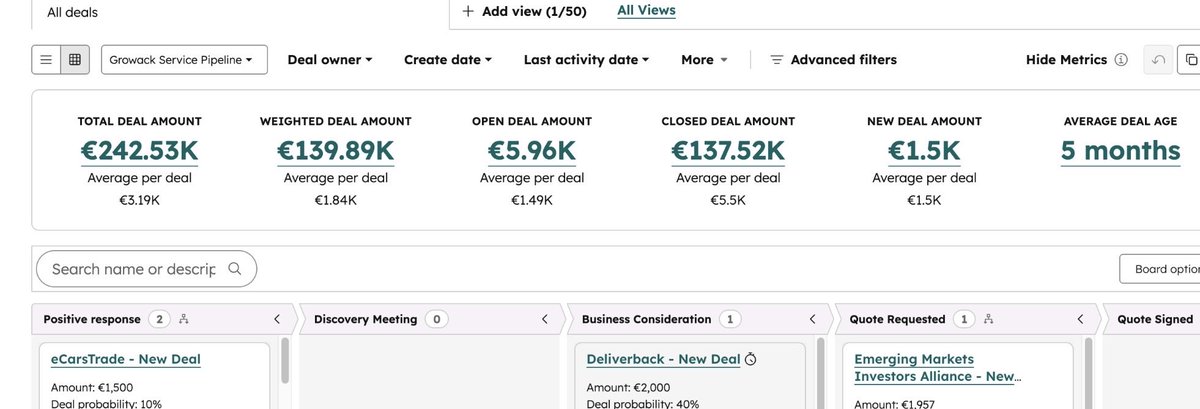
Growack pipeline:
€242,530 total
€139,890 weighted
€137,520 closed
Numbers don’t need hype
Boring is beautiful when it pays the bills.
I don’t chase virality.
I chase people who stay
Growack last 30 days:
• 13,450 pageviews
• 3,079 users
• 4m+ average session
• 33.9% bounce
Attention compounds before revenue does...
The future RevOps leader will not be the best spreadsheet person.
They will be the best system designer.
AI just gives that person leverage over complexity.
HubSpot + LinkedIn users, mark this down.
Jan 19, 2026 is the deadline.
If your LinkedIn personal account is connected to HubSpot, you must reconnect it to grant new API permissions.
Why it matters:
• Reconnect before Jan 19 → HubSpot backfills 365 days of follower data
• Reconnect after Jan 19 → Data starts from zero, only going forward
Actually useful if you track LinkedIn performance in HubSpot instead of posting into the void.
Don’t be exporting LinkedIn analytics manually in February wondering why your dashboards are empty.
Spent 45 minutes inside a B2B SaaS client’s HubSpot portal today.
Spotted a few quiet RevOps leaks, equally applicable to any B2B SaaS:
• MQLs auto-promoted with weak intent signals
• Outbound replies logged but never routed back to pipeline
• Lifecycle stages manually overridden, breaking attribution
• Lead scoring untouched for months while ICP evolved
• Workflows firing, but no one owns the outcomes
None of this shows up in dashboards.
All of it shows up later as churn, pipeline gaps, or “sales isn’t following up”.
This is the unsexy side of growth.
Fixing systems before scaling activity.
Not every comeback is loud.
Mine isn’t.
I started a meetup in 2017 to learn how to speak, connect, and build a network.
That led to clients
That led to a one-man agency
That led to Growack.
Then life happened.
Solo agency.
Booked €136K in 1st year
+40% YoY
COVID shut rooms.
Market & business panicked.
Momentum slowed.
I moved from job → freelancer → agency → back to a job.
Kept the agency running in parallel.
Some months were good.
Some weren’t.
No big announcements.
No “back stronger than ever” posts.
Just showing up.
Serving clients.
Rebuilding quietly.
Growack isn’t being rebuilt with noise.
It’s being rebuilt with experience, patience, and better judgment.
Some journeys don’t restart.
They continue, just differently.
Reminder : never quit
Process and foundation takes time deliver value . A good reminder how important it is to focus on clean setup of CRM and MarTech systems form day 1.
#hubspot
In B2B growth, the most dangerous moment is when things look quiet.
Data is finally clean
HubSpot is finally stable
Funnels finally make sense
It feels like nothing is happening.
That is exactly when momentum is being built.
Stay.
Nobody talks about this:
most progress happens when no one is watching,
before there’s anything to feel proud of.
Building systems takes time
It happens in silence
Growth comes after many iterations
Educate yourself and become the go-to AI Search expert.
GEO didn’t even exist as a topic 12 months ago.
You’re not “late” You’re just early enough to own it.