Bringing information-theoretic encryption to businesses through software is a big deal.
Letting the community own nodes supporting that infrastructure makes it personal.
That’s the QuStream proposition.
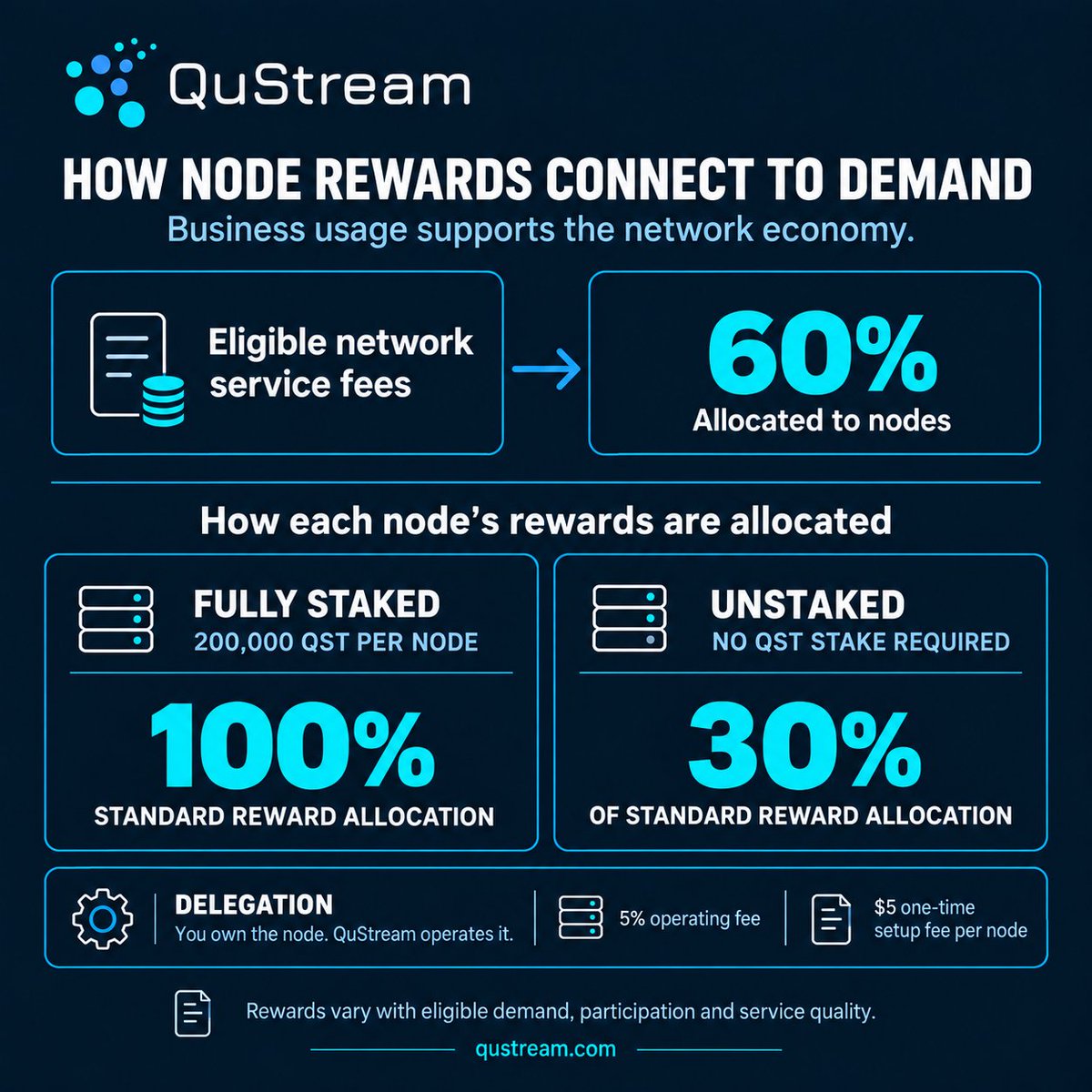
Own the node. Delegate operations. Participate in solana:AUuCEHQ7sm2i5GmaHrpE961voWcTY8U6mgrkhcV7pump rewards.👇
For a company, an encryption breakthrough has to survive contact with the real world.
Existing equipment. Live applications. Networks that cannot stop for a security upgrade.
QuStream is designed around those constraints.
Fresh traffic keys are derived at the endpoints from public noise and private local state. The network carries the public material; the traffic keys do not need to travel with it.
The protection fits into existing infrastructure as an overlay.
PQC can support authentication and key establishment alongside it.
The significance is practical: a different approach to confidentiality, designed to work with existing infrastructure.
QuStream’s ambition is to make that architectural difference useful where it matters: inside operational networks.
That is the technology behind $QST.
“Quantum threatens specific algorithms. AI threatens everything.”
That was Adrian’s warning during the latest QuStream community call, and it reframes the conversation around the future of encryption.
Quantum computing attacks particular mathematical assumptions. AI is broader. It can continuously probe algorithms, ciphertext structure, protocol behaviour and implementation weaknesses, learning and adapting at machine speed.
This is where QuStream’s information-theoretic security approach matters.
Rather than relying only on a mathematical problem remaining too difficult to solve, QuStream is designed to minimise exploitable structure and provide security that is not dependent on an attacker’s available computing power.
Quantum-safe is only part of the challenge. The next generation of security must also be built for an era of automated cryptanalysis.
That is the future QuStream is preparing for. $QST
Node Network Update
We’re marking a solid step forward for the QuStream node network.
• Test Phase Round 1 has officially wrapped, with contribution data and reward allocations now available in the operator dashboard.
• Round 2 is now live, opening a new contribution cycle for all operators.
• The account dashboard has been updated with Test Phase tracking, along with UI improvements and fixes based on operator feedback.
• A major focus of this phase has been strengthening the nodes and preparing the network for live deployment.
• All operators are required to pull the latest QuStream node image and restart their nodes. Older images will no longer connect to the Round 2 network.
• Round 2 contributions will be based on verified productive node time, with updated tracking reflected in the dashboard.
This Test Phase is exactly for this purpose: running the network in real conditions, surfacing issues, improving the operator experience, and hardening the infrastructure ahead of launch.
Big thanks to everyone who took part in Round 1.
Round 2 begins now.
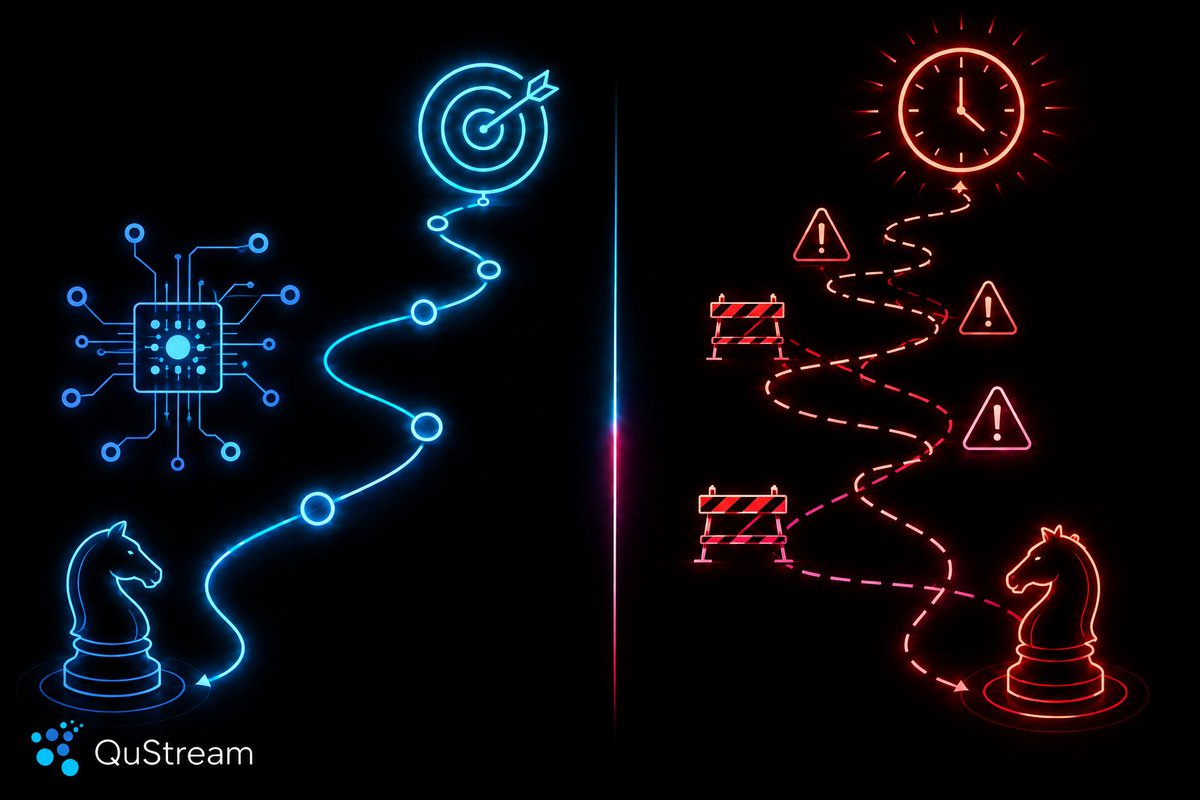
The quantum transition has an uncomfortable asymmetry.
You can spend years debating the perfect migration strategy... but you only get to be early once.
At some point “Which architecture gives us the strongest long-term security?” becomes:
"What can we get deployed before the window closes?”
Critical infrastructure should never reach that point.
The time to evaluate PQC, information-theoretic approaches, hybrid architectures and long-term migration risk is while there is still room to test, reject, redesign and choose deliberately.
A security decision made with five years of runway is architecture.
The same decision made with five months left is crisis management.
Crypto-agility is the ability to swap algorithms when the old ones are no longer trusted.
That is useful.
But it is still a strategy built around one assumption:
you may have to migrate again.
Computational cryptography works because certain mathematical problems are believed to be hard enough to solve.
As computing capabilities and cryptanalysis advance, those assumptions and security parameters have to be re-evaluated. Sometimes the answer is a bigger key. Sometimes it is a new algorithm. Sometimes it is another full migration.
That is where QuStream takes a different path.
In information-theoretic security, confidentiality does not depend on an attacker being “too slow” to solve a mathematical problem.
It depends on the attacker not having enough information in the first place.
QuStream’s architecture is designed to use secret state, single-use confidentiality material and continuous state evolution so that, in suitable deployments, long-term protection is not tied to the lifetime of one computational hardness assumption.
That is the difference between agility and stability.
Agility says:
when the algorithm stops being enough, replace it.
Stability says:
design the system so the confidentiality model does not need to keep changing every time computational assumptions do.
For long-lived infrastructure, that can be a much more powerful property.
Quantum Key Distribution (QKD) can solve an important problem:
creating shared secret material using quantum physics.
But generating secure material is only the beginning.
Once those keys leave the quantum link, the operational questions start:
- Where are they used?
- When do they rotate?
- Have they already been consumed?
- What happens after a restart?
- How is replay prevented?
That is the gap between key generation and key governance.
QuStream's Quantum Secure Networking (QSN) is designed for the lifecycle that follows.
QKD-derived material can provision or replenish secret state where quantum links exist.
QuStream can then provide a consistent model for key evolution, sequencing and consumption across the wider network.
So this is not:
QKD or QuStream.
It can be:
QKD for generation.
QuStream for ongoing governance.
Strong key material is the starting point.
What happens to it next matters just as much.
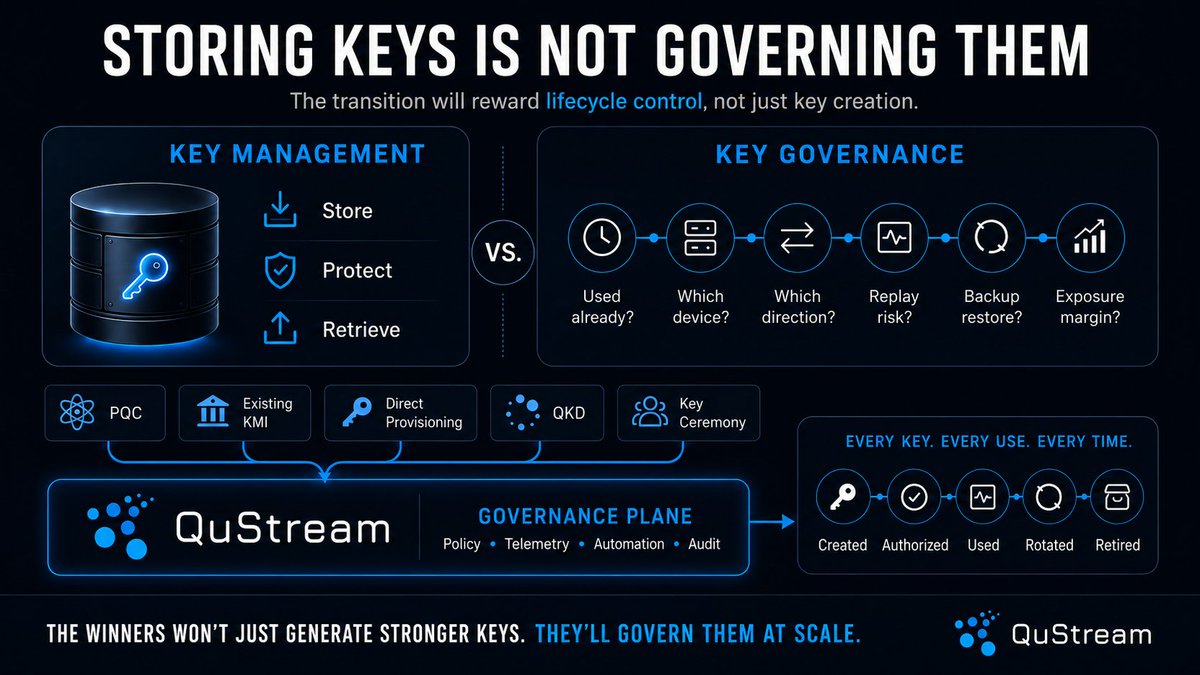
Most enterprises already know how to store cryptographic keys.
The harder question is:
what happens to those keys over their entire lifetime?
Was this key already used?
Which device used it?
Which direction was it assigned to?
Can an old message replay against it?
Can a restored backup bring it back?
Has any exposure reduced its security margin?
That is the difference between key management and key governance.
Traditional systems often solve parts of this with several separate products and processes.
QuStream is designed to make the ongoing key lifecycle part of the architecture itself.
Initial trust can come from different places:
PQC,
Existing key infrastructure,
Direct provisioning,
QKD,
Controlled key ceremonies,
but after that, QuStream provides a consistent model for how confidentiality material evolves and gets consumed.
That matters because the quantum transition will be messy.
Old systems, PQC systems and specialised high-assurance networks will coexist for years.
The winners won’t just generate stronger keys.
They’ll know how to govern them at scale.
Encryption is usually tested on healthy networks.
Real infrastructure does not always have that luxury.
- a tactical radio gets jammed
- a drone loses packets
- a remote link becomes noisy
- bits arrive damaged
With conventional authenticated packet encryption, corrupted data fails authentication (correctly) and the receiver rejects it.
From a security perspective, that is exactly what should happen.
From an operational perspective, it can mean losing the entire protected packet because of a small amount of transmission damage.
The QuStream-Delatr Protocol is designed for a different environment.
It operates as a true bit-stream cipher using single-use key material, so communication can be engineered to degrade with the link rather than immediately falling off a cryptographic cliff.
That distinction matters in contested communications.
If a channel is clean, both approaches work.
If the channel is being jammed, interrupted or pushed to its limits, the question becomes:
How much useful information can still get through safely?
QuStream isn't only being designed for the perfect network.
QSDP targets the network after somebody starts trying to stop it from working.
For defence, autonomous systems and other mission-critical links, resilience and confidentiality cannot be treated as separate conversations.
The secure message still has to arrive.
PKI is brilliant at solving one huge internet problem:
How can two strangers trust each other?
That makes perfect sense when your browser connects to a website it has never seen before.
But many networks look completely different.
A power grid operator already controls its devices.
A defence network already knows which equipment belongs inside it.
A satellite operator already commissions the endpoints.
Yet those environments can still inherit layers of certificate authorities, renewals, revocation systems and trust chains originally designed for an open internet full of strangers.
QuStream starts from a simpler idea:
if you already control the endpoints, establish trust when you provision them
The parties share an initial secret once.
From there, QuStream can continuously evolve the security state without requiring every interaction to depend on an external certificate hierarchy.
That doesn’t replace PKI everywhere.
It removes unnecessary trust infrastructure where the operator already controls who belongs inside the network.
Different environment.
Different trust model.
Different architecture.
A REBOOT SHOULD NOT ROLL YOUR SECURITY BACKWARDS
Imagine a secure device encrypting traffic all day.
Its cryptographic state advances as it works.
Then the power fails.
The device restarts from an older backup.
Everything may look normal.
But if that recovery also restores cryptographic material that has already been used, the system has just moved backwards in security.
That is why recovery is not only a data problem.
It is a cryptographic-state problem.
QuStream QSN treats this as part of the architecture.
Authenticated sequencing, anti-replay and persistent anti-rollback state are designed to prevent previously consumed material from becoming active again after a restart or backup restore.
The principle is simple:
Recovery should restore the system.
It should never rewind the security.
That matters for infrastructure expected to run for years through power failures, updates, hardware changes and thousands of restarts.
Security has to survive normal operations too.
Computational security is only as strong as the assumptions beneath it.
A new preliminary paper from AWS cryptographer Daniel Simon claims a polynomial-time quantum algorithm that, if validated, could have implications for lattice problems relevant to modern post-quantum cryptography.
No practical PQC break has been demonstrated.
But the direction matters.
QuStream was designed to reduce how much long-term confidentiality depends on computational hardness in the first place.
One initial secret.
Fresh key material block by block.
Single use.
Continuous state rotation.
Different security model. Different risk surface.
https://t.co/hF6Hp4k0h6
2) Start with PQC.
NIST has standardised ML-KEM for key establishment and ML-DSA / SLH-DSA for signatures. For the open web, PQC is the right answer, and organisations should already be planning migration.
1) Yesterday we said quantum readiness is not a single-algorithm upgrade.
Here is the architecture behind that sentence.
Here is the architecture behind that sentence: what PQC solves, what it does not, where QuStream fits, and how the key rotation works.
Companies already carry technical debt.
Most are now accumulating quantum debt.
Every system left unprepared becomes another migration project.
Every dependency becomes another integration.
Every supplier becomes another conversation.
Delay does not leave the problem unchanged.
It expands it.
The longer infrastructure waits, the larger the programme becomes.