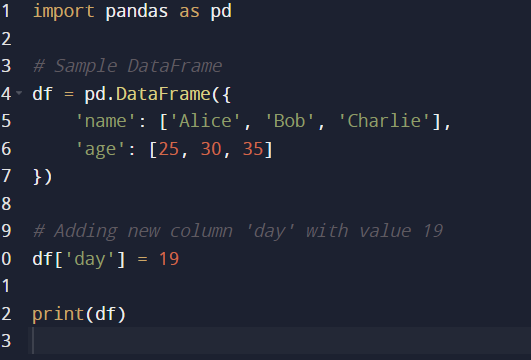
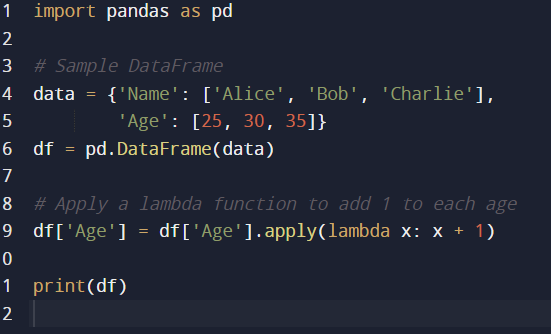
🐍 Day 18:- Today I applied lambda functions to Pandas DataFrames! This is a powerful way to perform operations on data with minimal code.
Key Points: Efficiency, Flexibility, Readability
Pandas make data manipulation a breeze! Stay tuned for more Python tips! 🚀
#Python#Pandas
Which of the following statements about Pandas's value_counts() function is true?
A. Only works with Df.
B. Setting normalize=True returns the counts of unique values.
C. Using bins parameter bins the values into equal-width intervals.
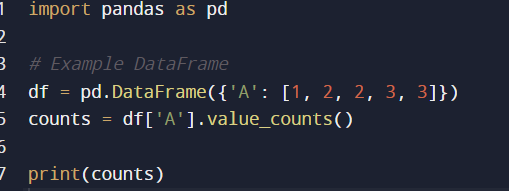
Day 16: Using value_counts() in Pandas
The value_counts() function returns a Series containing counts of unique values in descending order. The resulting Series will have the unique values as the index and the counts as the values.
#Pandas#Pyhton#DataScience#100DaysOfCode
Day 15 POST:- Using Pandas in Python, what does the df. sem() function calculate for a given df?
A) The sum of all elements in the df
B) The mean of all elements in the df
C) The standard deviation of all elements in the df
D) The standard error of the mean of elements in the df
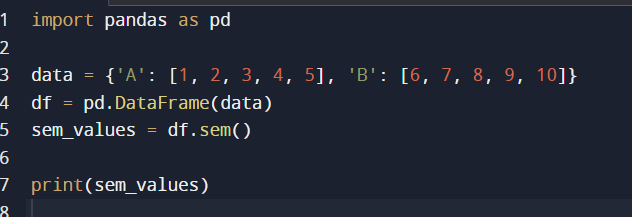
Day 15 📊 Pandas data frame.sem(): Use df. sem() in Pandas to calculate the standard error of the mean! Great for understanding sample mean variability. Example:
#Python#Pandas#DataScience#100DaysOfCode
Which of the following statements about MAD in Pandas is true?
A) Series. mad() calculates the median of the series.
B) MAD is a measure of central tendency.
C) MAD measures the average deviation of data points from the mean.
D) MAD is computed using Series. mean() in Pandas.
Day 14: 🐍📊 #Python#Pandas Tip!
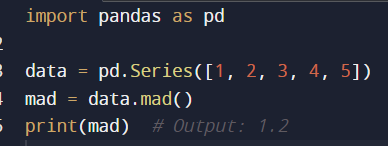
Use Series. mad() to quickly calculate your data's Mean Absolute Deviation (MAD). It's a measure of dispersion, indicating how spread out values are.
#Pandas#Python#100DaysOfCode#DataScience
🚀#100DaysOfCode:Day 13
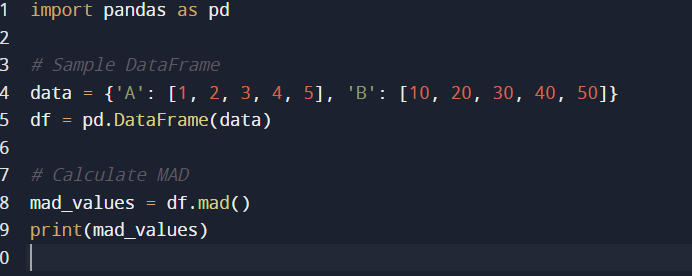
What does the DataFrame.mad() method in Pandas do?
A)The mean of all values in the df.
B) The median absolute deviation of values in the df.
C) The mean absolute deviation of values in the df.
D) The maximum absolute deviation of values in the df.
🚀 Day 13 of #100DaysOfCode: Exploring Pandas!
Today I learned about DataFrame.mad(), which calculates the Mean Absolute Deviation (MAD) of values.
MAD measures the average absolute deviation from the mean. Great for understanding variability! #Python#DataScience#Pandas
🚀 #100DaysOfCode: Day 12
🔍 Pandas Challenge: Can you guess the right option type?
How can you calculate the mean across rows instead of columns using the Pandas mean() method?
a) df. mean(axis=0)
b) df. mean(axis=1)
c) df. mean(skipna=False)
d) df. mean(level=0)
🚀 #100DaysOfCode: Day 12
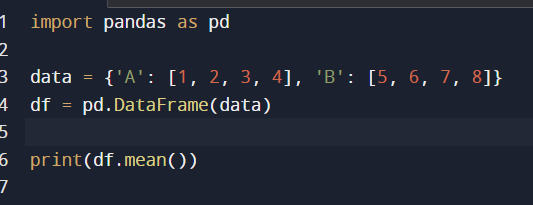
I am diving deeper into data analysis with Pandas! Today’s focus: the mean() method. 🐼
Pandas's mean() method is a quick way to calculate the average of your DataFrame columns. Here’s a breakdown:
#Python#DataScience#MachineLearning#Coding#Pandas
Hey everyone! 👋
I'm looking to #connect with people who are #interested in:
Python 🐍
Pandas 📊
Data Science/ML 🤖
Django 🌐
Web Development 💻
Software Development 🛠️
Backend ⚙️
Frontend 🎨
Full Stack 🌟
#letsconnect#connect#Python#DataScience
Which of the following commands will output the sum of the Sales column and the maximum value of the Quantity column?
A)df.aggregate({'Sales': 'sum', 'Quantity': 'max'})
B)df.aggregate(['sum', 'max'])
C)df.aggregate({'Sales': 'max', 'Quantity': 'sum'})
#Pandas#Python


![gsachdeva149's tweet photo. Which of the following commands will output the sum of the Sales column and the maximum value of the Quantity column?
A)df.aggregate({'Sales': 'sum', 'Quantity': 'max'})
B)df.aggregate(['sum', 'max'])
C)df.aggregate({'Sales': 'max', 'Quantity': 'sum'})
#Pandas #Python https://t.co/MA6LjELVmX](https://pbs.twimg.com/media/GO5YY5aXwAATGQ4.png)