The last proof of concept of 'India Shining' officially falls apart. The great liberalization experiment has finally wrapped up.
Yes, these companies are suspended as a result of current US political churn but the fact is "meritorious" leadership of these companies (many others) for nearly 30 yrs were happy with offshore contracts & building empires on "cheap labor" compared to US. Them & others exploited these laws that gave fuel to political conservatives there, instead of gradually building capacity/innovation in India.
In other sectors too, they've accumulated wealth without building global excellence. They built nothing that someone else in the world doesnt do better.
They pushed univs to produce 'workforce-ready' graduates & watered down curriculum, their own R&D is a joke, their vision is empty bravado (think Ola bikes, battery, Zomato temple). They cover this up with some bizarre self-aggrandizing PR (think Vantara) & giving lectures to work 72 hrs/week & "simple living" to workers.
Savarna entrepreneurs have collectively punctured the promise of India Inc.
The most expensive part of a hospital bill may never touch the hospital at all.
A patient admitted for care has no way of knowing whether the price on a medical consumable reflects its actual cost or a markup fixed long before it ever reached the ward. That gap in information is, at its core, a public health issue.
A survey of hospital consumables in Maharashtra found an IV infusion set with a trade price of ₹11.05 carrying a printed MRP of ₹325 ; a markup of 2,841%. A syringe procured at ₹6.75 carried an MRP of ₹57.20. A catheter procured at ₹29.41 carried an MRP of ₹310.
These are not elective purchases. Patients cannot compare prices, seek alternatives, or question a number printed on a box while receiving care and the MRP itself is often fixed upstream by manufacturers and distributors, disconnected from the trade price by a wide, unexplained margin. The result is a system where the party bearing the cost has the least information to evaluate it.
The regulatory gap is structural: scheduled medicines are capped under the Drugs (Prices Control) Order, 2013. Most medical devices and consumables are not leaving both the pricing and the information around it almost entirely unmonitored.
A review of these findings and clear guidelines on the permissible gap between trade procurement price and declared MRP have been recommended to the Department of Pharmaceuticals and the NPPA ; a step toward closing not just a pricing gap, but the information gap patients are left to bear alone.
#PublicHealth #GoodGovernance #Leadership #TukaramMundhe
https://t.co/Ye9CVzr8qU
The main driving force behind the Indian Rightwing movement is upper class resentment over ancient privileges diluted by democracy. Its objective is a hierarchical future similar to what tradition dictates. The hate you see is the necessary force to create the new hierarchy.
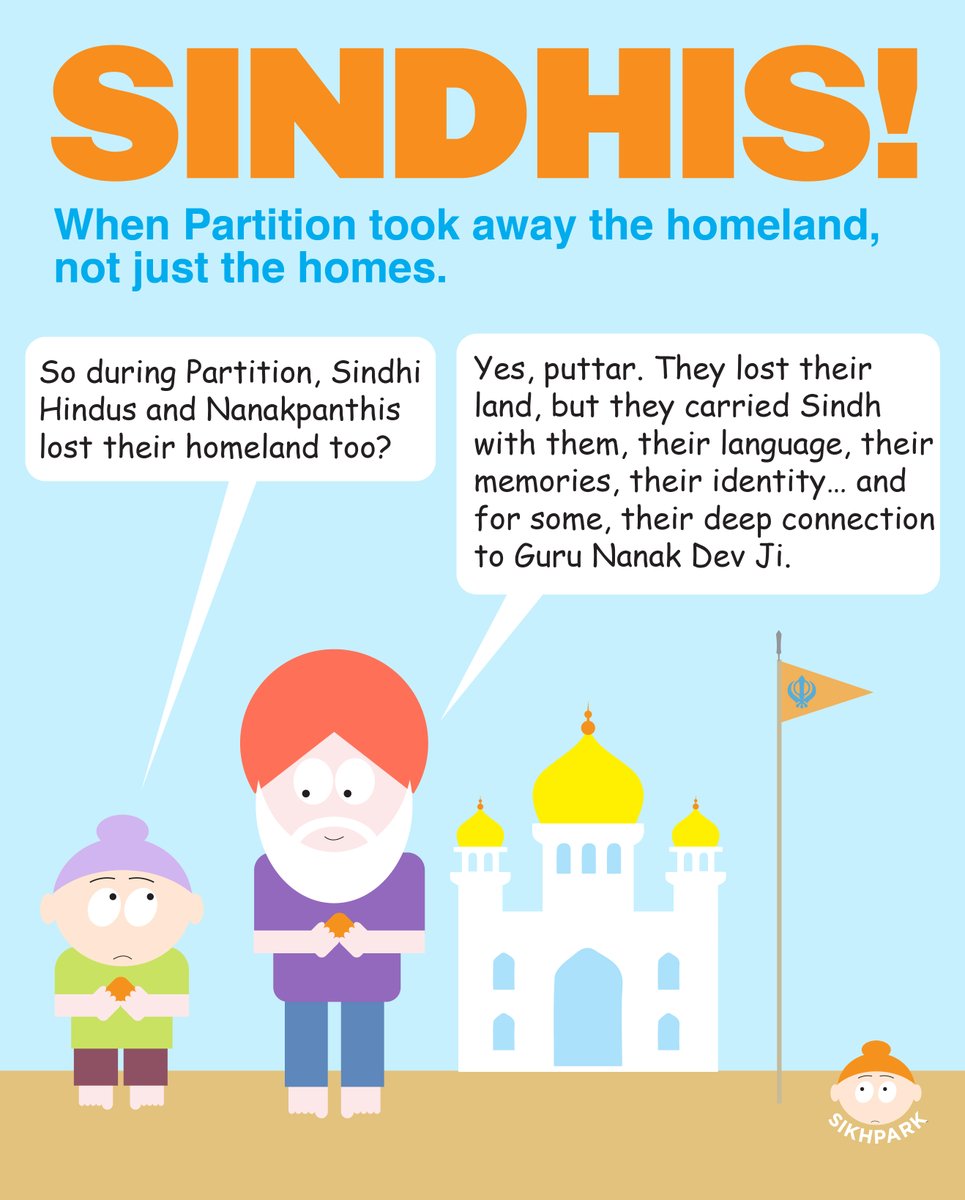
Sindhis & Partition.
After the post on the Partition of Bengal, a lot of people asked about Sindhis. So, this one’s for the Sindhis. ❤️
I actually grew up going to a Sindhi gurdwara. That was my first real glimpse into Sindhi culture, although, tbh, I knew very little about Sindhis back then. So I thought I’d share what I’ve learnt, but I’m definitely not an expert, so Sindhis, please jump in and correct/add to this.
In 1947, Sindh experienced Partition very differently from Punjab and Bengal. Sindh itself wasn’t divided, the entire province became part of Pakistan. In the 1941 Census, Hindus made up around 26.4% of Sindh’s population, while Sikhs were a much smaller community, numbering around 31,000. A significant number of Sindhi Hindus were also Nanakpanthis — followers of a tradition centred around Guru Nanak Dev Ji and the Guru Granth Sahib, while also retaining many Hindu customs and practices.
On 3 March 1943, G.M. Syed introduced a resolution in the Sindh Legislative Assembly supporting the creation of Pakistan. It was historically significant because Sindh became the first British Indian province whose legislature formally passed a resolution supporting Pakistan.
The vote was 24 in favour and 3 against. The three opposing votes were Hindu members. Several other Hindu members walked out rather than participate in the vote.
After Partition, hundreds of thousands of Sindhi Hindus and Nanakpanthis migrated to India, leaving behind homes, businesses and entire communities. They had to basically start from scratch and rebuild their lives in places like Ulhasnagar, Mumbai, Ahmedabad, Jaipur, Ajmer and Delhi. That’s one reason you’ll find Sindhi gurdwaras in many places where Sindhi communities settled.
Sindhis, this one’s yours. Please add, correct, educate. 🙏
@kushal_mehra@TheJaggi The role of an MP is not the same as that of an MLA or a councillor. Delimitation will serve little purpose .
The common voter needs to better understand and know the duties and responsibilities of each tier
VIDEO | Delhi: BJP MP and national spokesperson Sambit Patra, at a press conference, says, "This press conference is serious because I want to say from the bottom of my heart that we need to think very seriously about where we want to take the country, what direction the country is moving in and what India's future is. When we were teenagers, whenever we saw pictures of places abroad, we used to wonder why India could not be like that and why it was the way it was. The American dream became a benchmark for us. India can also have a goal, and on August 15, 2026, Prime Minister Narendra Modi outlined that goal before the country from the Red Fort."
(Full video available on PTI Videos - https://t.co/bIyFWTfmBd)
Once a king was presented with a heavy throne. He never sat on it, but stowed it in the rafters of his grass hut & slept below. One night a huge storm blew the roof down & the throne crashed onto the king, killing him. Moral: those who live in grass houses shouldn’t stow thrones.
Mohammed Irfan’s interview is all over. I first heard it a few days back, and it was hard to find sleep that night. In a follow up video, Rajat went to his ‘house’. Irfan says:
“Aap aa rahe hain, koi mehek na aaye kisi tarah ki isliye itr ki ek sheeshi chidak di thi…”
One resignation does not repair the exam system or answer for the violence inflicted on protesters. But the young have taught their elders something the parent generation had forgotten: governments are not all-powerful. Citizens can compel them to answer. Power can be made to yield. And that is the real victory of this moment.
The brutal reality of hiring skilled talent in Bharat’s manufacturing sector right now:
We need mould supervisors, machine maintenance, HR, QMS, admin & more....
Decided to go aggressive:
“Hire and see who sticks.”
Over 40 resumes came in.
Only 5 were decent. Hired all 5.
- 2 let go in <1 week (nowhere near what they claimed)
- 1 fired for eating gutka inside the plant
- 1 never showed up (phone off, ghosted)
- 1 worked for a week then vanished with the classic “mausi in village is unwell”
Massive waste of time and effort.
Back to square one with the next 40 resumes.
Building a reliable team in manufacturing is tough.
The gap between CV and actual capability is painful.
What frustrates me most? Seeing people complain there are “no jobs.”
There are jobs. Good ones.
They just demand real skills, discipline, and ownership.
@prakdadlani Couldnt agree more!! The gap between the CV and ability coupled with a lack of desire to work hard and gain experience through the grind is completely absent. Growth with such resistance is tiring