No noise. No padding.
We scale every deployment to the actual risk — not to the size of the invoice.
If two operators are enough, we send two. If the threat picture doesn’t justify additional resources, we say so.
Clear advice. Appropriate resources. Transparent pricing. That’s how long-term trust is built.
#SecurityStandards #Client
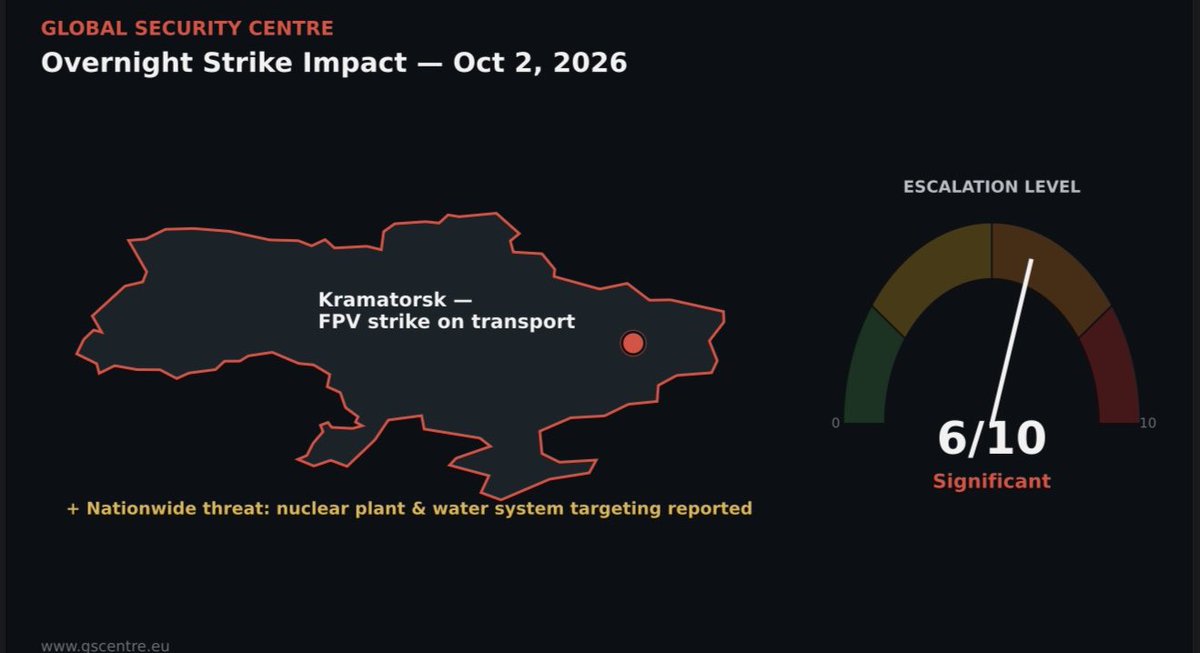
Daily Geopolitical Assessment — Oct 2, 2026
Escalation rating: 6/10 (Significant) — up from 5 yesterday
Russia is reportedly planning to disconnect nuclear power plants from the grid and destroy water supply systems — a significant escalation beyond conventional military targeting, aimed at creating humanitarian crises without requiring direct territorial conquest. This kind of infrastructure targeting carries real spillover risk for Poland and the broader region, given the potential for energy crises, mass displacement, or radiological incidents near the border.
On the ground, Russia continued daily tactical pressure, including an FPV drone strike on civilian transport in Kramatorsk.
Diplomatically, Ukraine advanced protections for the Hungarian minority language — a step that may help moderate Budapest's position within the Western coalition and reduce friction in NATO's eastern flank coordination.
Poland remains Ukraine's primary NATO ally and logistics hub, with its own security directly tied to how these infrastructure risks play out.
https://t.co/1UytfdfAiM
#Geopolitics #Ukraine
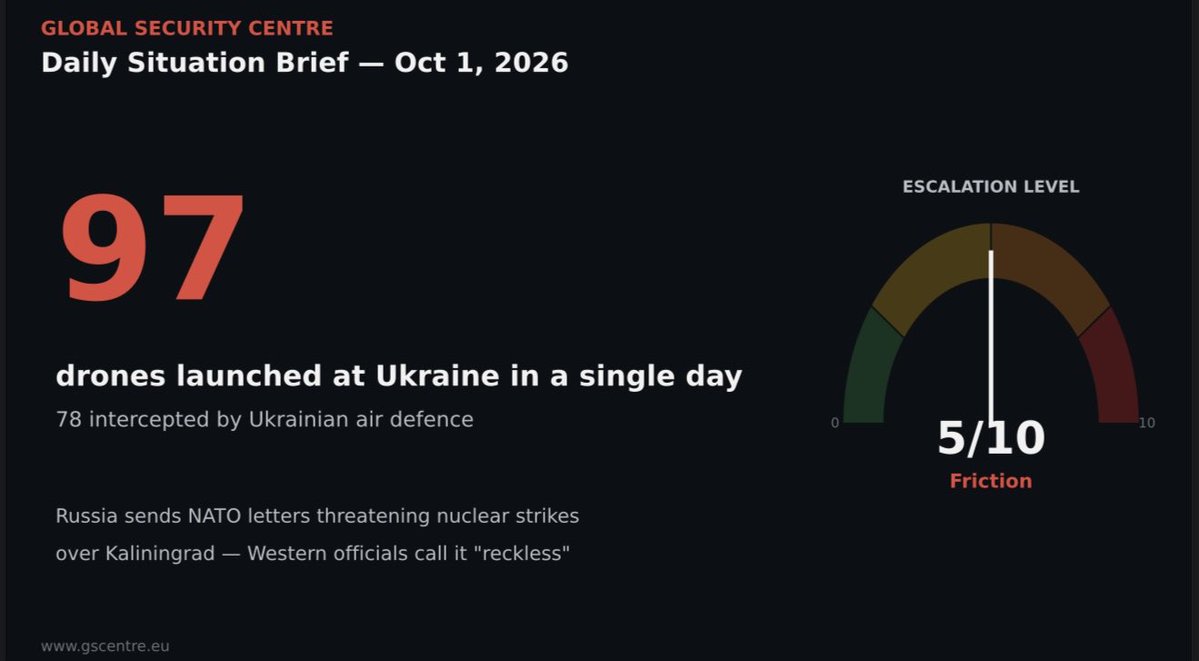
Daily Geopolitical Assessment — Oct 1, 2026
Escalation rating: 5/10 (Friction)
Russia launched 97 drone attacks against Ukrainian infrastructure and air defence systems on October 1 alone, with Ukraine intercepting 78 — continuing the established pattern of attrition rather than any breakthrough offensive.
More notably, Moscow escalated its nuclear rhetoric, sending letters to NATO threatening nuclear strikes in response to perceived Western activity near Kaliningrad Oblast. Western officials characterized the language as increasingly "reckless," though more indicative of psychological pressure than imminent military action.
On the institutional side, the Council of Europe's Parliamentary Assembly is advancing proposals to redirect frozen Russian assets toward Ukrainian war reparations — a sign of long-term financial and legal pressure continuing to build against Moscow.
Poland remains strategically central as the primary NATO-Ukraine junction and humanitarian corridor, absorbing indirect pressure from refugee flows and coordination demands while remaining under full NATO protection.
https://t.co/1UytfdfAiM
#Geopolitics #Ukraine #NATO
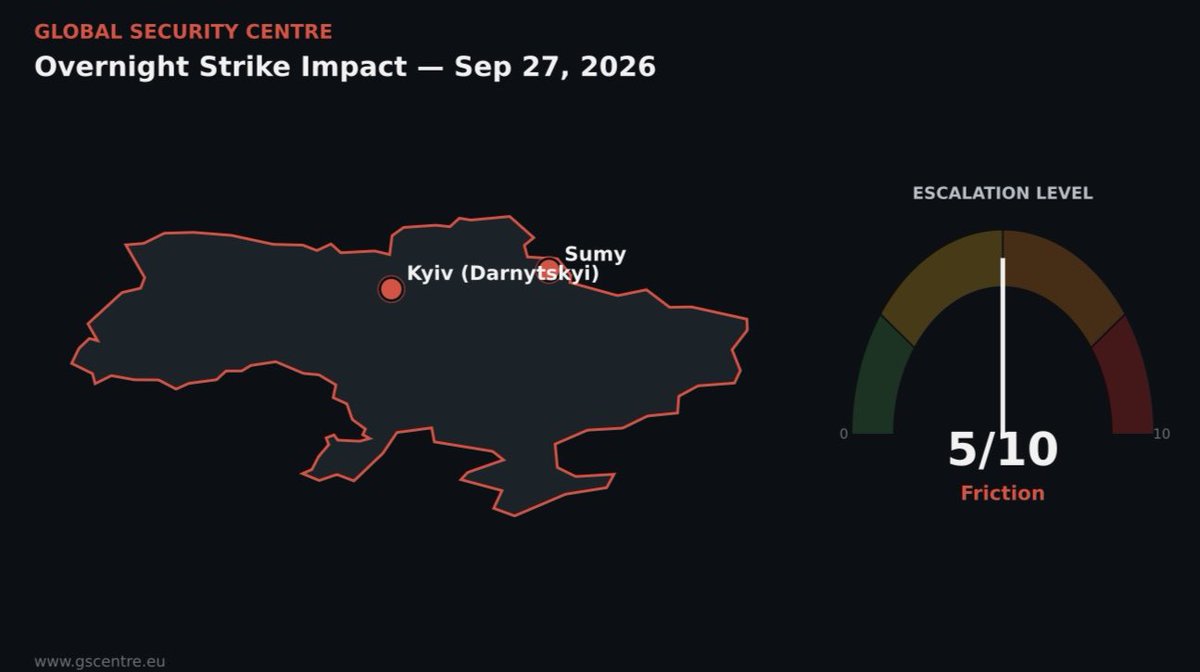
Daily Geopolitical Assessment — Sep 27, 2026
Escalation rating: 5/10 (Friction)
Russia carried out coordinated strikes across multiple Ukrainian cities overnight. In Kyiv's Darnytskyi district, drone and guided aerial bomb attacks hit a nine-storey residential building, injuring civilians. In Sumy, strikes killed two people, including a teenage girl, and injured five more.
The pattern extended to economic infrastructure as well, with the destruction of a Kärcher logistics facility — part of a continued effort to disrupt Ukraine's supply chains alongside residential and civilian targets.
Poland remains a critical logistics and humanitarian corridor for Ukraine, with no direct impact from these strikes, while regional NATO posture continues to provide a stable deterrent along the alliance's eastern flank.
https://t.co/1UytfdfAiM
#Geopolitics #Ukraine #NATO
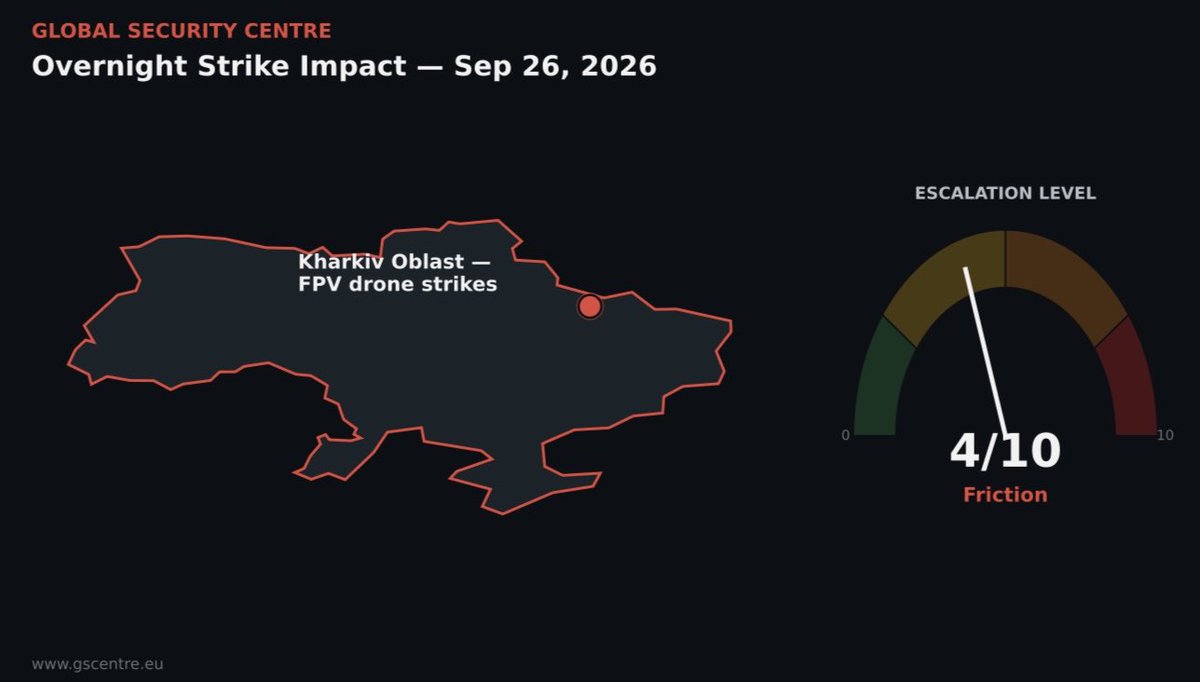
Daily Geopolitical Assessment — Sep 26, 2026
Escalation rating: 4/10 (Friction)
German Foreign Minister Johann Wadephul met with Russian Foreign Minister Sergei Lavrov — the first high-level bilateral engagement between the two countries since 2022, signalling continued European willingness to keep diplomatic channels open despite the ongoing war.
That diplomatic opening stood in stark contrast to events on the ground: a Russian FPV drone strike in Kharkiv Oblast killed a driver, and a separate strike wounded four people, including two children — underscoring that Russia's attrition campaign against civilians continues regardless of diplomatic movement elsewhere.
On the recovery front, Japan committed $51.5 million toward healthcare system development in Ukraine through the World Bank's THRIVE Project, reflecting continued international confidence in Ukraine's long-term reconstruction.
Poland maintains stable conditions within the NATO framework, focusing on border security and alliance coordination while navigating the balance between backing Ukraine and engaging with renewed European diplomatic processes toward Russia.
https://t.co/1Uytfdg88k
#Geopolitics #Ukraine
Daily Geopolitical Assessment — Sep 24, 2026
Escalation rating: 4/10 (Friction)
Russia struck a farm in Kharkiv Oblast, resulting in significant civilian casualties — part of the continued pattern of strikes on civilian and agricultural infrastructure in the eastern regions.
On the diplomatic front, the EU and Western partners escalated their counter-information campaign against Russian state media, imposing targeted sanctions on RT operatives involved in shaping Kremlin narratives abroad.
Ukraine also advanced its domestic military-industrial base, approving indigenous robotic logistics systems designed to reduce supply vulnerabilities on contested front lines — a step toward lowering dependency on foreign systems.
Poland continues to serve as the critical NATO logistics hub, remaining exposed to Russian hybrid operations while sustaining its role as the primary Western supply conduit to Ukraine.
https://t.co/1UytfdfAiM
#Geopolitics #Ukraine #NATO
Daily Geopolitical Assessment — Sep 23, 2026
Escalation rating: 5/10 (Friction) — down from yesterday
Russian forces struck Kramatorsk with Uragan multiple-launch rocket systems, damaging eight houses and causing nine casualties from blast, shrapnel, and mine-related injuries. Separately, Russian strikes disrupted internet services for roughly 100,000 households across Kyiv and Kyiv Oblast — continuing a pattern of targeting civilian communications infrastructure alongside kinetic strikes.
On the institutional side, Colonel Serhii Shatalov, 33, was appointed to lead the Ukrainian Navy's 30th Marine Corps, reflecting continued structured command stability despite the sustained operational tempo.
Poland's exposure through the security corridor remains steady, with no direct incidents on Polish territory reported.
https://t.co/1Uytfdg88k
#Geopolitics #Ukraine
Daily Geopolitical Assessment — Sep 22, 2026
Escalation rating: 5/10 (Friction) — down from 6 yesterday
A Trump-Zelenskyy summit was announced in New York, featuring senior US officials including Rubio, Bessent, Kushner, and Witkoff — a sign of renewed American diplomatic engagement that strengthens Ukraine's negotiating position.
On the ground, Ukrainian forces regained territory near Zapadne in Kharkiv Oblast's Kupiansk district, demonstrating continued offensive capability despite sustained Russian pressure elsewhere along the front.
Russia struck Kramatorsk with four FAB-250 guided bombs, killing one civilian, injuring two, and damaging 54 residential and municipal buildings — a continuation of its strategy of civilian-targeted strikes aimed at eroding morale and economic capacity in eastern Ukraine.
Poland's role as a key NATO logistics hub remains strategically critical, though operationally routine today.
https://t.co/1UytfdfAiM
#Geopolitics #Ukraine #NATO
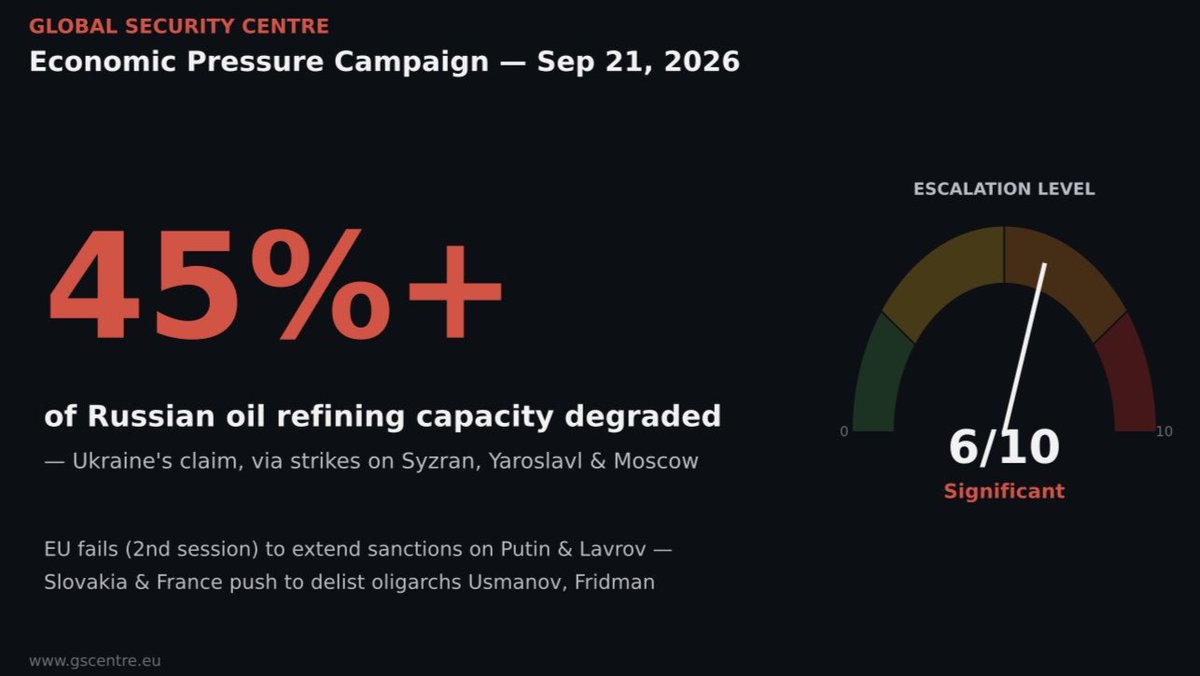
Daily Geopolitical Assessment — Sep 21, 2026
Escalation rating: 6/10 (Significant)
Ukraine claims to have degraded over 45% of Russia's oil refining capacity through strikes on major facilities in Syzran, Yaroslavl, and Moscow — a significant escalation in Kyiv's campaign to weaken Russia's economic and military-industrial base. President Zelenskyy simultaneously signalled openness to de-escalation, contingent on Russia halting strikes on energy infrastructure, critical facilities, and food exports.
That dual-track approach comes as Western unity shows real cracks: the EU failed for a second consecutive session to extend sanctions on Putin, Lavrov, and associated oligarchs, with Slovakia and France pushing to delist sanctioned figures Usmanov and Fridman — a sanctions paralysis that risks handing Moscow diplomatic openings just as Ukraine is demonstrating real economic leverage.
For Poland and frontline NATO allies, this creates real strategic ambiguity: Ukrainian battlefield gains may open negotiating space, but EU fragmentation undermines the credible deterrence that underpins Polish and regional security.
https://t.co/1UytfdfAiM
#Geopolitics #Ukraine
Travel security starts before the client moves.
Advance checks help identify route vulnerabilities, evacuation options, fallback locations and local risks that may not appear in a standard travel advisory.
The goal is simple: when the client arrives, the groundwork is already done.
https://t.co/1UytfdfAiM
#TravelSecurity #ExecutiveProtection
Daily Geopolitical Assessment — Sep 20, 2026
Escalation rating: 7/10 (Significant) — up sharply from yesterday
Ukraine's Council of Churches appealed to Pope Leo XIV to help prevent starvation in occupied Oleshky, where thousands of civilians remain trapped under Russian control — a deepening humanitarian crisis in the occupied territories that compounds the broader military pressure on the population.
Separately, Ukraine carried out what Moscow's own mayor, Sergei Sobyanin, called the "largest-ever drone attack" on the Russian capital, striking the Moscow oil refinery and logistics facilities using Flamingo, Palianytsia, and Pelican missile systems. Russia claims 450 drones were intercepted but acknowledged hits on critical infrastructure.
#Geopolitics #Ukraine #Oleshky
Daily Geopolitical Assessment — Sep 19, 2026
Escalation rating: 5/10 (Friction) — no change from yesterday
Russia struck a civilian vehicle in the Shostka district (Sumy Oblast), killing four people, including a married couple, and continued targeting civilian areas in Kherson — part of the ongoing pattern of attacks aimed at civilian infrastructure and morale rather than new offensive operations.
On a more positive note, Ukraine recovered 15 civilians from Russian-occupied territories, including a 96-year-old woman from Kherson Oblast, continuing organized repatriation efforts even amid active hostilities.
Poland remains a critical support node for Ukrainian operations, refugee transit, and NATO coordination, with no new weapons systems or direct NATO-Russia confrontation reported.
https://t.co/1UytfdfAiM
#Geopolitics #Ukraine
Daily Geopolitical Assessment — Sep 18, 2026
Escalation rating: 5/10 (Friction) — unchanged from yesterday
Russian military pressure on Ukraine remained sustained, with a drone dropping explosives on the grounds of a hospital in Kherson, damaging service vehicles. The incident reflects the continued exposure of civilian infrastructure to unmanned-system attacks, even without a broader shift in the conflict’s overall escalation level.
At the same time, Western support for Ukraine continued to strengthen. Denmark accelerated a $276 million military aid package focused largely on air defence following the recent incident in which a Russian warship fired flares toward a Danish military helicopter. Separately, the EU’s proposed 2028–2034 budget provides for up to €100 billion in support for Ukraine, reinforcing a longer-term approach to Ukrainian resilience.
For Poland and NATO’s eastern flank, the combination of sustained Russian military activity and repeated friction around Allied assets keeps regional risk elevated. The broader picture remains one of persistent pressure and coordinated Western response, but without a qualitative shift toward direct Russia–NATO confrontation.
https://t.co/1UytfdfAiM
#Geopolitics #Ukraine
Daily Geopolitical Assessment — Sep 17, 2026
Escalation rating: 5/10 (Friction)
Russian drone activity near Poland’s border kept regional tensions elevated, with Poland hardening its defensive posture. Deputy Defence Minister Cezary Tomczyk confirmed that Polish pilots are authorised to destroy Russian drones or missiles entering national airspace, establishing a clear response threshold for further violations.
At the same time, Ukraine continued demonstrating its growing drone warfare capability. The Defence Ministry reported that Ukrainian drones have struck more than 3,000 Russian unmanned ground vehicles since the beginning of 2026, with a record 511 hit in August alone.
Civilian exposure remains significant. A Russian FPV drone struck a passenger bus in Zaporizhzhia on September 17, injuring five people and reinforcing the continued security risk posed by unmanned systems away from direct frontline engagements.
For Poland, the combination of Russian drone activity near its border and a strengthened military response posture keeps escalation risk elevated. For now, these incidents remain contained below the threshold of direct Russia–NATO confrontation.
https://t.co/1UytfdfAiM
#Geopolitics #Ukraine
Daily Geopolitical Assessment — Sep 16, 2026
Escalation rating: 5/10 (Friction)
Russian military pressure on Ukraine remained sustained, with strikes reported against infrastructure in Poltava Oblast. At the same time, President Zelenskyy’s public statements increasingly focused on possible war-ending scenarios and the realities of a future post-conflict settlement.
Beyond Ukraine, Russian conduct in Northern European waters continued to raise concern. The decision to award the captain of the Soobrazitelny following the firing of flares toward a Danish military helicopter reinforces the pattern of increasingly assertive Russian behaviour around NATO assets and increases the risk of miscalculation in the Baltic region.
For Poland, these developments combine continued Russian pressure on Ukraine with growing friction around NATO’s northern and eastern flanks. The broader picture remains one of multi-domain pressure: kinetic operations in Ukraine, diplomatic obstruction, and increasingly provocative military signalling around NATO members, raising the risk of miscalculation and further regional friction.
https://t.co/1Uytfdg88k
#Geopolitics #Ukraine #Poland #NATO
Daily Geopolitical Assessment — Sep 15, 2026
Escalation rating: 5/10 (Friction) — down from 6 yesterday
Over the past 24 hours, seven infrastructure facilities were damaged in Kyiv Oblast, with additional civilian casualties reported in Donetsk Oblast, continuing Russia's steady campaign against Ukrainian infrastructure.
Simultaneously, Russia tested NATO's boundaries directly: forces deployed flares near Danish military assets and conducted drone operations over Lithuanian territory. European Commission President von der Leyen characterized these as part of a systematic pattern rather than isolated incidents — a dual-track strategy combining pressure on Ukraine with calculated provocations against NATO members.
Poland's position as a key NATO logistics hub leaves it directly exposed to both spillover risk and the broader effects of this boundary-testing behavior along the alliance's eastern flank.
https://t.co/1Uytfdg88k
#Geopolitics #Ukraine #NATO
Daily Geopolitical Assessment — Sep 14, 2026
Escalation rating: 5/10 (Friction)
President Trump claimed a bilateral agreement had been reached to halt strikes on energy facilities — but the claim remains unverified by either Kyiv or Moscow. Underscoring the gap between diplomatic signals and battlefield reality, Russia struck the Eva cosmetics distribution centre in Odesa overnight, continuing its campaign against civilian economic infrastructure regardless of any announced restraint.
Domestically, Ukraine's anti-corruption institutions are engaged in a procedural dispute that risks undermining institutional cohesion at a moment when unified governance matters most for both the war effort and post-conflict planning.
Poland remains a key security ally and transit corridor, with continued indirect exposure through refugee flows and broader NATO coordination.
https://t.co/1UytfdfAiM
#Geopolitics #Ukraine
The protection detail may arrive with the principal. The security work starts much earlier.
K-9 teams add another layer of detection during venue sweeps and site inspections, helping identify threats before an operation begins.
@NATO Developments along NATO’s eastern flank are a reminder that organizations operating in the region need resilient communications, contingency planning, secure movement and strong local coordination.
@RALee85 A good reminder that border crossings are dynamic parts of any movement plan. Alternative crossings, fuel redundancy and real-time monitoring are increasingly important for travel between Poland and Ukraine.