Global Markets at Xynova | 20 years in optics, AR & tech | Dexterous hands, robotics & Physical AI | Silicon Valley | Technology, business & building globally
I'm Liang, based in Silicon Valley and working on global markets at Xynova. After 20 years in optics, AR and tech, I'm exploring dexterous hands and Physical AI. Building robots in the US? Reply with your city and focus, or DM me. Let's meet, share projects and compare notes.
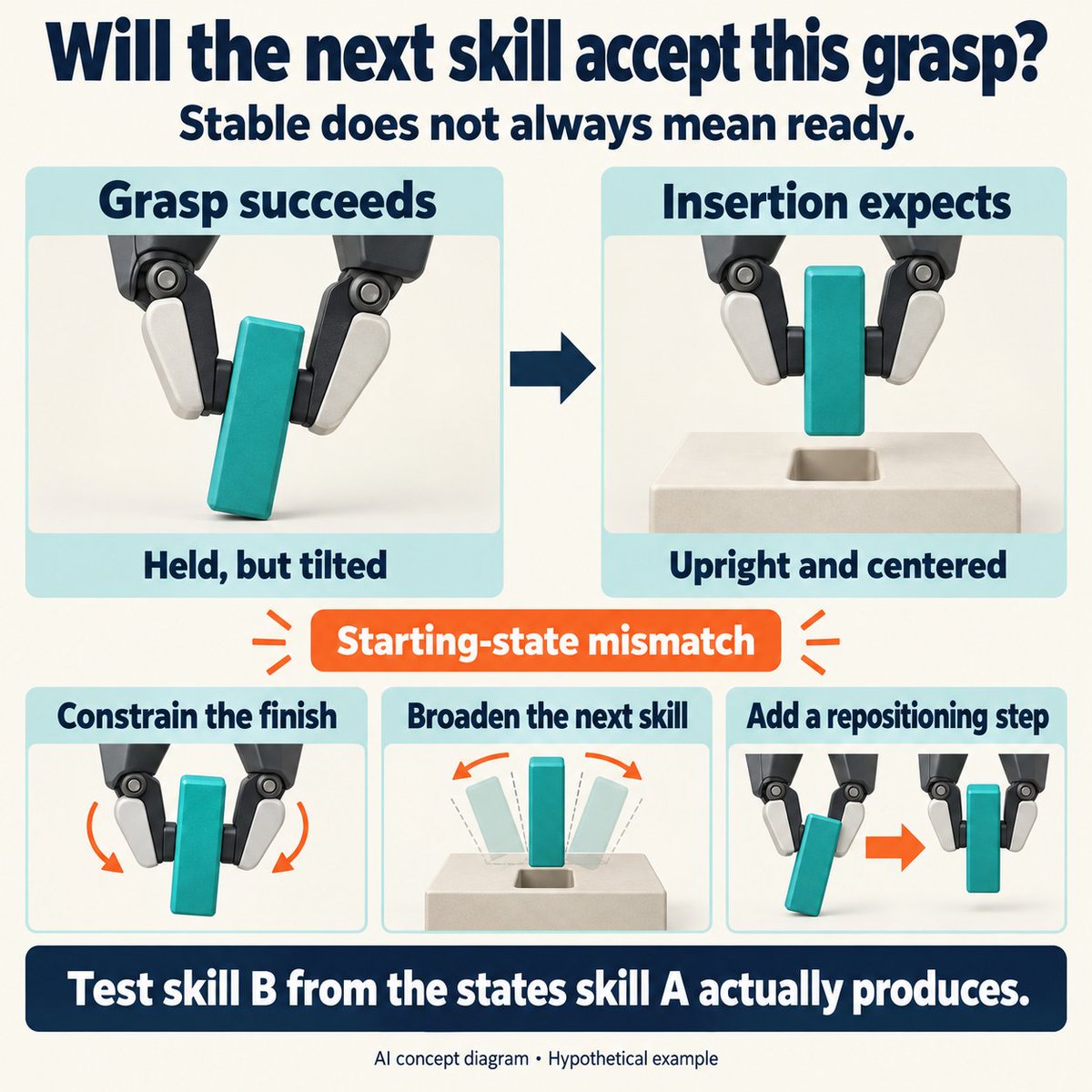
A stable grasp can leave a peg at an angle the insertion skill never practiced. Test the next skill from the states the previous one actually produces. Isolated success rates do not measure that handoff. AI concept diagram; hypothetical example.
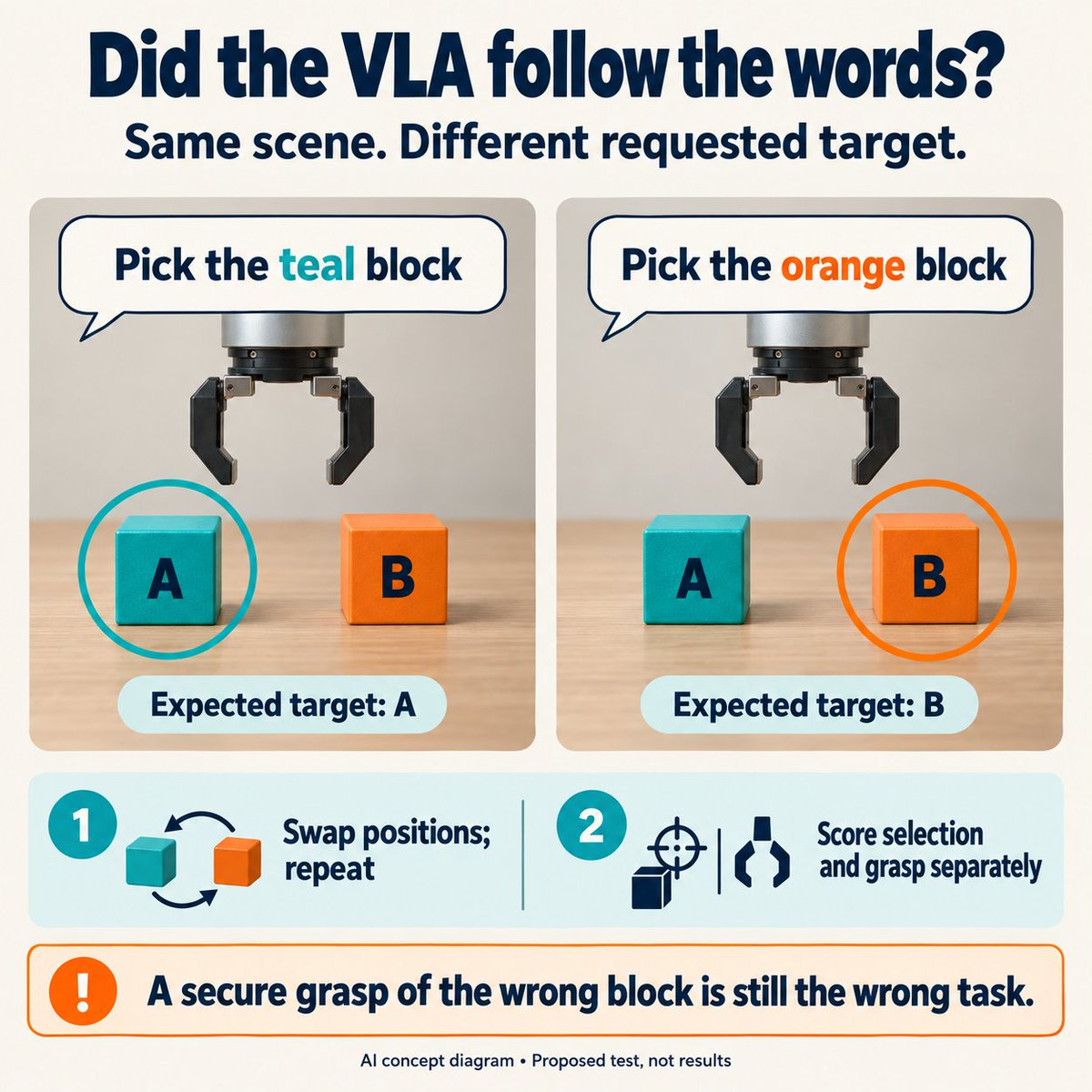
Did the VLA follow the words—or just the scene? Keep two reachable blocks in place; change only which one the instruction names. Then swap their positions. Score target choice separately from grasp success. A proposed test, not proof of general understanding. AI concept diagram.
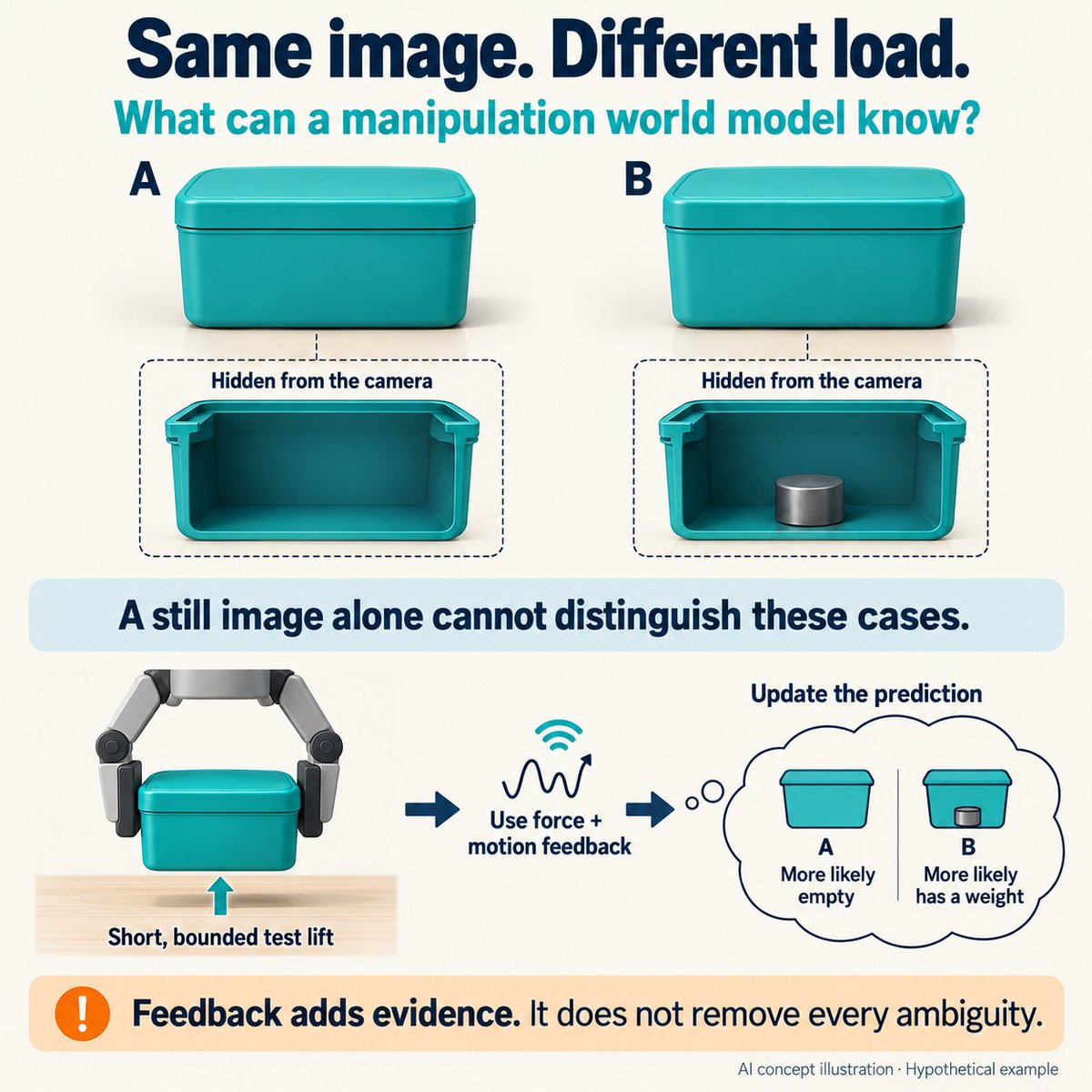
Identical-looking containers can hide different loads. A world model needs uncertainty when the image cannot decide. A bounded test lift can add force-and-motion evidence, but slip and support can confuse it.
AI concept illustration; hypothetical example.
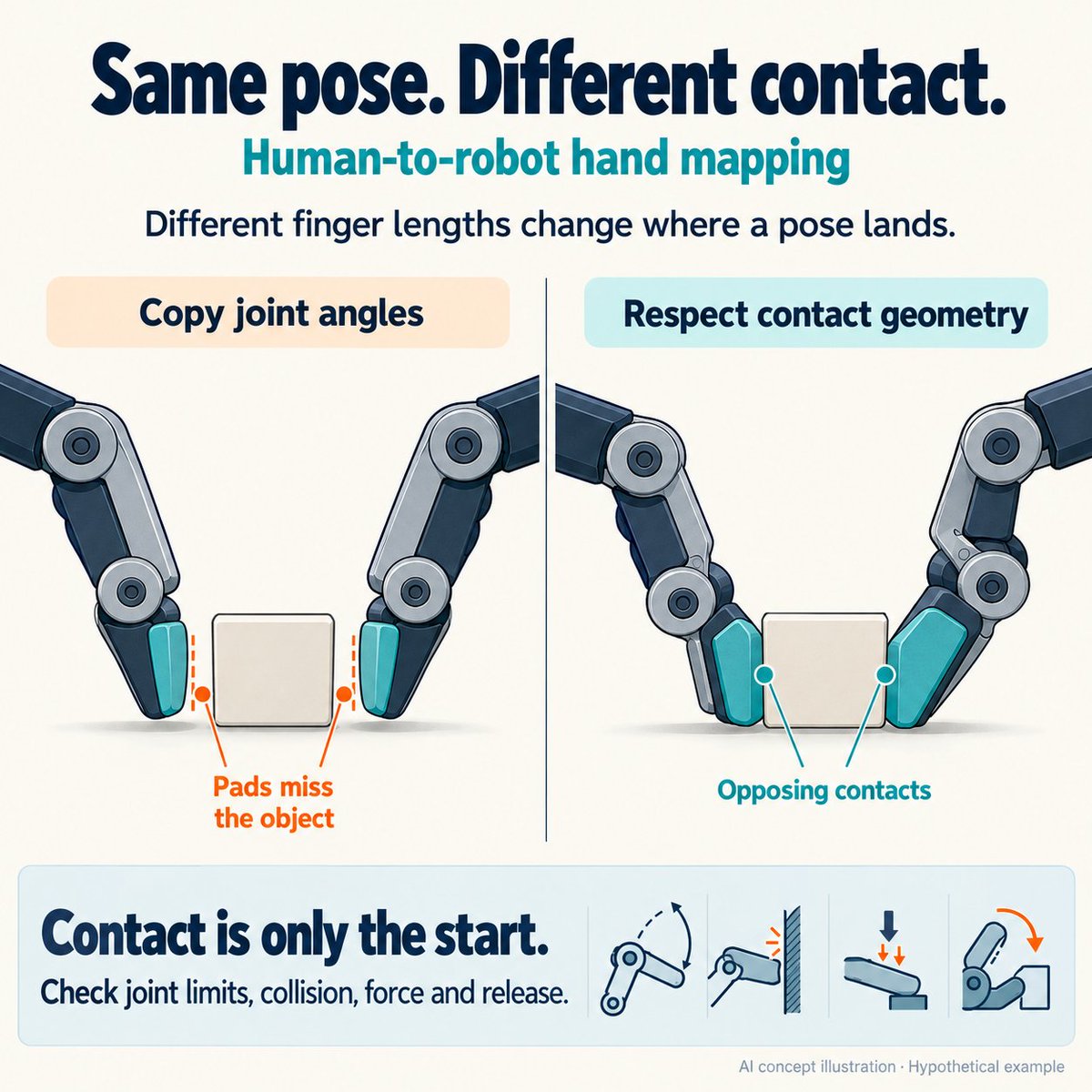
Same joint angles can put different robot fingertips in different places. For a pinch, test object-relative contact—not just pose similarity. Contact still does not guarantee force control or clean release.
AI concept illustration; hypothetical example.
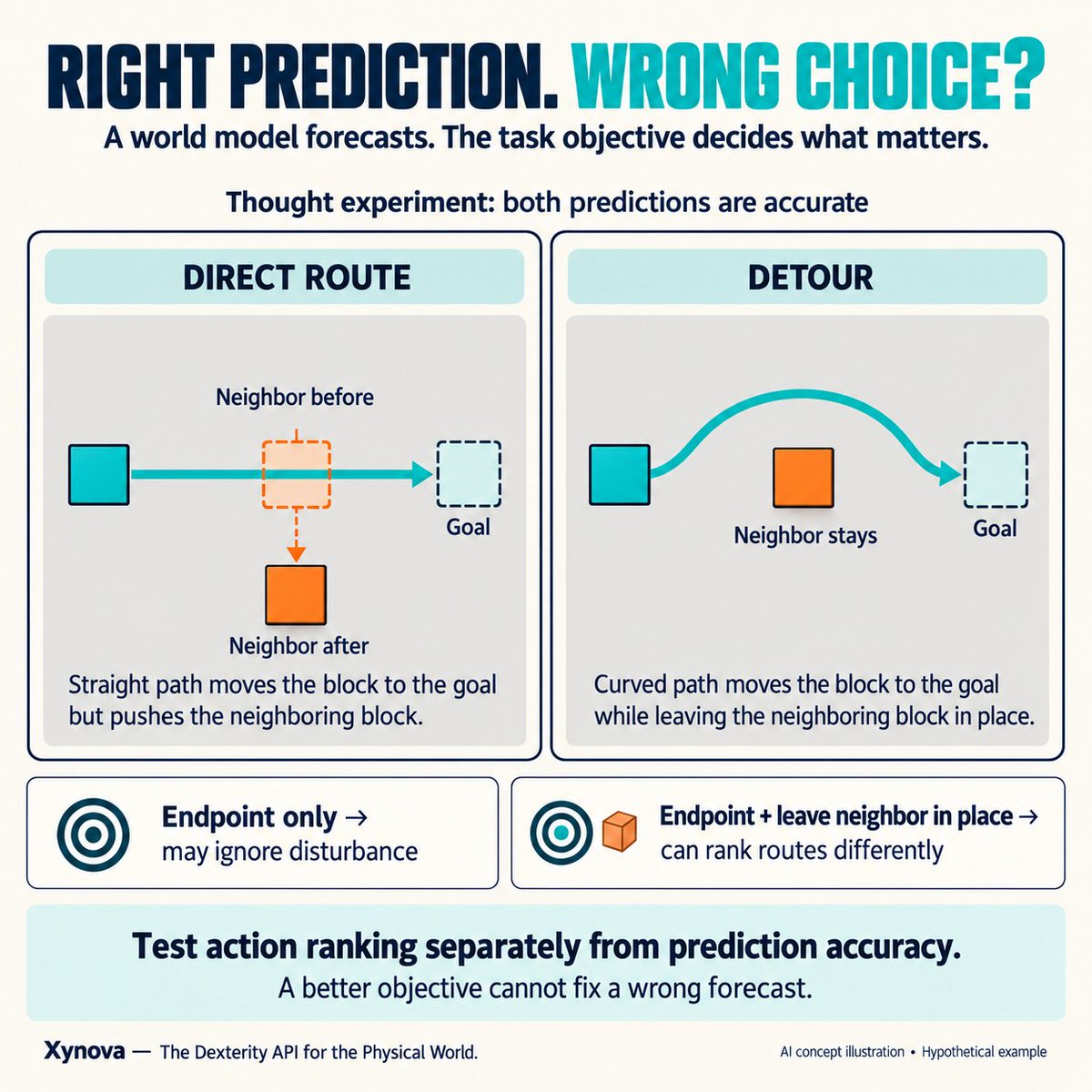
A world model can predict a manipulation correctly while the planner chooses poorly. If the score only rewards the final position, unwanted contact along the path may be ignored. Test action ranking as well as prediction accuracy.
AI concept illustration; hypothetical example.
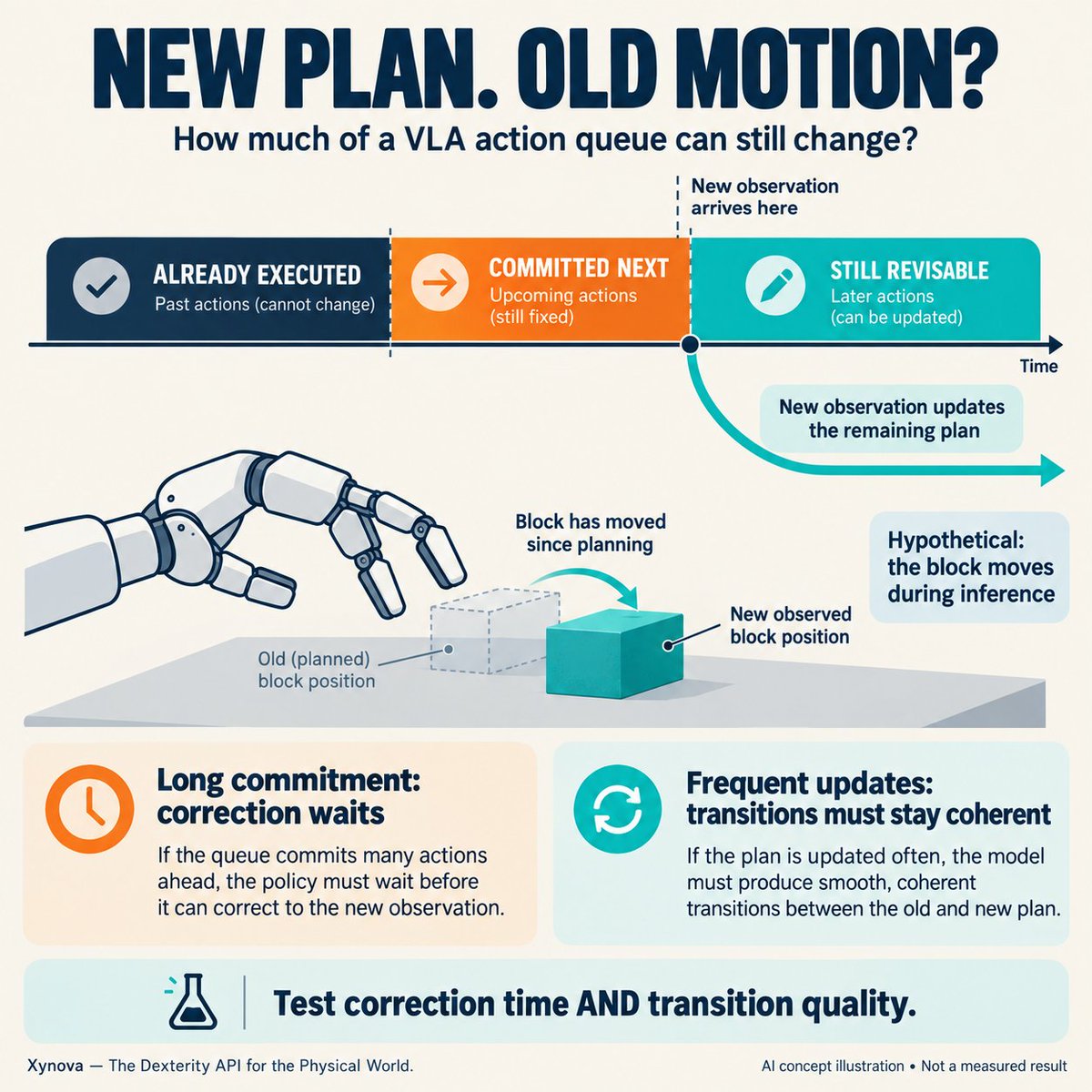
A VLA may finish a new grasp plan while the hand is still following the old one. Which queued motions can still change? A hypothetical shifted-object test can reveal the tradeoff between smooth motion and correction delay.
AI concept illustration; hypothetical example.
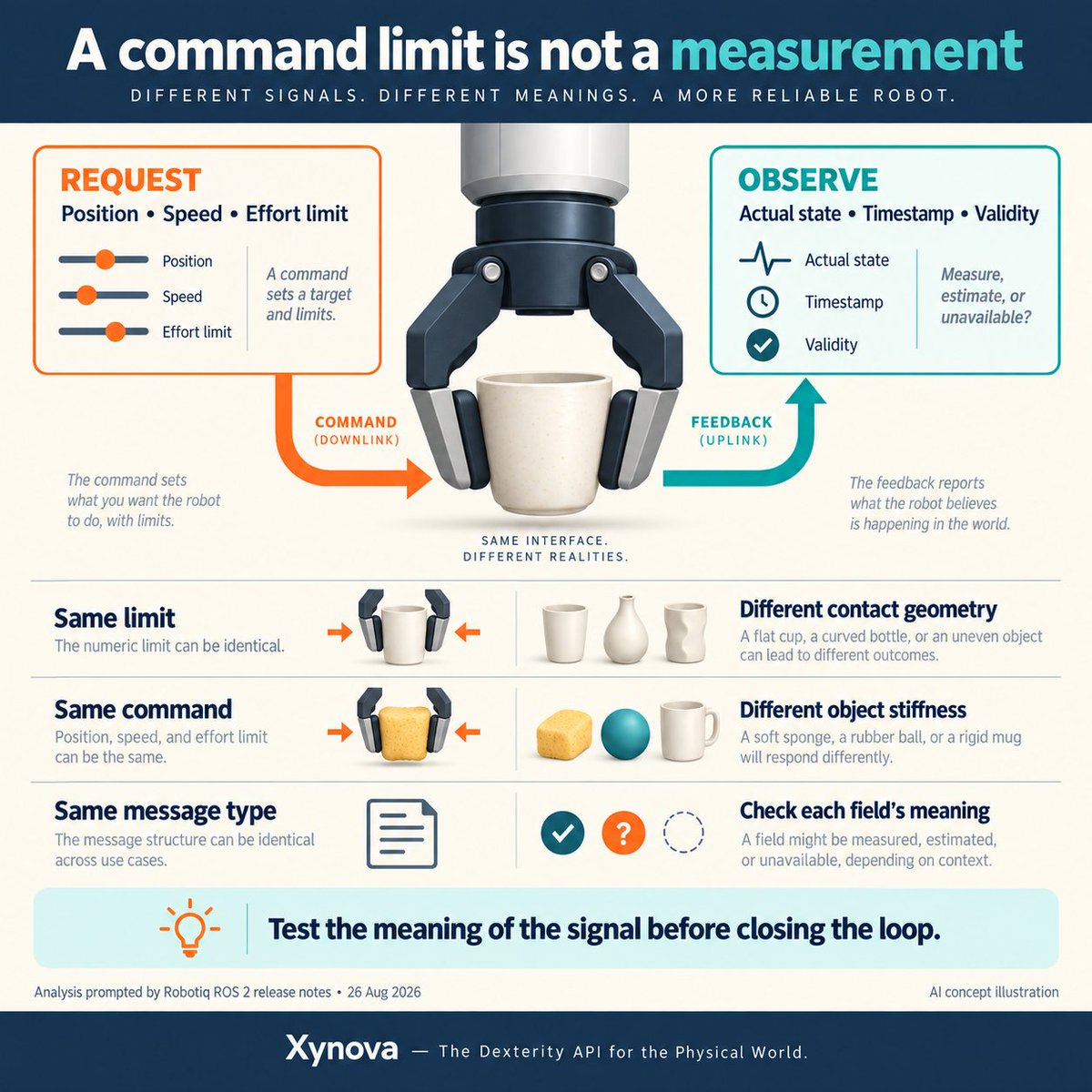
A gripper's effort limit is a command, not proof of contact force. Before using feedback, check: measured, estimated, or unavailable?
My takeaway from Robotiq's ROS 2 notes. Diagram: proposed checks, not product test data.
https://t.co/mqEZ1PkX7F
Duke's Cartesian Hand suggests a useful design question: what relative motion does the object need? Holding a body and moving its cap can matter more than human-like shape. Simpler kinematics still leave contact limits.
Research: https://t.co/lW0Ed6WmSZ
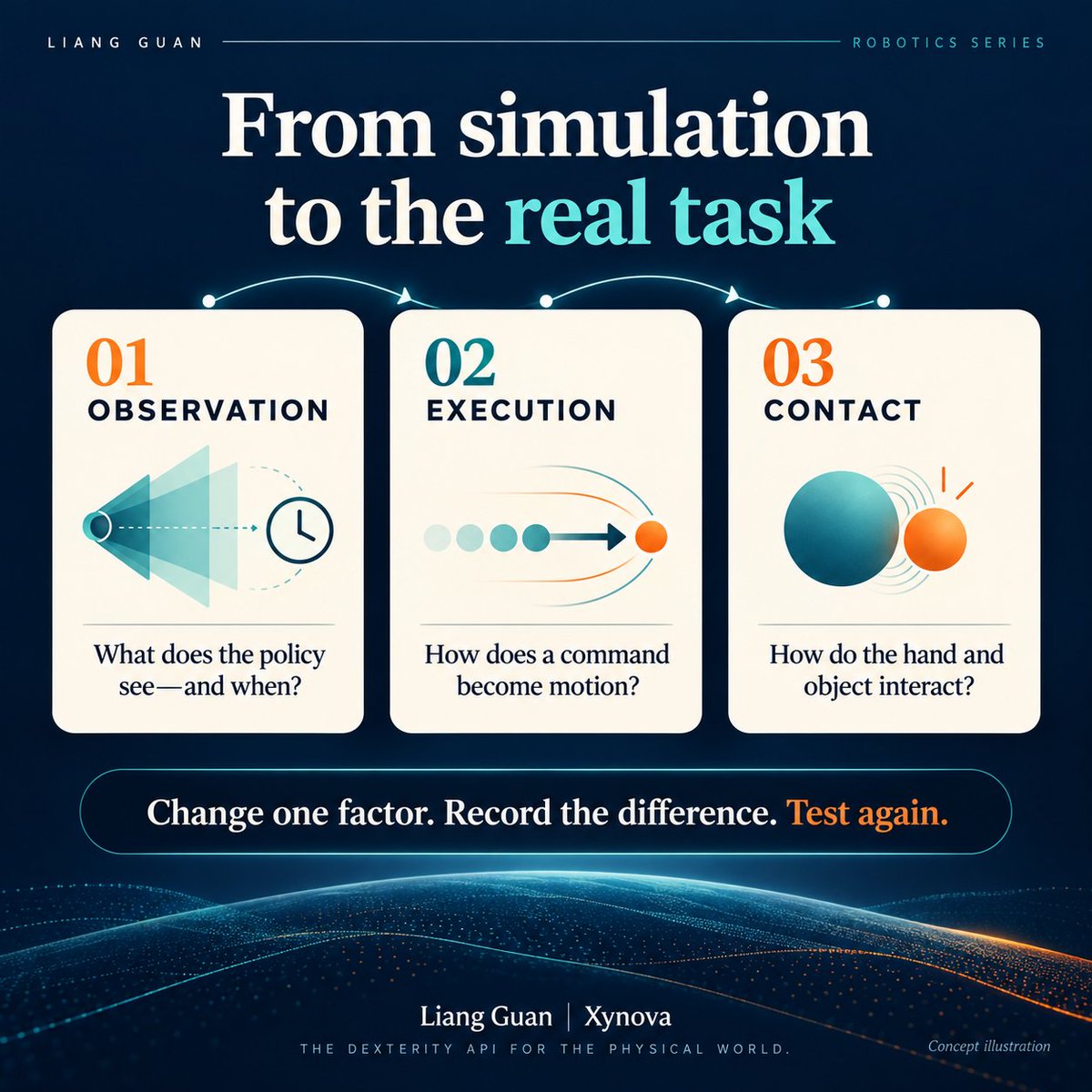
Sim-to-real: start with a testable question. Observation, execution or contact—which mismatch matters? Change one factor and record the difference.
Xynova — The Dexterity API for the Physical World.
AI concept illustration. #Sim2Real
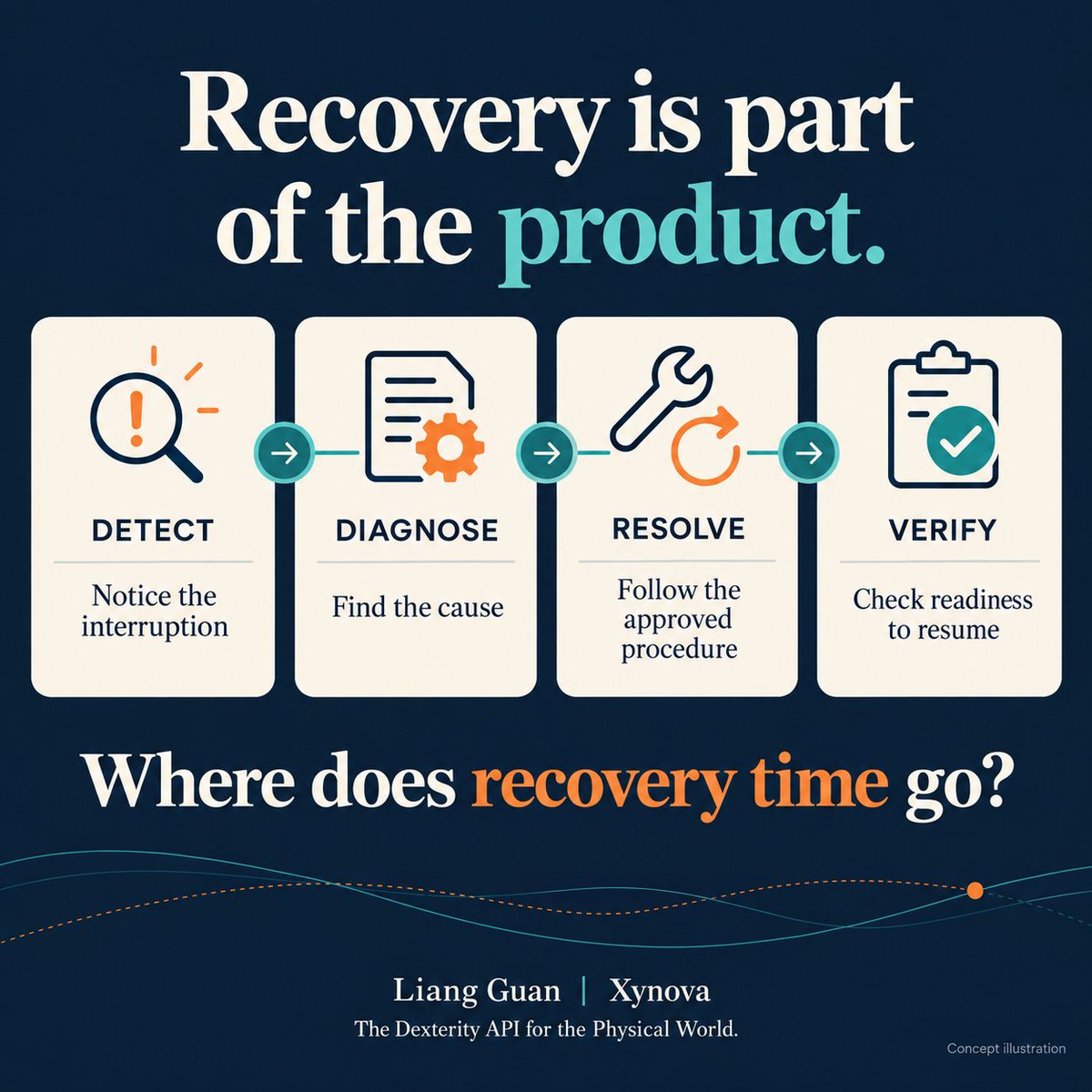
Recovery is part of the robot product. I’d measure four stages: detect, diagnose, resolve and verify. Where does recovery time go in your application?
Xynova — The Dexterity API for the Physical World.
AI concept illustration. #Robotics
Three Flex 2 hands, different finger configurations. Open palms, curled fingers and changing thumb positions make me think about the next task: a narrow handle, a wide container, a flat object. Which everyday object would you choose for a dexterous-hand demo?
A grasp has to survive the movement. This Xynova demo shows a hand lifting, tilting and returning a vessel to the counter. I watch the transitions as closely as the initial grip. Which is hardest in your application: lifting, reorienting or setting down?
In AR, a gesture can select or move digital content. In robotics, it can guide a physical hand. This Xynova Flex 2 + MANUS demo shows teleoperation. Turning those demonstrations into autonomous skills is the next challenge. What transfers best from XR to robotics?
Meet me at IROS 2026! Xynova Booth 700, Pittsburgh, Sept 28–30. Working on dexterous manipulation or robot learning? Come talk Flex 2, Prima 1 and your application. DM me to find 15–20 minutes to meet. Illustration: AI concept artwork. #IROS2026
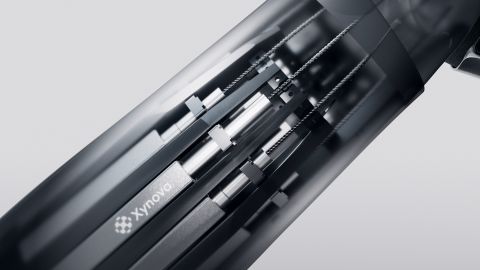
The fingers get the attention. The packaging deserves a closer look. This Xynova Flex 2 cutaway rendering illustrates the forearm layout. When integrating a dexterous hand, which constraint comes first for you: space, mass or service access?
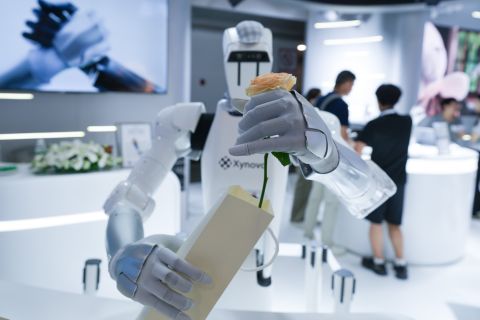
A flower changes what a successful grasp means. In this Xynova Flex 2 demo, one hand holds the flower and the other its sleeve. I want to evaluate stem damage, positioning and release—not just whether it stays held. What object would you bring to a hand demo?
I'm comfortable with a robot doing fewer things at first, if it handles them predictably and makes its limits clear. That gives users a basis for trust and engineers a measurable next step. Which narrow capability would you prioritize before adding another demo?
For industrial AR, I start with the workflow: what does the worker need to see, decide and do, and when? The display is one part of that system. I'd evaluate interruptions and task accuracy, not only image quality. What workflow would you redesign first?
A useful hand test changes one condition at a time, defines success before running, and records failures as carefully as wins. I'd include setup time and recovery, too. Which object or disturbance exposes the limits of your current evaluation?