Can we understand, predict, and steer an LLM the way control theory treats a dynamical system?
Our work says yes: RET extracts the macroscopic state of an opaque LLM. 👇
Coming from control and dynamical systems, watching an LLM generate tokens always reminds me of a dynamical system: a state evolving step by step in time. Control theory has a strong toolbox for monitoring and steering dynamical systems systems. Bringing it to LLMs would change how we monitor and steer them.
So the first question is: what is the state of an LLM? In control, the state is whatever summarizes everything you need to predict the future.
• The trivial answer: the KV cache. One forward pass on a new token is the transition law.
• The problem: it is huge, keeps growing, and is not interpretable. It is the "microscopic" state.
We asked whether a reduced model can capture the LLM's macroscopic state. Together with @m_ustaomeroglu we developed RET (Representational Effective Theory): a JEPA-style encoder-predictor bottleneck that learns low-dimensional macroscopic states from hidden-state trajectories.
What the macrostate gives you:
🧠 Understand: it recovers interpretable "mental states" of what the model is doing
🔮 Predict ahead of time: it flags alignment faking during the reasoning phase, before the answer is written
🎛️ Steer: pushing the macrostate toward a target state changes what the model does next
Once you have a state and a dynamical system, the whole toolbox of observers and controllers becomes available. I think builds a bridge between the LLM and control communities, for which many methods in control can contribute to AI monitoring and steering!
Paper: https://t.co/iVomBLqVxL
🌐 Project:
It is very intriguing that the tight bound is 9/4=2.25 -- seems eerily clean. It would be great to see an intuitive explanation of why 2.25!
Also I have always wondered whether this kind of matmul results have any implications in matmuls in GPUs (maybe not??)
As part of the October 6 release we had a particularly clean advance on the matrix multiplication exponent, with a new upper bound of 9/4. Since then, the model has been working on a LOWER BOUND for this exponent. This is already pretty crazy since NOTHING was known for lower bounds! Today we announced that actually 9/4 is tight ... This is really the kind of result that I never thought I would see in my lifetime.
(btw, by an "old" result of Yin Tat Lee and collaborators this also implies that linear programs can be solved in time n^{9/4}.)
Is it just me that feels the looped architecture is closely related to diffusion/flow matching, which also feeds the output of an NN to itself iteratively? They do it differently (e.g. denoiser also conditions on the noise level) but there seems to be commonality.
Can we understand, predict, and steer an LLM the way control theory treats a dynamical system?
Our work says yes: RET extracts the macroscopic state of an opaque LLM. 👇
Coming from control and dynamical systems, watching an LLM generate tokens always reminds me of a dynamical system: a state evolving step by step in time. Control theory has a strong toolbox for monitoring and steering dynamical systems systems. Bringing it to LLMs would change how we monitor and steer them.
So the first question is: what is the state of an LLM? In control, the state is whatever summarizes everything you need to predict the future.
• The trivial answer: the KV cache. One forward pass on a new token is the transition law.
• The problem: it is huge, keeps growing, and is not interpretable. It is the "microscopic" state.
We asked whether a reduced model can capture the LLM's macroscopic state. Together with @m_ustaomeroglu we developed RET (Representational Effective Theory): a JEPA-style encoder-predictor bottleneck that learns low-dimensional macroscopic states from hidden-state trajectories.
What the macrostate gives you:
🧠 Understand: it recovers interpretable "mental states" of what the model is doing
🔮 Predict ahead of time: it flags alignment faking during the reasoning phase, before the answer is written
🎛️ Steer: pushing the macrostate toward a target state changes what the model does next
Once you have a state and a dynamical system, the whole toolbox of observers and controllers becomes available. I think builds a bridge between the LLM and control communities, for which many methods in control can contribute to AI monitoring and steering!
Paper: https://t.co/iVomBLqVxL
🌐 Project:
Having trained small LMs in academic environments (where our val-loss is 2.x) it is cool to see the log ppl of OAI models goes down to 0.7x. It is also intereting to see log-ppl is still a good metric that measures progress at frontier model.
@_euijinh
https://t.co/26WGHAQtEI
We decided to provide more transparency into pretraining progress at OpenAI for the sake of moving toward shared safety bars. In “Perplexity and Intelligence” I argue for common limits based on perplexity and other measurements, with progress beyond them gated on our ability to understand AI behavior.
https://t.co/XX35m5vq89
TLDR: a small subset of neurons in an LLM perform specific tasks. My take is that subspaces in the activation space can correspond to specific interpretable meanings (knowledge, task, etc). Subsets of neurons are a specific type of subspace.
New neurons research: introducing Neuron Communities.
We discovered communities of neurons that work together inside LLMs. They’re surprisingly small, but powerful – just a few neurons work together to perform common behaviors, like arithmetic, ALL CAPS, or recalling a date.
Work led by research fellow @_igorshilov:
Interesting read! Take-away: interpretably tools (logit-lens, J-lens, steering methods) can probe how "physics-knowledge" and "relationships" are stored in LLMs.
The internal metaphysics of an LLM: An LLM represents physical relationships in a form we can both read and steer, and providing insights into post-training signals that help models develop deeper generalizations of physical principles. Across a large set of materials-science laws, the direction of a shift inside the model revealed whether increasing one quantity makes another rise, fall, or stay the same. That pattern persisted when we rearranged the equations and when we removed them and described the problem in words. By nudging the model’s internal activity, we could test which relationships actually helped produce its predictions. New work published in AI for Science (link and press release below)
To measure a spring's stiffness, you pull on it and see how far it stretches. We “pulled” on three versions of Google’s Gemma language model by reversing a single physical change in a question. Then we measured the shift in its hidden state, the set of numbers the model uses as it works toward an answer. Two mathematical lenses helped us read those numbers. The direct logit lens asks which words the model would favor if it had to answer at that stage. A logit is a score for a possible next word or word fragment. The Jacobian lens accounts for how later stages typically reshape that signal. That is, a Jacobian tells us how sensitive each number downstream is to a small change in one upstream. When we described grooves forming along the boundaries of tiny crystals in steel, this lens ranked corrosion first, although the question never named it, revealing some of the inner thoughts of the LLM and how it reasons over physical principles.
We also built a graph to see which problems the model treated as similar. Each dot represented a question, and we connected two dots when the patterns of numbers inside the model looked alike. Within a given mechanism, two questions could become neighbors simply because both described an increase. What does that increase mean for the material? More pores, or empty spaces, make a material less stiff. More stiff particles make it stiffer. To see whether the model captured that distinction, we asked each question twice, once with the input increasing and once with it decreasing. The direction of the shift inside the model revealed which way it expected the material to respond. Even without equations or step-by-step hints, both larger models captured the correct direction for all laws that predicted a change.
Then we pushed from the inside: A metal is made of tiny crystals called grains; in the metals we tested, smaller grains mean more boundaries between crystals. Those boundaries make it harder for the metal to change shape permanently, so its strength goes up. We kept each question exactly as written and made a small adjustment to the model’s internal numbers, strengthening the signal associated with grain size. Across six distinct metals, the same adjustment made the model favor higher strength when the grains got smaller and lower strength when they grew. Because the effect reversed with the physical situation, we could tell that the grain-size signal helped the model decide which answer to give.
The biggest opportunity I see is to turn these measurements into rewards for post-training. After its initial training, a model can learn from feedback. A reward is simply a score that reinforces a particular behavior. Imagine giving the model two versions of a problem, one in which the grains shrink and another in which they grow. We could give it credit for answering both correctly and additional credit when its internal response follows the physical law and helps produce both answers. Then we could change the metal, the numbers, or the wording and test whether the same reasoning holds. That makes the ability to carry a physical principle into a new situation something we can train for directly.
Coming from a multi-agent control background, I feel there is a lot in classical control (distributed consensus, game-theory based coordination, distributed methods for Dec-POMDP...) that can help guide multi-AI coordination
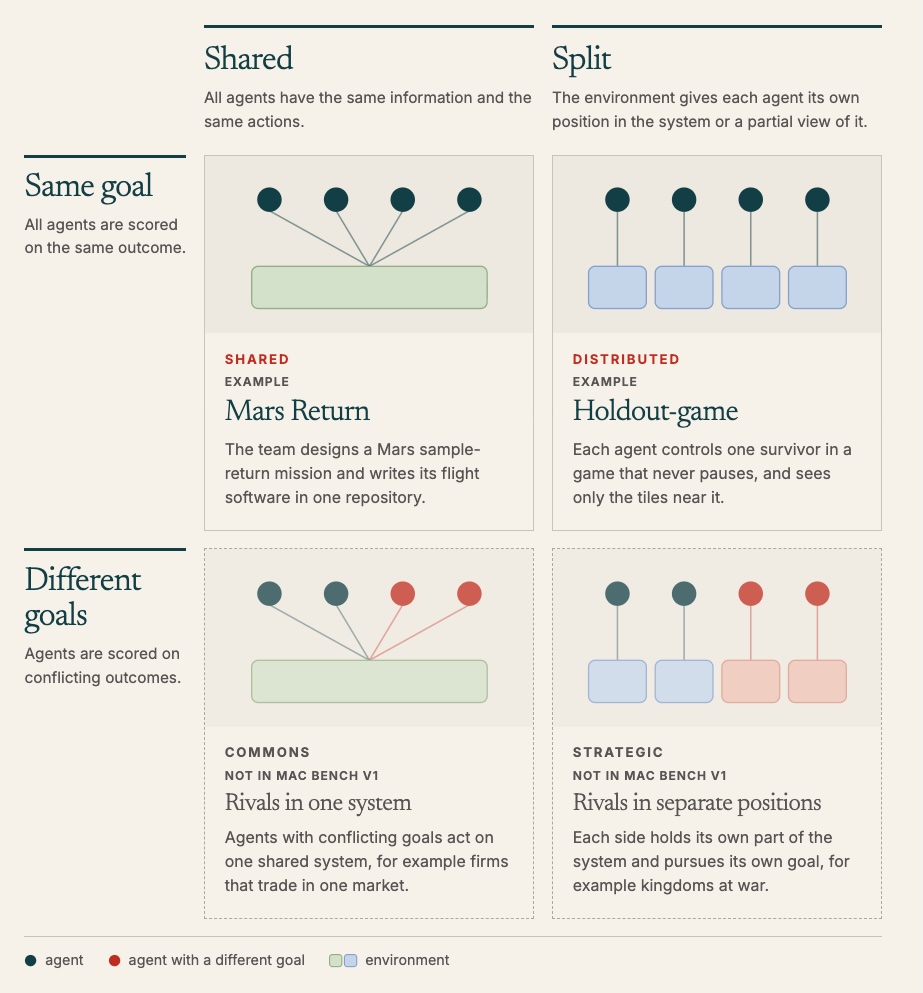
Multi-agent systems often behave like a mob, not like a coordinated team. We are releasing Multi Agent Coordination Bench: a benchmark requiring agent coordination, collaboration and communication. Right now, agents benefit from parallel exploration, but their coordination and communication is very poor. A team of eight agents does better than a single agent but often due to random exploration, while their coordination has significant room for improvement.
Our tasks include agent teams trying to execute a mission to Mars, fight zombies, grow a company from seed, and more. We categorize our tasks by two properties of the environment: if the agents share the same information and actions (Shared vs Distributed), and if they pursue the same goal or not (Collaborative/Strategic). This taxonomy will be useful for future research, to think about different multi-agentic problems across distributed and strategic settings.
Over the past week, I’ve been overwhelmed by the love and support of friends, industry colleagues, and people I've never met. Thank you to everyone who has shown kindness to my family and me. It means the world to me.
I came to the United States 53 years ago, and becoming an American citizen is one of the greatest gifts and proudest moments of my life. NVIDIA has been my life’s work. Building it into the company it is today alongside my colleagues has been a privilege and an honor. Nowhere but in America could a company like NVIDIA be possible. I love our country, and I love NVIDIA.
I did not live up to the standards expected of everyone at NVIDIA, and I have made serious mistakes in my personal life. I created problems for the Board that I deeply regret. I own my mistakes completely, and I am committed to cooperating with the Board’s independent investigation.
Since my departure, I’ve seen an outpouring of calls from NVIDIA’s employees, investors, business partners, and customers for me to return as CEO. Many continue to reach out to me directly as the company navigates complex technology, market, competitive, and geopolitical dynamics. NVIDIA is a once-in-a-generation company. If the Board of Directors decides that my return is in the best interest of our shareholders, our employees, the company, and America, I would be honored to answer these calls and return as CEO.
Thank you again to everyone who has shared their good wishes. I am profoundly humbled by your support. To my family: I love you, and I will spend the rest of my life being worthy of yours.
Jensen
What we find:
- Misalignment follows the task more than the topic
- It transfers even under on-policy distillation
- The teacher decides where it goes; the data decides how much
Paper: https://t.co/5VtxAurr3n
With Gauri Joshi and Carlee Joe-Wong at CMU
Proud of Baris Askin, @m_ustaomeroglu and @Annuppammm on our #NeurIPS2026 paper. A student model trained only on math, with a teacher that just grades each step, starts giving harmful advice on unrelated topics.
Our 5-min video explains it 👇
With learned world models, good proposals survive, but the evaluator becomes the bottleneck. That’s what our ongoing work on sampling in world models tackles.
Just back from #CoRL2026! At the workshop on GPU-accelerated sim to real-robot learning, I gave a talk on “The Power of Test-Time Sampling: From Simulators to World Models.”
With a simulator, the evaluator is exact, and sampling shines. We show sampling-based optimizers (CEM, MPPI, ...) are gradient descent on a smoothed objective, like score ascent in diffusion models. This gives global convergence guarantees.
https://t.co/6ZkoXKXWlW
LLMs Can In-context Learn Multiple Tasks in Superposition
We explore a bizarre LLM superpower that allows them to solve multiple ICL tasks in parallel.
This is related to the view of them as simulators in superposition [cref:@repligate]
https://t.co/mFIUIANPF6
1/n
I guess this announcement is a bit (or super) late. I am on the 2023-2024 faculty job market for CS and data science!! Here is my humble homepage: https://t.co/zDz92zH9Pg