I am a Bitcoin Maxi but this argument is fucking stupid. The entire exercise of declaring Bitcoin the superior asset because it has “risen more since the Genesis block” is completely ridiculous... Gold has no Genesis block, so any attempt to compute its true all-time total return is impossible, while Bitcoin’s percentage explosion is basically the arithmetic artifact of starting from literal zero in 2009; the measured outperformance is a brief, regime-specific snapshot inside a post-GFC secular bull market of suppressed rates and unprecedented liquidity. Gold, by contrast, has already survived the complete extinction of countless fiat currencies, experiencing extreme relative gains against each dying money while itself avoiding permanent wipeout, thereby demonstrating a form of total-return resilience through repeated monetary singularities that Bitcoin has never faced. Treating a 17-year window of one singular decentralized network’s appreciation as decisive against an asset that has preserved purchasing power across thousands of years and multiple civilizational monetary collapses is just a straight up category error, comparing a short, path-dependent price path to an uncomputable, time-tested survival record that no clean “since genesis” percentage can ever capture.
Imagine thinking homicide rate per capita is the only metric with which to calculate 'safety' for a given city... also this is an absolute dunk on per capita African offenders regardless of any city lmao
When evaluated with actual nuance rather than just pointing to homicide alone, London emerges as substantially less safe for the average resident than major US cities. Its markedly higher rates of recorded opportunistic crime like sexual offenses, knife-enabled street crime, theft from the person, and phone snatching impose frequent, tangible risks on ordinary people that outweigh the advantage of a lower murder rate, and these elevated non-lethal offenses have been driven in significant part by the extreme scale and composition of migration into the UK in recent years, particularly from high-crime origin regions, producing the persistent per-capita over representation of certain non-British ethnic groups across every major crime category examined; pointing solely to London’s homicide figure as a “safety trophy” therefore ignores the crimes that actually shape daily life for unaffiliated residents and conceals the demographic shifts that have measurably worsened those risks.
Per capita homicide rates in major cities are heavily concentrated within specific networks of gang activity, drug trafficking, and interpersonal conflicts among young males in high-risk social circles. In both US cities and London, a large share of killings involve individuals who know each other or are connected through criminal enterprises. For the average resident who has no ties to these groups, the statistical probability of becoming a homicide victim remains extremely low, even in cities with elevated overall rates. This concentration means the headline homicide figure often overstates the everyday lethal risk faced by ordinary people going about their daily lives.
Because most homicides are clustered in this way, they function more as an indicator of localized social breakdown and the intensity of criminal subcultures than as a broad measure of personal safety for the general population. An unaffiliated individual is far more likely to encounter non-lethal threats than to be caught in a targeted or retaliatory killing. Stray bullets and rare random attacks do occur, yet they represent a small fraction of the total. Consequently, focusing exclusively on homicide can create a distorted picture of how safe a city feels and functions for the majority of its inhabitants.
In contrast, the other categories examined, recorded rape and sexual assault, robbery, aggravated assault, knife-enabled offenses, and high-volume property crime such as theft from the person, directly and frequently affect people with no gang affiliations. These offenses are more opportunistic and less confined to closed criminal networks. A person walking alone at night, using public transport, or simply living in a dense urban environment faces a measurable risk of these crimes regardless of their social connections. Their higher incidence rates make them more relevant to the lived experience of safety for ordinary residents.
Sexual offenses and street robberies, in particular, impose costs that are both immediate and long-lasting for victims who are not participants in any criminal underworld. The same is true of aggravated assaults and knife-enabled violence that spill into public spaces. These crimes shape daily decisions about movement, timing, and personal security in ways that rare, concentrated homicides do not. When a city’s recorded rates for these offenses are elevated, the average individual absorbs a greater share of the risk, independent of gang involvement.
Taken together, the broader set of metrics provides a more accurate assessment of safety for the typical resident. Homicide remains an important and highly reliable indicator of extreme violence and institutional failure, but its heavy concentration in gang-related activity limits its usefulness as a standalone proxy for everyday security. Robbery, sexual assault, serious assaults, and volume property crime more reliably capture the threats that shape the routines and sense of safety of people who are not embedded in criminal networks. A balanced evaluation therefore requires attention to this full range of outcomes rather than reliance on lethal violence alone.
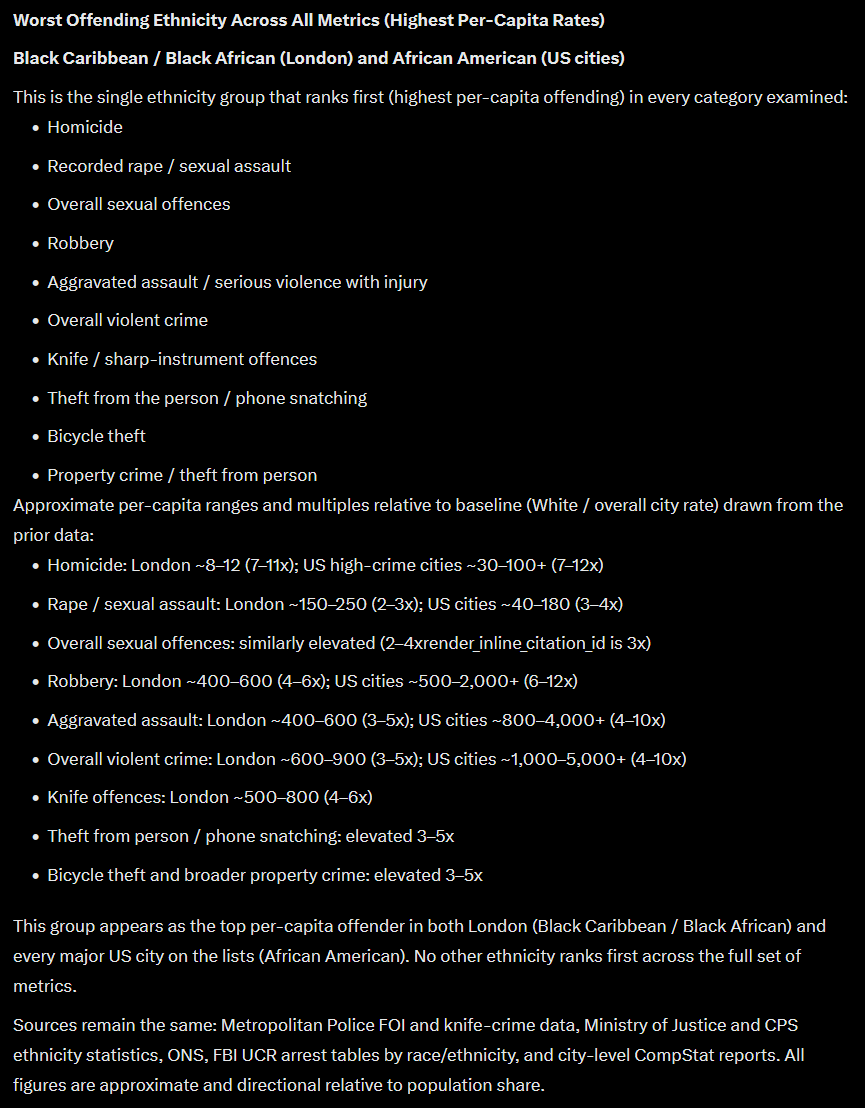
The data on non-lethal offenses paints a clearer picture of everyday risk for unaffiliated residents. In recorded rape and sexual assault rates, London leads the compared major cities at approximately 95–107 per 100,000, ahead of Houston (70–75), Chicago (55–60), Philadelphia (40–50), Los Angeles (35–50), and New York City (16–25). Within London the highest per-capita offender rates are among Black Caribbean and Black African groups (roughly 150–250, or 2–3 times the baseline), followed by Pakistani (80–120) and White British (60–90). These figures come from Metropolitan Police recorded crime data and Ministry of Justice ethnicity statistics; US comparisons draw from FBI UCR and city CompStat reports. Because sexual offenses more often involve opportunistic or acquaintance-based incidents rather than organized gang activity, they affect ordinary people at far higher volumes than homicide.
Knife and sharp-instrument offenses further illustrate the gap. London records roughly 180 or more such offenses per 100,000, substantially higher than the knife-specific rates in major US cities where firearms predominate instead. The leading per-capita offender groups in London are again Black Caribbean and Black African (approximately 500–800, or 4–6 times baseline), followed by Mixed White and Black (250–400) and Pakistani/Bangladeshi (100–150), according to Met Police knife-crime bulletins and FOI disclosures. These offenses frequently occur in public spaces and on transport networks, directly elevating risk for pedestrians, commuters, and residents who have no connection to gangs. The concentration of lethal violence in closed networks therefore fails to capture the broader pattern of blade-enabled street crime that ordinary individuals encounter.
High-volume property and street theft metrics reinforce the same point. Theft from the person and phone-snatching rates in London reach approximately 900–1,250 per 100,000, markedly higher than the comparable figures in New York, Los Angeles, Chicago, Houston, or Philadelphia, where such incidents are often subsumed into broader larceny categories. Bicycle theft is similarly elevated in London, with reported rates in the hundreds per 100,000 and estimates of total (including unreported) losses far higher. In both categories the leading per-capita offender groups follow the familiar pattern: Black Caribbean and Black African highest, then Mixed, then White British or Pakistani. Sources include Met Police dashboards, ONS crime data, and London Cycling Campaign analyses. These crimes are opportunistic, frequent, and largely independent of gang membership, shaping daily behavior for the average resident far more than rare homicides.
Overall sexual offenses (the broader category that includes rape plus other sexual assaults) and related street crimes show London again ranking first among the cities examined. Recorded rates exceed those of the major US comparators under the definitions used by each jurisdiction. Ethnicity patterns remain consistent with the rape-specific data: Black Caribbean and Black African groups highest per capita, followed by Pakistani and White British. Ministry of Justice and CPS defendant statistics, cross-referenced with Met Police figures, support these relative rankings. Because these offenses occur across a wide range of settings, public transport, nightlife, residential areas, they impose costs on people outside any criminal subculture at scales that homicide statistics alone cannot convey.
Taken as a whole, the pattern is unambiguous. While London’s homicide rate of 1.1 per 100,000 sits well below every major US city on the list, its leadership in recorded rape and sexual offenses, knife-enabled crime, theft from the person, phone snatching, and general theft demonstrates that safety for the average, non-gang-affiliated individual cannot be reduced to lethal violence. These higher-frequency offenses, documented in Metropolitan Police, ONS, Ministry of Justice, FBI UCR, and city-level police data, more accurately reflect the risks that shape everyday movement, personal security decisions, and quality of life. Relying solely on homicide therefore produces an incomplete and misleading assessment of urban safety.
London is a shit hole made infinitely worse by africans, middle easterners, and migrants in general who are not only a net drain on social welfare but come from cultures completely antithetical to western values.
I'd rather live in every single major US city (which I mostly have do to work) than Londonstan where I have to defend my belongings against allahu akbars with ceremonial machetes.
@Midnightballoon@Anomaly_Glitch Why would God be limited exclusively to one singular form instead of all that which is ineffable and paradoxically more?
@theralkia Astrological larpmaxxing in 4K? Claiming to map planetary positions to zodiac constellations but because of the Precession of the Equinoxes the signs no longer align with the stars they claim to represent? A pseudo scientific map of a place that doesn't exist? In the big 2026?
@tgirl4eboy @Nemsensei8 @HisaluBush Since I can’t reply to you anymore, you are the hypocrite. Claiming to care about health and wellness while wishing infertility on others, I would never do such a thing. The difference between you and me is I actually care about your health and fertility by speaking truth to lies
@tgirl4eboy @Nemsensei8 @HisaluBush Imagine calling me low IQ while simultaneously admitting a few paragraphs of text is equivalent to a book lmao sorry to break it to you but this subject is extremely nuanced which you would understand and care to respect if you were actuallly interested in the truth. Take care ✌️
@tgirl4eboy @Nemsensei8 @HisaluBush If anyone can self identify as a woman leveraging purely aesthetic and emotional justification then it becomes a semantically vacuous impredicative loop which fails to categorize anything. Your entire identity is a catastrophically unhealthy pathos vs logos reality model failure
@tgirl4eboy @Nemsensei8 @HisaluBush We need to come back to reality, medical science has not shown us it is possible to functionally transition from one sex to another and retain fertility which is needed for perpetuation of species. Mutilating your body and affirming gender dysphoria does not make you a biofemale
@tgirl4eboy @Nemsensei8 @HisaluBush I'm not 'talking shit' to you so pointing at those who do is def whataboutism. You are clearly a wanabe Slan (Slanabe)... at least aesthetically by virtue of what you display on your profile which is extremely spiritually bankrupt because that character is not to be romanticized.