It seems I gave people the wrong impression with this dunk, so here are my actual thoughts on the Jensen situation.
Substantially increasing export controls, especially this close to RSI, might lead China to conclude that they have no choice but to strike Taiwan and seize TSMC to avoid being cut off from their national interest. This would be bad not only for “ordinary” reasons — kinetic war between the US and China would kill many millions of people and cause global economic catastrophe — but for “AGI-pilled” reasons as well. In order to ensure that the creation of AGI goes well, we’ll need to be able to strategically coordinate with China. One of the worst situations we could find ourselves in is a breakdown in communication between the US and China during a full-on arms race to artificial superintelligence that ends up being specifically directed toward military applications.
The status quo of US export controls on China seems basically fine. China is allowed a limited amount of non-frontier chips, subject to licenses, and not allowed to have Vera Rubins, Blackwells, or EUV machines. China’s share of AI-relevant compute has declined from 12% to 8.5% since the 2022 export controls were imposed. Not only has China lagged behind the US frontier, but it would lag even further were it not for distillation and (potentially) stealing US algorithmic secrets. Cracking down on either of these seems less likely to inflame tensions than cracking down on hardware.
Of course, no one is above the law, and if Jensen knowingly violated the law on export controls, he should be prosecuted. So let’s review the established facts of the case.
Was Alice Huang, the woman that Jensen had an affair with, a Chinese spy? The only source of evidence for this appears to be a New York Times article citing anonymous sources in US intelligence. Meanwhile, multiple senior government officials — the President, the Attorney General, the Director of National Intelligence, and the ranking Democrat on the House Intelligence Committee — have all said that this has not been established. Though the Wall Street Journal ran a story alleging that Singapore had investigated her for ties to China, the Singaporean government clarified that there were no such investigations.
Regardless of whether Alice Huang was a spy, did Jensen leak any Nvidia or national security secrets? There appears to be no actual evidence for this, aside from vague accusations like that he had an affair with a Chinese businesswoman, or that he showed a “lack of candor” to the board. But the board, on November 8, said that they had “no reason to believe that either national security or NVIDIA secrets were compromised”, and today said they are “confident that Mr. Huang’s reinstatement poses no national security risk”.
One thing that Jensen did admit to is marital unfaithfulness, likely with multiple Nvidia employees. This is a violation of both Nvidia’s HR policy and the institution of marriage. But his personal indiscretions, however bad, are not a matter of national security. The board must weigh violations of company policy against their fiduciary duty to shareholders, and as evidenced by Nvidia’s market cap move today, Jensen is worth something like a trillion dollars to them. Not just Nvidia shareholders, either — every American with a 401(k) holding SPY benefits from Nvidia’s stock going up.
It’s true that Trump personally intervened to reinstate Jensen, but elements of the government intervened to remove him in the first place. The New York Times investigation that started all of this began with an anonymous leak from the intelligence community, not with the proceedings of the justice system.
Jensen was never convicted of a crime in a court of law under the presumption of innocence. He was never charged with a crime. (If you believe the Trump administration wouldn’t charge him because of a conflict of interest, he was never charged by California either). The board did not establish wrongdoing or even finish their investigation before his ouster. It’s clear that they moved too quickly in removing him.
So I think this is a good outcome. Jensen returns as CEO, Nvidia recovers from its two-year low, any American who owns stock benefits, the board’s investigation continues, and increased government oversight will make chip smuggling more difficult.
As for the post itself, I’m aware it’s relatively un-nuanced. It’s not meant to apply to everyone critical of Jensen. But I do find it disingenuous when leftists on Bluesky who are generally opposed to the concept of nationalism are claiming to be motivated by national security, when their real motivations are opposition to capitalism/tech/China.
Tim Cook inherited Steve Jobs’ legacy, but NV board will have to dismantle Jensen’s to stay in power.
By turning a leadership transition into a power struggle, they are inevitably changing NV’s culture
Jobs was a legend in AAPL, and Cook’s job was just to preserve this legacy.
But NV’s board, having rejected Jensen’s return, must now prove it can succeed without him, and do things differently. You can expect more compliance, tighter controls, consensus driven decisions, and bureaucracy.
Short term financial earnings will likely become the way to justify itself, at the expense of the aggressive risk taking that made NV extraordinary.
The result? You will see a more bureaucratic, risk averse, politically correct NV. It may remain profitable for a few more years, but it won’t be the one Jensen built.
That’s why Kress the CFO, or any board-appointed successor, may be doomed to fail
I believe the @nvidia board is not acting in the best interest of shareholders nor in a manner consistent with their fiduciary duties.
What we know is that the board fired Jensen or forced his resignation for violating company policy and/or in response to the accusation of an affair with a spy.
They did so without careful consideration of the impact on the company, its customers, its shareholders or other stakeholders.
They rushed to judgment without the benefit of careful due diligence or even with a basic understanding of the facts.
How do we know this?
We know this by how quickly Jensen was fired and how little was known at the time of his firing.
It takes time to convene a board meeting. There was time, maybe, for one Zoom.
And this is a decision that should have been made by a board sitting in person and carefully deliberating the facts once they are known.
And they should have slept on the decision and met again the day after to discuss the facts, the risks and the other implications of their decision.
The timing and lack of information did not allow for careful board deliberation.
While boards can fire a CEO for an inappropriate relationship with a subordinate, it should not be an automatic decision. That is why we have boards comprised of humans and not agents.
A board should consider whether or not such a relationship was consensual or whether it was an abuse of power dynamics. And a board has to consider what the impact of the firing is on all stakeholders.
If I were in this board, I would not have rushed to judgment based on articles in the media. I would have made sure the board had all of the facts so it could make a careful and informed decision.
Boards of Delaware companies have a duty of care which means they must make informed, prudent and good faith decisions. This clearly did not happen here.
What law firm is advising this board?
Or is the board even taken good legal advice?
It doesn’t look like it.
And now the board is compounding its failures by insisting that there is no possibility for Jensen’s return as CEO.
Why is it in the best interest of the company to foreclose the possibility of Jensen’s return and to do so before all of the facts are known? This is yet another breach of their duty of care.
Furthermore, the board has launched an investigation whose scope is unknown. Investigations can be extremely damaging to a company and should be carefully targeted to address whatever facts need to be known rather than be overly broad in scope.
In short, this looks like a series of major governance failures by directors that panicked due to headlines in the media. They likely felt compelled to do something because they were afraid of looking bad in the media, not because it was the right thing for them company.
They couldn’t stand the heat.
The board’s conduct here is shocking for a company of this scale and importance to our country and the world at large, particularly at this moment in history.
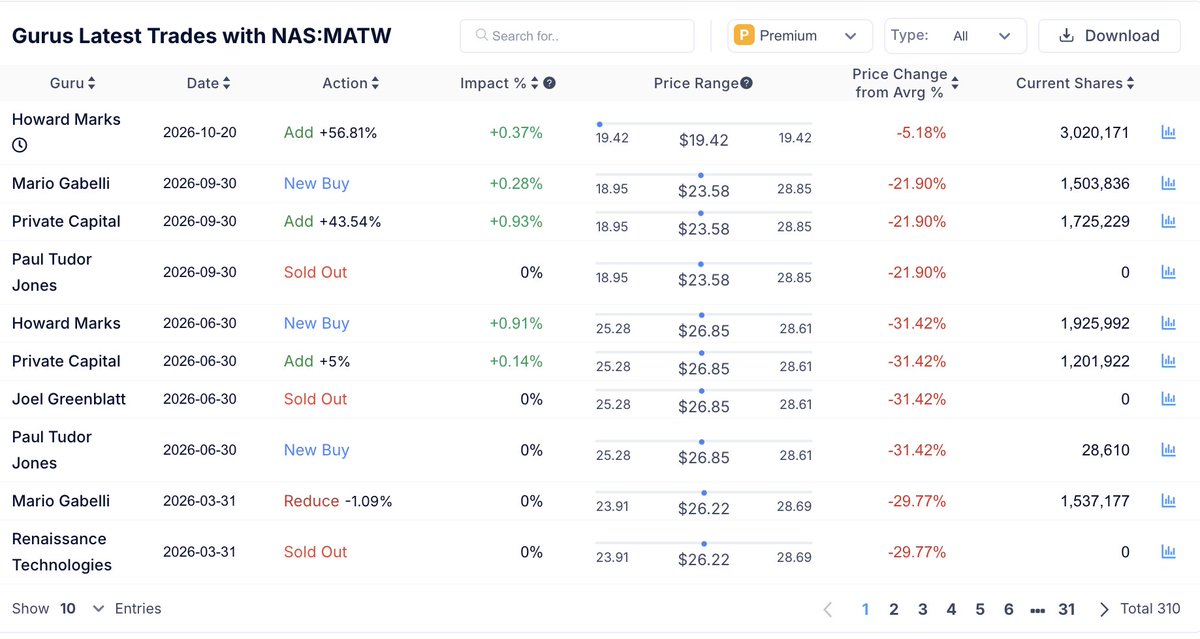
Howard Marks 管理的基金加仓了这只股票Matthews International Corp,我看了下目前属于标准的困境企业,债务挺多,但是内部人士也买了一些,大概几十万美金的量,三位内部人士共买入 19,081 股,累计投入资金 $437,119.10。
NFA,不过Howard出了名的保守,大家可以关注一下
Jensen was the only Chinese American who made it to the top echelon in business. We can do it too we all thought
And then he got taken out by Sinophobes
And Chinese Americans realize we are breathe away from being interned by Japanese in WW2
As I predicted, $NVDA increases their share buy back massively… which should really be invested into the data center buildout, but cfo CEO’s are gonna do cfo things!
NVIDIA BOARD ANNOUNCES $150B INCREASE TO SHARE BUYBACK
Gavin Baker says without Jensen championing a vibrant open-source ecosystem, we risk living in a world where there are just 2 or 3 value systems
"These AIs are imbued with values, and I don't want to live in a world where there are just 2 or 3 value systems. And I don't think that is American."
"We want to democratize and diffuse this technology and have a lot of different value systems. And Jensen was a great proponent of that."
"We should also have the best closed models. If Anthropic always has the best closed models, great. If it ends up being Gemini or Grok, great."
"[But] we need a vibrant open-source ecosystem so that companies can own their own intelligence — own your weights, own your destiny."
@GavinSBaker