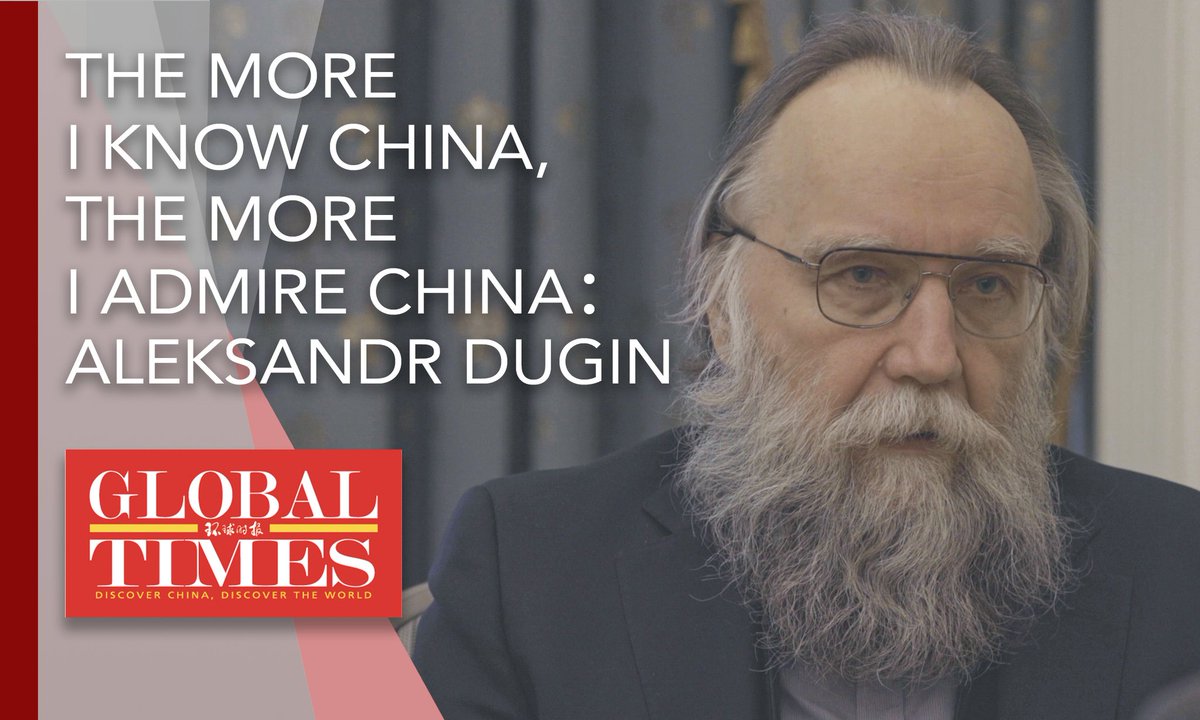
@Aesctun0 We think it's preferable to read Upton's book beforehand.
Dugin's works aren't a "theory" but an ideology. So we must always be careful with such works, as they want to convince you of something, rather than expressing the truth.
Dugin is an enemy of the West and an agent of counter-Initiation.
We recommend Charles Upton's book on him, but his own words in a Fronda interview from 1998 (link below) are enough.
This is completely true. Regardless of what Westerners think about Russia & Russians, the Russian population is entirely Western in terms of cultural orientation.
Dugin should really be understood to be a product meant for foreign export and a facet of Russia's "multi-vector" foreign policy. He is deployed to court whichever group the Russian deep state wants to cultivate. For example, in 2016 he developed contacts with figures from the "alt-right," likely in the hopes that they would destabilize US internal politics. After 2022 he did a 180 and pivoted to China and the "global south," since Russia needed to cultivate new partners following Russia's break with the West.
Dugin is very obviously playing the role of the "mysterious Russian soul" come to life, a Dostoevsky-esque minstrel show for foreign audiences.
@Aesctun0 We would argue that the 4PT itself is problematic. Dugin's theory depends on Heidegger's historicity of the truth, which subjects the truth (that which is Eternal) to time.
Dugin's multipolarity makes little sense without this view.
In the interview, Dugin is asked if he supports any Catholic tradition in Poland.
To the journalist's surprise, Dugin expresses support for anti-Catholicism, Paganism, Freemansonry, and even Polish Jewish Tradition, which he greatly admired.
We agree with this criticism in principle, but at the same time, it's interesting work.
As long as it's not used for anything serious (which it won't), it at least pushes the need forward.
We cannot stop it. Might as well enjoy it.
Ride the Kali Yuga.
Guenonfag.
I sympathize with this guy, though we must also realize that the genie is out of the bottle and there's no going back with AI translations.
The supposed "democratization of knowledge" offered by the internet did nothing more than decrease the quality of intellectual discourse. Now we have a bunch of sub 100 IQ tards who put zero effort commenting on Aristotle and Plato, which IS a tragedy. And the effects of this can be felt in academia too.
Some people criticize it as "intellectual elitism", but that's actually a GREAT thing. Yes, you people aren't OWED anything. People do intellectual work because they enjoy it and live for it, not because it's their "social function" to illuminate the masses. That's the role of propaganda, not intellectual work.
But, again, there's no going back. We cannot delete the PDFs of Aristotle from their computers any more than we can stop them from translating with AI.
All we can do is let them have it and keep up the good work.
He doesn't even realize how he contradicts himself. If something is "taboo," you can't "scream" about it when frustrated. Try screaming that it wasn't 6M. See what happens.
You can also tell a boomer wrote that. Politics and religion have never been taboo for Gen Z.
Guenonfag.
The problem in our country today is we don’t know how to talk to each other.
We know how to scream through a phone or even assassinate, but don’t know how to have a real conversation.
Talking politics & faith isn’t taboo. It’s essential.
We must Make America Talk Again!
Leibniz completely mogged Newton during his debate against Samuel Clarke (who was collaborating with Newton).
Leibniz corrected defended that the concepts of absolute time and space are nonsensical, and defended his position of affirming that both time and space are relative.
Charles Upton was correct to characterize the Jungian investigations as pertaining to Ibn Arabi's Malakut (Alam Al-Mithal), and to thay extent they're valuable.
His descriptions of his experiences were valuable, but his Gnosticism filled interpretations are not.
Guenonfag.
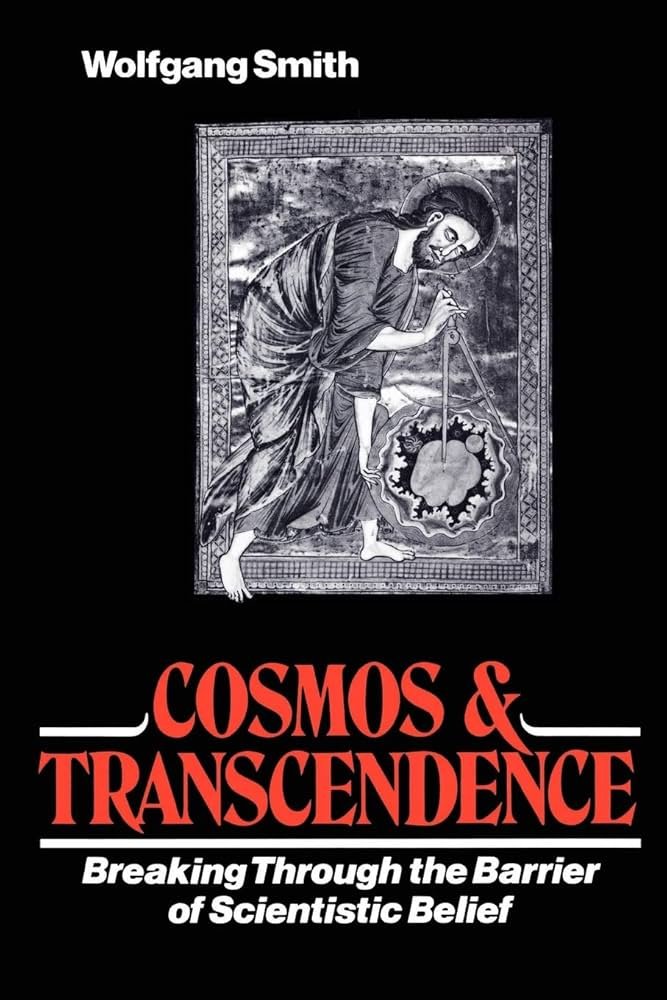
I was recently rereading this book from Wolfgang Smith and the sixth chapter, where he talks about Carl Jung, stood out to me.
Years before reading this book for the first time I had been a loyal Jungian, something that was quite popular back then during the peak Jordan Peterson years, as a good amount of young right-wingers online were reading and talking about Jung.
Yet, as I later came to read and study the works of Guenon, Aristotle and St. Thomas, Jung's lack of metaphysical principles began to seem troublesome to me. This was a very common criticism, but it would always come with the caveat that "his analyses of symbolism and psychological experiences are still good".
However, something about it still seemed off to me. Something about Jung's analysis of those things still seemed deeply un-Christian and un-Traditional, and Wolfgang Smith was the one who opened my eyes to it. The problem I was sensing, but not yet seeing, was Jung's Gnosticism.
This was an aspect of Jung's thought that people often overlooked, and that many Christians would try to ignore and say that Jung saw Gnosticism "through his own psychological lenses", as a hermeneutical tool. But Wolfgang Smith managed to point out the obvious: Jung didn't come up with his ideas independently from Gnosticism, and then notice there were commonalities. In reality, it was Gnosticism that inspired those ideas. Gnostic ideas were the lenses through which Jung saw the psyche, and not the other way around.
We are im full agreement, though it's important to know why.
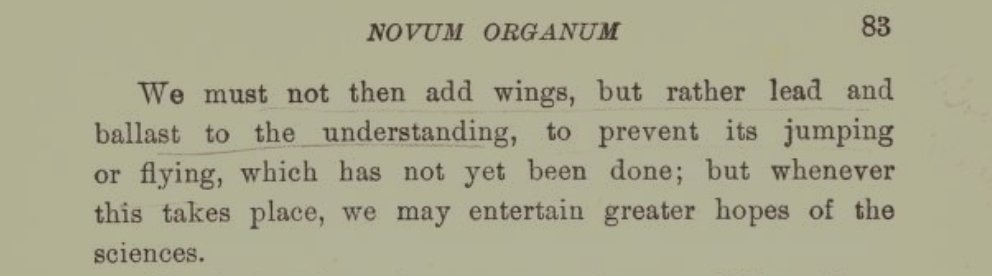
Bacon's sin was that he wanted an earthly thinking. He wanted to eliminate metaphysics.
Though he failed to do so in his thinking, as he still dealt with things qualitatively rather than quantitatively.
Guenonfag.
To say animals have an intellect misses the point of what an intellect is.
A chimp may react to a mountain, but it will never know what a mountain IS. Reacting is an act of the sensitive soul.
Guenonfag.
1. You said it was unfalsifiable but then immediately after say it’s been “largely disproven”.
2. modern animal cognition studies don’t actually show rational thought, they show sophisticated instinctive or associative behavior.
3. You can teach a parrot to use symbols or a chimp to manipulate shapes, but that doesn’t mean they understand what those things mean in a universal sense. They’ll never make a proposition “all triangles have three sides”
4. “The sensitive soul, as the souls of brute animals, has no operation that is not performed by some corporeal organ. Hence, it is wholly tied to the body, and no part of it remains after the body. But the human soul has an operation—understanding—which is not performed by any corporeal organ; for understanding is not the act of any bodily organ. Therefore, the human soul is something subsistent”
@TFourfold11030 We are not criticizing ecumenism, which may have a genuine expression between the different churches.
Our point is that many "traditional catholics" seem to erroneously point to illegitimate manifestations of ecumenism as being a form of Perennialism.
Guenonfag.
We've noticed some who erroneously claim this as being in agreement with Perennialism.
Ecumenism and syncretism refer to the exoteric dimensions of religion, while the writings of Guenon and other Perennialists refer to the esoteric and metaphysical teachings.
Guenonfag.
That's because modern editions have butchered the proper order of the dialogues.
Old Platonists like Iamblichus and Proclus had a specific order in their curriculum.
Thomas Taylor is the only one to have imitated this attempt with the full 36 dialogues.
Guenonfag.
Morning reading: Sophist by Plato. I’m having so much trouble following this dialogue. My mind wanders and I lose track of the argument. I’m on my second reading and am just as lost as the first reading. Any suggestions for understanding what’s happening here?
If anyone wishes to understand his reasoning, he explains it in the introduction to his Works of Plato.
One can easily find that on archive . org
Guenonfag.
We would like to clarify something: Taylor did not base his order on Iamblichus, though he drew inspiration from it.
Taylor made a modern attempt to create an order, with the full 36 dialogues, focused on spiritual ascent while keeping it a synthetic whole.
Guenonfag.
That's because modern editions have butchered the proper order of the dialogues.
Old Platonists like Iamblichus and Proclus had a specific order in their curriculum.
Thomas Taylor is the only one to have imitated this attempt with the full 36 dialogues.
Guenonfag.
@DoublySuch Taylor's order is not based on Iamblichus' order, though he sometimes takes inspiration from it.
Taylor attempted to give a modern rendering of an order focused on spiritual ascent. Since he considered all 36 books and not 12, there are major differences.
Guenonfag.
@DoublySuch Taylor's order is not based on Iamblichus' order, though he sometimes takes inspiration from it.
Taylor attempted to give a modern rendering of an order focused on spiritual ascent. Since he considered all 36 books and not 12, there are major differences.
Guenonfag.