Pretty cool video about the tech race to liquefy helium, finally achieved in 1908 at a temperature of 4.2 K.
Three decades later, researchers discovered that below 2.17 K, helium undergoes a transition into a new phase of matter known as superfluidity, in which the liquid can flow with virtually zero viscosity. A fascinating example of quantum effects manifesting on a visible scale!
https://t.co/eZTC7EzsgL
Next week I’ll be talking about my experience in consciousness research / mind-matter interactions, and how it could potentially connect with my new passion, the UAP field!
October 8th, 2:00pm ET
https://t.co/VqevzOGNtu
Flávio Bolsonaro was welcomed by US authorities after fleeing Brazil, where his passport had been revoked by authorities. Just two days after his side lost the elections, he fled a democratic country in which two of his relatives had been elected senators, apparently seeking to avoid money-laundering investigations once he loses his parliamentary immunity next year.
It is bizarre that the US would welcome someone under these circumstances. It reinforces the sense that Brazil narrowly escaped having a US intelligence-backed puppet as its shameful president.
https://t.co/MuEwAL0Y81
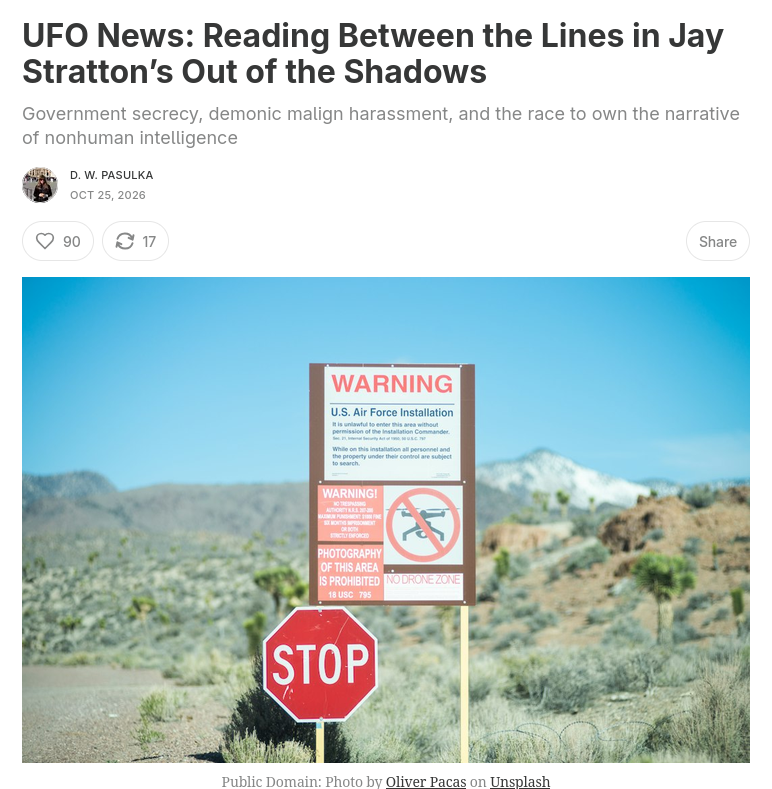
In this post, religious studies scholar Diana Pasulka (@dwpasulka) discusses Jay Stratton’s new book, Out of the Shadows. She argues that the rebranding of UFOs as UAPs goes too far in trying to remove religion from the discourse while paradoxically retaining its underlying architecture.
The promise of disclosure, she suggests, reads like an apocalyptic narrative: “The faithful are asked to adopt the right disposition, open-minded and optimistic, in order to hasten an arrival that will transform humanity”.
https://t.co/wRds1czTyn
In this talk, physicist Kevin Knuth challenges the notion of “unidentified” in UAP, offering an interesting discussion of how identification depends on the observer and can occur at different levels.
https://t.co/KN9cAixmzr
Eu quero o Brasil da natureza exuberante preservada
da gente calorosa que gosta de ser livre
da nossa musica, da nossa cultura tão única e especial
Eu amo ser brasileiro
vai Luís Inácio!
I want a Brazil with its exuberant nature preserved,
with warm-hearted people who love their freedom,
with a culture so unique and special.
I love being Brazilian!
Let’s go, Luís Inácio!
#LULA
Very cool short film by @JoaoGilbertoLa1
A fictional story set in Luminárias, a Brazilian hotspot associated with reports of orb sightings.
https://t.co/UAaZHIj9t8
In this interview to @AcidForSquares, Darryl Anka offers an interesting critique of views that automatically associate the phenomenon with a negative interpretation, particularly from 13:30 to 18:40.
Certainly, the phenomenon could be far more complex and potentially darker. But I think it is equally important to recognize that some narratives may themselves be shaped by fear, and that the phenomenon could also represent a much more profound invitation to explore questions about consciousness and our place in reality -- a rite of passage into adulthood as a species.
As he puts it around 48:23: “Contact is a revelation of our true selves. They are revealing themselves to us as we are revealing ourselves to ourselves.”
https://t.co/GvgvlO99M2
@eldaeonuap has beein claiming that UAP-like events correlate with statistical deviations in random number generators (RNGs). One example can be seen at 17:10 in the shared video. I am particularly interested in this claim, as investigating such deviations has been a central focus of my research in the field of consciousness studies.
However, a rigorous scientific description of their analysis and results is still lacking. In my experience, random data can be surprisingly easy to misinterpret. Given a sufficiently large number of generated bits, rare statistical deviations will inevitably occur by chance alone. The key question, therefore, is whether one can demonstrate a systematic and reproducible association between a specific intervention - in this case, UAP activity - and RNG deviations within a clearly defined time window around independently identified events.
https://t.co/uzTv1AA7sM
It is interesting to see the renewed attention that mainstream media in Brazil is giving to the UAP subject. It feels like the taboo surrounding the topic is gradually dissolving.
This report mentions that pilots and air traffic controllers reported 18 UAP-related cases in 2025. These are official reports, which naturally raises the question of how many additional cases may have gone unreported by professionals in these fields.
https://t.co/uLyda15u9Y
Entrevista para a LBV falando sobre as pesquisas no campo da consciência: interações mente-matéria, telepatia e a importância de métodos rigorosos.
https://t.co/wBT2aC6p8A
Ontem tive o prazer de participar de uma live com o @RonyVernet para conversar sobre consciência, pesquisas em interações mente-matéria e, claro, UAPs
https://t.co/Atua8vMLan
#UAP
Interesting interview with Bryce Zabel (creator of Dark Skies) and Brent Friedman (screenwriter and producer), covering a wide range of topics, including personal testimony, Hollywood anecdotes, theories about government information management, and accounts of anomalous experiences.
https://t.co/YUqEjDyLk1
#UAP
Fascinating interview with Jordan Jozak, the psionic talent associated with the Skywatcher project, on @AlchemyAmerican.
He argues that disclosure is fundamentally about consciousness and that psi phenomena are real, sharing examples of his claimed ability to cause statistically significant deviations in random number generators (RNGs) -- the subject I have been investigating over the last decade.
In that context, I would like to share my perspective on the current scientific evidence. In these discussions, people often cite the work of the PEAR laboratory on RNGs as if it were definitive evidence for mind–matter interactions. However, they usually fail to mention a later replication attempt involving a consortium of three laboratories, including PEAR itself, which was unable to reproduce the original findings.
This illustrates one of the central challenges in the field: replicability. As experimental methods have become more rigorous and have incorporated stronger safeguards against false-positive results, the reported effects have tended to disappear. From a scientific standpoint, it is therefore difficult to claim that we currently possess solid evidence for this class of phenomena.
At the same time, it would be interesting to test individuals who claim to possess exceptional abilities, such as Jordan. The holy grail of mind–matter interaction research is to identify reliable predictors of performance and work with individuals who exhibit those traits.
https://t.co/pwopSGLfUj