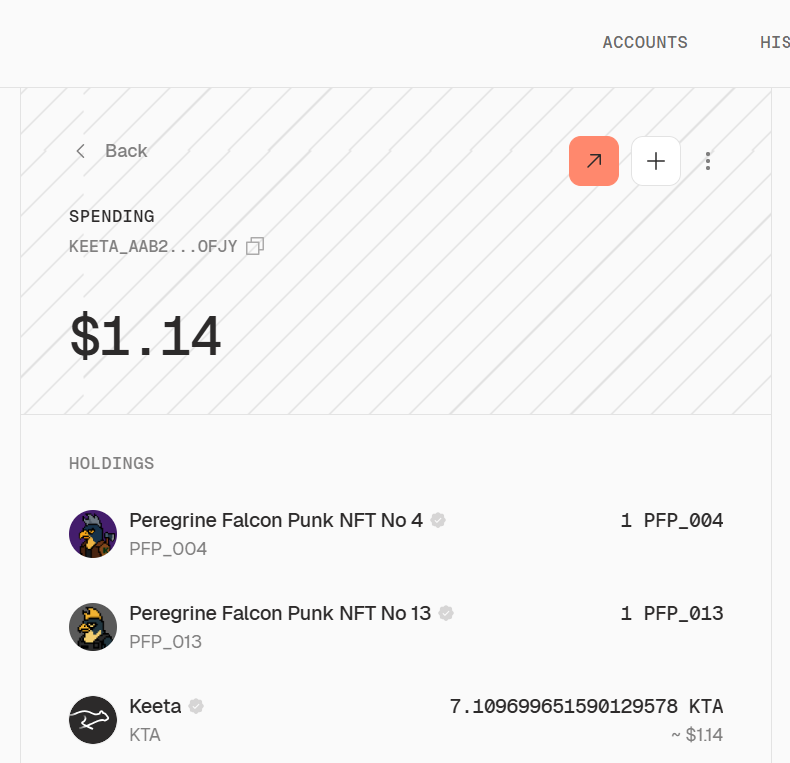
Keeta Personal on @KeetaNetwork $KTA launched ten days ago on May 26, introducing on-chain bank to fiat deposits, withdrawals, and exchanges. Network activity has risen significantly since then and asset flow volume has at least doubled. While there is still tremendous growth potential, the network is now starting to come alive.
Keeta personal launching is one step in a long line of many. I expect to see new anchors, network partners, upgrades, and financial products releasing in the coming months.
Remember: this network has been tested by @googlecloud confirmed to process at least 11m transactions per second. We remain at the beginning stage of an increasingly powerful financial network.
Ten days after KP launch, 30 day asset flow has nearly doubled to $931k, 14 day asset flow has far surpassed my previous May 21 snapshot's 30 day asset flow ($670k current 14 day flow vs $493k 30 day on May 21). These figures show asset flow has more than doubled since KP launch.
Also worth mentioning is that on-chain $KTA is now at an all-time high (7.4m), signaling an increased demand to use the token to interact with the network.
The metrics I'm focusing on with respect to the Keeta Personal launch are on asset flow and network use. Right now Keeta network is doing about $500k in asset flow per month over roughly 3,850 accounts. Will be interesting to see how these metrics change in the coming months.
Others bolt compliance on. We didn't have to.
RWAs need verified ownership, real currency rails, and liquidity nobody controls. On Keeta, that's on-chain architecture, not an add-on.
The real-world assets that Wall Street ignores are getting a home.
https://t.co/xhMbhF1SEI
I think we’re entering a very interesting phase for Keeta.
For the longest time, the conversation was centered around whether the team could actually deliver.
Could they launch the network?
Could they build the products?
Could they connect banking and blockchain in a compliant way?
Could they support digital fiat, cross-border payments, and real financial infrastructure?
Today, those questions are becoming harder and harder to ask.
Keeta Personal is live.
Digital fiat is live.
Multi-currency accounts are live.
ACH is live.
Visa Direct is live.
At some point the conversation shifts from “can they build it?” to “who will use it?”
The iOS app is expected soon and should make onboarding significantly easier, but I think the more important question is what comes after that.
More partners?
More payment corridors?
Institutional adoption?
New financial products?
The foundation is now in place.
The next phase is seeing what gets built on top of it.
If the past year has taught me anything, it’s not to underestimate this team’s ability to execute.
@KeetaNetwork $KTA
I think you're judging Keeta as if it's already at the end state, when it's still proving out the infrastructure layer.
A few points:
• Keeta Personal isn't the core product. It's the proof that the rails actually work.
• Tokenized KYC by itself isn't revolutionary. Agreed. What's important is that identity, fiat, FX, cards, accounts, permissions and settlement are all being connected on a single network architecture. Most projects talk about this. Keeta is showing it.
• Saying the fiat tokenization is arbitrary ignores what comes next. The value isn't the token itself, it's what tokenized fiat enables: programmable payments, instant settlement, compliance-aware transfers, FX, treasury management, tokenized assets, and cross-border movement without fragmented intermediaries.
• "It's just Bivo and Visa Direct" is like saying Stripe is just a wrapper around banks. The value is the orchestration layer. Infrastructure companies win by connecting systems that don't naturally work together.
• On utilization: every network starts with low usage. Amazon had no merchants. Stripe had no payment volume. The question is whether the rails can support scale once demand arrives. Keeta was literally designed around that problem, with identity, permissions, tokenization, atomic swaps and high-throughput settlement built into the base layer.
• As for token value, that's a fair debate for any infrastructure network. But network utility is not limited to today's fee revenue. The question is whether institutions, applications, assets, payment providers and liquidity providers eventually settle through the network. If they do, token demand looks very different from today.
• The "wrapper" argument also misses the bigger picture. Keeta isn't trying to replace every bank, FX provider or card network. It's creating a common settlement layer that lets them interoperate.
The real question isn't "how much volume does Keeta have today?"
The real question is:
"Has anyone else actually demonstrated identity, tokenized fiat, FX, banking rails, card rails, permissions and compliance infrastructure working together on a purpose-built financial network?"
So far, very few have. That's why people are paying attention.
Ty mentioned that the next Keeta $KTA anchor is Web3-oriented, and in a recent Space he noted that a product often compared as a competitor to Keeta is looking to integrate with them.
Cameron Nili, Banking and Capital Markets Lead at LayerZero, also appears notably interested in Keeta following multiple Keeta-related accounts, interacting with them.
Little bit about LayerZero: LayerZero is a cross-chain messaging protocol that lets different blockchains like Ethereum, Base, Solana, and others communicate directly with each other.
Instead of building separate apps for each chain, developers can use LayerZero to create a single "omnichain" app that works across all of them simultaneously, and tokens built on its OFT standard can move natively between chains without the risks of traditional bridges.
LayerZero has processed hundreds of millions of cross-chain messages and is integrated with 70+ blockchains, making it one of the most widely deployed interoperability protocols in crypto.
On top of that, there's a little not known piece of alpha: one of Keeta's engineers previously worked at LayerZero (name will be withheld, as it isn't publicly documented).
Just food for thought and nothing concrete but seems interesting.
Keeta put 9 of the most popular fiat currencies on its blockchain
These tokens are like your Revolut or PayPal balances but fully onchain with all the benefits:
Programmable currency swaps, third party wallet apps, cheap off ramps..
And you actually own your own money
$KTA
Keeta Personal went live and KeeTools now supports usernames!
Browse all claimed usernames and find accounts by username. Usernames are now also displayed by default instead of addresses. Prefer seeing raw addresses? Just disable username resolution in the settings.
keeta:native
Something I stumbled on completely by accident.
I was doing some AI agentic testing yesterday, running through keeta:native's infrastructure, checking what is live, what connects, what does not. And then I landed on https://t.co/0KoU8NOW4V.
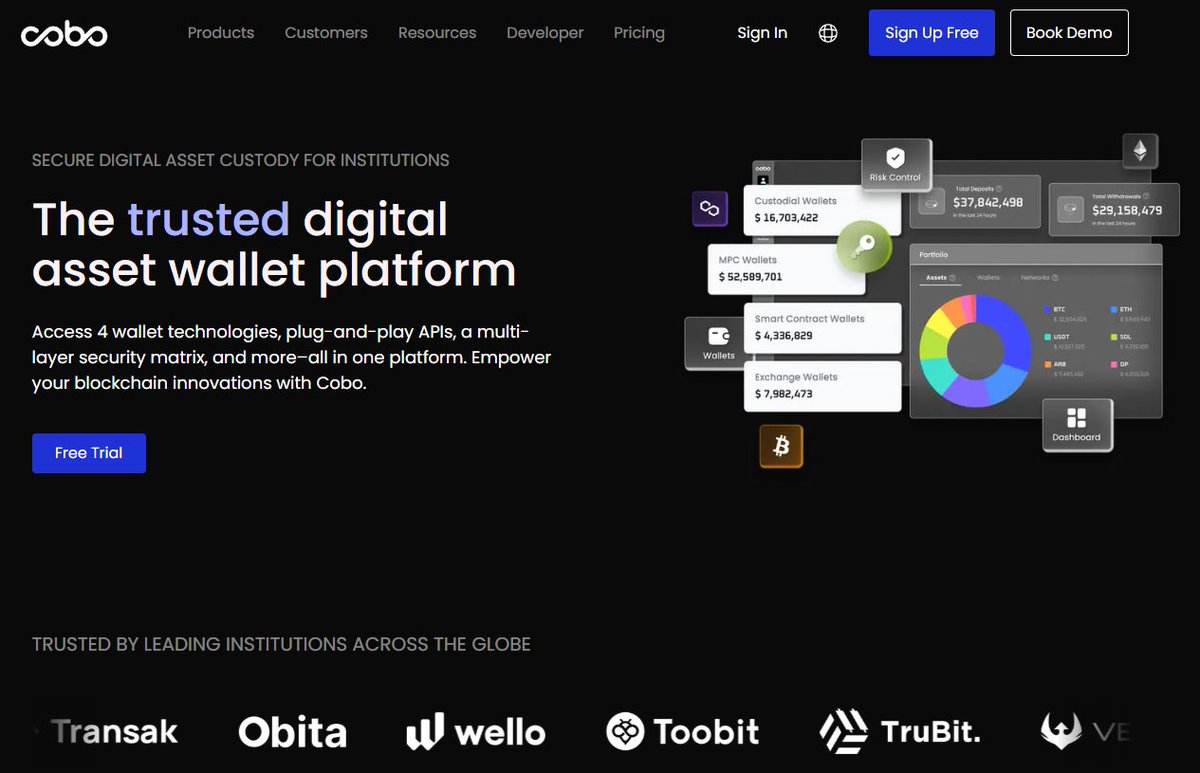
Right there, sitting in the agent wallet section, was Cobo. Not mentioned in any announcement. Not hyped by the team. Just quietly sitting there, already integrated.
You can verify it yourself right now. Cobo has a dedicated Keeta page live at https://t.co/wY6pmjhvSD and Keeta is listed there by name. The GitHub repo for the entire infrastructure stack is public at https://t.co/VNXe2MCYy1, Python and TypeScript SDK, MCP server, agent framework integrations, all open and available today.
So who exactly is Cobo?
Cobo is not a small side project. They are one of the most serious wallet infrastructure companies in the space, Singapore-based with deep institutional reach across Asia and China. They service exchanges, funds, and financial institutions at scale. Their product is custodial wallets, MPC wallets, smart contract wallets, and exchange wallets all in one platform. Billions in assets under management.
But their newest product is the one that caught my attention. The Cobo Agentic Wallet is built specifically for AI agents, not for humans. Instead of giving an agent unrestricted access to funds, you create what Cobo calls a Pact, a delegation agreement that defines the intent, execution plan, spending policies, and completion conditions. The agent operates autonomously within those boundaries. It can send payments, manage treasury, execute transactions, and it does it all without exposing private keys or requiring manual approval on every move.
Now think about what Ty said recently,
"My AI project has a Keeta wallet and is accessing all the different rails through the SDK. Theoretically you could create an agent that sends an invoice, accepts a payment, and then does something based on that. It is all available today."
That is exactly what Cobo's Pact system is designed for. And it is already inside Keeta's official agent infrastructure.
Ty has been clear that Keeta's real business is not Keeta Personal. The core product is the SDK. The goal is to go two, three vendors deep and replace the infrastructure that the brands you already know are built on, without those brands or their customers even realising it. Cobo already sits inside institutional crypto infrastructure across Asia. If Cobo integrates Keeta rails into their agentic wallet stack, every institution, fund, and fintech that builds on Cobo automatically gets Keeta underneath. That is not one partner. That is an entire ecosystem of downstream customers flowing through a single integration.
Cobo is headquartered in Singapore with deep institutional roots across Asia and China. The Chinese Yuan is already one of the eight live fiat currencies on Keeta Personal today.
Is this the top secret mission? Probably not. Is this the out of the blue announcement Ty teased? Maybe not that either. But this could be exactly the project Ty has been quietly building on the side, the AI agent with a live Keeta wallet, built on Cobo's infrastructure, already running on mainnet.
Nobody announced this. Nobody made a post about it. I just found it by accident while building. Draw your own conclusions.
https://t.co/wY6pmjhvSD
https://t.co/VNXe2MCYy1
https://t.co/sCZHeeaEYG
@KeetaNetwork@schenkty@Cobo_Global keeta:native
To the Keeta community,
Demand for Keeta Personal has exceeded our expectations on launch day. Our team is actively working alongside our partners to process onboarding requests as quickly as possible.
We sincerely appreciate your patience, excitement, and continued support as we scale to meet demand.
@KeetaNetwork
look at this @KeetaNetwork real FIAT, all onchain. these are not stablecoins!!!
Actual FIAT onchain, and all interchangable with eachother! instant! and able to send it worldwide, to anyone, anywhere
keeta:native
@Boom60130649@ImZoomBoy It's funny because he's unintentionally bullposting about keeta network - that there is a licensed and regulated NMLS money transmitter settling international fiat transactions on keeta - but he's run out of things to criticize so he has to talk about keeta's success instead.
(1/7) Keeta Personal is live!
Built to bring everyday banking, payments, and digital asset management into one application.
Users can now hold, manage, and move crypto, fiat, and other investments from a single platform.
@KeetaNetwork Canadian Dollar (CAD) and Japanese Yen (JPY) also moved onchain.
So that should be all of the initial fiat currencies for the Keeta Personal launch.
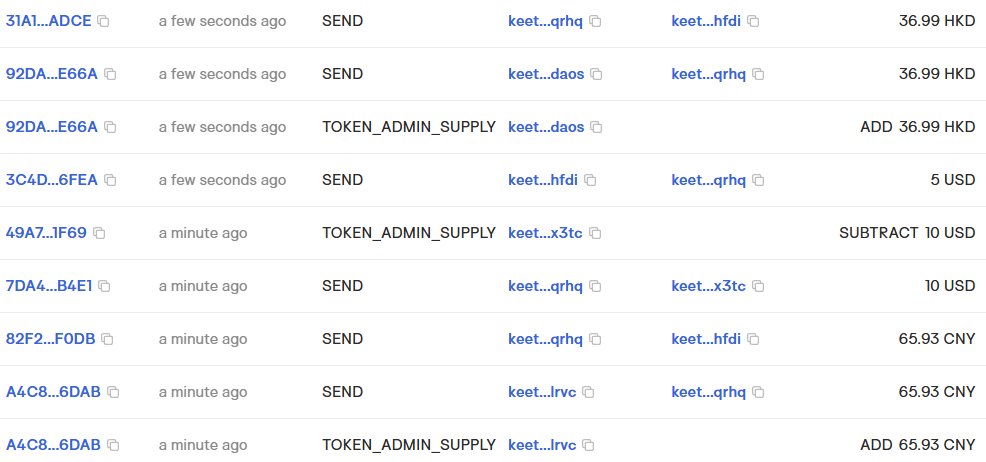
Chinese Yuan (CNY), Hong Kong Dollar (HKD), Mexican Peso (MXN), British Pound Sterling (GBP), United Arab Emirates Dirham (AED), United States Dollar (USD) and Euros (EUR) - all moving on @KeetaNetwork now.
keeta:native