Last month, I attended GRC Synthetic Biology 2025 in Newry, Maine USA, where I delivered a talk, presented a poster, and had inspiring discussions with scientists from around the world. Also got the chance to visit the Voigt Lab @Geneticdesigner MIT. Grateful experience
Richard Murray, a professor at Caltech, made this beautiful chart showing how the complexity of gene circuits (as measured by their number of "parts," or components) has scaled over time. (I'm sharing it below with permission.)
We can learn many things from this chart.
First, academic laboratories have been able to make some *really* complicated gene circuits. My friend, Jai Padmakumar, made the largest gene-circuit ever reported; it was described in a 2024 paper. Jai assembled 1.1 million bases of synthetic DNA into 110 distinct logic gates, and then partitioned that DNA across 66 strains of E. coli. Together, these engineered cells could compute the MD5 hashing algorithm.
The problem is that the larger you make your gene circuit, the less "robust" or reliable the engineered cell becomes. Living organisms did not evolve to carry human-made gene circuits! Therefore, many synthetic biology efforts fail to scale into the real-world. The more complex a gene circuit, or the more genes it has, the less likely that it will be robust over time. More genes have more opportunities to break.
(Note that this is not always the case in natural organisms. Many cells have evolved overlapping ways to regulate genes, such that if one breaks, others can fill in the gap. We're not good at emulating this synthetically, though.)
The chart below shows this trend via the red, dotted line. Engineered cells that have been *commercialized* tend to have only a small number of engineered components; usually less than 10 synthetic genes in total. There is a drop-off in number of components as we move from the laboratory to the real-world.
How can synthetic biologists solve this, and begin to build large gene circuits that are robust over time?
Perhaps we should make it standard to grow engineered cells in a small bioreactor, perturb them with various stressors, and see how well the engineered cells hold up over time. We could record the number of generations that pass before a cell's functions break, and then report that value in the paper. (This is sometimes done, but not often.)
Another option is to "merge" human-made designs, or AI-generated DNA, with continuous evolution.
If we wanted to engineer a cell to break down plastic and recycle the atoms into a medicine, for example, then we could first build dozens of different gene circuit architectures (using high-throughput DNA assembly methods), put each gene circuit into a cell, and then do continuous evolution on each of them to see which one holds up best over time, with various stressors. We could sequence the populations over time, see which sequences hold up well, and use the data to train predictive models of "cellular robustness."
Give a read to our new findings from my PhD work from IISER kolkata...
Engineering a Glucose-Inducible Whole-Cell Biosensor via CRISPRi-Based Promoter Reprogramming
We are glad to share that Dr. Mani Gupta, a recent graduate from Prof. Supratim Datta's group in the Dept. of Biological Sciences has been awarded the very competitive Marie Skłodowska-Curie Postdoctoral Fellowship.
@EduMinOfIndia@PTI_News@PIB_India@skkhare781@priyank_june
Presented my work at SMMA-2025, IISER Kolkata (13–15 Nov),Spoke on next-gen strategies for enzyme immobilization for biocatalysis.
Presented works were collaboration across the DCS, grateful to @banerjee_r@sayanb_iiserk@paul_satyadip Abhinash and Prof. Sayam Sen Gupta.
I am delighted to share that I have joined as a Scientist at @csiriict. I am grateful to @banerjee_r for unwavering guidance, inspiration, and support during my PhD and beyond. Thank you Prof. Supratim Datta and @gupmani also for their assistance throughout my journey.
I finally read the Kosmos "AI Scientist" paper from FutureHouse. Here is a bit about what they did and what I think about it.
> The general idea behind this paper, and others like it, is that science follows a series of steps and that much of these steps can be automated. Those steps are:
- Search the literature. Read stuff.
- Use your reading to come up with new hypotheses. Try to draw connections between things.
- Analyze data to draw conclusions. Write up your results.
- Repeat.
Kosmos uses two separate agents — one for data analysis and another for literature searches — to go out and do these tasks while sharing information with each other. The agents can see what the other agents have learned, in other words, which is super useful. They exist within a single "world model." A single run of Kosmos can execute up to 42,000 lines of code across 166 different data analysis agents, and also read 1,500 scientific papers using 36 literature review agents. Each run takes up to 12 hours.
So that’s the gist. You spin this thing up, give it a huge prompt, and then let it cook. In this preprint, they report seven discoveries that they say were made by Kosmos; “three discoveries made by Kosmos reproduce findings from preprinted or unpublished manuscripts,” which are not in its training dataset, “while the remaining four make novel contributions to the scientific literature.”
FutureHouse handed Kosmos to researchers around the world, working in myriad fields (electronics, neurology, materials, etc.), and let them test it out. Here are some of the “discoveries” they reported:
1. By feeding Kosmos some mouse brain metabolomics data, it suggested that cooling the brain’s temperature might activate nucleotide-salvage pathways, which basically preserves neurons during hypothermia. This had been shown in an unpublished paper and was later re-confirmed.
2. Using environmental sensor data from a recent arXiv paper, it identified a linear relationship between the solvent vapor on a solar cell and that cell’s current. In other words, humidity matters a lot? Not sure if this is surprising or not, as I have no background in this field. But again, it was a sort of “re-discovery” to see if Kosmos could find results that humans had already identified (but had not yet published.)
3. Higher levels of an enzyme, called superoxide dismutase 2, in the blood may reduce myocardial fibrosis. Published papers had previously identified a correlation between SOD2 and myocardial fibrosis, but Kosmos re-pointed at it and humans followed up to show it’s causal.
Here are my quick thoughts:
1. Many other AI scientists (both at nonprofits and for-profits, which have not yet been released) are trying to do the same thing. We clearly need better benchmarks to know what is real and what is fake. It seems like Kosmos is real, but how does this compare to Google etc?
2. I’m not wholly convinced that the idea of extremely long runs will be palatable to most biology researchers. My take is that researchers are looking for more of a real-time collaborator, where you’re constantly prompting and getting immediate feedback, rather than just delegating huge, open-ended tasks to agents. If a “general user” tests out Kosmos, pays the large price tag, and is disappointed by the results, will they keep using it? The wait time is a huge barrier, as is the price (even though academics get generous access.) Also difficult to prompt engineer?
3. This paper tries to quantify “the time it would take for a human scientist to complete the work that Kosmos performs in an individual run,” but I find it a bit hand-wavy. They say it takes a typical researcher 15 minutes to read a paper and 2 hours to write a Jupyter notebook for data analysis and, since Kosmos can read 1,500 papers per run, it offers a huge time savings.
But human scientists don’t need to read hundreds of papers to make a discovery! The best scientists have an innate ability to “triangulate to innovation;” to find the right combo of papers and discussions that enable them to make conceptual advances. This seems difficult to replicate.
I'd like to have more discussions about AI Scientists, if any of you are interested.
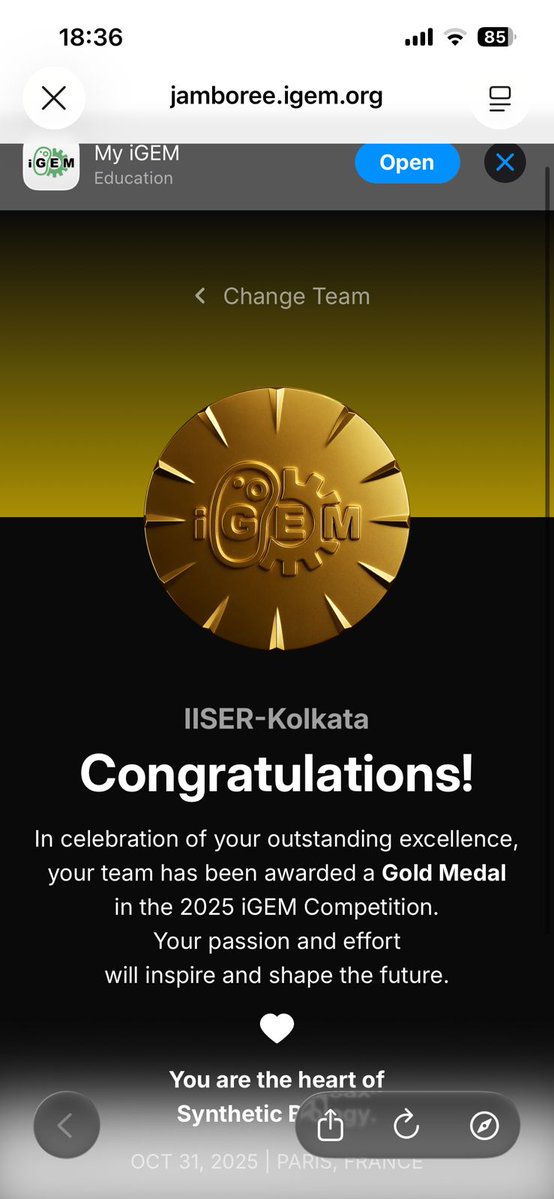
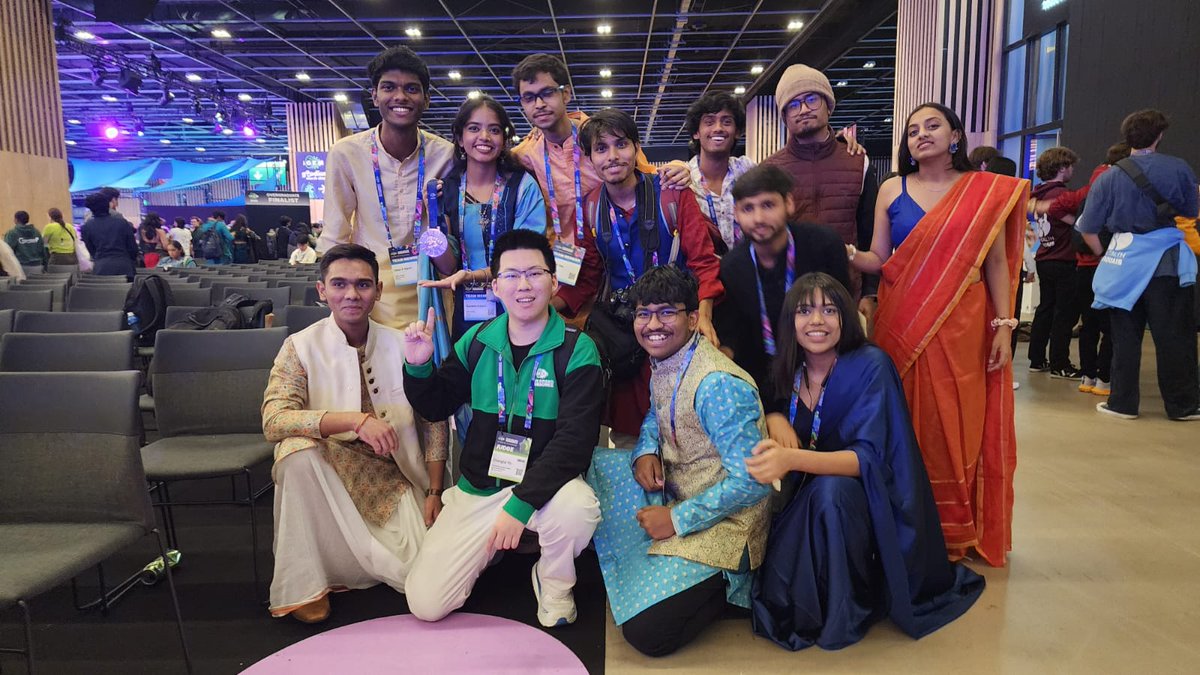
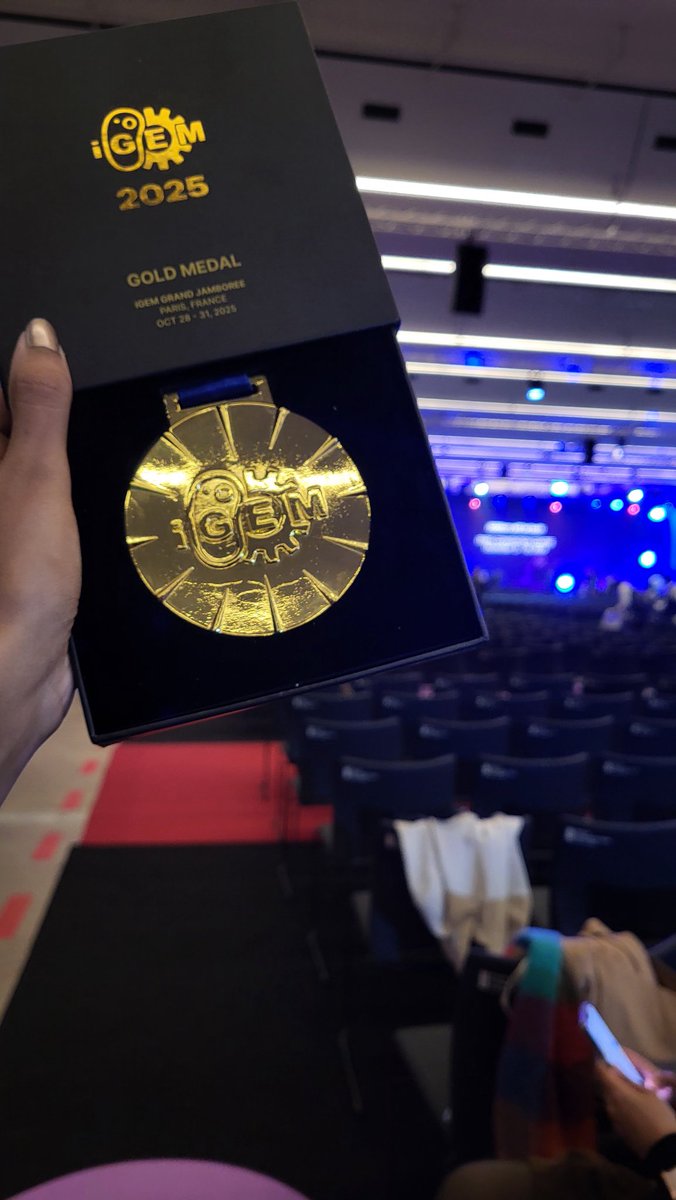
4th consecutive 🥇 for iGEM IISER Kolkata at the Grand Jamboree!
Feels special as it’s my last year at IISER & I’ve had the joy of advising the team for 5 years.
Proud of how every batch kept the legacy alive! 💛
#iGEM#SyntheticBiology#IISERKolkata
Had the pleasure of joining Doordarshan Kolkata’s Bigyan Prasange live to discuss this year’s Nobel Prize in Chemistry, awarded for the pioneering work on Metal–Organic Frameworks (MOFs).
#NobelPrize#ScienceCommunication#Doordarshan@iiserkol
https://t.co/8tWvnYti6O
BREAKING NEWS
The Royal Swedish Academy of Sciences has decided to award the 2025 #NobelPrize in Chemistry to Susumu Kitagawa, Richard Robson and Omar M. Yaghi “for the development of metal–organic frameworks.”
Congratulations to @gupmani from @iiserkol, who was awarded an IUBMB Travel Fellowship to present his research at the @GordonConf on Synthetic Biology on Emerging Technologies and Applications in Synthetic Biology.
Thanks @iubmb for this Award.
This fellowship provided me the opportunity to present my research at @GordonConf Synthetic Biology 2025 at Maine, USA.
@iiserkol
In June, I had the chance to attend #ME16 in Copenhagen ,
I gave a flash talk, presented a poster & listened to inspiring talks from scientists like Jay Keasling, Tae Seok Moon, Chris Voigt, Aditya Kunjapur & Rodrigo Ledesma-Amaro.
Grateful to IMES & my mentors for the support!
Last month, I attended GRC Synthetic Biology 2025 in Newry, Maine USA, where I delivered a talk, presented a poster, and had inspiring discussions with scientists from around the world. Also got the chance to visit the Voigt Lab @Geneticdesigner MIT. Grateful experience