I scored 96.5% in Class 12 and 750/800 in CUET, yet I couldn't get into my dream college, SRCC. I accepted that maybe I could have studied harder.
But when I joined college, I saw students admitted through reserved categories with CUET scores of around 500–600. That was the moment my blood boiled.
My family owns no property, no business nothing. We have struggled financially like countless others. Yet I was denied the same opportunity simply because I belong to the General Category, while candidates from reserved categories, despite being economically well off, still benefited from reservation.
From that day until today, I have continued to raise my voice against the reservation system and I will keep speaking up as long as I have your support. One day I will uproot this biased system from this country!
Sunil Singh
- A general category student
- His father is a grocery shop owner in Kanpur
- Scored 590 in NEET but the paper got cancelled. Scored 595 in the re NEET still didn't get a seat
- Came from Kanpur to Delhi by bus
- Has no food to eat and crying because he doesn't know what to do next
Sujat Ambedkar
- Great grandson of Bhim Rao Ambedkar
- Travels in a BMW
- Wears Hugo Boss suits worth 1 lakh
- Has no worries about studying
- Joined politics and enjoying wealth
- If his son or daughter wishes to become a doctor, they will get 50% reservation
Sunil's entire family's life would have changed if he had been selected. Sujat's life would have remained same even without reservation. Fair education can't coexist with reservation 🙏
This was heartbreaking to watch!
A woman in Aligarh died after stepping into electrified water on her way to her husband's shop.
You will never see a politician die like this - it is always the common citizen !
@Lenskart_com Fix your website. The customer care number in the top right is what all search engines are picking and the lady picking the call is clearly not your customer care.
What happened in Ayodhya is happening in Ujjain, Madhya Pradesh now
CM Mohan Yadav's Wife, Son and Daughter in law purchased almost 165 acres of land in Ujjain for around ₹45 Crores
Then suddenly Govt has announced a plan to develop Ujjain named "Ujjain Master Plan 2035"
Coincidentally all their land is near the Govt announced projects
Now their land's value went up multiple times
And then Modi says, "Na khaunga, Na khane dunga" 🤡
I grew up on Bangalore’s Brunton Cross Road.
I still live on the same road.
When I first came here as a 15-year-old beginning college in 1966, it was one of the most beautiful streets in the city. Tree-lined, shaded, peaceful. Bungalows stood amid gardens. There were pavements one could actually walk on. It was a residential neighbourhood, not a traffic corridor.
Today, almost every bungalow has disappeared, replaced by apartment blocks. The gardens are gone. The road has become a two-way thoroughfare carrying a relentless stream of vehicles. What was once a neighbourhood has become an artery.
The photographs below tell the rest of the story.
Broken pavements. Open drains. Excavated roads. Construction debris left strewn about. Garbage accumulating around work sites. Hazardous walkways. Traffic forced through improvised bottlenecks. Senior citizens pick their way through rubble simply to cross the street.
For more than a year, the authorities have ostensibly been repairing the road and drainage infrastructure. Yet the result has been months of disruption, chaos and inconvenience with little visible evidence of systematic planning or timely execution.
The issue is not that roads need repair. Every city requires maintenance. The issue is how it is done.
Why are roads dug up and left exposed for weeks and months? Why are drains left uncovered? Why are pedestrians treated as an afterthought? Why are debris allowed to remain on public land? Why are traffic diversions so poorly managed? Why is there no visible sense of sequencing, coordination or accountability?
These are not problems of poverty.
They are problems of governance.
India’s urban crisis is often discussed in terms of infrastructure deficits, but what I see outside my own front gate is something more basic: a deficit of civic management.
We build flyovers, metro lines and technology parks, yet struggle to maintain a pavement.
We speak of becoming a developed country, yet tolerate public spaces that would be unacceptable in much poorer societies.
This is why comments from outsiders such as Peter Thiel, however provocative, sometimes strike a nerve. When he describes India as “messed-up”, many of us instinctively object. Yet standing on Brunton Cross Road amid broken concrete, open trenches and unregulated traffic, one cannot entirely dismiss the criticism.
The uncomfortable truth is that our cities often function despite the system rather than because of it.
What is especially frustrating is that the solutions are neither revolutionary nor prohibitively expensive.
Road projects should be coordinated and completed within fixed timelines.
Pavements should be continuous, safe and accessible.
Residential roads should be protected from becoming uncontrolled traffic corridors.
Traffic rules should be enforced.
Construction waste should be removed immediately.
Public infrastructure should be maintained before it collapses rather than repaired after it does.
Most importantly, citizens should not have to negotiate danger merely to walk down their own street.
The decline of roads like Brunton Cross Road is not simply about nostalgia for a vanished Bangalore. Cities change. Growth is inevitable.
But growth without planning produces disorder. Development without civic discipline produces dysfunction.
A city is not measured only by the value of its real estate, the number of its startups, or the sophistication of its technology sector. It is measured by the quality of everyday life it offers its residents.
Bangalore still possesses extraordinary strengths: talent, enterprise, creativity, greenery and a climate most cities would envy.
What it increasingly lacks is the orderly civic management that allows those strengths to flourish.
Looking at these scenes outside my home, I cannot help but wonder: when did we begin to accept disorder as normal?
And more importantly, when will we decide that we deserve better? #Bengaluru #UrbanIndia #CityPlanning
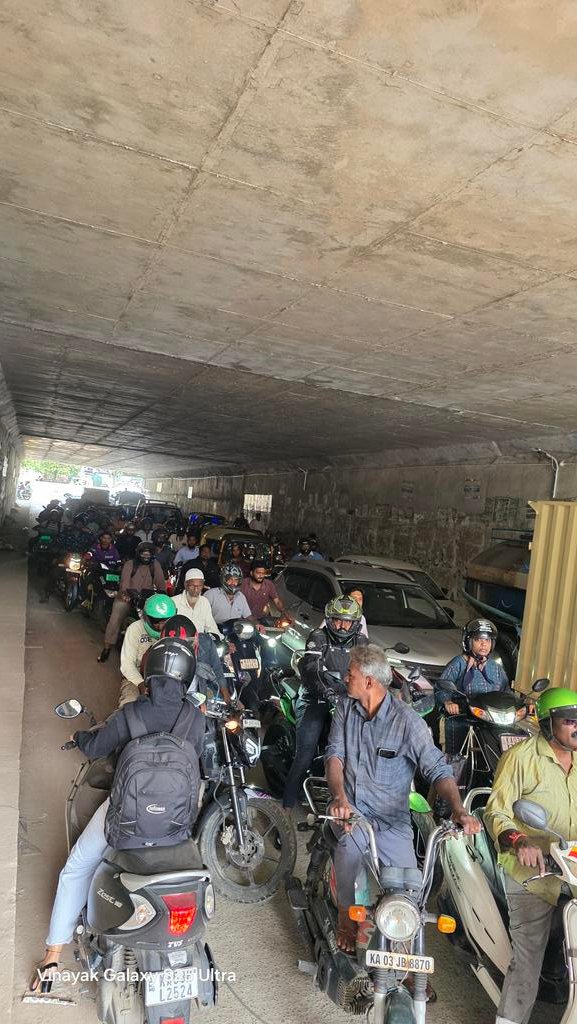
@krishnabgowda ji the daily long wait & congestion at Kaggadasapura Railway Gate LC136 has become unbearable for thousands of commuters. Please expedite the RoB construction and provide long pending relief to the public. @AshwiniVaishnaw@VSOMANNA_BJP@GBAChiefComm@DKShivakumar
Fire NOC = paper. Nothing more.
Bengaluru airport's bamboo-heavy ceiling looks impressive. But it raises a question worth asking.
Bamboo doesn't just burn. It burns fast, produces dense smoke, and is notoriously difficult to douse in enclosed spaces. Whether it has every approval in place or not, it's fair to ask: would fire safety experts outside India approve this design?
A Fire NOC is supposed to answer the uncomfortable questions. What burns. How fast. How much smoke. How safely people can exit.
Too often, outside airports, hospitals, and pharma labs, it's just another piece of paper.
Img src: Internet
This is the situation of a prime intersection in Bangalore yesterday called Marathahalli.
In a radius of 5 km around this point there are offices of multiple MNC giants including Google, JP Morgan, Wells Fargo, EY, HSBC etc.
@amazonIN Amazon Now, if you accidentally press the back button after the payment option to add something you missed, you need to re-create order again. As that one remains stuck in payment pending and there is no means to pay again.
BJP has announced below freebies in Bengal elections:
Unemployed will get Rs 3,000
Pregnant women will get Rs 21,000
Farmers will get Rs 9000
Journalists will get Rs 5000
Some families might actually receive more than Rs 40k/month.
Taxpayers really need to take a stand now !
I’m thrilled to announce we’ve raised $44M to build a new home for product design. Meet @noondesign.
No workflow is more broken and fragmented in 2026 than the product designers’. The very same people who care most about building software don’t have software purpose built for them. @kushagrasinha7 and I have lived this problem first hand as designers ourselves.
That’s why we built Noon. The first product design tool that works entirely on your product code, so you can design not only how a product looks, but also how it works. With AI at its core that works in seconds, not minutes.
For the first time, you can create, iterate, build, test and ship. All in one canvas. No translations or roundtrips to the codebase and back.
Comment “Get Noon” and we’ll get you on the list for early access.