How are Shein & Temu responding to the tariffs? Per LatePost:
Shein and Temu are both actively reducing their reliance on the U.S. market.
At one point, the U.S. — the world’s largest consumer market — accounted for over 50% of sales on both platforms. According to our understanding, that share has now dropped to around 30%.
In response to the upcoming cancellation of the T86 policy* (de minimis) and the imposition of additional tariffs, both cross-border e-commerce platforms are taking similar measures:
•Shifting to alternative customs clearance methods and absorbing the tariffs.
•Temu is accelerating the transition from fully managed to semi-managed logistics in the U.S., while both platforms are pushing for deeper localization and recruiting more local merchants.
•For example, Shein is building production capacity in places like Turkey and Brazil.
•Temu plans to open 6 fully localized sites and 9 semi-local sites between April and June. (Both site types cater to sellers with local fulfillment capabilities—fully localized sites are for locally registered companies, while semi-local ones are for Chinese-registered entities.)
•Refocusing business expansion on other regions, such as the European market. Temu’s merchant onboarding teams are also encouraging sellers to explore markets like Canada and Mexico in the broader Americas.
•Considering price increases to pass some of the additional costs onto consumers.
•Starting April 8, under Temu’s semi-local and fully localized models in the U.S., the standard pricing benchmark for most products has been adjusted from 85% of Amazon prices to 90%.
* Entry Type 86 is a special electronic customs clearance process launched in 2019 by CBP to handle the surge in de minimis e-commerce shipments
What we've learned from LLM is that when your sample is monstrously large, induction can fool you as it becomes nearly indistinguishable from deduction.
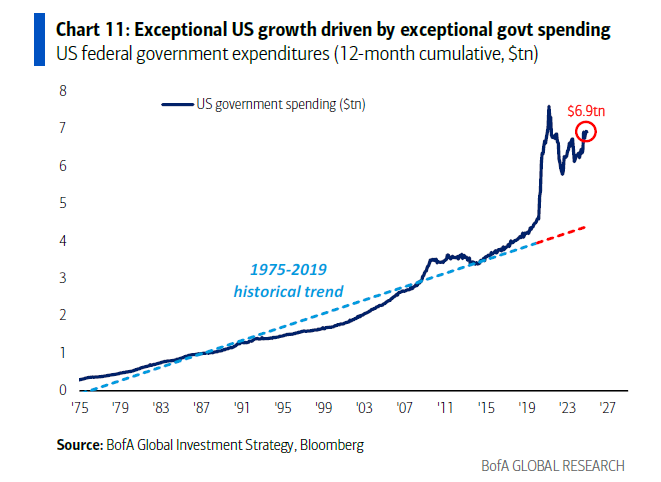
what happens to "exceptional" US growth when exceptional government spending drops from its current record $6.9 trillion per year. And if it doesn't drop, what happens to exceptional US debt?
My biggest weakness is being too far ahead of the curve to be actionable. If I'm right at the wrong time, I'm wrong. Solve: follow my gut while requiring that 3-5 independent, highly-correlated (yet meaningfully diversified) indicators are moving in my vision's direction.
Criminal law is structured to deter future crime, but if the establishment doesn’t meaningfully address the pains driving extremism, the threshold for meaningful deterrence rises, devolving society exponentially toward revolution. Will the status quo take the signal and reform?
📌 Sentiment
Most market sentiment indicators are showing a risk-on stance among investors, suggesting an optimistic short-term outlook for financial markets
👉 https://t.co/jJ1iAXzd0Y
h/t @GoldmanSachs#sentiment#sp500
$spx #spx#equities#stocks#bonds#vix
Record-keeping on AI development
https://t.co/pYOOWa7UL1
Biggest question around ease of use, dictating if rollout becomes productivity-unleashing without major legacy org change vs a slow grind reminiscent of historic tech rollouts (can involve periods of negative productivity)
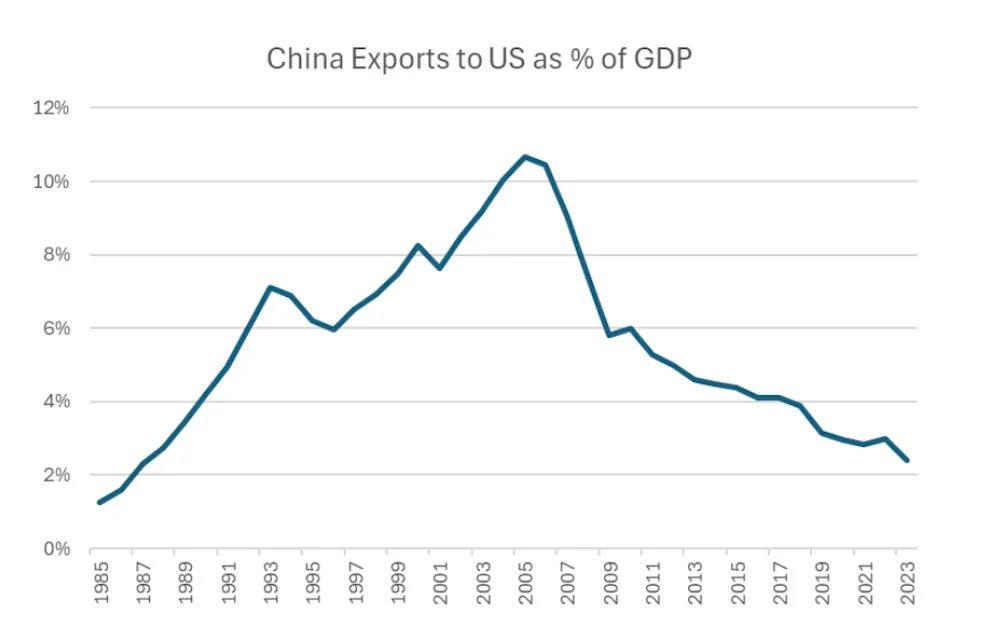
🚨🇨🇳🏦 Message to Trump: China has “tariff-proofed” its economy
Exports to the US account for only 2% of China’s GDP.
Meanwhile, American industries are heavily dependent on spare parts and rare earth metals from China.
I've officially been drawn out of my congressional district by a small group of politicians.
It’s blatant corruption, but I’ve got news for them:
I’m running for Attorney General, and I’m going to use that job to fight political corruption.
Join us: https://t.co/tb9ykB1pUH
The loss of Chinese competitiveness is one of the biggest multi-year shifts going on today.
It is creating weakness for Chinese labor markets and removing a structural disinflationary force that had been so prevalent for a few decades. MEX and BRZ are notable beneficiaries.
You must come to grips with the fact that history may, of all alternatives, take the most irrational path, that is, the one that makes the least amount of sense to educated & neutral observers.
The German poet Heinrich Heine once visited the Amiens Cathedral where he realized why we don't build such buildings anymore: "In those days men had convictions, whereas we moderns only have opinions, and something more is needed than an opinion to build a Gothic cathedral.”