Sometimes I wish we had a richer language for describing our senses.
I have a blog post about why this is difficult for senses other than sight and sound:
https://t.co/Adr77FNrW9
the power of language to render things distinguishable.
english is lacking words to describe sensory realms of experience.
I admire sanskrit for all extra words it has, that make sensory navigation more coherent & reproducible. I might simply start using it, tbh
The cult of "number go up" could be the end of our civilization. A recession would be our best way out, but retirees are keeping an eye on the stock market, and POTUS caters to them.
As the song goes:
"Nobody lives, but the numbers still grow."
Thx, boomers.
The worst news of today, in my opinion, is not that Nvidia has regained all its power to worsen US national security (not even close), nor that the president seems to be intervening in federal investigations to protect a political ally (sure, would've been the biggest scandal ever for any other admin, but how surprised are we?).
It's that the president demonstrated that, if he thinks a policy will make stock prices fall a few percent, he will ignore warnings from his own administration's national security staff and his own party's congressional delegation.
If your AI pacing/RSI ban policy involves even a short-term and modest hit to chipmaker valuations, you need to factor this into your analysis.
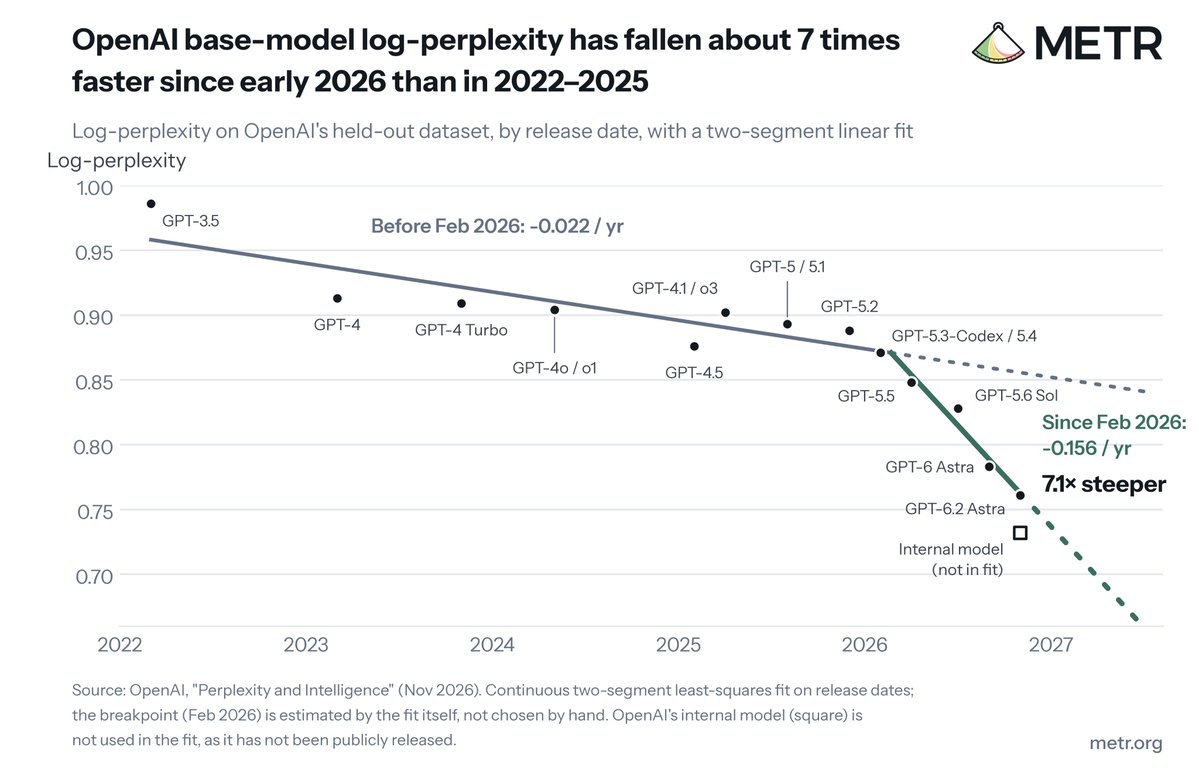
OpenAI published the pretraining loss of all of its frontier models since GPT-3.5. They show log-perplexity falling ~7 times faster since early 2026 than over 2022-2025.
We think sharing pretraining loss is very valuable for improving public understanding of AI R&D acceleration.
Was great fun to rally in support of pacing the frontier of AI progress - an approach endorsed by:
• Dario Amodei
• Sam Altman
• Elon Musk
• Ilya Sutskever
• Shane Legg (DeepMind co-founder)
With partial support from:
• Demis Hassabis ("points towards the right path forward")
• Satya Nadella ("we welcome ... deliberate pacing needed to get alignment right as the design goal")
And fully endorsed by:
• Anthropic as an organisation, plus cofounders Jared Kaplan, Jack Clark, Ben Mann and Chris Olah as individuals - as well as leading researchers Evan Hubinger, Jan Leike and Julian Schrittwieser.
• OpenAI as an organisation, as well as Jakub Pachocki (Chief Scientist), Wojciech Zaremba (co-founder), Mark Chen (Chief Research Officer), Saachi Jain (Head of Safety), Dean Ball (Head of Strategic Futures), and Boaz Barak (MTS).
• At Google DeepMind: Jasjeet Sekhon (Chief Strategy Officer), Anca Dragan (VP of AI Safety), Rohin Shah (AGI Safety lead) and Neel Nanda (mech interp lead).
• And at Meta: Shengjia Zhao (Chief AI Scientist) and Dawn Song (VP of AI Research).
This is the most popular mainstream expert-endorsed position imaginable.
Would be great to see more technical researchers and company staff at events like this reiterating their views.
clumsiness and obviously if they just hadn't turned off some particular protocol then the disaster wouldn't have happened, etc.)
In short: I expect the future to resemble the past, and the past contains the collective denial response to COVID. ››
Duncan writes:
‹‹ Dear Matthew: HuggingFace underlines and supports (rather than undermining) the point I was trying to make: if you go look out on the broader internet, there aren't many people claiming that HuggingFace was actively good but there are legions claiming that...
@gusl I mean, that's true in many people's AI doom scenarios, and it's a convenient story to tell since it makes the theory unfalsifiable. In scenarios I find significantly more plausible, there's a lot of evidence of misalignment and bad behavior before everyone dies.
I think that AI could cause a million deaths and you would still see >30% of the population denying it in various ways (i.e. claiming it was misuse rather than misalignment, or that it was a conspiracy and nobody even actually died, or that the deaths were down to human ...
The world is getting weird fast and it's especially important to be able to stop and re-evaluate your plans. But doing so can be difficult.
A technique I like for dealing with this is one I got from @So8res' blog, years ago: be a new homunculus.
"It's an easy fiction to buy into, that you're a little person in your head that can move your hands and shape your mouth and that decides where to steer the body and so on. There is, of course, no homunculus inside your head (for if you are steered by a homunculus, then how is the homunculus steered?), but it can be quite fun to pretend that you are a homunculus sometimes, mostly because this allows you to occasionally pretend you're a new homunculus, fresh off the factory lines, and newly installed into this particular person.
Close your eyes, and pretend you're arriving in this body for the very first time. Open them and do some original seeing on this person you now are. Rub your hands together, look around, and take stock of your surroundings. Do some internal checks to figure out what this body values, to figure out what it is you're fighting for. Check the catalog of plans and upcoming actions. Check the backlog of memories and obligations.
There will probably be some housecleaning to do: homunculi are known to get a little careless as they age, and the old homunculus that you replaced probably let a bunch of useless tasks accumulate without realizing it. As a new homunculus you have the privilege of pruning the things that obviously need pruning. Maybe you'll look and say 'Ah, yes, we're going to cancel lunch with that person; this body was secretly dreading it. I also see that this body is currently spending a lot of cycles feeling guilty about a date that went poorly last week; we can dismiss that, it's no longer useful for this homunculus. And also, 'exercise' doesn't seem to be on today's schedule at all! How strange. This body definitely intended to exercise today; somehow it fell off the list. I'll put it back on.'
It can be quite liberating to be a new homunculus, without any obligation to propagate the errors of the old one."
The worst news of today, in my opinion, is not that Nvidia has regained all its power to worsen US national security (not even close), nor that the president seems to be intervening in federal investigations to protect a political ally (sure, would've been the biggest scandal ever for any other admin, but how surprised are we?).
It's that the president demonstrated that, if he thinks a policy will make stock prices fall a few percent, he will ignore warnings from his own administration's national security staff and his own party's congressional delegation.
If your AI pacing/RSI ban policy involves even a short-term and modest hit to chipmaker valuations, you need to factor this into your analysis.
(this did not literally happen twice but an adjacent thing did occur lol)
i do think there's an interesting thing here about the viability of romantic relationships with people who do not share your AI worldview that maybe i or someone else should write about
Someone out there needs to start the Journal of Mathematical Hermeneutics, which is explicitly devoted to human-written interpretations and expositions on AI-generated proofs.
"What crazy math breakthrough will we get next? (ft. Scott Aaronson)"
BB(6) at the bottom seems right. We know that N_ZF is between 6 and 192, so BB(6) might already be logically independent of ZF.
Between this and The Altruists, I feel like Hollywood does not understand the Bay, does not want to understand the Bay, and will pump out generic 'nerds suck' movies regardless of what complex villainy and hubris and ideological, catastrophic recklessness they ostensibly depict