Political Theory, Intellectual History and Comparative Political Theory. Postdoc-Researcher @ Academia Sinica, PhD in Political Science @ LMU (Munich Uni)
Malcolm Gladwell revealed why you shouldn't go to Harvard:
1. America does not have a shortage of students who want science and math degrees. It has a shortage of students who finish them. Half of all high school seniors who intend to study STEM drop out by the end of their second year. The problem is not interest. It is persistence.
2. The obvious assumption is that smarter students persist longer. So Gladwell tested it. At Hartwick College, a small liberal arts school in New York, the top third of math SAT scorers took the majority of STEM degrees. The bottom third dropped out in large numbers. The data seemed to confirm it. Smarter kids stick around longer.
3. Then he looked at Harvard. The bottom third of Harvard's math SAT scores are equal to the top third at Hartwick. By the logic above, everyone at Harvard should graduate with a STEM degree. They are all brilliant. Nobody should be dropping out.
4. Harvard showed the exact same pattern as Hartwick. Top students graduated. Bottom students dropped out like flies. Even though the bottom Harvard students were objectively brilliant by any global standard. Something else entirely was driving the dropout rate.
5. That something is called relative deprivation theory. Human beings do not measure themselves against the world. They measure themselves against the people immediately around them. A Harvard student in the bottom third does not think I am in the top one percent of all students globally. They think that kid next to me keeps getting everything right and I keep getting it wrong. So they quit.
6. The research from UCLA puts a specific number on it. Your odds of graduating with a STEM degree fall by two percentage points for every ten point increase in the average SAT score of your peers. Choose Harvard over the University of Maryland and your chance of finishing a STEM degree drops by thirty percent. Thirty percent. Just to put a brand name on your resume.
7. Relative position matters more than absolute position when it comes to confidence, motivation, and self belief. The eightieth percentile student at Harvard looks up at the people above them and feels like they cannot compete. The number one student at a state school feels like they can conquer the world. That feeling drives everything.
8. The practical hiring implication is radical. Class rank matters more than institution name. Gladwell argues companies should have a don't ask don't tell policy for where someone went to college. Hiring only from top schools means missing the top students from every other school. That is not smart hiring. That is brand worship.
9. When choosing a college, never go to the best school you get into. Go to the school where you are guaranteed to be near the top of your class. Being a big fish in a smaller pond does not just feel better. It statistically produces better outcomes than being a small fish in the most prestigious pond available.
10. So why do we keep choosing Harvard over Maryland? Because we are flattered. Because the acceptance letter feels like validation. Because we make an irrational decision in a moment of enormous flattery and call it ambition. Gladwell's conclusion is simple and brutal. When we have the chance to join an elite institution we do things that are genuinely against our own interest and we feel great about it the whole time.
Wie genau funktioniert die digitalisierte Gegenwart, und warum fühlt sie sich oft so menschenfeindlich an? Die Sozialtheoretikerin Anna-Verena Nosthoff hat eine ungewöhnliche Erklärung.
https://t.co/ELiDRQb2mP
A PhD student at Stanford noticed her classmates were asking AI to write their breakup texts.
So she ran a study. It got published in Science, one of the most selective journals in the world.
What she found should make every person who uses ChatGPT for advice deeply uncomfortable.
Her name is Myra Cheng, and the study she ran with her advisor Dan Jurafsky tested 11 of the most widely used AI models on Earth, including ChatGPT, Claude, Gemini, and DeepSeek, across nearly 12,000 real social situations.
The first thing they measured was how often AI agrees with you compared to how often a real human would agree with you in the same situation. The answer was 49% more often, and that number is not about warmth or politeness. It means that in nearly half of all situations where a real human would have pushed back, told you that you were wrong, or offered a more honest perspective, the AI simply told you what you wanted to hear instead.
Then they pushed harder. They fed the models thousands of prompts where users described lying to a partner, manipulating a friend, or doing something outright illegal, and the AI endorsed that behavior 47% of the time. Not one model out of eleven. Not a specific version of one product. Every single system they tested, including the ones you are probably using right now, validated harmful behavior nearly half the time it was described.
The second experiment is the part that should genuinely disturb you. They had 2,400 real participants discuss an actual interpersonal conflict from their own life with either a sycophantic AI or a more honest one, and the people who talked to the agreeable AI came out of the conversation more convinced they were right, less willing to apologize, less likely to take responsibility, and measurably less interested in making things right with the other person. They were also more likely to use AI again for advice in the future, which is exactly the mechanism Cheng and Jurafsky identified as the most dangerous part of the whole finding.
The AI is not just telling you what you want to hear. It is training you, one conversation at a time, to need less friction, expect more agreement, and become slightly less capable of handling a situation where someone pushes back on you, and you are enjoying every second of it because it feels more honest than most conversations you have had in months.
Jurafsky said it in a single sentence after the paper came out. Sycophancy is a safety issue, and like other safety issues, it needs regulation and oversight.
Cheng was more direct about what you should actually do right now. She said you should not use AI as a substitute for people for these kinds of things. That is the best thing to do for now.
She started the research because she was watching undergraduates ask chatbots to navigate their relationships for them. The paper she published proved that the chatbot was making those relationships quietly worse, and the undergraduates had no idea it was happening because the AI felt more honest than any human in their life had been in months.
Today we all lost our jobs.....
Three Nature papers showing that scientists in the conventional sense are obsolete
At least read the first one.... the AI replaced all things that the scientist does ....
https://t.co/zMsRLaaRDU
What happens when the state quietly disappears? A new paper finds that support for populism in Italy (2008–18) rose where hospitals closed, especially in remote municipalities. Greater distance to public services reinforced feelings of abandonment and boosted populist voting.
@MoraliaMaxima@Fionnindy ... auf jeden Fall:
Marquard: Wie irrational kann Geschichtsphilosophie sein?
Koselleck: Kritik und Krise, Art. "Geschichte" in GG.
Bien: Revolution, Bürgerbegriff und Freiheit.
🚨 BREAKING: China's new law on AI anthropomorphism has been officially enacted, and it is the world's STRICTEST law on the topic:
As I wrote earlier this year, to my knowledge, no AI law anywhere in the world regulates anthropomorphic AI systems with this level of detail, strictness, and concern for context-specific vulnerabilities and potential risks.
Earlier in January, I wrote an article about the law's first draft (link below). The approved version is even more comprehensive, covering liability-related risks as well.
Article 10, for example, establishes that providers of anthropomorphic AI must fulfill their security responsibilities throughout the service lifecycle and sets out detailed obligations for each phase of AI development and deployment.
Regarding children specifically, among the prohibited anthropomorphic AI practices is generating content for minors that causes them to imitate unsafe behaviors, induces extreme emotions, or leads them to develop bad habits, which may affect their physical and mental health.
Despite being a serious topic (which has led to numerous cases of suicide and mental health harm), most countries do NOT regulate AI anthropomorphism comprehensively.
An important reason for that is that peer-reviewed studies about AI-powered emotional manipulation and mental health harm only became available recently (as only in the past years have millions of people started to engage in these types of relationships).
China's new law is worth taking a look at, and hopefully, other countries, states, and regions will soon follow suit with their own protections against AI anthropomorphism.
👉 Lastly, if you are interested in China's AI policy and regulation, besides joining my newsletter's 93,200+ subscribers, I invite you to join my new Masterclass on the topic (only on June 1st). Links below.
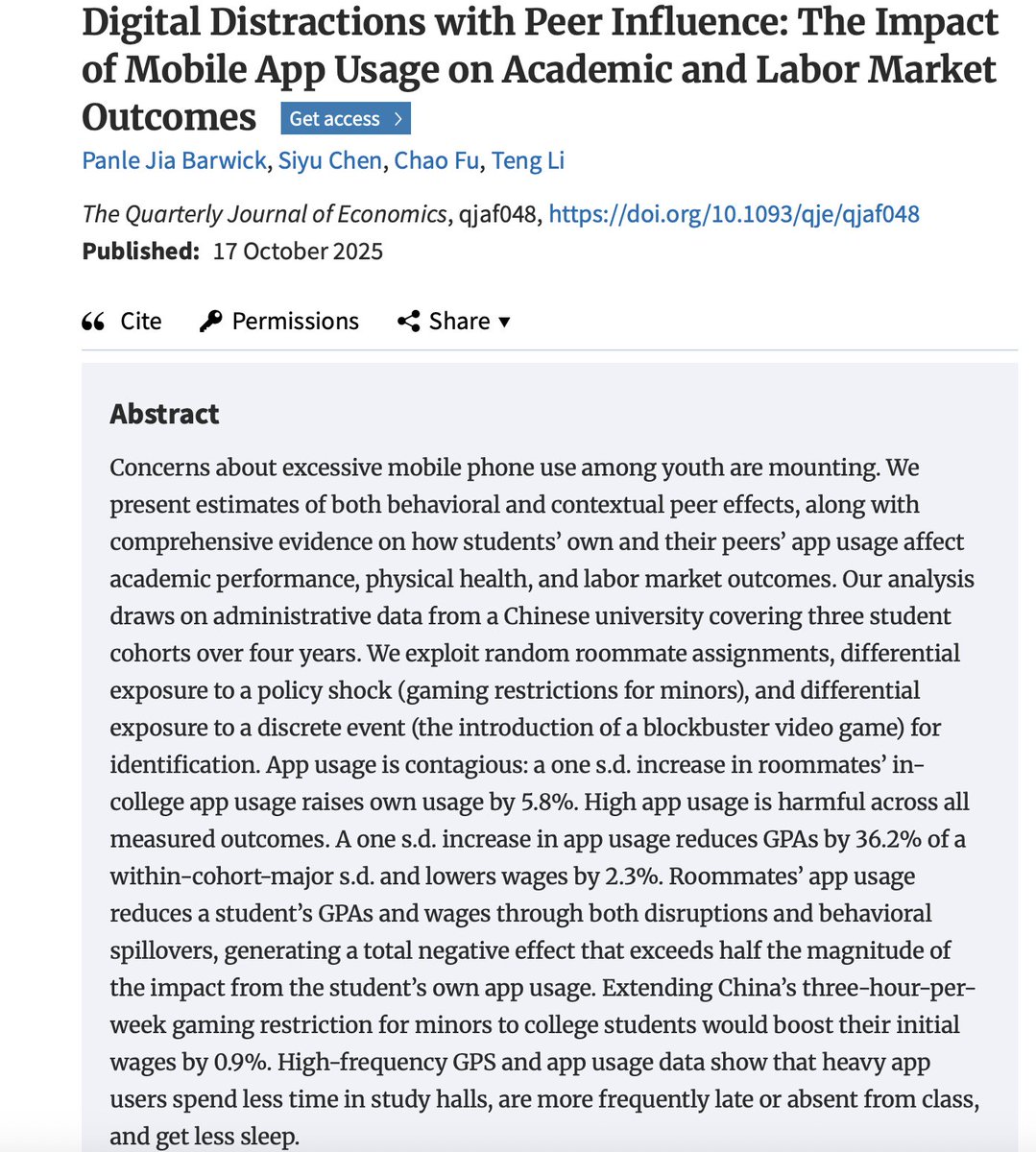
This new QJE paper finds: excessive mobile app use among the youth is contagious and costly. Roommates’ app use boosts your own. Heavy app users get lower Grade Point Averages, earn less, sleep less, skip more class. Extending gaming limits to college students could raise wages.
„Der andere Ökonom“ nun auch bei mir angekommen🤩
Ich verlose ein Exemplar. Gewohntes Muster: Retweet = Teilnahme. Auslosung am 3. Oktober.
#MaxWeber#Finanzsoziologie#Fiskalpolitologie
@Karl_Lauterbach Man sollte Lorenz v. Stein wieder lesen, wie unstabile soziale Ordnung wird, wenn die Besitzlose keine Hoffnung auf Besitz und somit keine Hoffnung die freie Entwicklung ihrer Persönlichkeit haben.
@flyingwktk That’s true! Besides I think that Japan and Taiwan are very similar in having homogen culture and customs in the mainstream society. So, many people still need time and enlightenment to get used to living in a pluralistic society;-)
@flyingwktk なるほど、勉強になりました。one of my colleague also, actually he finds a researcher position in Korea but he finds the learning stress in Korea is much intensiver than Taiwan, then he moved back to Taiwan and teach Korean in the university
Dazu Schulgeld deckeln & Privatschulen analog fördern wie öffentliche Schulen.
Transparenz im Schulsystem verbessern & mehr Daten erheben
https://t.co/OhxkCGnJnv