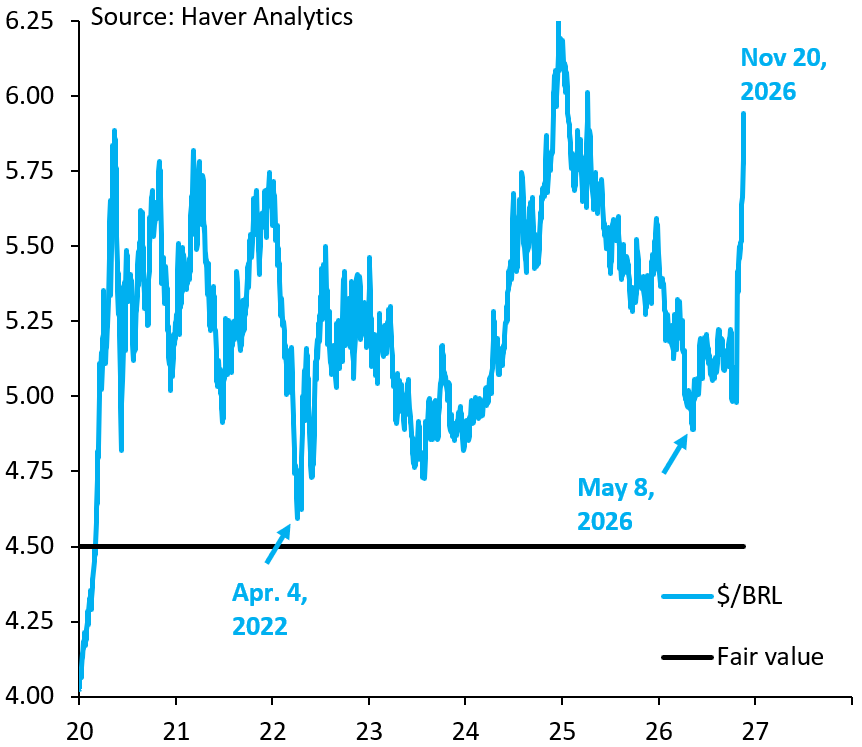
Yeah, the FED hawkishness has devalued the real against the, checks notes, yen, yuan, rupee, ruble, euro, pound,...
The election has put Brazilian finances on a trajectory of a severe fiscal crisis. Before the election there was hope that a change in administration would put public finances in order and prevent this.
Now, the Titanic is heading straight to the iceberg at full speed while the current Brazilian administration appears to be in denial that the iceberg exists.
Well, looking at the bright side, maybe in the future economists will have a good example of a large recession in a large economy induced by fiscal policy to study. It will also provide a canary in the coal mine for other economies with large debts.
The collapse in the Brazilian Real is painful to watch. As much as you want to blame the election, the latest weakening isn't about Lula. The Real is just caught up in a broad selling wave across all EM that's happening because of the Fed's hawkishness...
https://t.co/tIBUSIcmkk
@Andre_S_Duarte Provavelmente vai sair a reforma da previdencia da inflacao: os precos vao disparar mais altos, e o custo real da previdencia vai cair. Mesmo que ajustem, por exemplo, anualmente, uma inflacao alta e constante vai erodir todo ajuste.
In 1927, the hourly wages of unskilled construction workers in the US could purchase 9 pounds of bread (Williamson 1995, wage and price data from Philadelphia).
In 2026, the average hourly wage of US unskilled construction workers was $22.50, enough to purchase 11 pounds of bread (BLS).
The early 20th-century US was already a very rich society.
@uliano_andre Sim, precisamos de uma nova reforma da previdência urgente (desvincular a previdência do salário mínimo).
Além de uma reforma do funcionalismo federal (ajustar os salários de funcionários públicos aos níveis de mercado: o que a iniciativa privada pagaria aos mesmos).
É perfeitamente possível fazer um ajuste fiscal gigantesco sem tirar um centavo dos pobres: dos gastos primários do governo federal, o Bolsa Família é o dinheiro que realmente vai para os 30% das famílias mais pobres e representou apenas 5,3% dos gastos primários do governo federal em 2025.
Ou seja, é só fazer um ajuste fiscal para cortar dos outros 95% e assim não cortar os gastos para os pobres. Inclusive, é possível cortar um pouco os gastos com o Bolsa Família sem prejudicar os pobres, passando o pente-fino nas fraudes.
Mas é claro para quem não é ingênuo, não é disso que Lula está realmente falando nesse discurso.😉
“Não haverá nenhuma hipótese de eu tirar um centavo dos pobres para controlar o orçamento. Esse bando de yuppie da Faria Lima fica querendo questionar a seriedade do governo. Eles não estão preocupados com os pobres, estão preocupados em ganhar mais dinheiro. Não é o sistema financeiro que vai me ensinar a dirigir o país. Quem vai me ensinar é o povo.” - o fecho do Lula na #LiveDoExercito.
Was that the 90s?
In the 90s the US was clearly the dominant great power and there were lesser powers, China and Russia already existed, Japan was an economic great power but not a military power, etc.
I think that both Russia and the US have certain advantages over China: more natural resources and military experience. In particular, China is dependent on imported oil, I think this weakness will be corrected with EVs and once its fully corrected, we will be back in a world like the 90s, but with China as the main power.
The Cassiopeia claim of being the first computer-animated movie is highly obscure; I learned about it in the Brazilian edition of the Guinness Book of Records when I was a kid. Nobody cares about it.
While the "Santo Dumont invented the airplane" thing is the ideological product of Getúlio Vargas's dictatorship, a regime that created a lot of national mythology to support his project of forging a strong Brazilian national identity.
Third, I also don't think the Wright Brothers are technically "the inventors of the airplane" since nobody technically invented the airplane, as there is no clear line separating a motorized glider from an airplane. There were many early aviation pioneers, starting with the French Éole plane in 1890: https://t.co/zOSwa5FXup
Brazilians also have a claim of inventing full-length computer-animated feature films because of Cassiopeia; even though Toy Story was released 2 months earlier, they claim it was not a "fully computer-animated film" for technical reasons: https://t.co/Dlo4OY1JSL
This claim employs analogous logic to the argument for Santos Dummond having the claim of inventing the airplane.
So apparently Brazil legitimately teaches that the Wright Brothers didn't invent the airplane. This might be nuttier than denying the moon landing. The Wrights documented their invention quite well.
Fazendeiro de Brotas-SP organiza caça a colonos austríacos que haviam fugido de sua propriedade e captura idoso e algumas crianças, relata um jornal em 1886. (1/2)
No. But I don't think it's applicable. Romania is a small, rich country (in GDP per capita, Romania is closer to the US than it is to Brazil); Brazil's current situation is perhaps similar to historical episodes in Argentina and Venezuela.
In fact, the closest historical analogy to Brazil in 2026 is Brazil in 2014.
In 2014, Lula's party got reelected with 51% of the vote, facing fierce opposition; the fiscal trajectory over the past 6-7 years had been unsustainable, and it blew up in a huge fiscal crisis in late 2014: GDP collapsed 8% from late 2014 to mid 2016, when the president's impeachment stopped the collapse, and Temer's administration put things back on normal track.
However, Brazil has not yet fully recovered from the 2014 crisis. One could say that now equity prices cannot go as low as they could have become in 2014 because we are already in the deep sh*t, so it cannot get much worse (i.e., Brazilian stocks cannot fall much lower than their levels now, while during the 2014- 2016 crisis, stocks fell over 30% before they began recovering; now Brazilian stocks have already collapsed 20% over the past 3 weeks, before the official recession starts).
Na verdade, não é uma suposta "resistência" a aumentar impostos, mas o fato de o Brasil já ter uma carga tributária extrema para seu nível de renda e, portanto, capacidade de pagar: nosso código tributário já é o mais complexo do mundo e a receita tributária não tem espaço para aumentar pelo aumento de impostos.
A partir de agora, a criação de novos impostos só vai deprimir ainda mais a atividade econômica formal.
Não existe saída além de 1) Lula renunciar e Alckmin assumir, o que mudaria completamente as expectativas dos agentes (como foi com o Temer), ou 2) promover uma mudança de 180 graus na política fiscal do governo, com cortes robustos na trajetória de gastos futuros, para também mudar completamente as expectativas dos agentes com relação à solvência fiscal do governo.
Não acho que nenhum dos dois vá ocorrer. O que acho que vai ocorrer é uma grande crise, provavelmente hiperinflacionária, como nos anos 80.
O governo aumentou a carga tributária em 2.p.p. do PIB e ainda assim temos um déficit primário de 0,6%. Como contrapartida, nenhum aumento de investimento, nem melhoria na educação e saúde. E ainda deixam +10p.p. do PIB de endividamento para as futuras gerações, com um insustentável custo de dívida.
Será que não entenderam a resistência em aumentar impostos sem a contrapartida de oferecer eficiência e melhoria na qualidade dos gastos?