Secularism and democracy don’t work for Kurds. The result of adapting secular democracy is a failed, weak, dependent and divided KRG
Kurds need Sharia to get things in order and become powerful!
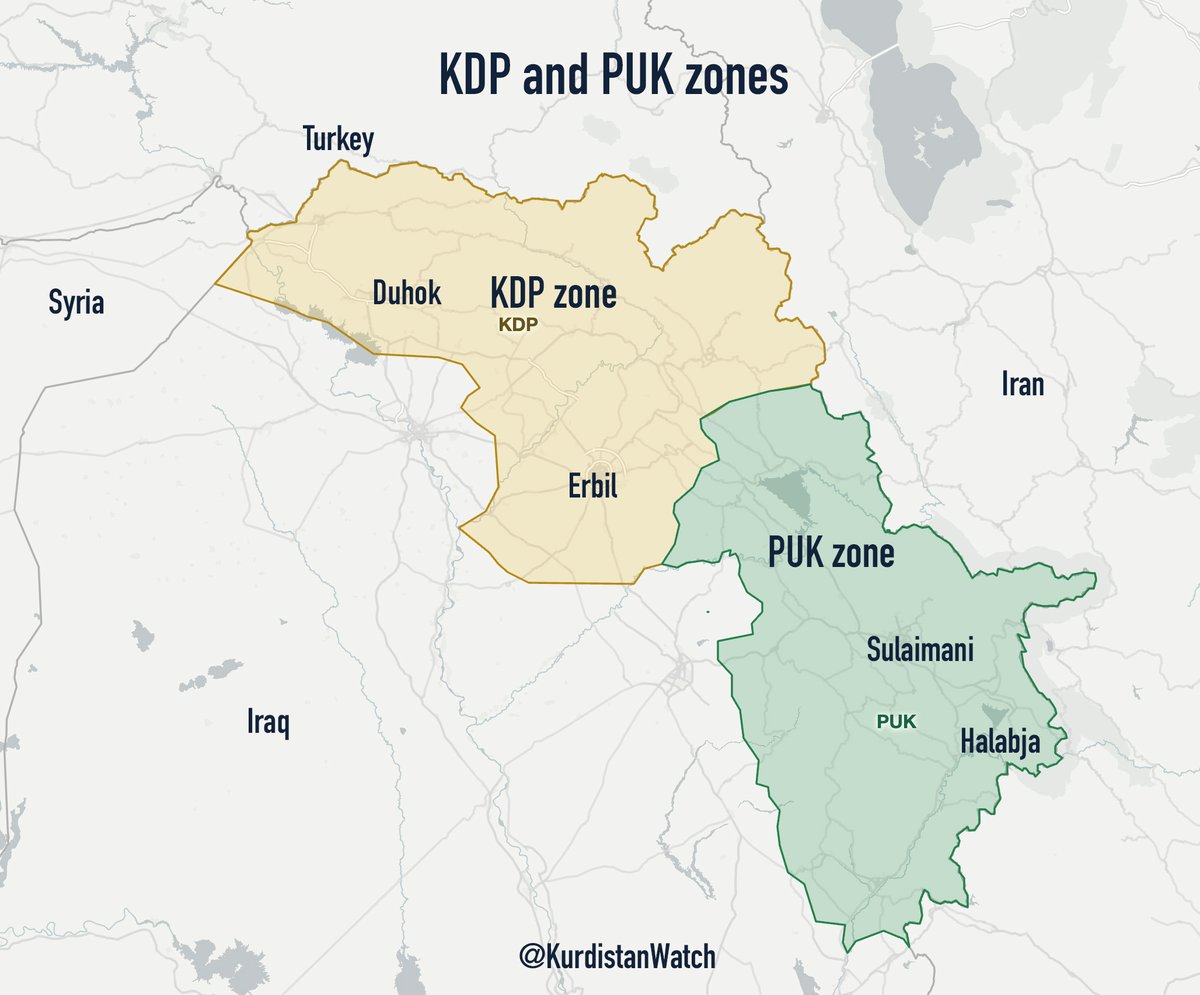
What is now emerging in the Kurdistan Region? Two administrations within one nominally unified federal region.
Despite media campaigns suggesting otherwise, the administrative split between the KDP and PUK zones is now complete, and KDP-PUK negotiations have reached a deadlock.
As of today, the PUK’s team in the KRG, down to general managers, has begun working from Suleimani. Ministers and deputy ministers are based in the building that formerly housed the Suleimani provincial council, general managers are in a nearby building, and Qubad Talabani, the KRG deputy prime minister, also has an office in the area. Lower-ranking PUK employees will continue working from their current posts, including in Erbil.
Meanwhile, PUK leader Bafel Talabani has reportedly reached a tentative understanding with Baghdad for direct payment of civil servants’ salaries in the PUK-controlled zone, along with separate investment allocations. The PUK appears to be relying partly on a February 2024 Federal Supreme Court ruling that explicitly permits government institutions and their directorates in the Kurdistan Region to deal directly with Iraq’s Finance Ministry over salary payments. The ruling also recognises the Region’s governorates’ investment entitlements under federal budget law, though whether these allocations can legally be transferred directly to Suleimani, bypassing Erbil, would depend on the applicable budgetary framework.
Since the KDP-initiated parliament session on 4 November, the KDP appears to have backed away from further parliamentary moves. The other main parties have refused to attend under current conditions, and the PUK has vowed to escalate in response to any further unilateral KDP action.
For now, parliament may be left dormant while the KDP uses the session as leverage. The PUK, meanwhile, is collecting signatures from 10 percent of Suleimani’s voters as a backup plan for forming a separate federal region. It does not yet appear serious about pursuing this, and wants the option available if relations with the KDP reach a point of no return.
On the ground, however, two completely separate administrations are taking shape. In the near future, the PUK plans to change electricity tariffs and taxes, introduce other populist measures and launch a slew of projects to show that a separate administration is already delivering tangible benefits. One of the PUK’s central arguments is now that KRG Prime Minister Masrour Barzani deliberately withheld projects from the PUK zone.
The financial separation is also advancing. The PUK has severed financial ties with Erbil, while the Sulaimani branch of the Kurdistan Region's central bank and several major public banks are reportedly already functioning as the financial apparatus of the emerging PUK administration.
So what we will have is no active parliament, and with the newly consolidated administrations, elections, which are due in less than two years, also look highly unlikely, given that the differences are now so deep that the parties are unlikely to agree on even how the elections should be held and under what laws and regulations.
@nucenas Average secularist cuck wants to be under the west. Because of this cuck mentality you secularists are always humiliated like in Rojava
I said let Kurdistan be without any interference from outside including muslim countries and lets see who will take over
@nucenas Yeah of course what we need is another failed dictatorship in the middle east which depends on western protection 🤦♂️
Just let Kurdistan without outside interference and let us see who is the strongest natural force and will take over, your dictator or the mujahideen
@KurdistanWatch@KurdistanWatch so who started this signature campaign?
In this post you said its the PUK collecting signatures for a separate region, can you clarify?
What is now emerging in the Kurdistan Region? Two administrations within one nominally unified federal region.
Despite media campaigns suggesting otherwise, the administrative split between the KDP and PUK zones is now complete, and KDP-PUK negotiations have reached a deadlock.
As of today, the PUK’s team in the KRG, down to general managers, has begun working from Suleimani. Ministers and deputy ministers are based in the building that formerly housed the Suleimani provincial council, general managers are in a nearby building, and Qubad Talabani, the KRG deputy prime minister, also has an office in the area. Lower-ranking PUK employees will continue working from their current posts, including in Erbil.
Meanwhile, PUK leader Bafel Talabani has reportedly reached a tentative understanding with Baghdad for direct payment of civil servants’ salaries in the PUK-controlled zone, along with separate investment allocations. The PUK appears to be relying partly on a February 2024 Federal Supreme Court ruling that explicitly permits government institutions and their directorates in the Kurdistan Region to deal directly with Iraq’s Finance Ministry over salary payments. The ruling also recognises the Region’s governorates’ investment entitlements under federal budget law, though whether these allocations can legally be transferred directly to Suleimani, bypassing Erbil, would depend on the applicable budgetary framework.
Since the KDP-initiated parliament session on 4 November, the KDP appears to have backed away from further parliamentary moves. The other main parties have refused to attend under current conditions, and the PUK has vowed to escalate in response to any further unilateral KDP action.
For now, parliament may be left dormant while the KDP uses the session as leverage. The PUK, meanwhile, is collecting signatures from 10 percent of Suleimani’s voters as a backup plan for forming a separate federal region. It does not yet appear serious about pursuing this, and wants the option available if relations with the KDP reach a point of no return.
On the ground, however, two completely separate administrations are taking shape. In the near future, the PUK plans to change electricity tariffs and taxes, introduce other populist measures and launch a slew of projects to show that a separate administration is already delivering tangible benefits. One of the PUK’s central arguments is now that KRG Prime Minister Masrour Barzani deliberately withheld projects from the PUK zone.
The financial separation is also advancing. The PUK has severed financial ties with Erbil, while the Sulaimani branch of the Kurdistan Region's central bank and several major public banks are reportedly already functioning as the financial apparatus of the emerging PUK administration.
So what we will have is no active parliament, and with the newly consolidated administrations, elections, which are due in less than two years, also look highly unlikely, given that the differences are now so deep that the parties are unlikely to agree on even how the elections should be held and under what laws and regulations.
Names like Muhammed, Yusuf and Ömer dominating Kurdish regions. Our people haven't forgotten their roots. May Allah preserve that attachment to Islam for generations to come.
Today at 9:05, Türkiye falls silent, and I stand in silence with it.
88 years after his passing, Mustafa Kemal Atatürk’s example speaks directly to our moment. A soldier who knew the cost of war better than anyone, he chose to build: a republic from the ruins of empire, institutions in place of grievance, and a creed that still guides this nation: “Peace at home, peace in the world.”
That is the work before us now. Across a region still searching for stability, his lesson holds. Sovereignty and dignity are won by courage, and secured by the harder courage of turning adversaries into partners.