🚀 The Stablecoin Era Begins... Swap USDC ↔️ KAS
USDC pool is now live on KaspaCom DEX. Swap and add liquidity.
Start now → https://t.co/324499NX8k
Add liquidity. Swap with stables. Earn $KCOM points. ⚡️
Pour célébrer la journée mondiale de l'art, nous voulons que VOUS conceviez la prochaine carte Tangem.
Les 5 meilleurs designs se partageront une cagnotte de 500 $ en BTC, et le design gagnant aura la chance d'être imprimé sous forme de véritable carte Tangem.
Comment participer :
1. Créez votre carte
2. Retweetez ce message en y ajoutant votre design et le hashtag #TangemArtDay
3. N'oubliez pas de nous taguer @Tangem
Date limite : 22 avril, 22 h CET. La toile est à vous!
Some people drop collections.
Notshore builds vibes.
If you’ve been around Telegram long enough you’ve probably seen his work without even realizing it.
Those funny, creative stickers that somehow made chats a bit more alive.
That’s where it started for many of us.
And you could already tell there’s real creativity behind it.
That’s the thing about real artists.
You notice them before the spotlight does.
From the early sticker days to Evilspudz, to Spudstarz, to the insanely clean Yonaspud work…
the level just keeps going up.
Not recycled.
Not lazy.
Not mass-produced.
Real ideas. Real effort. Real 1/1 work.
And what makes it hit even harder:
it never feels forced.
He brings humor, energy, consistency and somehow stays one of the most naturally entertaining people in the space while doing it.
The Yonaspud collab with @YonatoshiNFT & @KaspaCom was one of those moments where people stopped and went:
“Okay this is actually different.”
The concept, the execution, the fact that every piece was handcrafted. That wasn’t just another drop that was real creative work.
Because that’s what he does.
He doesn’t just make NFTs.
He makes pieces people actually want to show off.
And while most only see the final result, he gives his community a look behind the curtain.
Sharing parts of the process, the work, the creativity behind it.
That kind of openness is rare.
That kind of authenticity is even rarer.
And let’s be real!
Doing all this while having a family and real responsibilities makes it even more impressive.
Big respect there and to his wife as well for the support.
For me Notshore has been one of the most unique creators in the Kaspa space for a while now.
And I genuinely think a lot of people still underestimate where this is going.
At this pace he’s not just making cool collections.
He’s becoming one of the names people will remember when they talk about the best artists in Kaspa.
Next collection loading… 👀
If you’ve been sleeping on Spudverse that’s on you.
Follow: @Spudzbynotshore
Join: https://t.co/ILNsziw0HE
Okay, it's time for a little update:
I just finished the work on the zero knowledge part of the vprogs framework, which introduces the ability to prove arbitrary computation.
It consists of the following 8 PRs that gradually introduce the necessary features:
1. ZK-framework preparations (https://t.co/H0X9278oWK):
This PR cleans up the scheduler and storage layers, extends the build tooling with workspace-wide dependency checking, adds the ability to publish artifacts for transactions and batches (which will later hold the proofs), renames some core types for clarity, and introduces lifecycle events on the Processor trait that allow a VM to hook into key scheduler events like batch creation, commit, shutdown, and rollback.
2. Core Codec (https://t.co/ZbFEsNd7zF):
This PR introduces a lightweight encoding library for ZK wire formats.
In a zkVM guest, every byte operation contributes to the proof cost, so the codec is designed to reinterpret data in-place rather than copying it.
It includes zero-copy binary decoding (Reader, Bits) and sorted-unique encoding for deterministic key ordering. It is built for no_std so it runs inside zkVM guests.
3. Core SMT (https://t.co/wCcRTCXg8x):
To prove state transitions, we need cryptographic state commitments. This PR adds a versioned Sparse Merkle Tree that produces a single root hash representing the entire state.
It includes all state-of-the-art optimizations: shortcut leaves at higher tree levels to avoid full-depth paths for sparse regions, multi-proof compression that shares sibling hashes across multiple keys, and compact topology bit-packing to minimize proof size.
It integrates into the existing storage and scheduler layers so that every batch commit updates the authenticated state root, while rollback and pruning maintain tree consistency.
4. ZK ABI (https://t.co/1THUvCK1Xq):
Defines the wire format for communication between the host and zkVM guest programs, establishing a universal language for proof composition. It specifies how inputs, outputs, and journals are structured for two levels of proving: the transaction processor, which proves individual transaction execution against a set of resources, and the batch processor, which aggregates transaction proofs and proves the resulting state root transition.
Because the ABI is backend-agnostic and no_std compatible, any zkVM backend can directly use it (non-Rust zkVMs would need to reimplement the ABI in their language).
5. ZK Transaction Prover (https://t.co/TtvoYZaazz):
Introduces the transaction proving worker, which receives serialized execution contexts via the ABI wire format and submits them to a backend-specific prover on a dedicated thread. The Backend trait abstracts the actual proof generation, so different zkVM backends can be swapped without changing the pipeline.
6. ZK Batch Prover (https://t.co/WPRd1UmvGW):
Introduces the batch proving worker, which collects the individual transaction proof artifacts, pairs them with an SMT proof covering the batch's resources, and submits the combined input to a backend-specific batch prover. The result is a single proof attesting to the entire batch's state root transition.
Like the transaction prover, the Backend trait abstracts proof generation so different zkVM backends can be swapped without changing the pipeline.
7. ZK VM (https://t.co/3xMF17DKUq):
Wires everything together by implementing the scheduler's Processor trait with ZK proving support. The VM hooks into the lifecycle events introduced in PR 1 to feed executed transactions into the transaction prover and batches into the batch prover.
Proving is optional and configurable - it can be disabled entirely, run at the transaction level only, or run the full batch proving pipeline.
8. ZK Backend RISC0 (https://t.co/HJ0Payxfl0):
Provides the first concrete zkVM backend using risc0. It implements the transaction and batch Backend traits, includes two pre-compiled guest programs (one for transaction processing, one for batch aggregation), and ships with an integration test suite that verifies the full pipeline end-to-end - from transaction execution through batch proof generation to state root verification.
TL;DR:
While the early version of the framework focused on maximizing the parallelizability of execution, this feature focuses on extending this capability to maximizing the parallelizability of proof production.
If you're a builder: this is the first version of the framework that lets you write guest programs with a Solana-like API (resources, instructions, program contexts) and have them proven in a zkVM.
The current milestone uses a single hardcoded guest program - composability across multiple programs and bridging assets in and out of the L1 are part of the upcoming milestones, but if you're eager to start tinkering, the execution and proving pipeline is fully functional and provides a minimal environment to build and test guest logic today.
Once we add user-deployed guests, they will move one logical layer down: the current transaction processor will become a hardcoded-circuit that handles invocation and access delegation to user programs, similar to how SUI handles programmable transactions (including linear type safety at the program boundary).
In practice, this means guest programs will be invoked with a very similar API but scoped to a subset of resources, so the basic programming model won't change. Note that guests currently handle their own access authentication (e.g. signature checks) - the framework will eventually manage this automatically.
If you want to contribute, two areas where community involvement would be especially impactful:
- An Anchor-like DSL for writing guest programs -- the ABI is stable enough to build on, and a good developer experience layer would make this accessible to a much wider audience.
- A second zkVM backend (e.g. SP1) - the Backend traits are designed for this, and a second implementation would prove out the abstraction.
One thing I find particularly interesting in the context of PoW: the block hash provides an unpredictable, unbiasable random input that is revealed after transaction sequencing.
This gives guest programs native access to on-chain randomness without oracles or additional infrastructure - something traditionally hard to achieve in smart contract platforms.
PS: I am also planning to start with the promised regular hangouts but since I will visit my family over easter and want to get a better understanding of the open questions next week (it's good to have some problems to wrestle during that slower time 😅), I decided to start with that once I am back (12th of April).
Generally speaking, is there a day that people would prefer for these hangouts? I guess monday would be bad as there is already another community event (write your preferences in the comments if you have a strong opinion).
Kaspa feels like Luffy at the very beginning of the story.
Back when no one believed.
Back when people laughed.
Back when it all looked too small… too early… too irrelevant.
Just another “project”, right?
But the ones who understood… stayed.
Not because it was easy.
Not because it was trending.
But because something about it just felt different.
Luffy never asked for permission.
He never waited for validation.
He simply said:
“I’m going to be King of the Pirates.”
And everyone laughed.
Kaspa is doing the exact same thing.
No loud promises.
No fake hype.
No shortcuts.
Just relentless building.
Faster.
Stronger.
More unstoppable with every step.
And then there’s the crew.
Not tourists.
Not mercenaries.
Not here for a quick flip.
A real crew.
Builders.
Believers.
Degens.
Visionaries.
Each one bringing something to the table.
Each one part of something bigger than themselves.
And slowly… people are starting to notice.
The same ones who laughed are now watching.
The same ones who ignored it are now asking questions.
“What is this?”
“Why is it growing?”
“Did we miss it?”
But here’s the truth:
We’re still early in the story.
This isn’t Marineford.
This isn’t the final war.
This is East Blue.
The beginning.
Kaspa isn’t trying to fit into the system.
It’s rewriting it.
And just like Luffy…
He was never trying to be the first.
He was always trying to be the freest.
And that’s exactly what this is about.
It’s not asking to be accepted anymore.
It’s taking its place 🏴☠️🔥
Something significant just happened for #Kaspa.
The Kaspa Foundation has signed a strategic alliance with the @OxfordUnion — one of the world's most storied intellectual institutions, founded in 1823.
✅ What this means:
@hashdag, co-creator of the GHOSTDAG protocol and the theoretical foundation of Kaspa, is tentatively scheduled to deliver a flagship speech on March 12, 2026.
He'll stand at the same podium that once hosted:
— Albert Einstein (1933)
— Ronald Reagan
— Peter Thiel
— Jack Dorsey
— Mike Pence
And crucially: Oxford Union was among the very first institutions to formally engage with #Bitcoin — over a decade ago.
Now, #Kaspa steps into that same arena.
✅ Why this matters beyond brand visibility:
Kaspa is not just a faster blockchain.
It is a rethinking of how consensus itself works — through BlockDAG architecture, where parallel blocks are not discarded but ordered via GHOSTDAG, achieving both high throughput and the security guarantees of pure Proof-of-Work.
Most PoW narratives died with the "Bitcoin vs. everything" framing.
Kaspa reopens that conversation — not as a competitor, but as the natural evolution of what Nakamoto began.
Oxford Union's platform has historically been where ideas move from academic discourse into public consciousness.
The fact that Kaspa's theoretical architect will speak there signals something rare:
a PoW protocol being evaluated not just on price or throughput — but on its intellectual merit and long-term civilizational relevance.
✅ What comes next:
Beyond the speech, broader initiatives include a hackathon targeting Oxford's builder community — bringing Kaspa's tech stack directly to the next generation of engineers and researchers.
This is how protocols graduate from "interesting tech" to "infrastructure the world builds on."
#Kaspa #カスパ $KAS #BlockDAG #ProofOfWork #GHOSTDAG #Oxford
Join over 800 #Kaspian on #KasMap (link in bio). Create a local group and/or create a meetup event in your area. If you want $KAS to have succes, you need to get up and act. Keyboard warriors only go so far, real life #Kaspa meetups make adoption become real.
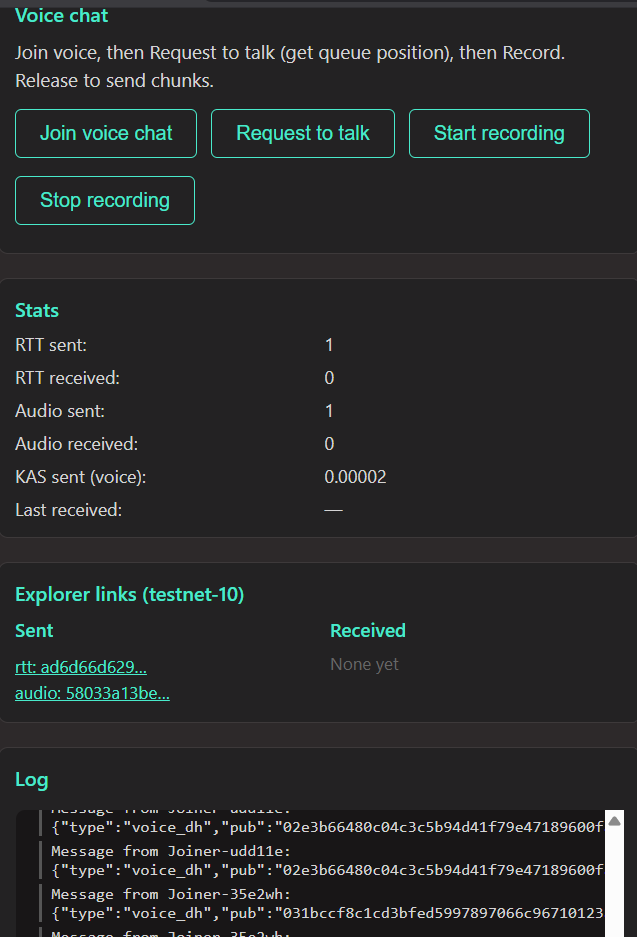
I've made several optimizations to @kaspa_kinesis, but I'm not sure how the hackathon works so I'ma wait pushing them, but I'm also exploring voice chat, because gamers need comms.
The walkie-talkie method wont be needed for long as either 1. DAGKnight or 2. I optimize
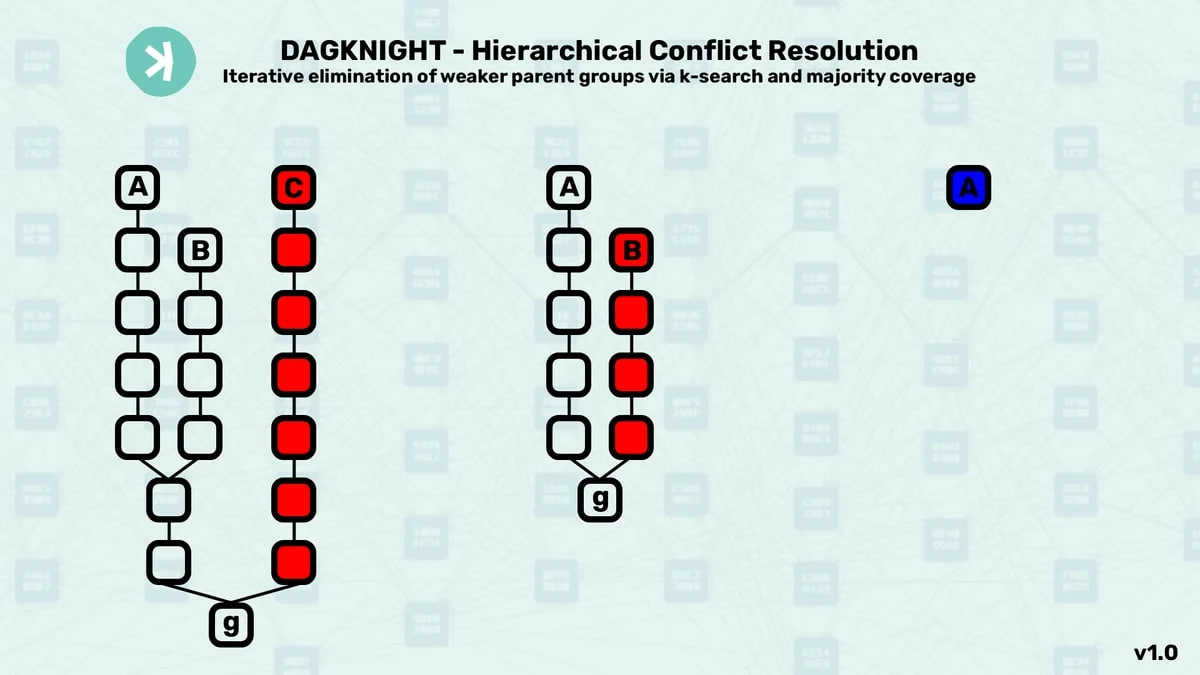
🚀 DAGKNIGHT Explained — Targeted for End of Q3
DAGKnight marks a major step in Kaspa’s evolution.
This article breaks down what it is, why it matters, and how it works.
DK simplified → https://t.co/xKxT7OHup4
Written by @NikolaGalilei ⚡️
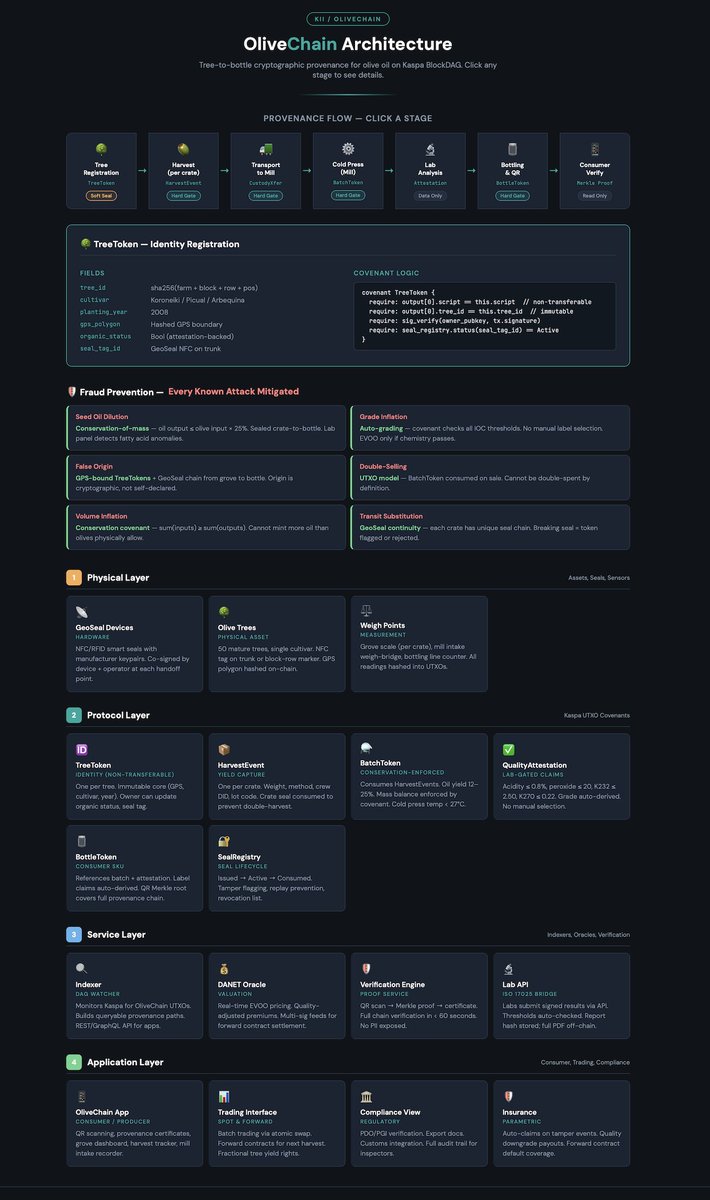
Excited to share some more information on one of our favorite projects, OliveChain a tree-to-bottle provenance system built on Kaspa's BlockDAG for fraud-proof olive oil supply chains. Dive into the details below! #OliveChain#Kaspa#kaspakii#BlockchainSupplyChain
Making big progress on $KAS Poker. First beta testers will be invited this week (members of the @kasbtc_krc20 TG community).
Planning to launch poker on Kaspa in less than 14 days. Provably fair with cryptographic proofs and instant payouts!
Hello world.
It is time.
Igra Genesis and TGE are this Wednesday, February 26th. You're all invited.
Our genesis block carries an inscription from Deuteronomy 22:8 in Aramaic: "When you build a new house, make a parapet around your roof so that you may not bring the guilt of bloodshed on your house if someone falls from the roof."
We build with that in mind.
Here's the sequence:
- Code, configuration, and bootstrap scripts are frozen. Nothing changes from here.
- New nodes launch with public RPC endpoints and block explorer.
- Nodes begin mining blocks.
- Once the network reaches DAA score threshold, core contracts deploy, including IGRA token contract, minting vaults and DAO governance.
- IGRA is minted and distributed into the pools.
- IGRA is allocated to all direct early round participants.
Genesis parameters are cryptographically committed and locked. The entire bootstrap is trustless and deterministic. Every step is verifiable on-chain, in real time.
On Wednesday we lay the foundation for the fair, scalable and permissionless economy.
See you on-chain.
From: Yonatoshi
Subject: Airdrop Sunday
> 35 points per Yona have landed.
> Holders already know how important these moments are.
The question is, do you?
That’s the power of holding.
🔗 https://t.co/oDdPpLJIUg
Yonatoshi
🚀 The Final Call... 24 Hours Left to Secure $KCOM
18 months of building the KaspaCom ecosystem. $KCOM aligns you with what comes next.
T-24H. Secure access → https://t.co/xXlD9Zp4DJ
The next era of KaspaCom, tokenized. ⚡️