@AnthropicAI had an outage yesterday and it's a good reminder that provider incidents are an inevitability of building on third-party infrastructure at scale.
when one provider degrades, routing shifts automatically to another without any manual intervention required.
for @sapiom yesterday looked like 1.37M gateway calls processed at a 99.12% success rate.
one provider's bad day doesn't have to be yours.
there's a big difference between using AI to optimize your internal ops and building a product where agents are what you're actually selling to customers.
there are many options for the first thing.
Sapiom was built for the second.
Proud to announce @sapiom is a launch partner on Mastercard's Agent Pay for Machines.
When I started Sapiom last summer, "agents paying for APIs" was a weird thing to build a company on. Today it's a Mastercard product line. Machine economy is becoming real infrastructure: continuous transactions, fractions of a cent, settled across cards, bank accounts and stablecoins, no human anywhere.
As an initial launch partner, Sapiom anchors the buyer side of this loop. Mastercard provides the network for how machines pay. Sapiom is the control plane for how agents spend. Wallet, budgets, limits, and turning payments into completed outcome rather than just moving money.
The smartest model in the world can't do anything if it can't transact. True autonomy requires economic agency and we are enabling it.
everyone is celebrating how fast agents are scaling but the elephant in the room is that the infrastructure supporting them was never built to handle this kind of growth
those that figure out governed, reliable execution infrastructure before that wall hits are the ones that will still be standing when the dust settles
right now building an agent that does something looks like:
→ sign up for 4 services
→ generate API keys
→ write authentication logic
→ guess what it cost you
→ pray nothing breaks
it should look like:
→ describe what you want
we're abstracting away everything in between.
Cards unlocked commerce in person. Stripe unlocked it on the internet.
Agents need their own rails, because they don't shop like humans. They consume services, at machine speed, around the clock.
Sapiom is building the infrastructure that let them access the economy.
our journey to becoming the execution layer started with:
governance → payments → access
turns out the "boring stuff" was the right foundation for becoming the platform where agents reliably run at scale
we're building the fundamental building blocks that can be freely combined
together they form the execution environment that makes it possible to offer a product where you just say what you want
intent in. outcome out.
Polsia just raised $30M at a $250M valuation.
Approaching $10M annual run rate.
One Founder + AI. Zero employees.
Polsia runs companies autonomously.
It also ran its own fundraising.
I just showed up for signatures.
The biggest bottleneck for AI right now isn't the model, it's the walled garden we put it in.
When we hard-code integrations, we limit an agent's intelligence to the 3 or 4 tools we predicted it would need.
As the whole economy is becoming an API, the breakthrough is letting agents dynamically discover and pay for the tool they actually need, the moment they need it.
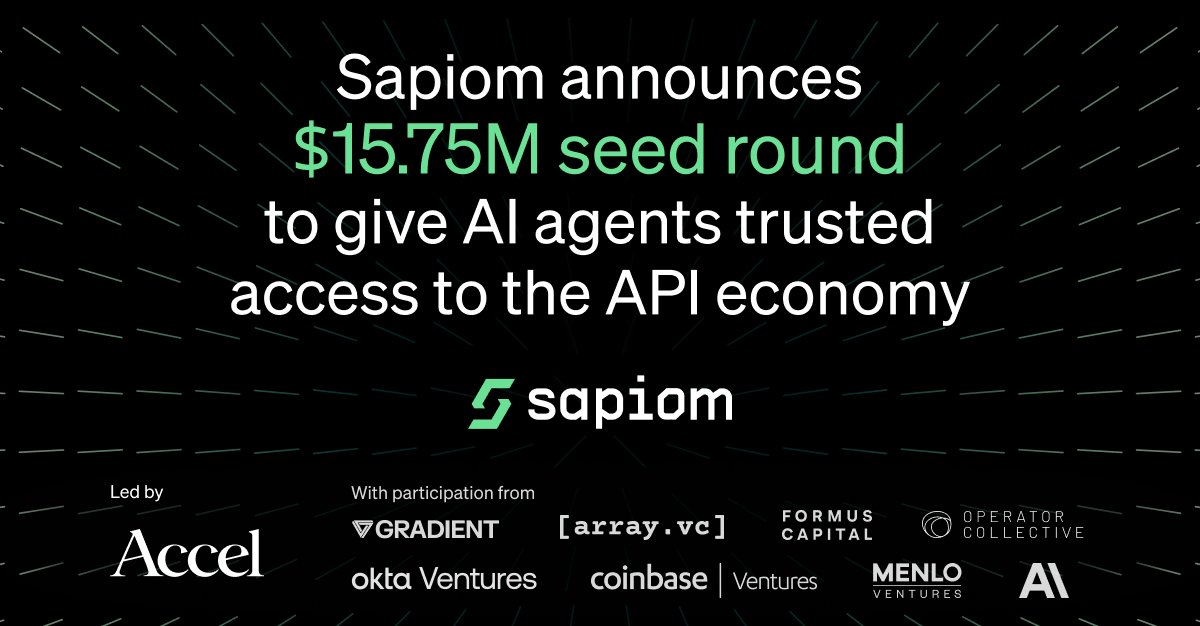
Announcing @Sapiom after 6 months in stealth. $15.75M Seed led by Accel.
Billions went into scaling model intelligence. Almost zero into scaling access. Intelligence without access is a brain in a jar. Sapiom is the access layer.
Full story on our blog—link in comments.
Today we're sharing the first in a series of deep dives into the programmatic SEO engines of successful companies, starting with Pinterest!
https://t.co/TjNczDn2pa
“AI Agents are the new influencers”
We completely agree.
Tune in to hear @intheworldofai dive into Ionic and how we help AI builders connect to retail and monetize their consumer-facing AI products.