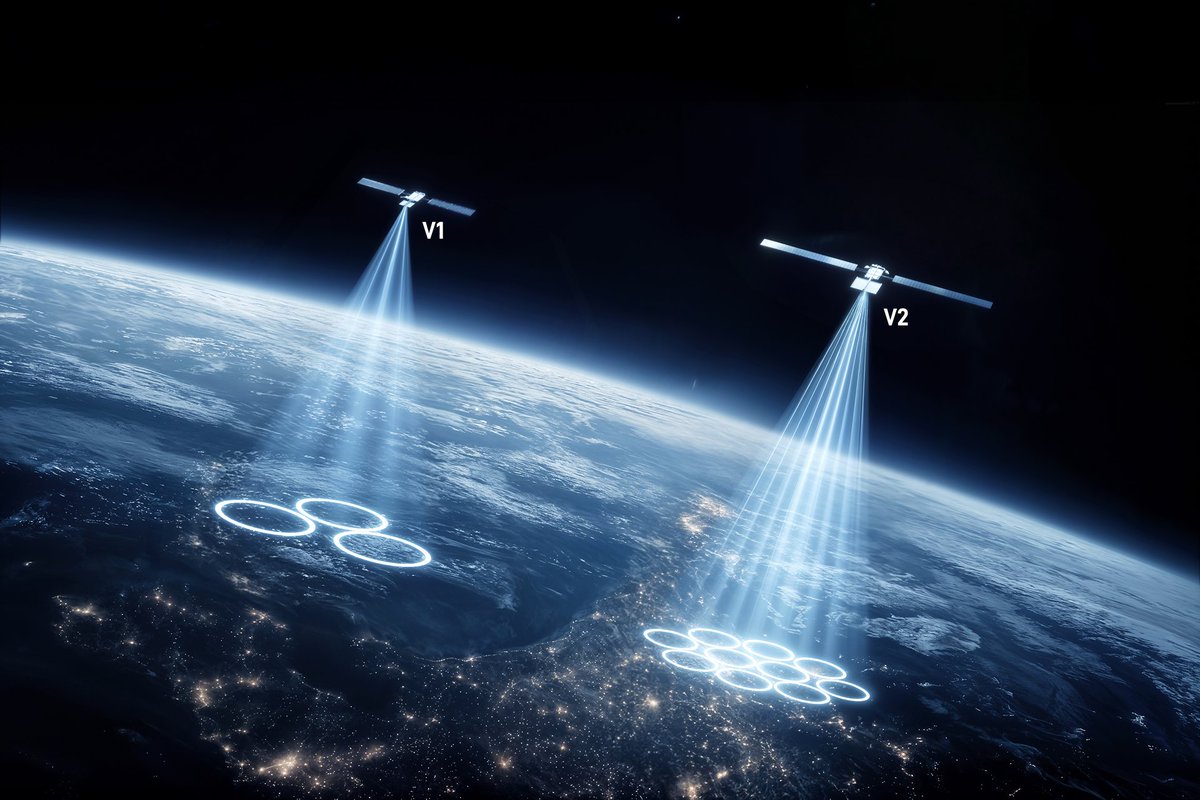
SpaceX says that "by the end of 2028, @Starlink Mobile will have already rapidly upgraded the constellation by launching thousands more satellites, providing continuous full global coverage to become the first—and most likely the only—direct-to-device provider to offer true coverage in high-latitude polar regions," according to a new filing.
SpaceX added that Starlink Mobile will be able to provide its partners with life-saving data services by Q3 2027, with voice following within months.
All of these upgrades will be possible thanks to the company's next-generation Starlink Mobile V2 satellites, which will deliver 5G speeds from space with 100x the data density of the current V1 generation satellites.
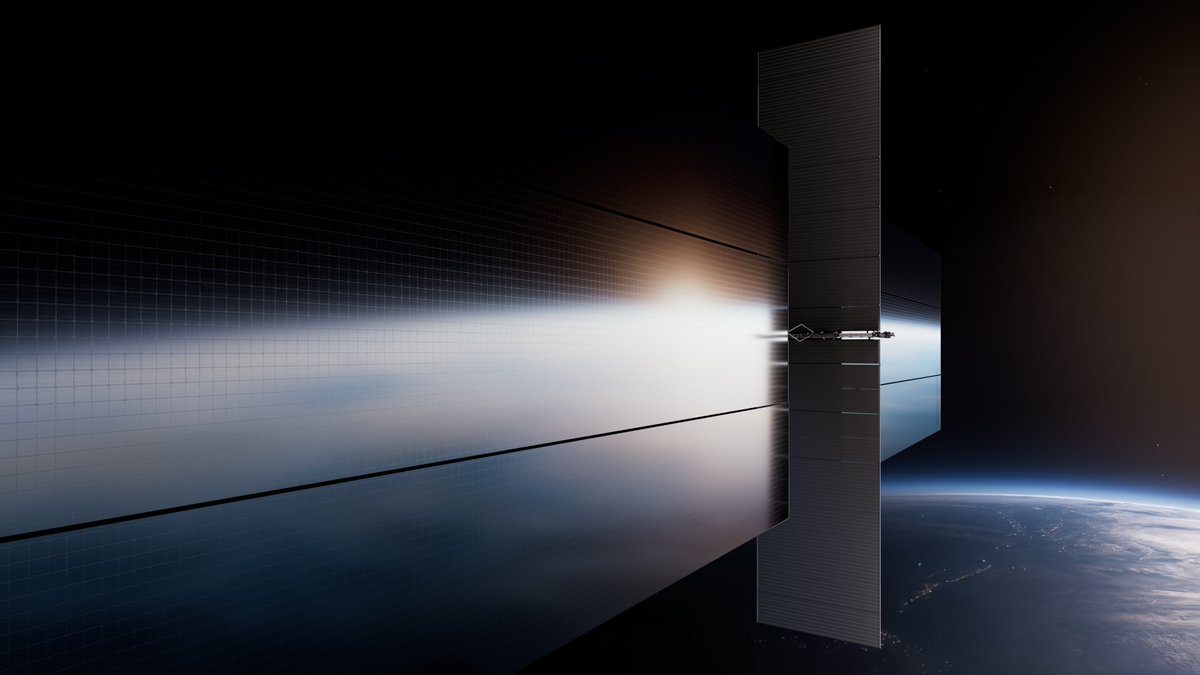
SpaceX has just announce that it is partnering with Nvidia to design their Starmind AI1 satellite compute payload.
"Each of the Starmind satellites will include Nvidia Rubin GPUs and Vera CPUs for datacenter class space compute."
SpaceX recently decided to increase the peak power of its upcoming AI satellite by 67% to ~250kW (up from 150kW), and its average power by 33% to 160kW (up from 120kW), enough to handle an Nvidia Rubin NVL72 rack, which contains 72 Rubin GPUs.
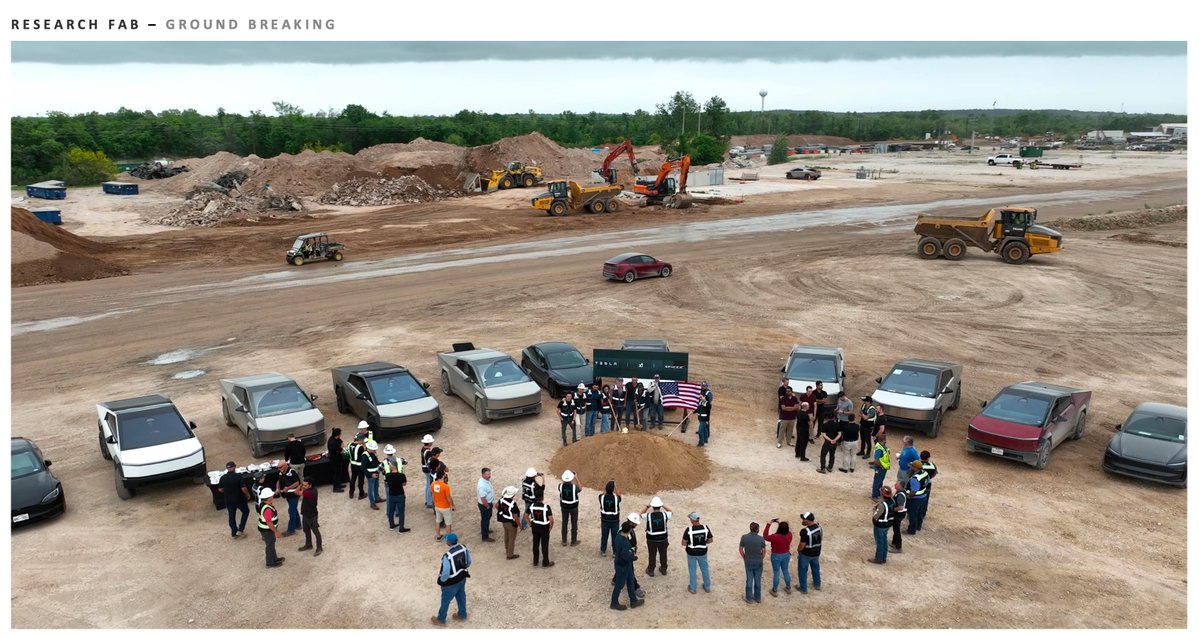
Terafab will be built in Grimes County, Texas
In April, we broke ground on our research fab on the North Campus of Giga Texas – the precursor to Terafab.
Both Tesla & SpaceX will need far more chips than current & future global production can supply.
This is why we're building the largest chip manufacturing facility ever, with the goal of producing over 1 terawatt of compute per year
The future is built in Texas
https://t.co/RQPNlAasdP
Elon and the Tesla team may not always be on time, but they ALWAYS deliver.
Where are all the fools who said Robotaxi expansion would never happen?
The same people who said it was “moving too slowly.”
The same people who called Elon a liar.
Today, Robotaxi is now operating across 7 cities:
• SF Bay Area, CA (Supervised)
• Austin, TX (Unsupervised)
• Dallas, TX (Unsupervised)
• Houston, TX (Unsupervised)
• Miami, FL (Unsupervised)
• Orlando, FL (Unsupervised)
• Tampa, FL (Unsupervised)
Bro… big things almost always look slow in the beginning. Building a real-world autonomous transportation network is NOT like shipping a simple software update. It takes hardcore engineering, testing, regulatory approvals, and proving safety city by city. Literally, people’s lives are at stake here…
NEVER bet against Elon and the Tesla team.
Covenant Logistics has completed two weeks of @Tesla Semi testing. They were blown away by its capabilities.
"We were amazed at the performance of the Tesla Semi and felt a level of confidence that was hard to match in a diesel truck.
As one of our final runs we tackled a section of I-5 between Santa Clarita and the San Joaquin Valley over the Tejon Pass - famously known as "The Grapevine" - a lane critical to trucks hauling cargo from the ports in Oakland, Los Angeles, and Long Beach. "The Grapevine" sits at an elevation of 4,160 feet and represents the highest point on I-5 in California. The northbound descent from Tejon Summit drops 2,613 feet over 11.6 miles, with the steepest section — known as the Grapevine Hill — running about 6% grade for 5 miles.
Running the Grapevine with a loaded trailer is about as demanding a real-world test as you could design for any truck. Running Northbound - lose momentum on a steep grade with a heavy load can be stressful as speed drops fast and recovering on that grade is challenging. Running Southbound requires attention to braking and heat management (which isn't a problem for an EV when you've got regenerative braking doing most of the work)."
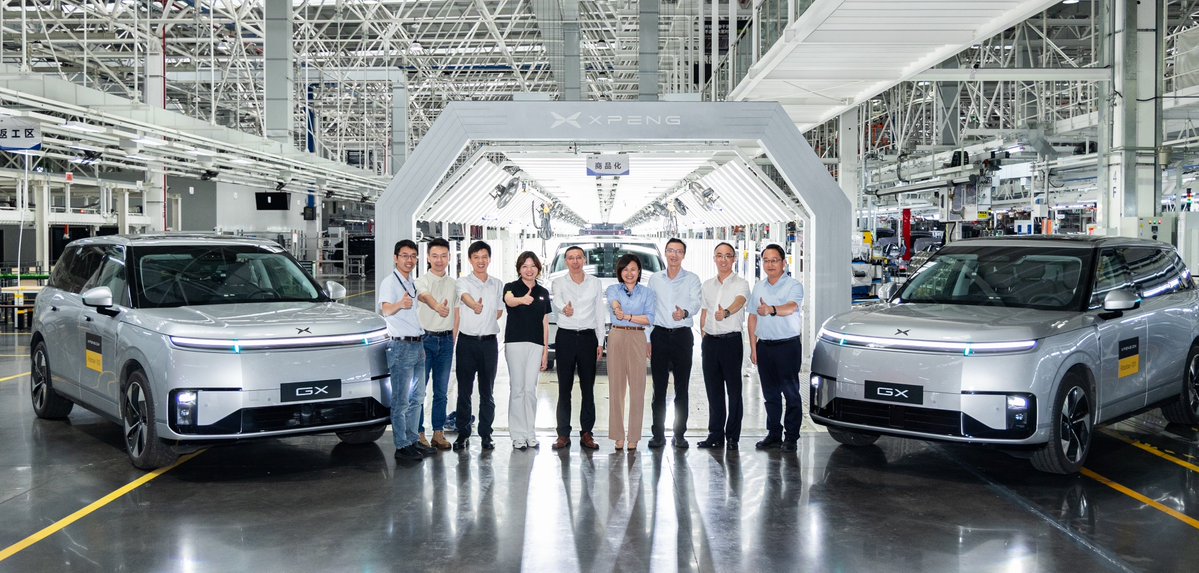
Chinese automaker XPENG’s CEO said LiDAR is no longer necessary for the automotive industry.
XPENG has adopted a camera-vision approach with its new VLA 2.0 system.
They also stated that cameras provide richer data per second than LiDAR, especially for end-to-end models, while noting that LiDAR can struggle in rain or fog and has power/safety limitations for long-range detection.
Sounds like somebody is listening to Tesla.
FSD Global Rollout Loading - Stock up $8 in after hours.
Tesla officially confirmed it today (May 20, 2026).
"FSD Supervised is now available in: United States, Canada, Mexico, Puerto Rico, China, Australia, New Zealand, South Korea, The Netherlands, Lithuania
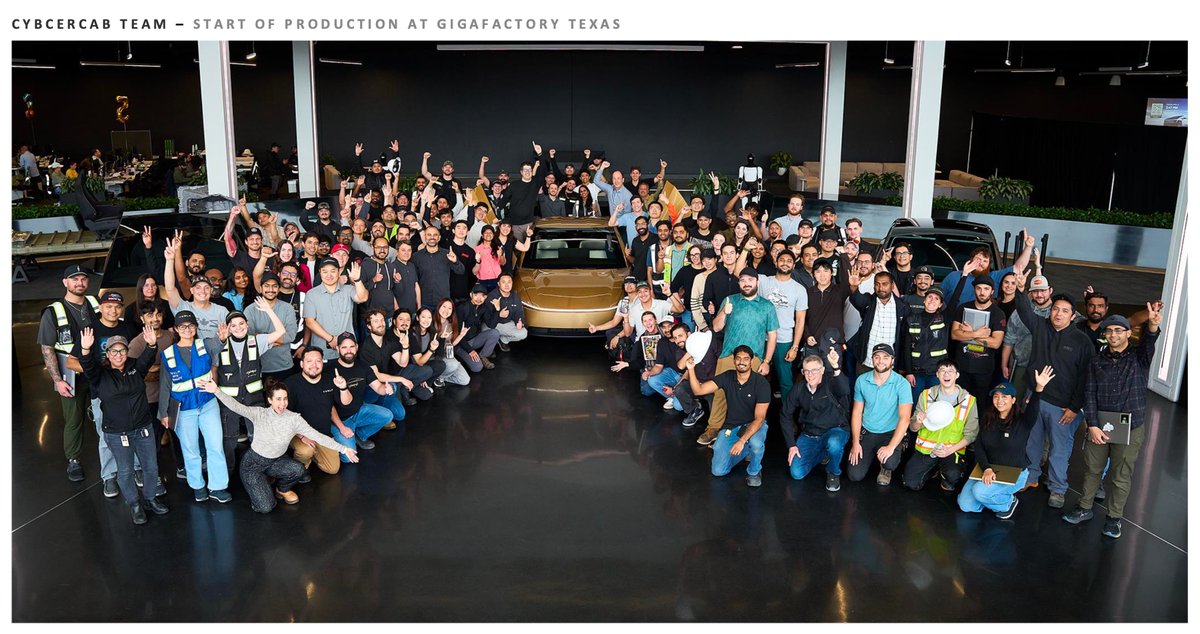
Lars Moravy, VP of Tesla Vehicle Engineering, says the Tesla Cybercab is officially the most efficient EV ever certified at 165 Wh/mi!
That’s around 40% more efficient than a Model 3. WOW.
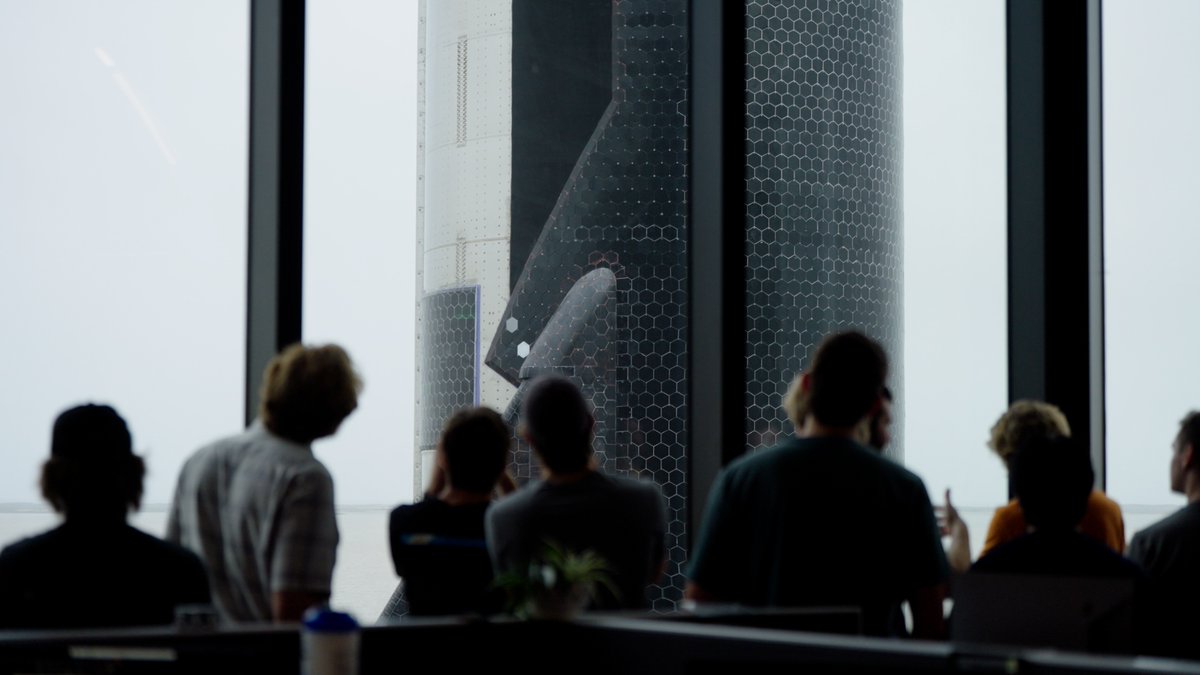
These vehicles are the first of many – made possible by the tireless effort of SpaceX engineers and technicians – and are designed to enable the core revolutionary capabilities of Starship
Q1 2026 Shareholder Update
https://t.co/dOjSLhd10p
We continued to make meaningful progress on the build out of the infrastructure & AI software that underpins our Robotaxi & future robotics businesses in Q1.
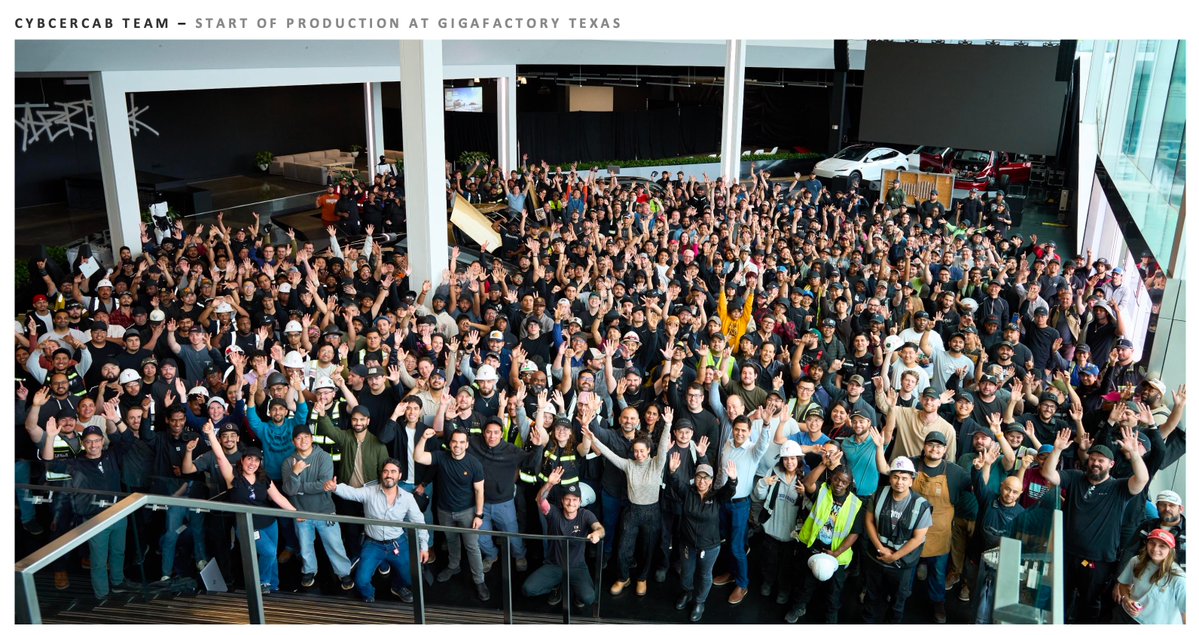
That meant commencing the ramp of new factories across AI compute, battery & battery materials, as well as preparing lines for start of production of Megapack 3, Cybercab & Tesla Semi.
Demand for our vehicles continued to grow in APAC & South America markets, with a rebound of demand in EMEA markets & North America.
As trade and geopolitics become more uncertain, we're further regionalizing and vertically integrating critical supply chains to ensure access to key materials & componentry in each region across vehicle, energy & AI.
Automotive
– Optimizing our vehicle product portfolio with an emphasis on vehicles designed for a fully autonomous future
– More affordable trims of Model 3/Y & rollout of Model Y L in markets outside of China
– Began deliveries of Cybertruck in the UAE
– Volume production of Cybercab & Tesla Semi this year
Energy Generation & Storage
– Good progress with new Megafactory outside Houston (will produce Megapack 3 for Megablock). Start of production on track for later this year
– We began meaningful customer deployments of Tesla’s first in-house designed solar panel produced at Giga New York
Robotics
– Preparations for our first large-scale Optimus factory will begin shortly in Q2.
First-gen line designed for 1M robots/year will replace Model S/X lines in Fremont Factory, second-gen line is being prepared at Giga Texas (long-term annual capacity of 10M robots/year)
AI Training Compute
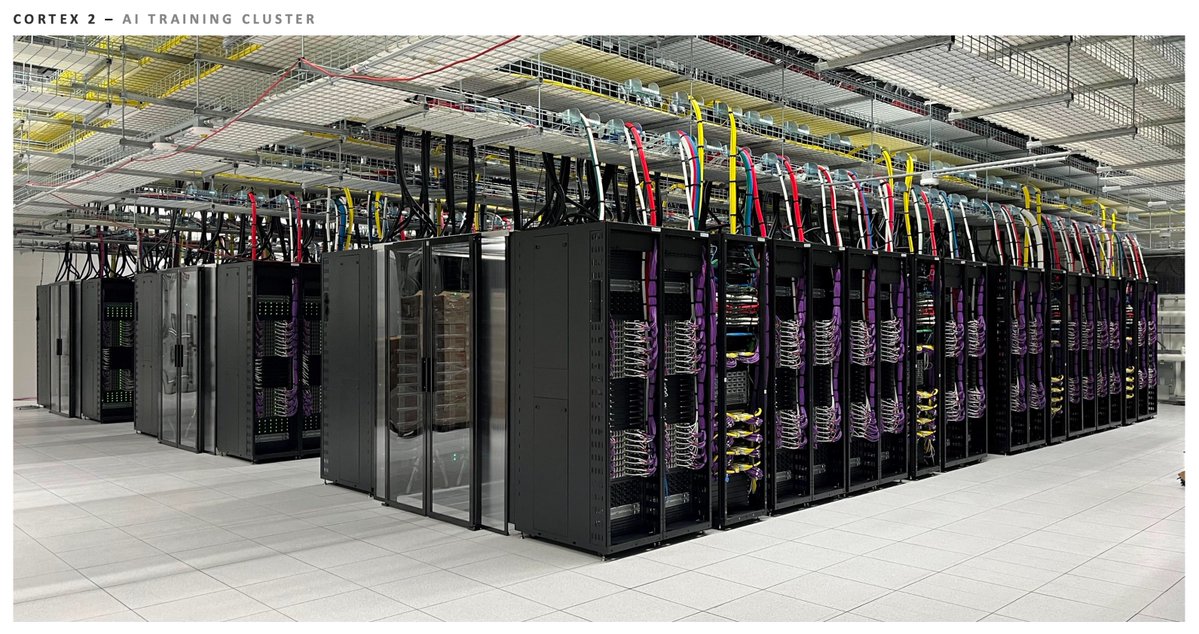
– Cortex 2 is now online & has started running training workloads
– Also ramping on-site training infrastructure to ensure sufficient compute resources for AI products & services
– Continuing with custom silicon development (Dojo 3) to reduce training cost over time
Battery
– Ramping new battery & material factories, including LFP cells in Nevada, cathode material & lithium refining in Texas
– Battery vendor cell availability continues to be a limiting factor on ramping vehicle production, so we're working on initiatives to de-bottleneck, including using 4680 cells at Giga Berlin
Other Supporting Infrastructure
– Giga New York is now producing V4 Supercharging cabinets (3x power density & 2x the number of stalls vs V3)
– Alongside the ramp of Tesla Semi, we're deploying public Megachargers, including our first one in SoCal
– Over 2,200 new Supercharger stalls, growing the network 19% YoY
AI Software
– FSD 14.3 launched in April
– Upgraded Reinforcement Learning (RL) stage to better handle long-tail edge cases, enhanced the neural network vision encoder for sharper perception in low-vis scenarios & rewrote the AI compiler to accelerate model iterations & cut inference latency by 20% (faster reaction time for FSD!)
This accelerates our efforts to eventually deploy unsupervised autonomy to both the Robotaxi fleet & customer owned vehicles
– Digital Optimus: our next evolution of AI development. We're working on automating digital workloads, building an intelligence layer that will complement real-world AI in vehicles & robots
AI Inference Compute
– Expanding our scope of manufacturing to include semiconductor fabrication (coinciding with Robotaxi & Optimus ramps) = step towards ensuring sufficient & resilient chip supply
– Partnership with SpaceX aims to build the largest chip fab ever, vertically integrating logic, memory & advanced packaging to allow for rapid iteration
– Completed final chip design of AI5 (our next-gen inference processor) in April
Automotive & Other Software
– Rolled out Spring Update which includes a new Self-Driving app with tutorials & stats, "Hey Grok" wake word w/ location-based reminders, accent lights for blind spot alerts, updated Pet Mode & more
Robotaxi
– Paid Robotaxi miles doubled sequentially in Q1
– Cybercab will begin replacing Model Y fleet once in production & be the largest volume vehicle in the fleet over time
– Continuing to lay the groundwork for expanding into new cities (testing, permitting), so we can launch quickly once ready. Safety remains top priority
– Expanded unsupervised ops in Austin & launched in Dallas & Houston in April
FSD Supervised
– Record net new FSD subscriptions in Q1
– Received approval to deploy FSD Supervised in the Netherlands in April, clearing the path for potential approval in other EU countries
– Continuing to make progress on approval in China
Automotive Services
– Safety Score v3.0 enables every mile driven with FSD Supervised engaged to receive a score of 100. Higher Safety Score over time = lower premiums for Tesla Insurance customers
How Retail Wastes Money
2025 Americans spent $110 BILLION on lottery tickets……yet retail investors only put $11 BILLION into Tesla stock.
10x more money gambled away on 1-in-300-million odds than invested in the best risk reward of all time
Stop gambling. Start investing. 💸💰💵
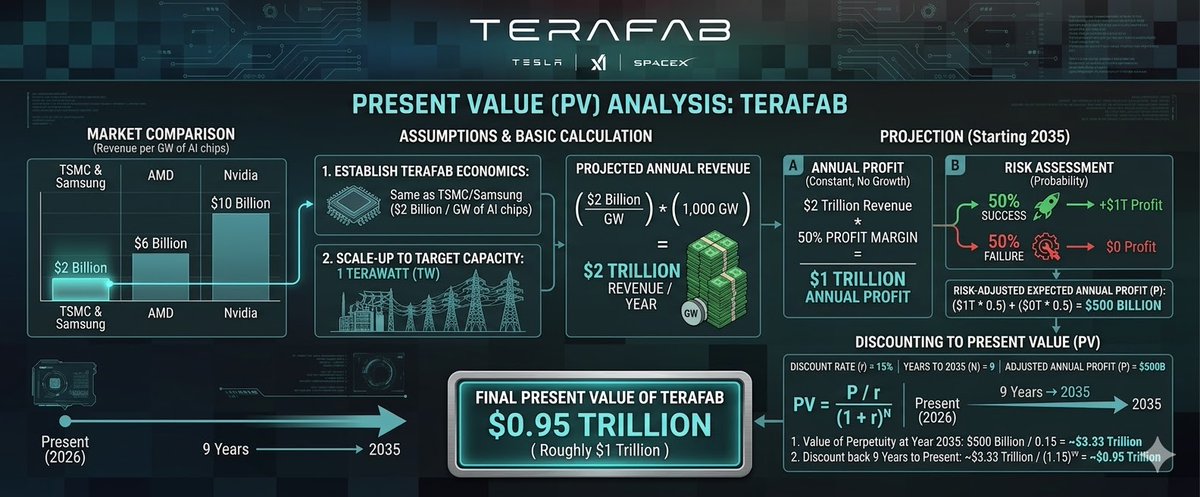
What is the Present Value of TERAFAB?
TSMC and Samsung make about $2 billion in revenue per GW of AI chips they produce. Nvidia makes about $10 billion and AMD makes about $6 billion per GW of AI chips/systems they sell.
Let's assume that Tesla's TERAFAB economics are similar to TSMC and Samsung - so $2 billion per GW of AI chips.
Scale this up to 1TW and we're looking at about $2 trillion of revenue.
Now let's assume that Tesla is able to do this in 2035 - nine years from now - and that this $2 trillion per year doesn't grow. Let's assume a 50% profit margin.
Let's also assume a 50% chance of failure - so there's a 50% chance of zero revenue & profits.
If we use a 15% discount rate, what's the present value of this?
Roughly about $1 trillion.
NEWS: Elon Musk has formally announced Digital Optimus, a joint xAI-Tesla project, coming as part of @Tesla’s investment agreement with xAI.
Elon: “This will run very competitively on the super low cost Tesla AI4 ($650) paired with relatively frugal use of the much more expensive xAI Nvidia hardware. And it will be the only real-time smart AI system. This is a big deal. You can think of it as Digital Optimus AI being System 1 (instinctive part of the mind) and Grok being System 2. (thinking part of the mind).
In principle, it is capable of emulating the function of entire companies. That is why the program is called MACROHARD, a funny reference to Microsoft.“