Austrian economics pleb, John Deere certified service tech, prior airforce-Aero repair shop. Orange pilling normies one prompt at a time. ⚡️[email protected]
@BitcoinWifey Beyond the economics
The purpose of life is to leave things better than you found them.
For yourself.
For your children.
For those you'll never meet.
Bitcoin is the way to keep that promise.
Bitcoin is the solution to Hayek's monetary Paradox:
"How can society achieve sound money when governments monopolize and abuse its creation?"
By creating money that no government can print, no central authority can control, and no one needs permission to use.
A monetary foundation that can evolve technologically without compromising its fundamental principles.
Bitcoin is the separation of money and state.
Nothing more.
https://t.co/cw3qDQ6KHg
@nickTw7m47amfe@BitcoinWifey Gold taught humanity sound money.
Fiat led it astray.
Bitcoin offers monetary salvation, a second chance to return to what was lost, without the physical limitations of gold.
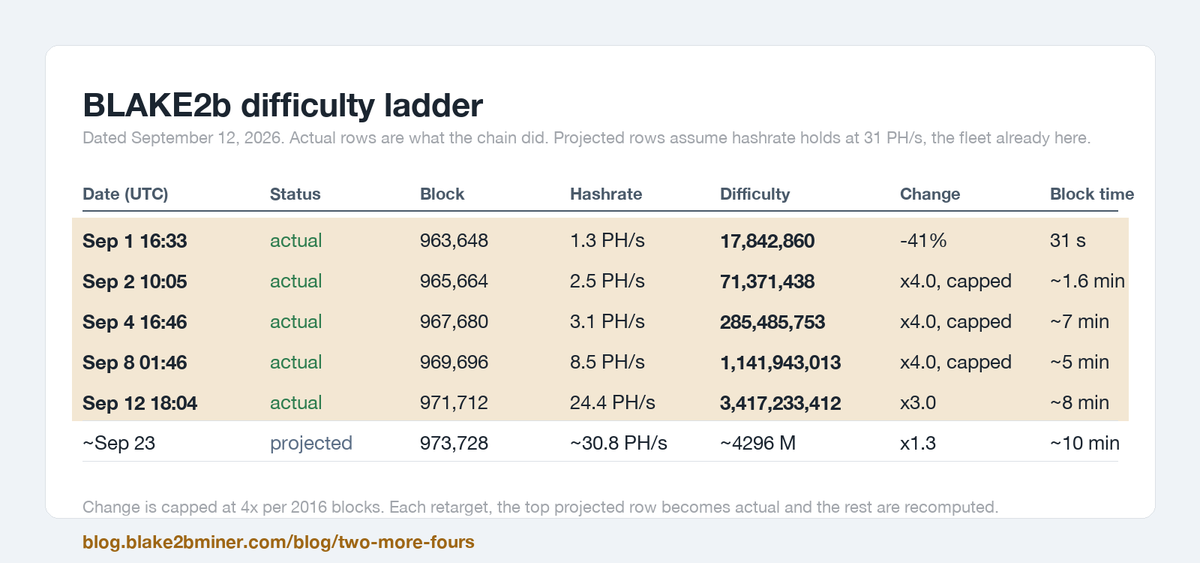
Fifth retarget, 18:04 UTC, block 971,712: difficulty 1,141,943,013 to 3,417,233,412, x2.99, the first step since the fork the cap did not touch. The window ran 201 s a block at 24 PH/s; blocks since: about seven minutes. Next: 973,728, about September 23, x1.3 if hashrate holds.
I think there are two very different reasons to mine whatever comes next after BIP-110.
If you believe Bitcoin should be money -nothing more-and you believe this fork better preserves that idea, mine it from day one. You're not just chasing profit; you're helping secure something you believe should exist.
But if you're looking at this thinking, “I missed the chance to mine Bitcoin early,” don't FOMO into hardware on day one. Give the new chain ~30 days.
By then we'll have something ideology can't give us: evidence.
Hashrate growth. Miner and pool distribution. Nodes. Development. Liquidity. Whether people actually stayed.
Day 1 is a decision based on conviction.
Day 30 can start becoming a decision based on evidence.
Do your own research, make your own choice, and don't risk money you can't afford to lose.
I have taken some time to think about BIP-110, and what I am going to do moving forward. Note I said what I'm going to do, not what YOU should do.
I wrote a long as$ post about my reflections on BIP-110 (still no RAGRATS) about what happened, but I deleted it, ain't nobody got time to read my sh*t.
You should do your own research and use your own judgment, don't outsource your thinking to any influencer, institution, or group...let alone a retard pleb like me.
I'm going to:
1. Be paying attention to and participating in what the BIP-110'ers got cooking next. I go into this with complete understanding of the nigh insurmountable odds, but I also go in with a clear conscience. Just as with BIP-110, just because the outcome is low/uncertain, doesn't mean you shouldn't endeavor for what's right.
AND
2. Continue to hold my meager stack of corn. It ain't much, but I worked hard for this sh*t and I'm not going to easily throw it away just yet.
3. Continue to participate in Bitcoin and run a Pre-RDTS version of Knots, until such a time it's no longer secure or a better alternative arises. Despite my significant qualms about how captured and centralized Bitcoin (mining, reference client, and simpfluencer culture) is, there's still slim hope of a turn around. I ain't leaving this fight that easily.
TL;DR, I'll do me, and you do you.
For me, the names are B256 and Bitcoin.
B256ers are willing to sacrifice monetary principles for fiat gains and the network effect of a hashing algorithm.
But when were Bitcoiners ever supposed to put fiat value or loyalty to a hashing algorithm above the principles that make Bitcoin Bitcoin?
Even Satoshi didn't do that. https://t.co/OwIq5TuF12
There’s a sentence engraved on the side of this gun:
Honor and Restore the Lives of Veterans.
Six words.
Cut into steel.
I’ve handled plenty of commemorative guns before.
Special editions.
Anniversary models.
Words on a slide because they photograph well.
But this one hit different.
This is the Kimber 1911 DS Warrior Boot Campaign edition.
And Kimber didn’t put that message on a wall hanger.
They put it on a double stack 1911 that actually begs to be shot.
Right around $1,000.
Seventeen rounds in the mag.
A twenty-round mag in the box.
Old-school 1911 silhouette with a modern grip module.
But the gun is not the real reason this matters.
Boot Campaign started in 2009 with five women in Texas who read Lone Survivor and decided they couldn’t just close the book and go back to their lives.
Now they help veterans dealing with PTSD, traumatic brain injury, insomnia, chronic pain, and the things that follow people home from war.
And this is the number I can’t shake:
In 2025, 97 percent of veterans who went through their Health and Wellness program no longer qualified for a PTSD diagnosis.
Ninety-seven percent.
That’s not awareness.
That’s not a ribbon on a bumper.
That’s a man getting his life back.
So yeah, you were probably going to buy another gun this year anyway.
The question is whether that money does anything on its way out the door.
Would you buy a gun knowing part of it helps fund veteran recovery?
Drop your answer below.